

sukchulmok and BRBB Architects Turn Their Own 1974 Seoul Brick House into a Hybrid Studio-Home
A 195-square-meter renovation in Myeongnyun-dong preserves the red brick streetscape while carving out a sculptural live-work interior.


Myeongnyun-dong, tucked into Jongno-gu in central Seoul, is the kind of neighborhood that announces its era from the curb. Block after block of red brick facades from the 1970s establish a tight urban grain, and any renovation here faces a clear test: respect that fabric or ignore it. sukchulmok and BRBB Architects, working on their own future studio and residence, chose to keep the original 1974 building's exterior almost entirely intact, letting its material irregularities and worn geometry stay legible on the street.
What makes this project worth studying is not the restraint on the outside but what happens once you step through the arched ground-level openings. Inside 195 square meters stepping down a sloping corner site, the architects have created a sequence of spaces that fuse living, working, and exhibiting through a vocabulary of curved elements, exposed concrete structure, and okoume plywood. The result is a building that reads as two distinct projects from two different vantage points: a quiet neighbor from the sidewalk, and a highly specific, almost sculptural interior from within.
Respecting the Red Brick Context
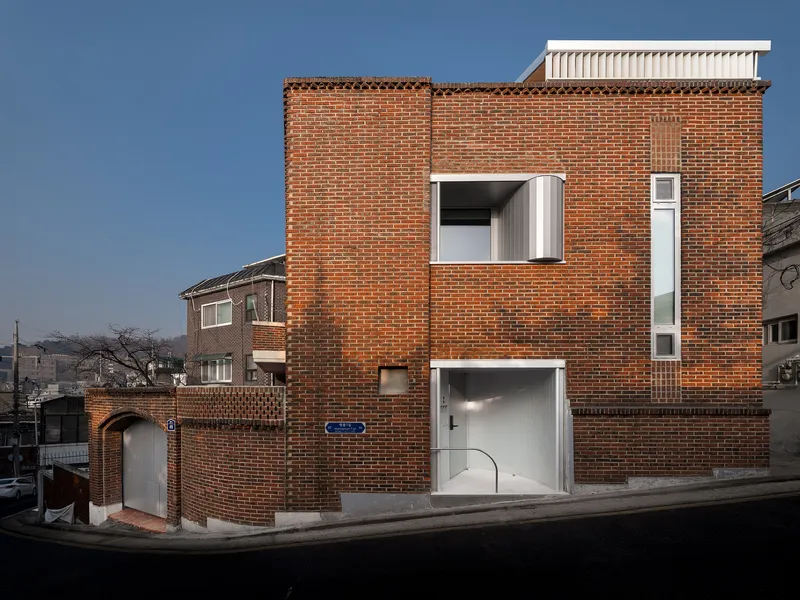
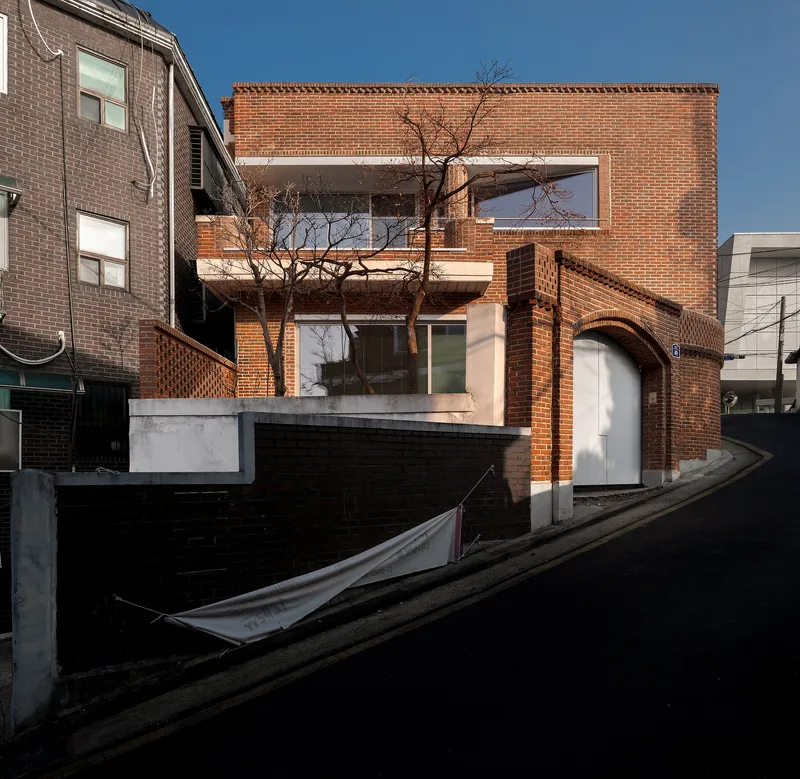
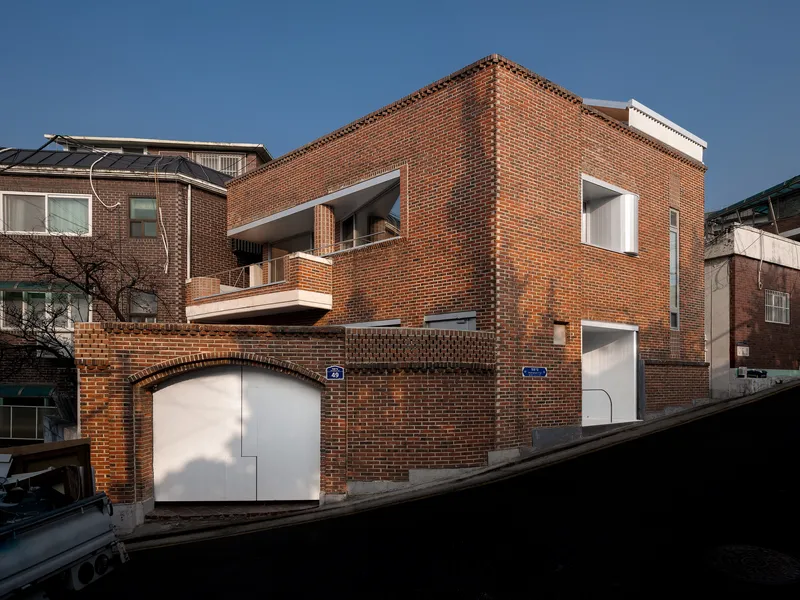
The decision to retain the original exterior is the project's most consequential move. From the street, the building remains legible as a product of its time: red brick walls, the proportions of a 1970s Seoul residential block, arched openings at ground level. New clay bricks were added where repairs were needed, referencing the original bonding pattern rather than contrasting with it. The only visible interventions are white metal window inserts and a modest rooftop addition that reads as a light, recessive volume against the solid masonry below.
The corner condition is particularly well handled. Seen from across the intersection in late afternoon, the recessed balcony and arched garage doors give the facade a civic presence that most renovations of this scale never attempt. The architects understood that in a neighborhood defined by repetition, subtlety is a form of generosity.
Exposed Structure as Interior Character

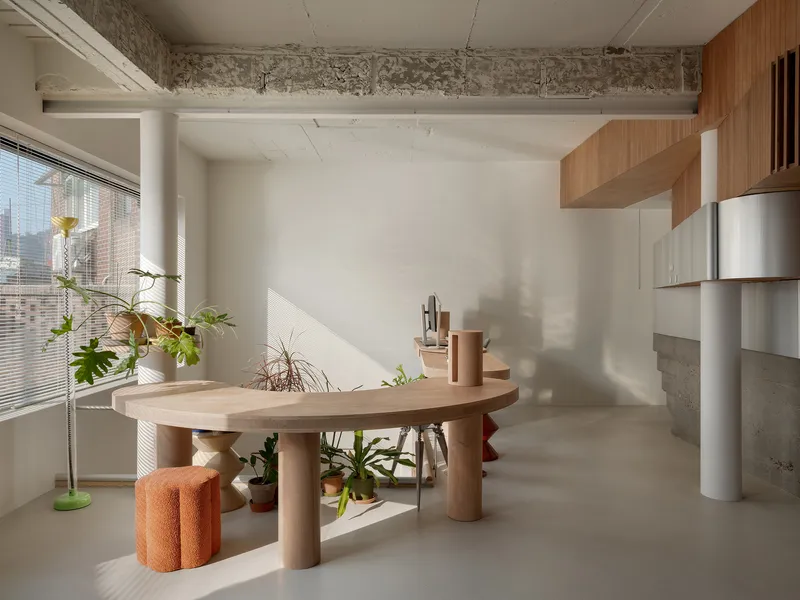

Strip away the finishes of a 50-year-old concrete frame and you either get a raw mess or an honest skeleton worth celebrating. Here, the existing concrete beams are left exposed across the ceiling plane, their rough surfaces contrasting with the smoother plywood and white-painted steelwork added for structural reinforcement. The effect in the main workspace is of working under an archaeological layer: you are always aware that this building had a previous life.
The double-height space at the core of the plan amplifies this reading. A cylindrical pillar, built up from stacked curved sections of concrete, metal, and timber, anchors the room both structurally and visually. It becomes a kind of totem around which the program orbits, connecting the mezzanine storage level above to the open workspace below. Potted plants on the upper ledge and a sculptural timber table at ground level give the space a lived-in warmth that prevents it from feeling like a gallery.
The Curved Elements: Storage, Systems, and Spatial Flow
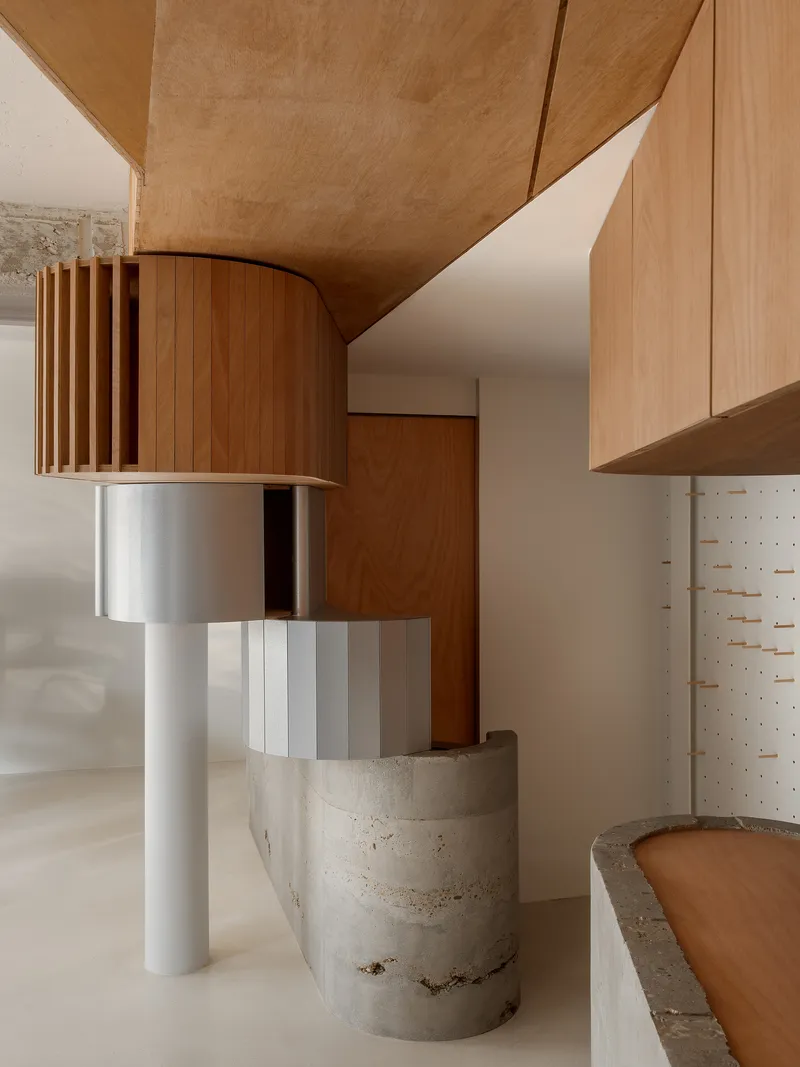
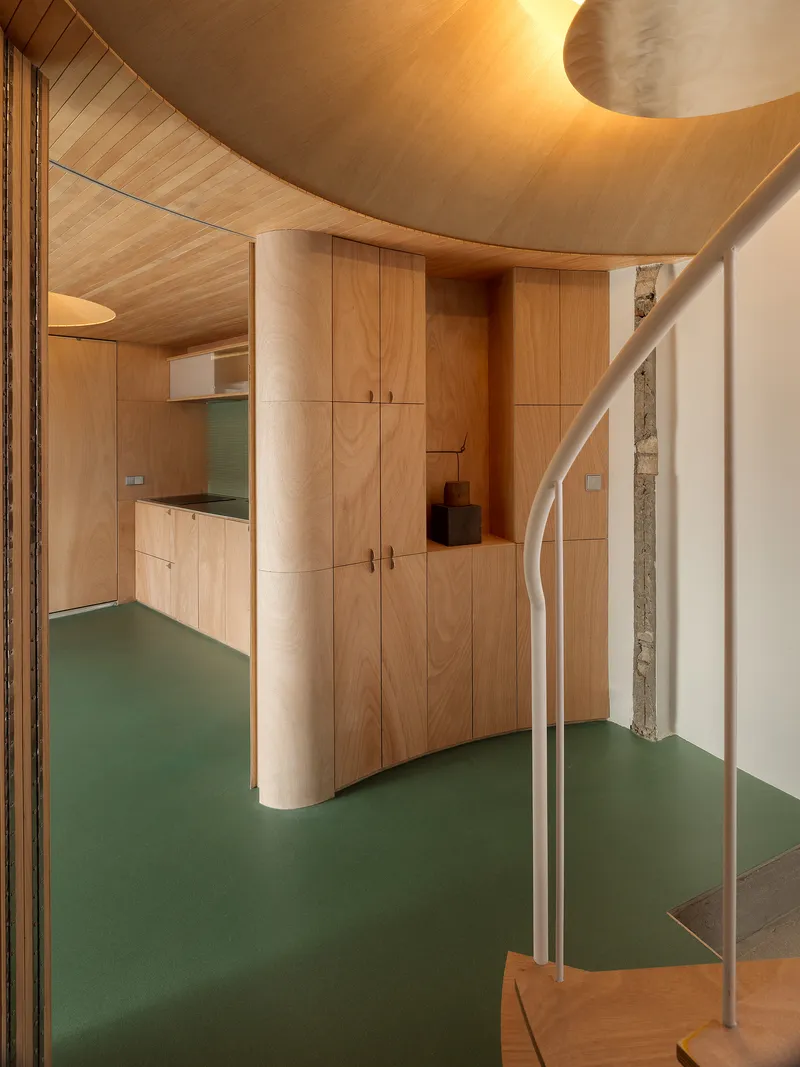
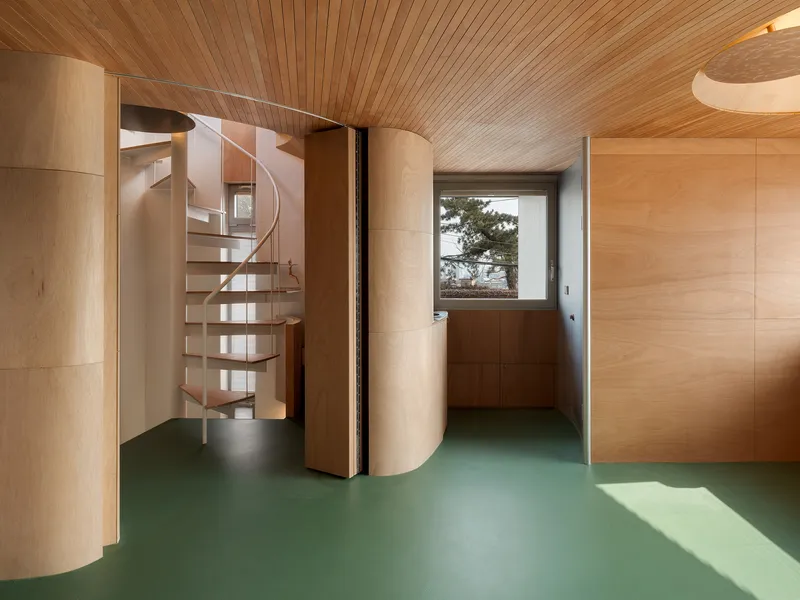
Throughout the interior, curved plywood and steel-clad volumes do triple duty. They conceal extensive storage, house mechanical systems (lighting, HVAC, sound), and define spatial boundaries without hard walls. The kitchen hood, for instance, sweeps upward in a smooth timber arc from the steel range, its form shaped by function but softened into something almost gestural. Beside it, a concrete cylinder drops below plywood cabinetry, grounding the composition.
A spiral staircase, visible through curved plywood wall openings, stitches the levels together with a vertical continuity that keeps the compact plan from feeling segmented. The warm indirect lighting embedded in the curved walls makes each transition between zones feel deliberate rather than incidental. For a 195-square-meter building, the spatial generosity is remarkable, and it comes precisely from hiding the clutter of domesticity and infrastructure inside these sculptural shells.
Living at the Top: Okoume, Green Floors, and Circular Skylights
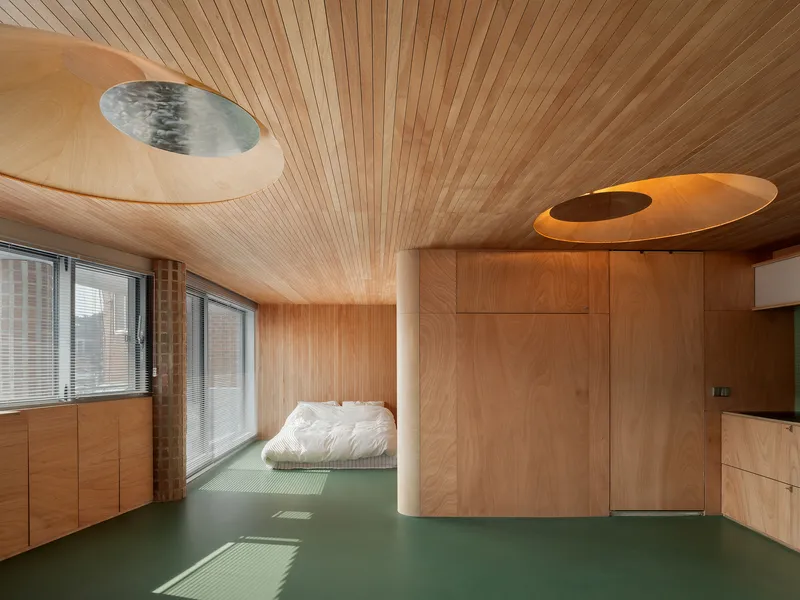

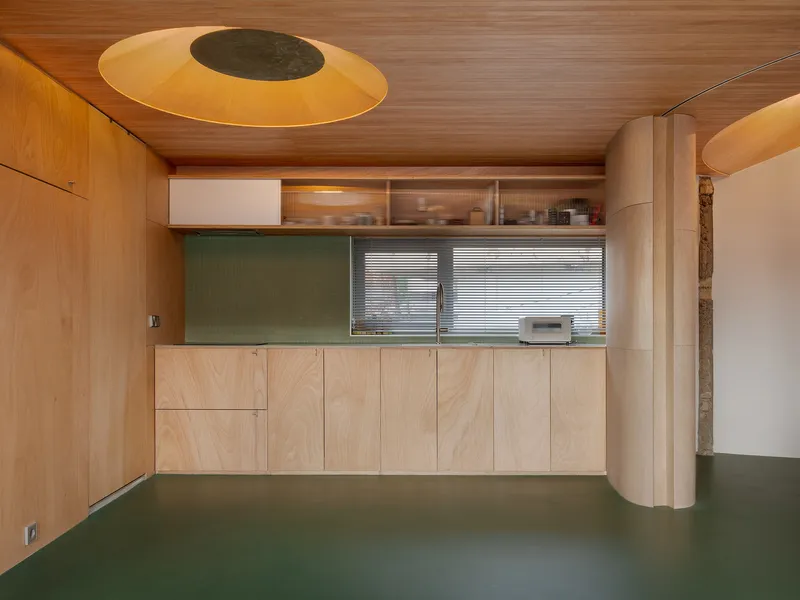
The top level, which forms the main living space, is where the material palette reaches its most cohesive expression. Okoume plywood lines the ceiling in warm slatted bands, creating a canopy that unifies the bedroom, window seat, and kitchenette. Against this timber warmth, the floors are finished in a saturated green rubber that provides a surprising but effective counterpoint. It is a bold choice that signals this is not a neutral renovation; the architects had specific tastes and were unafraid to commit.
Circular skylights, punched through the ceiling as dome-shaped oculi, deliver focused daylight to specific moments: above the bed, over the window seat, beside the kitchenette. Light fittings are recessed into these impressions, blurring the distinction between natural and artificial illumination. The cylindrical column from the lower levels continues upward here, standing beside the low bed like a quiet sentinel, reminding you that structure runs uninterrupted through the building.
The Flexible Basement: Exhibition, Work, and Rest

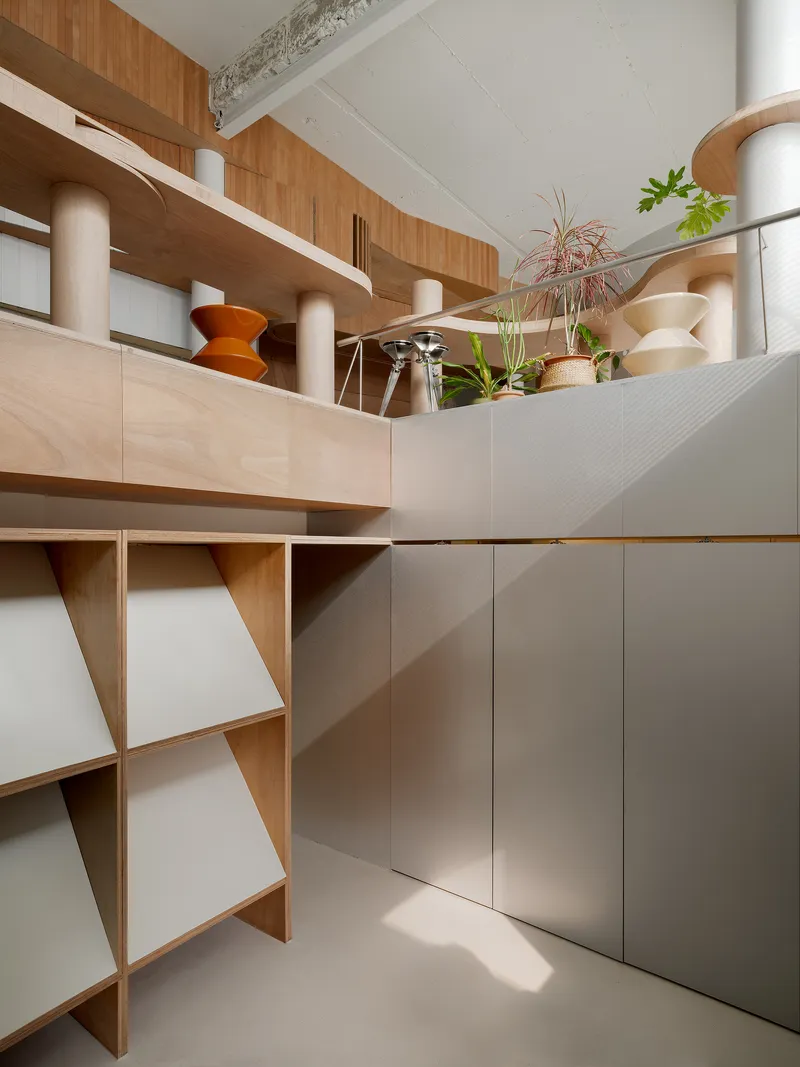
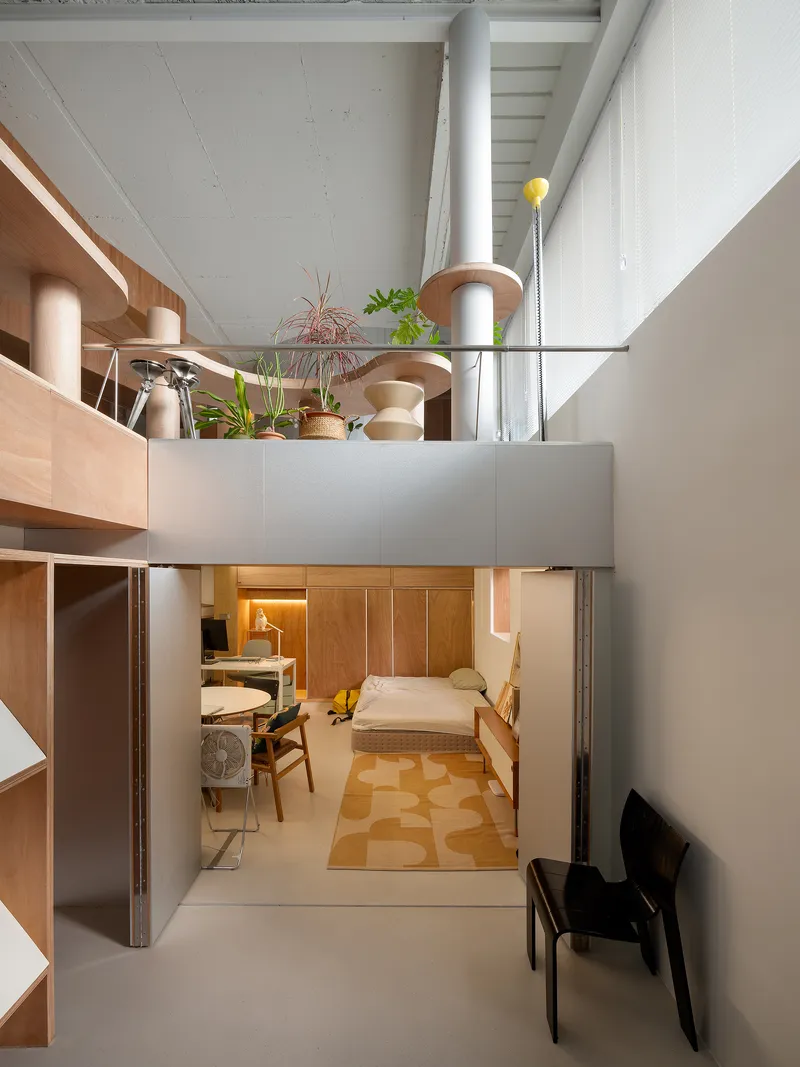
Below grade, the program shifts toward flexibility. A built-in display wall and modular shelving units with diagonal wood bracing define an exhibition space that can also serve as a workspace. Folding doors conceal a bedroom at the back, allowing the entire basement to open up as a single room for events or close down for private use. The light wood cabinetry against white walls and exposed concrete ceiling keeps the palette restrained, letting the objects on display do the talking.
The sleeping nook beneath the mezzanine, with its patterned rug and timber wall panels, is compact but not cramped. A pill-shaped bench at the edge of the upper level overlooks this basement through a void, creating a visual connection between the domestic and professional programs that is the project's central spatial idea: you live where you work, and the architecture makes that feel like a choice rather than a compromise.
Custom Joinery and Material Precision
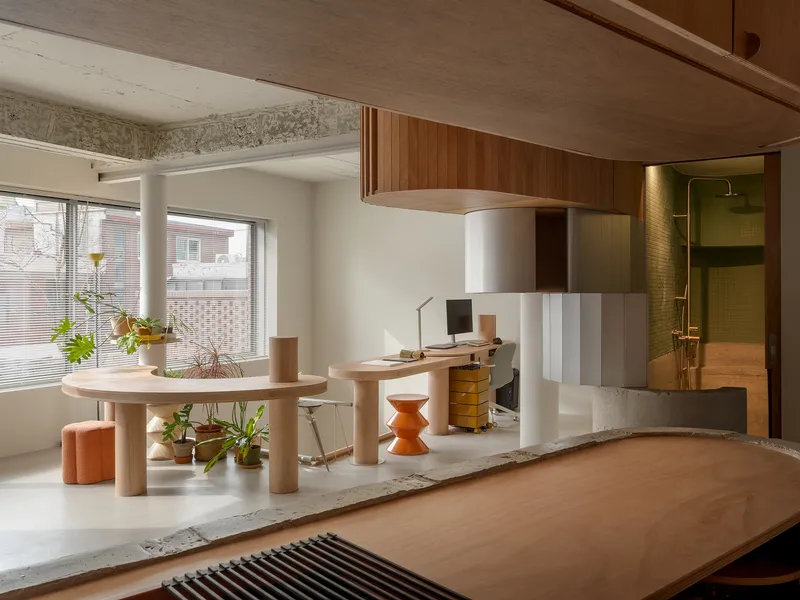
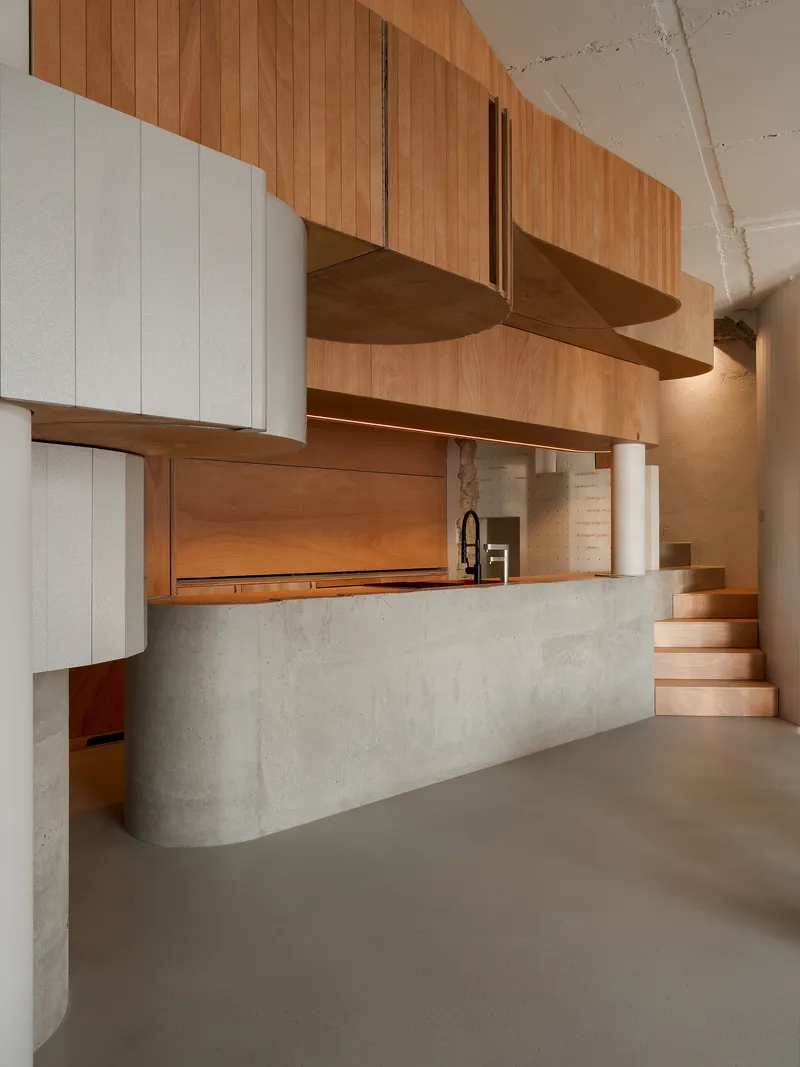
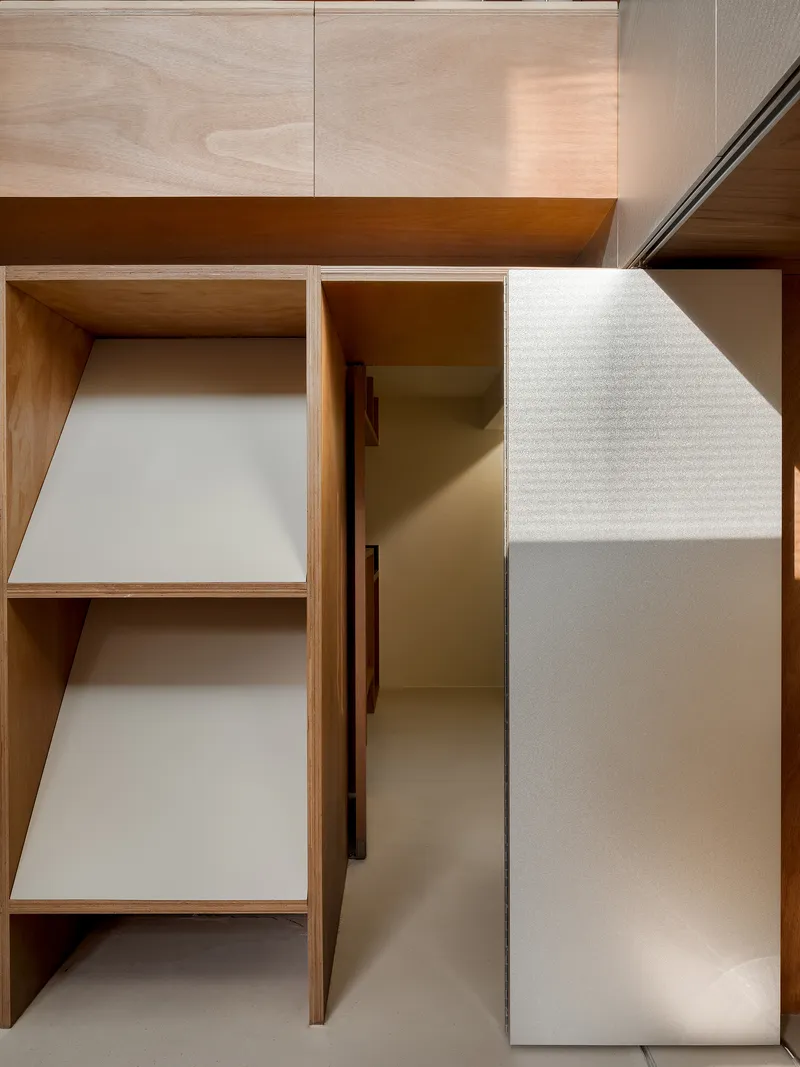
The detailing throughout rewards close inspection. A concrete-and-plywood bar in the living area is flanked by a curved steel-clad storage volume and a tiled bathroom, each material transition handled with deliberate precision. The kitchen island, with its poured concrete base, anchors the upper level while the suspended wood cabinetry above keeps sightlines open. Angled plywood shelves with white laminate surfaces cast crisp diagonal shadows that change through the day, a small detail that reveals how carefully the architects considered the interplay of form and light.
When architects design for themselves, you learn what they actually value. sukchulmok and BRBB Architects clearly value material honesty, spatial interconnection, and the kind of craft that does not announce itself loudly but holds up under scrutiny.
Plans and Drawings
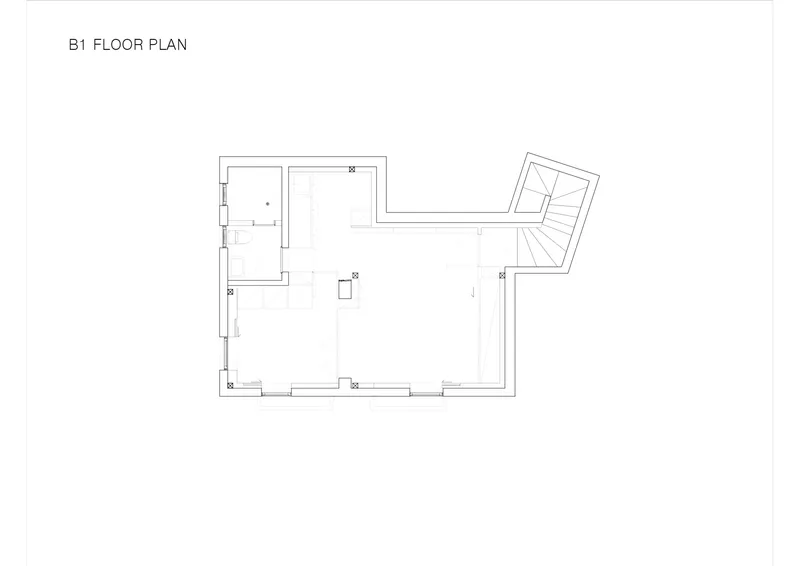


The three floor plans reveal how the program negotiates a sloping corner site. The basement level is the most regular volume, a rectangular footprint with an angled stair projection reaching toward the street. By the first level, the perimeter walls angle outward to follow the site geometry, accommodating the bathroom fixtures within what would otherwise be awkward leftover space. The second level, with its spiral stair and kitchen tucked into the angled corner, shows how the architects extracted maximum utility from a tight and irregular footprint without resorting to orthogonal force.
Why This Project Matters


Seoul's dense residential fabric is under constant pressure to demolish and rebuild. Projects like this one argue persuasively for a different path. By retaining the 1974 shell and concentrating all invention inside, sukchulmok and BRBB Architects demonstrate that renovation can deliver spatial ambition without erasing urban memory. The red brick streetscape of Myeongnyun-dong loses nothing; it gains a building that is more useful, more considered, and more alive than before.
More broadly, the project is a case study in what happens when architects are their own clients. The absence of compromise is visible in every curved plywood element, every exposed beam left unpainted, every green rubber floor that a cautious developer would have vetoed. At 195 square meters, it proves that conviction scales down as well as up, and that the most interesting renovations are often the ones where the designer had the final word.
Reinterpreting a 50-Year-Old Building in Myeongnyun-dong, designed by sukchulmok and BRBB Architects. Located in Myeongnyun-dong, Jongno-gu, Seoul, South Korea. 195 m². Completed in 2026. Photography by Hong Seokgyu.
About the Studio
Share Your Own Work on uni.xyz
If projects like this are the kind of work you want to make, uni.xyz is a place to publish your own, find collaborators, and enter design competitions.


Popular Articles
Popular articles from the community


Opera by the Sea Estonia: Three Shells Dissolving Architecture into Tallinn's Coastline
A winning opera house proposal replaces monumental form with interconnected shells that blur the boundary between building, park and Baltic Sea.

Singing Woman: Contemporary Architecture Inspired by Estonia’s Voice and the Sea
Singing Woman turns Estonia’s song culture into flowing opera house architecture, blending public life, landscape, sea, and national memory.

Cloaked Colonization: A Mobile Underwater Habitat That Moves Like a Fish
Micah Abaya's shortlisted EHC Pacific entry reimagines ocean settlement as a dispersed network of self-sustaining architectural organisms.

Temporary Home for Dogs: A Reversed Zoo Rethinks Animal Shelter Architecture
In Bucharest, a sinuous corridor and freed landscape flip the logic of containment, designing a shelter that works to make itself unnecessary.

Similar Reads
You might also enjoy these articles

Bao Huynh Watercolor Atelier: A Serene Art Retreat in Hội An
Bao Huynh Watercolor Atelier in Hội An blends multifunctional art spaces, sustainable design, local materials, and family-friendly living in a serene environment.

Atelier Macri Concept Store Interior Design by CASE-REAL
Atelier Macri store features a "ko" counter, walnut wood details, cork displays, blending retail, gallery, and seamless customer experiences.

Manuel Vargas Izquierdo Stadium and High-Performance Sports Center: Architectural Excellence in Jalpa de Méndez
The Manuel Vargas Izquierdo Stadium blends sustainable design, inclusive sports facilities, and cultural-inspired architecture, revitalizing Jalpa de Méndez’s public spaces.

KAKR Buluh Awar Hall: Revitalizing Community and Ecology Through Bamboo Architecture
Community built bamboo hall revitalizes Buluh Awar village, empowering youth, restoring ecology, celebrating vernacular craftsmanship through sustainable architecture and culture.

Explore Modern Architecture Competitions
Discover active competitions in this discipline

Challenge to design mud housing for contemporary communities

Challenge to design luxury tourism on rails

VR headsets Storefront design competition

Designing a staircase for a client
Comments (0)
Please login or sign up to add comments
No comments yet. Be the first to comment!