
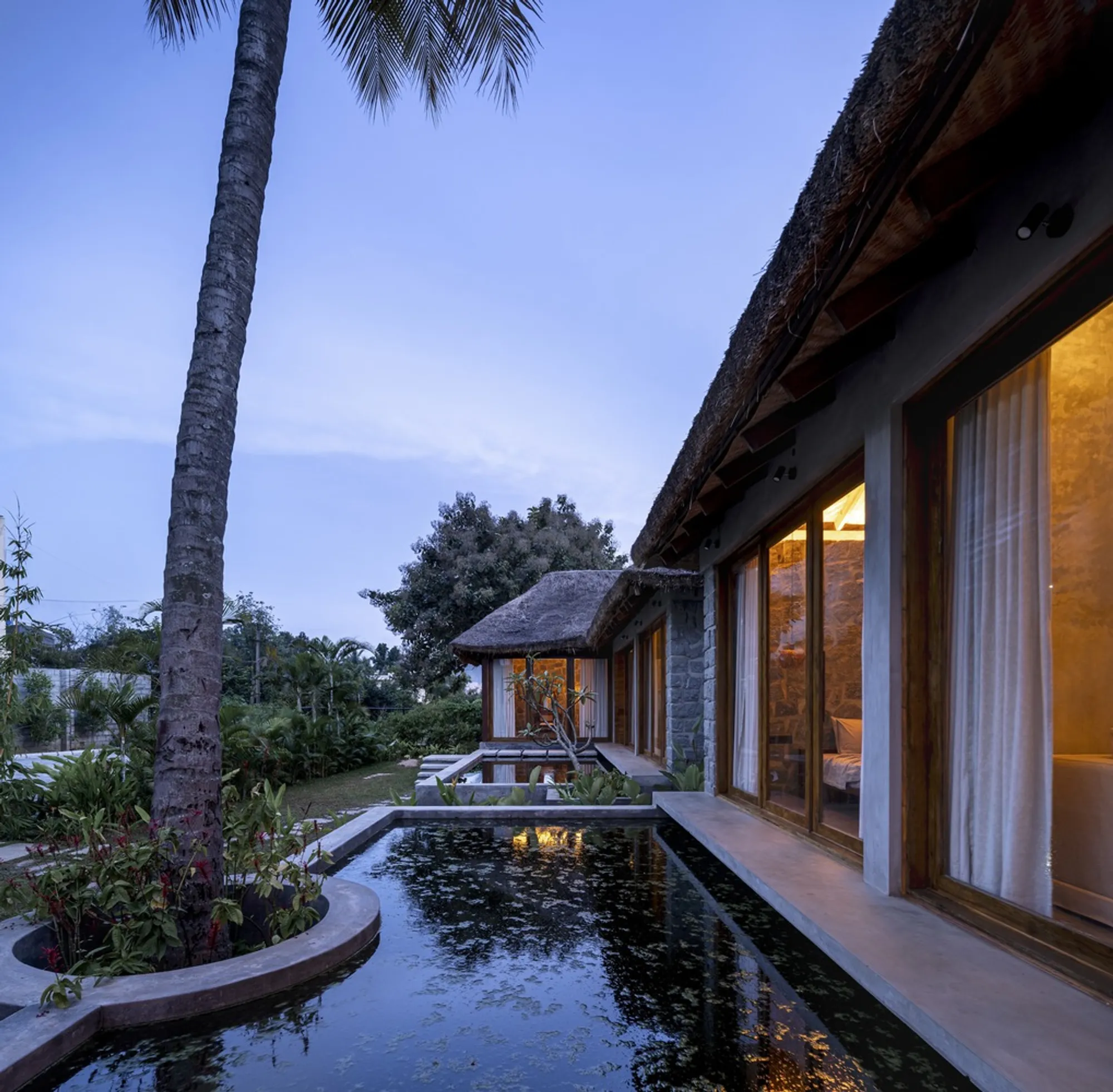
The Auburn Studio Builds a Bawa-Inspired Wedding Villa on a Former Nursery in Bengaluru
Two symmetrical thatched-roof villas frame a central reflecting pool on a 100-by-100-foot plot in JP Nagar, channeling Geoffrey Bawa's tropical modernism.


The pandemic rewired how people celebrate, and outdoor wedding venues became a sudden priority for families with the land to spare. In JP Nagar's 9th Phase, on the southern fringe of Bengaluru, a family that had run a plant nursery for years saw the opportunity clearly. They brought in The Auburn Studio, led by architect Sushmitha Ramesh, to convert the 100-by-100-foot site into Sumatra Bali Villa: a 3,500-square-foot homestay and wedding venue that doubles as a serious exercise in tropical modernism.
What makes this project worth studying is how directly it engages with the legacy of Geoffrey Bawa without devolving into pastiche. Bawa's signature move was dissolving the boundary between building and garden, using water, covered walkways, and deep overhangs to stitch indoor comfort to outdoor atmosphere. The Auburn Studio transposes that playbook to a tight urban plot in Karnataka, relying on regionally sourced IPS concrete, rubble stone, bamboo-mat ceilings, and reclaimed Chettinad timber to keep the material story rooted in South India rather than Southeast Asia. The result is a pair of mirror-image villas that feel genuinely immersive, not decorative.
Symmetry and the Central Water Body
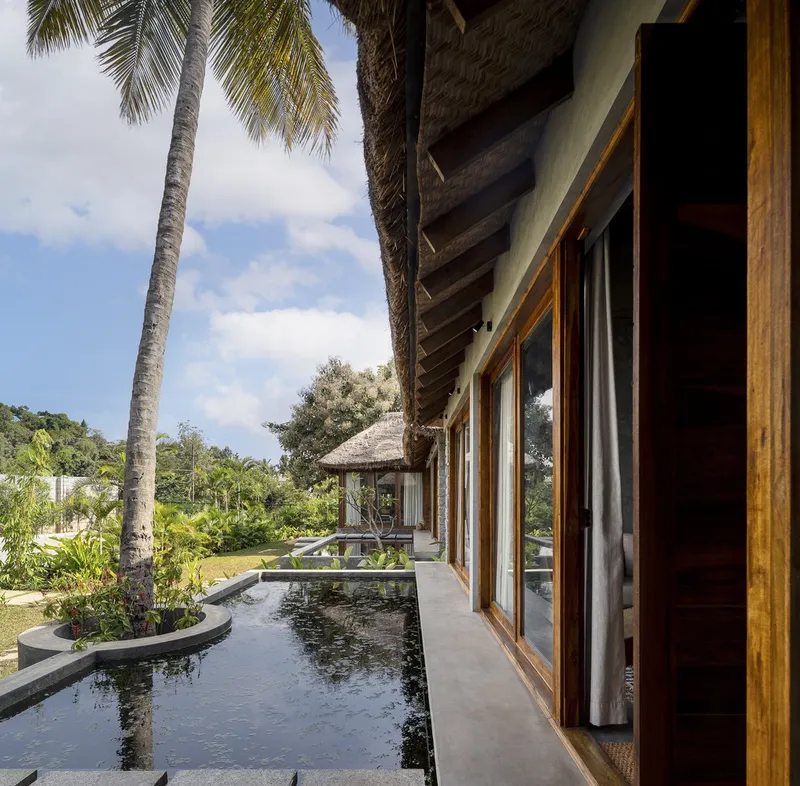
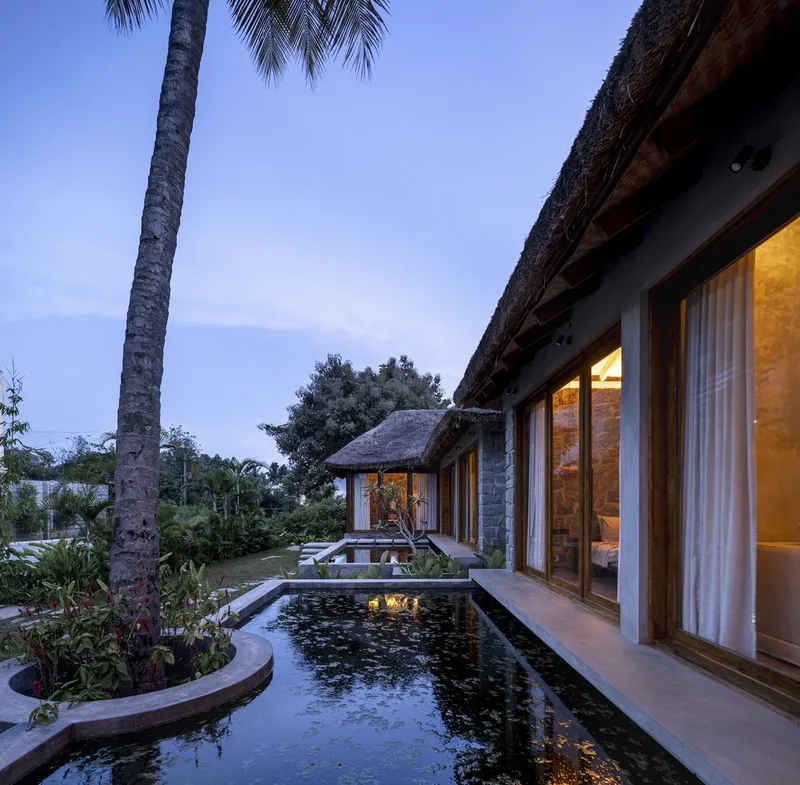
The site plan hinges on a single compositional device: two identical U-shaped structures placed symmetrically along a central axis, with a linear reflecting pool running the length of the gap between them. Guests arrive via stepping stones laid across the water, a threshold sequence that immediately lowers the register from Bengaluru traffic to something closer to a Balinese compound. The pool does more than set a mood. It acts as a mirror that doubles the vertical presence of the surrounding palms and thatched rooflines, stretching the perceived scale of what is, in reality, a modest footprint.
The symmetry is also programmatic. Each villa houses two bedrooms flanking a shared living room, designed so that one structure can host the bride's party and the other the groom's during a wedding weekend. It is a plan driven by social ritual, not just aesthetics.
The Thatched Ceiling as Protagonist
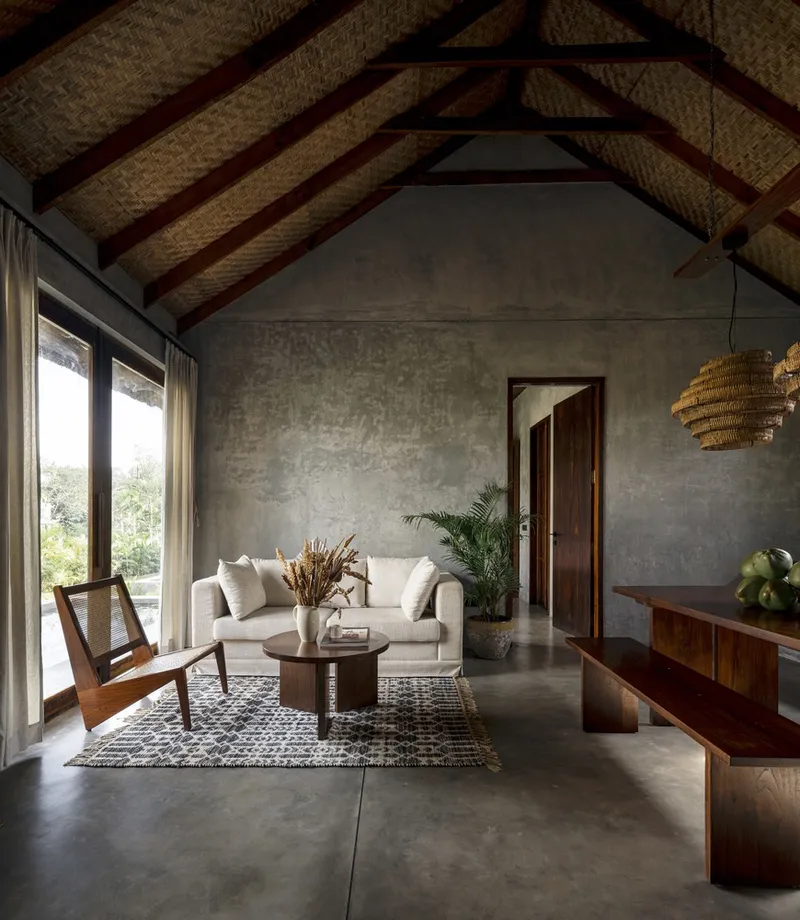
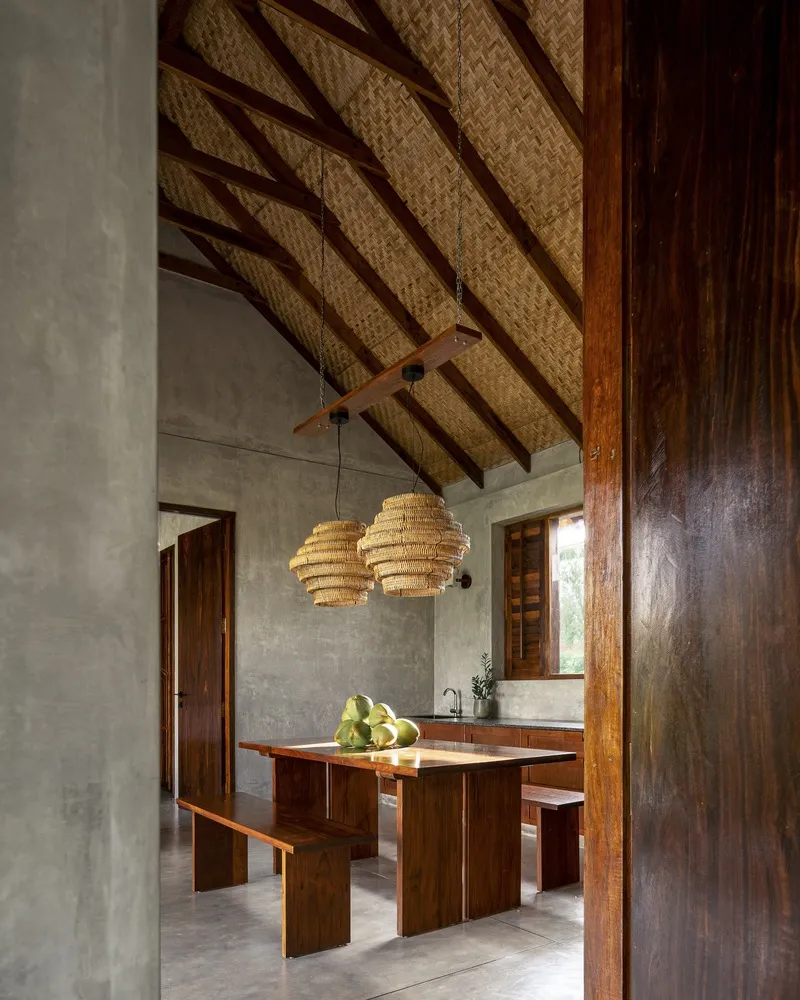
Walk inside and your eye goes up immediately. The high-pitched ceilings are the interior's defining gesture: exposed timber rafters supporting woven bamboo mats that slope upward into a generous volume. These are not decorative appliqués. The bamboo thatch acts as a passive cooling layer, insulating the interior from Bengaluru's afternoon heat while creating a textural warmth that polished concrete floors alone could never deliver. The living area and the dining zone share this ceiling language, unified by the rhythm of the rafters.
Woven pendant lights drop from the trusses in the dining area, reinforcing the handcrafted register without overcrowding the visual field. The palette is restrained: timber, bamboo, and cane against neutral concrete. That discipline is what keeps the project from tipping into resort kitsch.
Material Sourcing and Local Craft
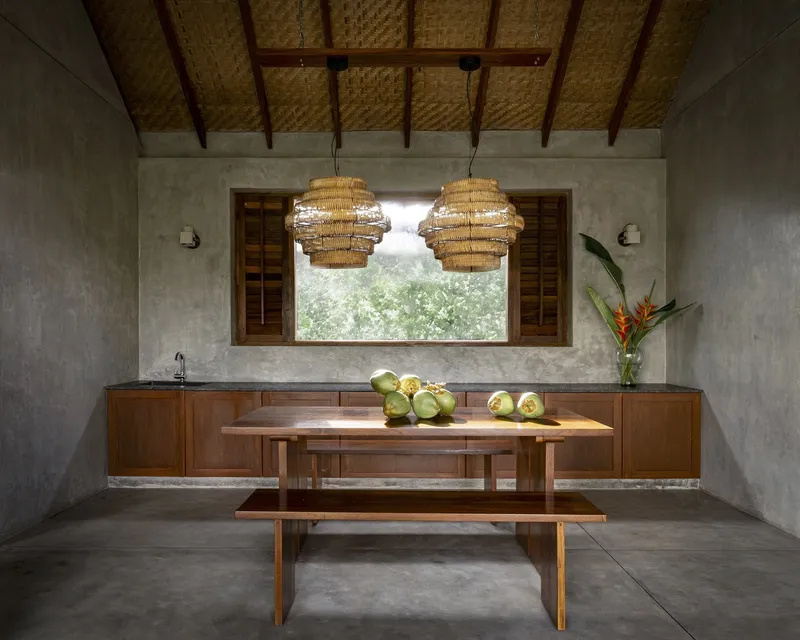
The kitchen offers perhaps the most concentrated example of The Auburn Studio's material philosophy. Timber cabinetry is paired with a horizontal louvered window fitted with Kalimarudhu wood planks salvaged from Chettinad heritage homes in Tamil Nadu. Reusing these planks is not a sentimental gesture; Chettinad timber, typically teak or rosewood, is extraordinarily durable and carries a patina that new lumber cannot replicate. It connects this Bengaluru project to a broader South Indian building tradition without forcing a stylistic match.
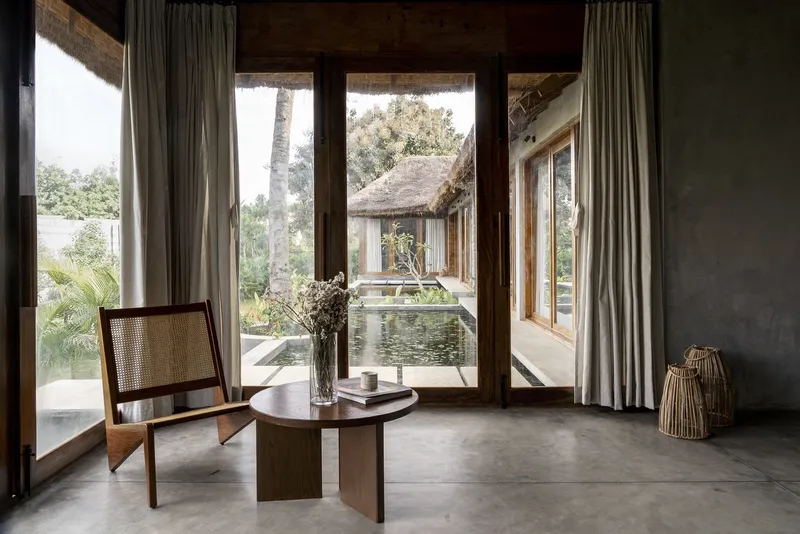
Elsewhere, locally quarried rubble stone appears as accent walls, creating a coarse textural contrast against the smooth IPS floors. Rattan and cane furniture, sourced from regional artisans, fills the living spaces. The cane armchair framed against the glass doors to the courtyard pond reads almost like a catalog image, but it is doing real work: demonstrating that local craft can hold its own alongside sliding glass walls and polished concrete.
Bedrooms That Open to Sky and Stone
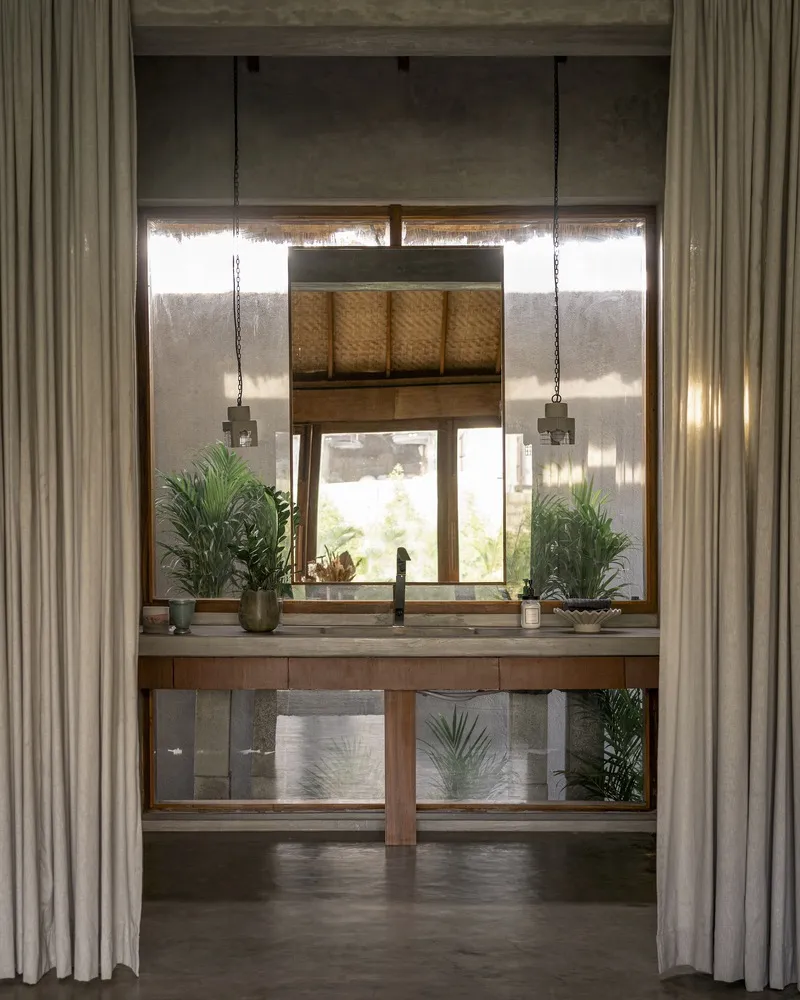
The master suite pushes the indoor-outdoor logic furthest. An open-concept washroom places the vanity behind draped curtains with pendant lights, facing a window that gives directly onto the surrounding greenery. There is no attempt to seal off the bathroom as a private box; instead it borrows the garden view to create a spa-like continuity. In the second bedroom, a skylit pocket of plants filters daylight through foliage before it reaches the interior, so even the more enclosed room never feels cut off from the landscape.
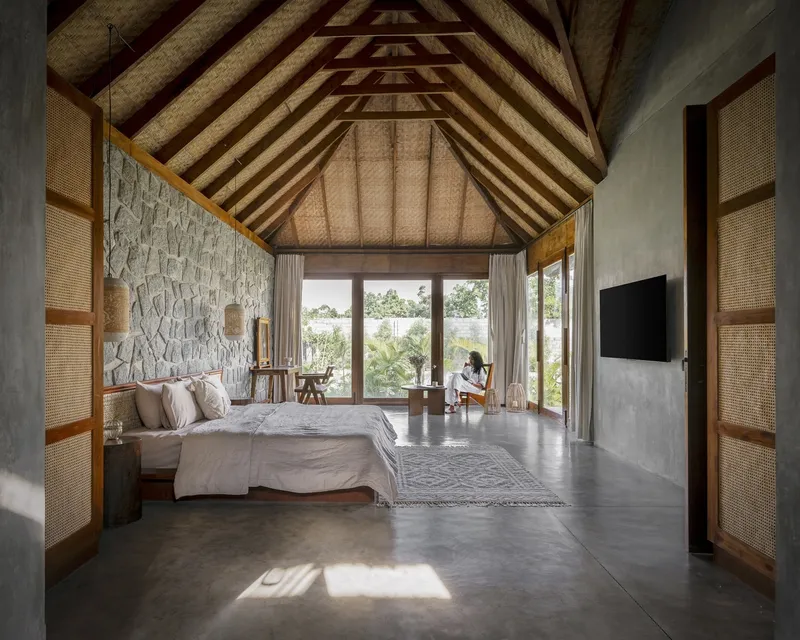
The vaulted thatched roof reappears in the bedrooms, and the rattan-paneled doors provide ventilation and visual layering. A figure seated at the window in the main bedroom captures the intended atmosphere precisely: contemplative, unhurried, framed by natural materials on every surface.
Landscape as Urban Shield
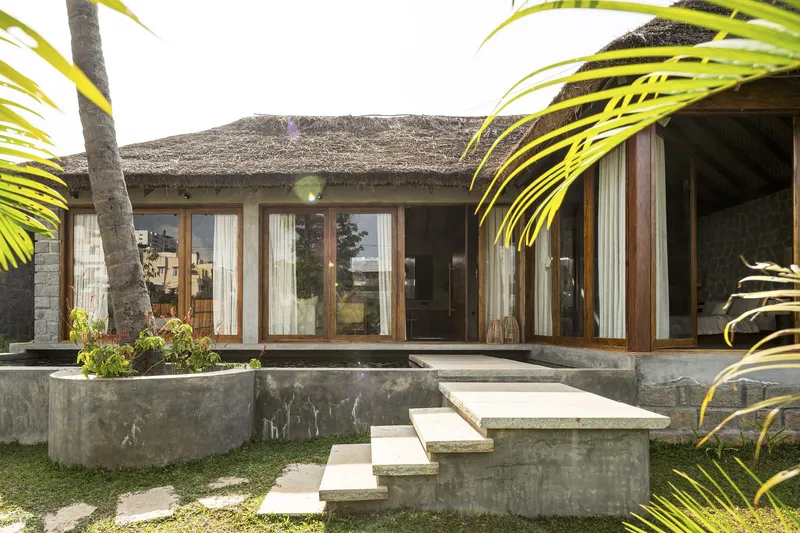
Bengaluru is not Bali. It is a rapidly densifying city with construction on all sides, and any tropical retreat here has to actively manufacture its own seclusion. Third Eye Landscape handled the planting strategy, using dense palm canopies and layered tropical vegetation as a green buffer that screens the villas from neighboring development. The garden facade, visible behind concrete planters and cascading palm fronds, demonstrates how the landscaping does not merely decorate the architecture but enables it. Without that planted perimeter, the thatched roofs and reflecting pool would read as set design rather than genuine environment.
The nursery heritage of the site is not incidental. The family's existing knowledge of plants and soil informed the planting palette, and the project essentially repurposes the nursery's green infrastructure as architectural context. It is a smart conversion that preserves the site's ecological character while giving it a commercial future.
Why This Project Matters
Sumatra Bali Villa is a compact demonstration that tropical modernism does not require a beachfront or a rural estate. On a tight urban plot in South India's tech capital, The Auburn Studio has produced a convincing argument for regionally sourced materials, passive cooling strategies, and landscape-first planning. The Geoffrey Bawa influence is legible but not mimicked; the project translates principles rather than copying forms, which is the only way architectural lineage stays productive.
The dual-villa typology is equally instructive. Designing for the specific social choreography of an Indian wedding, where two families occupy parallel but distinct spaces before converging, gives the symmetry a functional logic that pure formalism would lack. It is architecture shaped by ceremony, built from local stone and reclaimed wood, and shielded from the city by the very garden that preceded it. That convergence of program, material, and site history is what makes this project more than a pretty homestay.
Sumatra Bali Villa by The Auburn Studio, lead architect Sushmitha Ramesh. JP Nagar 9th Phase, Bengaluru, Karnataka, India. 3,500 sq ft. Completed 2023. Landscape by Third Eye Landscape. Photography by Yash R Jain.
About the Studio
Share Your Own Work on uni.xyz
If projects like this are the kind of work you want to make, uni.xyz is a place to publish your own, find collaborators, and enter design competitions.




Popular Articles
Popular articles from the community


Lunar Spiral: Space Architecture Shaped by the Mathematics of the Universe
Lunar Spiral reimagines space architecture through Fibonacci geometry, lunar regolith, levitating habitats, and self-sustaining Moon living.

Riyadh For All: Intergenerational Urban Design for Active Aging in Rabat
Riyadh For All reimagines urban design in Rabat with intergenerational co-living, adaptive courtyards, and Moroccan cultural exchange today.

Play: Fragments of Their World
Familiar architecture becomes modular playground design, creating safe spaces where displaced children can learn, connect, imagine and play.

Co-life: Sustainable Architecture for Age-Friendly Community Living
Co-life reimagines sustainable architecture for seniors through courtyards, rammed earth, shared gardens, and spaces designed for belonging.


Similar Reads
You might also enjoy these articles


Hodi-Mandai Geram
Project Function: Preservation and revitalization of the Intangible heritage and socio-spatial identity of the Hodi by Housing, Cultural Memory Center, Sacred Grove, landscape, local tourism economy


Olio Towers: A Mid-Rise for Performers That Fuses Housing, Rehearsal, and Stage
Located blocks from Houston's Theater District, this modular tower stacks living units around a central performance atrium.

Oasis: Modular Green Housing Carved into Dhaka's Urban Fabric
A shortlisted Plugin Housing entry reclaims unauthorized settlements in Dhaka with stepped concrete volumes, green roofs, and ventilation-driven design.

Black Hole: A Floating Megastructure for the Post-Physical Era
Emiliano Mazzarotto envisions a spherical, self-scaling arena where e-sports, digital hotels, and holographic stadiums replace traditional public space.


Explore Architecture Competitions
Discover active competitions in this discipline



Challenge to reimagine the Iron Throne


Photograph architecture without architects


Illustrate the lost glory of Angkor Wat - Render Challenge


Design challenge to reuse E-waste
Comments (0)
Please login or sign up to add comments
No comments yet. Be the first to comment!