
A Flood-Resilient Neighborhood in Lisbon That Stores Water Beneath Its Streets
Underground water chambers, elevated courtyards, and permeable urban fabric turn flooding from threat into resource in this Lisbon proposal.


What if a neighborhood didn't just survive flooding but was designed to absorb it? Rather than treating stormwater as a problem to be engineered away, this proposal for Lisbon reimagines an entire residential district as a sponge: water is captured, stored underground, and reintroduced into the landscape as a visible amenity. The logic is deceptively simple, yet the architectural consequences ripple through every decision, from building section to street geometry to the placement of a fire pit in a courtyard.
Designed by Ravisha Vanjari, Nidhi Joshi, Padmawati Thakre, this People's Choice entry in the Ohana competition on uni.xyz proposes a flood-resilient neighborhood that draws on Lisbon's Mediterranean materiality (white stucco, terracotta, azulejo tile) while embedding a new hydrological infrastructure below grade. The result is a district where water is neither hidden nor feared; it sits at the center of communal life.
Water as Civic Space, Not Civil Engineering
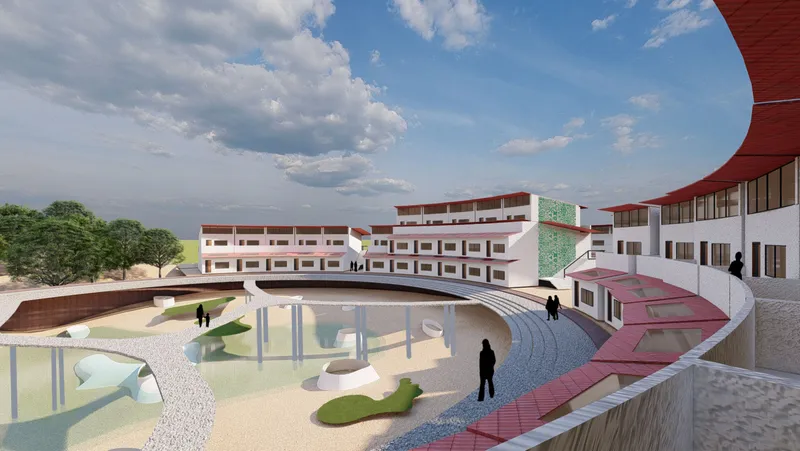
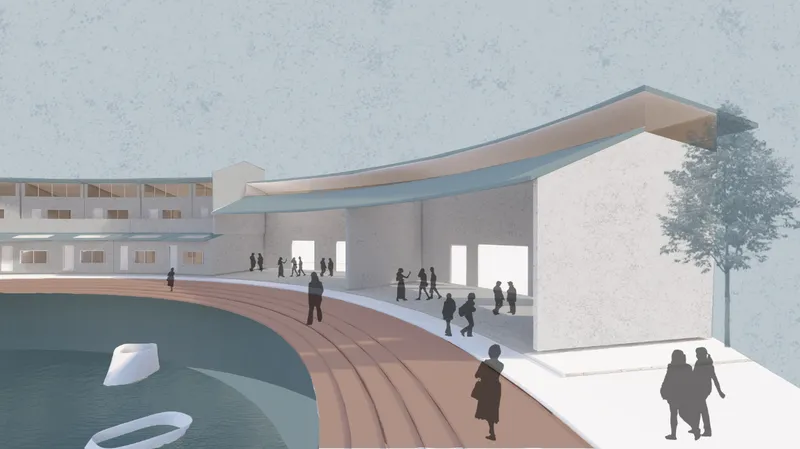
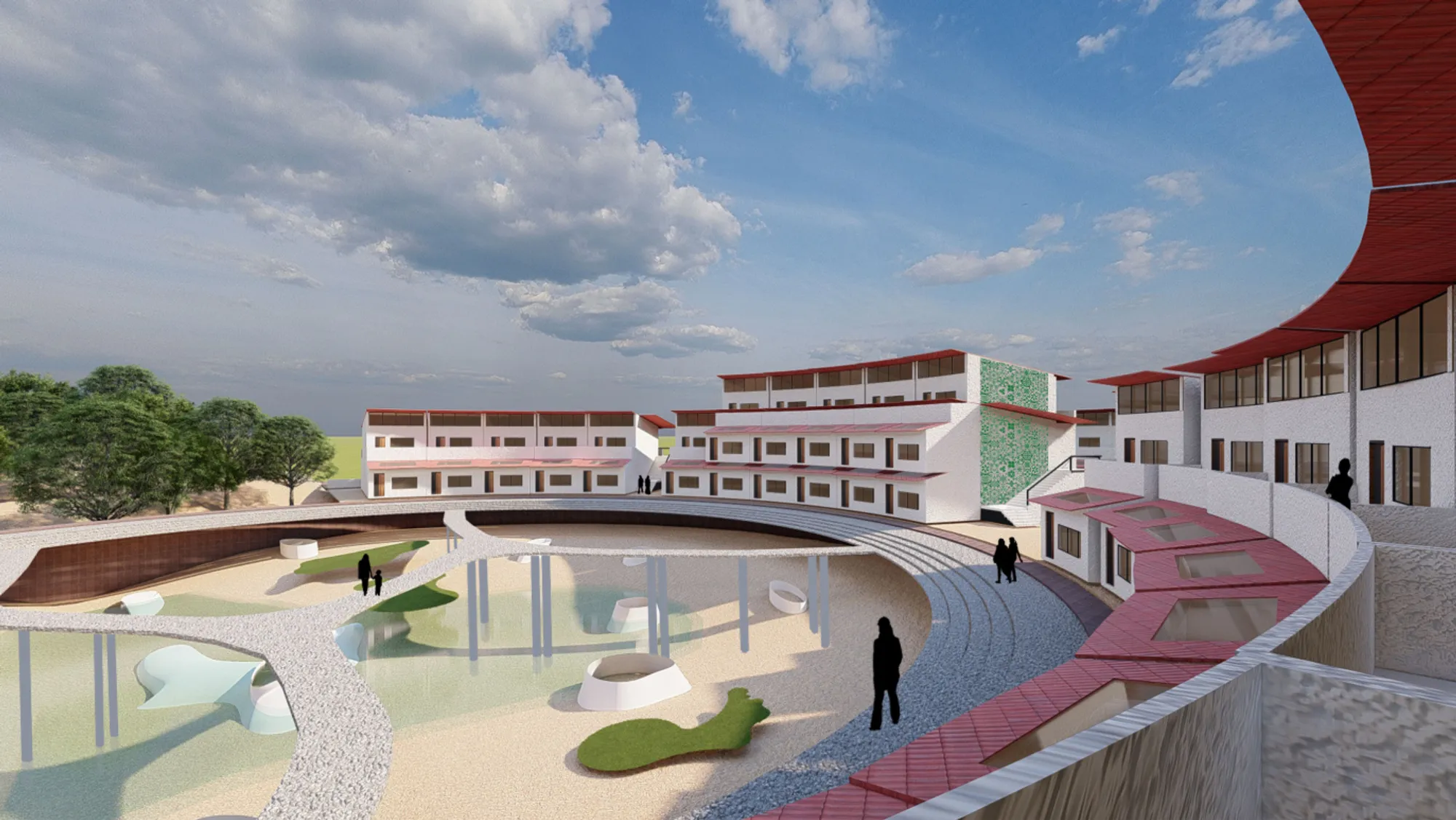
The most striking move here is the treatment of water at ground level. A broad water feature stretches between curved residential wings, populated by organic planted islands that serve as both bioretention zones and landscape ornament. Viewed from across the pool, the low-slung buildings and distant tree canopy recall the scale of a Mediterranean fishing village more than a drainage basin. A covered walkway wraps around a secondary pool where white sculptural forms break the surface, and pedestrians move through a soft mist. These are not decorative ponds; they are the visible face of an integrated stormwater management system, designed to fluctuate with rainfall and slowly release stored water back into the ground.
What Happens Below the Street
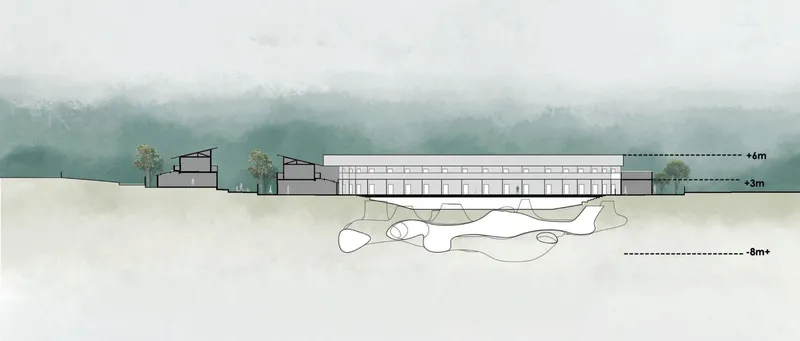
The section drawing is the project's most revealing document. Building volumes sit above grade on a landscape that appears relaxed and permeable, but beneath the surface, large underground water chambers collect and hold stormwater runoff. Tree silhouettes along the section edge suggest deep root zones that interact with these chambers, turning the planted areas above into active participants in the hydrological cycle. The relationship between the inhabited surface and the engineered subsurface is clearly legible: every courtyard, lane, and garden bed is positioned to feed water downward during heavy rain events and draw it upward during dry spells.
This below-grade infrastructure allows the designers to keep the neighborhood's streets and public spaces at a comfortable, walkable scale without resorting to the massive concrete culverts or raised embankments that typically accompany flood-mitigation strategies. The architecture does the work quietly.
Curved Lanes and Terracotta Shadows
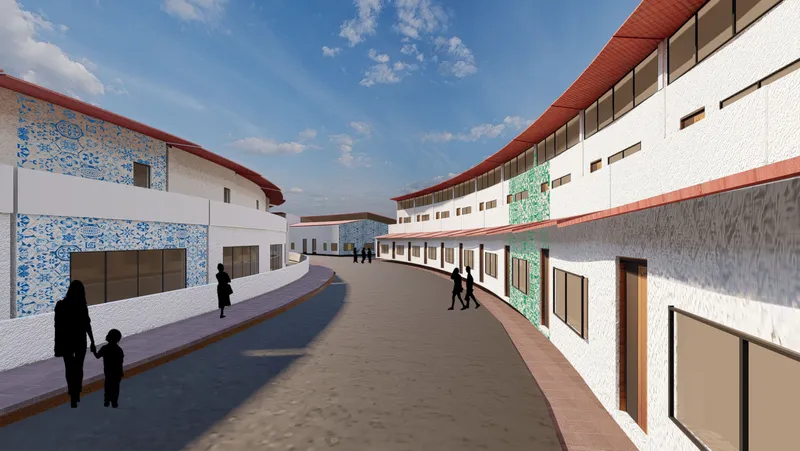
At the scale of the pedestrian, the neighborhood reads as distinctly Lisboan. A curving lane flanked by white stucco facades narrows and widens as it winds through the district, with terracotta roof canopies projecting overhead to cast deep afternoon shadows on the paving below. The geometry is not arbitrary: the curves slow foot traffic, create pockets of shade, and introduce the kind of spatial compression and release that makes walking through old Alfama or Mouraria such a pleasure. Permeable surfaces at the lane level also serve the hydrological strategy, allowing rainwater to percolate rather than sheet off into drains.
A Courtyard That Gathers More Than People
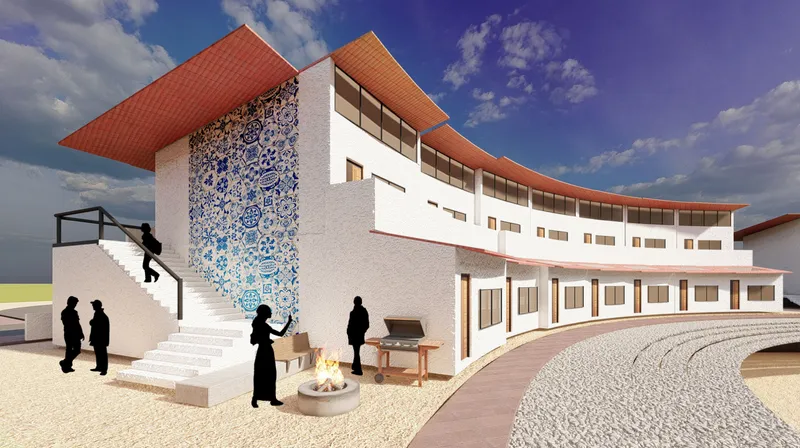
The courtyard view reveals a more intimate scale of intervention. A blue tile feature wall, an unmistakable nod to Lisbon's azulejo tradition, anchors one edge of the space. An outdoor staircase climbs to an upper terrace, and a fire pit draws silhouetted figures together under a clear blue sky. The courtyard functions as a social nucleus, but its depressed profile and surrounding surface grading suggest it also serves as a temporary retention zone during extreme rainfall, holding water briefly before it drains into the underground chambers below. Dual purpose, singular space.
Why This Project Matters
Flood resilience in architecture too often defaults to either hard engineering (seawalls, levees, pumps) or performative greenwashing (a rain garden next to a parking garage). What makes this Lisbon proposal compelling is its refusal to separate the hydrological strategy from the spatial experience. The underground chambers are not an add-on; they are the foundation on which courtyards, lanes, and water gardens are composed. The result is a neighborhood where resilience is invisible to the casual visitor but legible in every section cut.
For Vanjari, Joshi, and Thakre, the project also demonstrates a mature understanding of context. The material palette, the street geometry, and the courtyard typology all belong to Lisbon. Flooding is a universal urban threat, but the response here is site-specific, rooted in the particular light, culture, and topography of the city. That specificity is what elevates the work from a generic sustainability diagram to a place you could actually imagine living in.
View the Full Project
About the Designers
Designers: Ravisha Vanjari, Nidhi Joshi, Padmawati Thakre
Enter a Design Competition on uni.xyz
uni.xyz runs architecture and design competitions year-round that reward proposals with spatial conviction and real site intelligence.
Project credits: CIAZEDE RIAZ by Ravisha Vanjari, Nidhi Joshi, and Padmawati Thakre. People's Choice, Ohana competition (uni.xyz).




Popular Articles
Popular articles from the community


Conexión: Biophilic Design Reimagines High-Rise Living in Hong Kong
Conexión reimagines high-rise living in Hong Kong through biophilic design, green facades, shared spaces, daylight, water and nature within.

The Ocean Hive: Sustainable Architecture for a Self-Sufficient Civilization at Sea
The Ocean Hive imagines sustainable architecture at sea, where modular habitats, algae, wave power and ocean waste sustain a growing colony.

Riyadh For All: Intergenerational Urban Design for Active Aging in Rabat
Riyadh For All reimagines urban design in Rabat with intergenerational co-living, adaptive courtyards, and Moroccan cultural exchange today.

The Musturak Paradise: Senior Living Architecture for a Connected Future in Temara, Morocco
The Musturak Paradise reimagines senior living architecture in Temara via private homes, social spaces, culture, community, and shared care.


Similar Reads
You might also enjoy these articles

Day and Night Park: A Time-Based Urban Newsstand in Beijing
A temporary urban newsstand in Beijing blending travel, light, and reading through poetic colors, compact form, and community-focused design.

Modernist Patio Renovation in El Masnou, Barcelona by Oliver Segura Arquitectura + Cebrià Arquitectura
Modernist patio renovation blending tradition and innovation with a movable pool, leveled floors, and Catalan materials in El Masnou.

Alto Residencial Coop: Cooperative Housing Development in Santiago de Compostela by Carbajo Barrios Arquitectos
A linear cooperative housing complex blending white volumes and perforated metal façades, enhancing community living, natural light, privacy, and urban integration.

Vil Genis School by BPA ARCHITECTURE – Massy, France
Vil Genis School in Massy, France, features sustainable design, south-facing classrooms, community integration, accessible spaces, and modern educational architecture.


Comments (0)
Please login or sign up to add comments
No comments yet. Be the first to comment!