

Sustainable Creche: Where Paint-Splatter Terraces Teach Children About Climate
A shortlisted Form Follows Climate entry organizes a kindergarten by age group, using colorful terraces as passive shading devices and micro-landscapes.


Viewed from above, the terraces look like splatters of paint thrown across a canvas. From the ground, they function as shading overhangs that block high-angle summer sun while letting winter light flood south-facing playrooms. That dual reading, playful and performative, captures the core proposition of the Sustainable Creche: a building that treats climate-responsive design not as an engineering afterthought but as the spatial language through which young children first encounter architecture.
Designed by Małgorzata Mikita and Diana Ddd, the project was shortlisted in Form Follows Climate 2020. The competition asked entrants to demonstrate how climate drives architectural form. Mikita and Ddd responded with a childcare facility whose irregular, block-like massing and colorful terraces directly express passive environmental strategies, proving that sustainability and a child's sense of wonder can be designed from the same set of moves.
Irregular Massing and Colorful Facades as Climate Tools
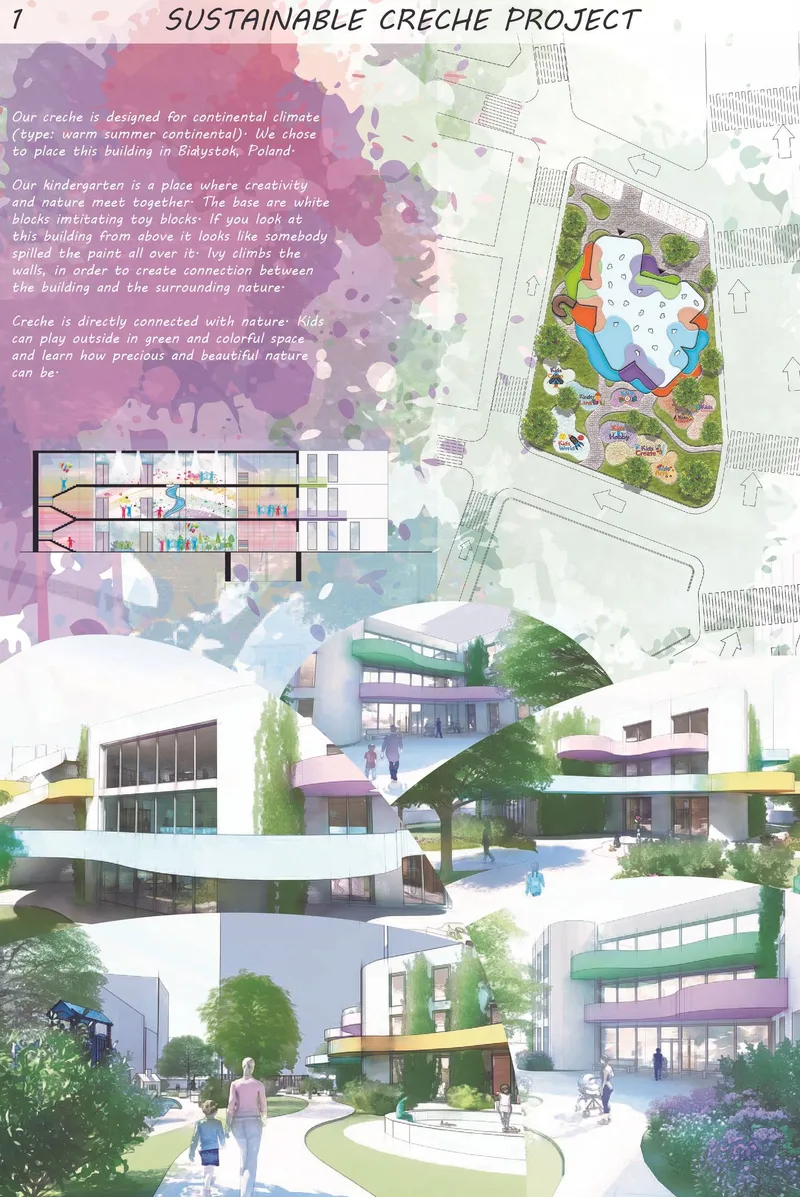
The presentation board reveals a building whose overall form imitates the irregular shapes of children's blocks, deliberately avoiding orthogonal rigidity. Colorful terraces cascade across each level, creating a dynamic silhouette visible in section and rendered views alike. These are not decorative appliqués. Each terrace overhang is calibrated to shade the floor below during summer months while permitting solar gain through large south-facing windows in winter. The southern orientation of major playrooms and activity areas maximizes natural light, and thick, well-insulated exterior walls improve thermal stability year-round. Exterior staircases connect playrooms directly to the playground, eliminating corridor bottlenecks and giving children immediate access to outdoor space.
The site plan and section drawing show how the building's active systems complement its passive strategies. A heat pump housed in the basement works alongside a heat recovery ventilation system and ground heat exchangers to reduce operational energy demands. The designers explored photovoltaic panels but set them aside when shading limitations on the site made them underperform. That willingness to drop a fashionable technology when the numbers don't support it signals a mature understanding of sustainable design: not every green gesture belongs on every building.
Organic Floor Plans Tuned to Developmental Milestones
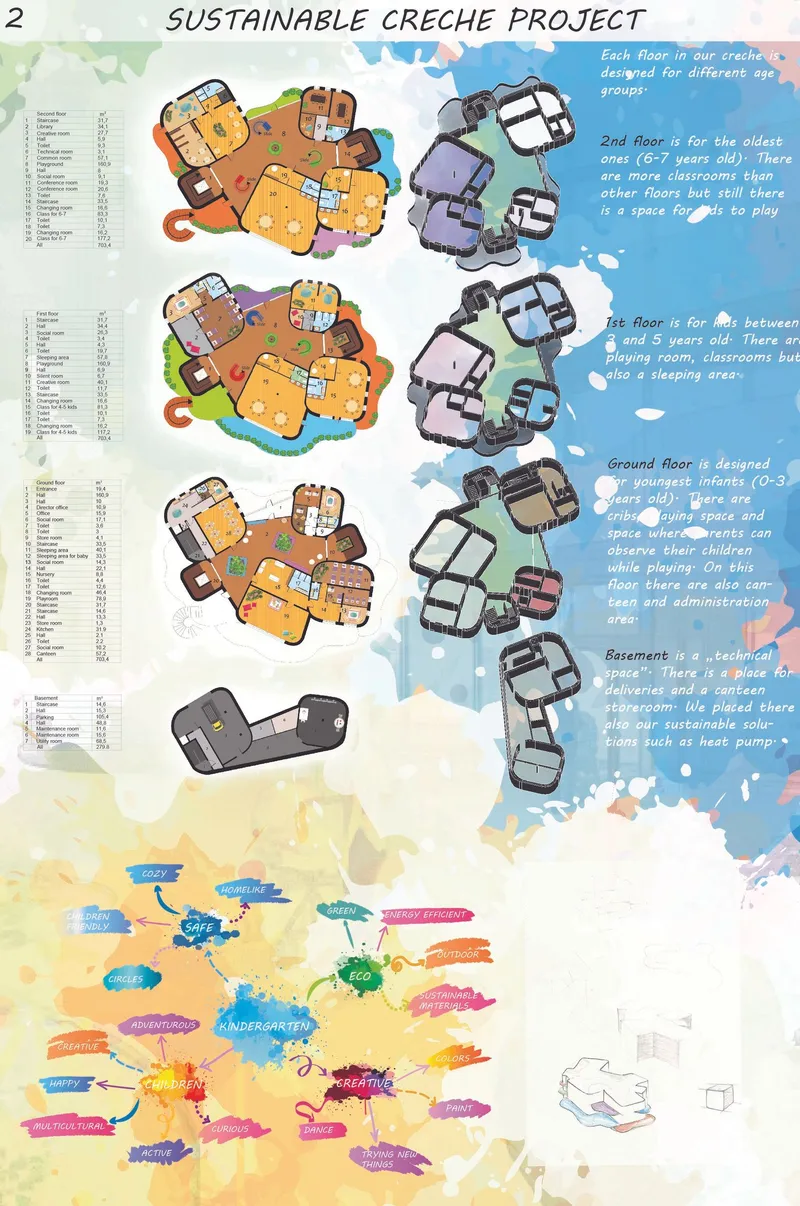
The floor plans tell a story of spatial differentiation by age. The ground floor serves infants from birth to three years old, with cribs, calming play zones, parent observation spaces, and the building's administration and canteen functions. Move up one level and the programme shifts to classrooms, playrooms, and sleeping areas sized for three-to-five-year-olds. The second floor addresses six-to-seven-year-olds with larger classrooms, interactive play pockets, and dedicated creative spaces. This vertical zoning keeps the youngest children closest to the ground and to their caregivers, while progressively granting older children more complex environments and greater autonomy.
What stands out in these drawings is the organic, clustered geometry of each room. Spaces are color-coded by function and shaped with curves that resist the institutional feel of a standard kindergarten corridor. Outdoor landscape connections appear at every level, reinforcing the designers' emphasis on green walls, vibrant outdoor gardens, and natural activity zones as instruments of sensory exploration and ecological awareness. The basement, though functional, houses the mechanical heart of the building: storage, canteen storeroom, heat pump systems, and delivery circulation, all kept out of the children's experience.
Shading Studies and Energy Calculations Made Visible
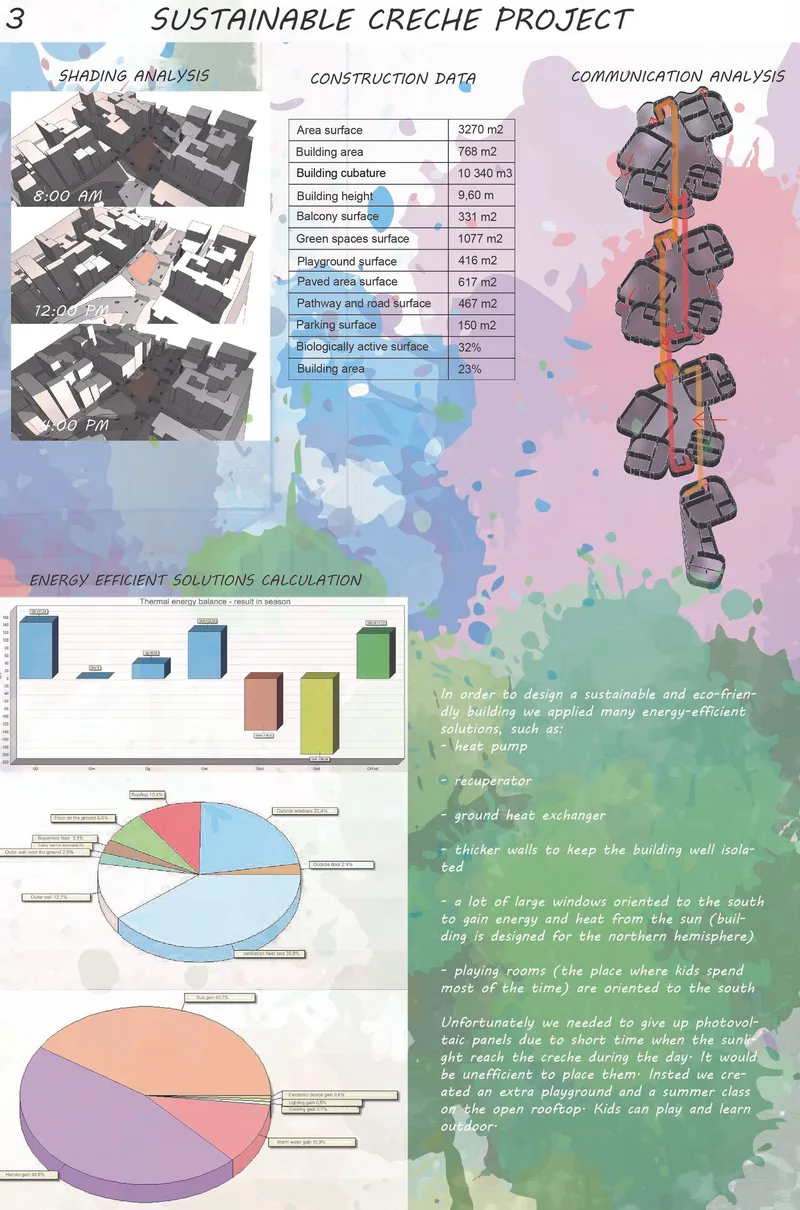
A dedicated analysis board lays out the quantitative backbone of the project. Shading diagrams demonstrate how terrace overhangs intercept solar radiation at different times of year, while circulation pattern studies map the flow of children, staff, and service deliveries through the building. Pie charts and construction data tables break down energy efficiency metrics, giving the design argument a legibility that pure renderings cannot provide. For a competition premised on the relationship between climate and form, this transparency is essential: it shows that the playful massing is driven by environmental logic, not aesthetic whim.
Why This Project Matters
Childcare facilities are among the most demanding building types to get right. They must be safe enough for infants yet stimulating for older children, energy efficient yet flooded with daylight, robust enough for daily wear yet inviting in their materiality. Mikita and Ddd address these tensions by making climate performance the generator of spatial character. The terraces that shade south-facing glazing also become micro-landscapes for outdoor play. The insulated walls that stabilize interior temperatures also define the building's sculptural presence. Every sustainable strategy doubles as a design feature.
The Sustainable Creche suggests that early childhood environments can serve as a child's first lesson in environmental stewardship, not through signage or curriculum, but through the architecture itself. When a terrace blocks the midday sun and the room stays cool without mechanical assistance, that comfort is something a child can feel before they can name it. Designing buildings that teach through sensation rather than instruction is a subtle ambition, and one worth pursuing far beyond this competition.
View the Full Project
About the Designers
Designers: Małgorzata Mikita, Diana Ddd
Enter a Design Competition on uni.xyz
uni.xyz runs architecture and design competitions year-round that reward proposals with spatial conviction and real site intelligence.
Project credits: Sustainable Creche by Małgorzata Mikita, Diana Ddd Form Follows Climate 2020 (uni.xyz).


Popular Articles
Popular articles from the community


Faces of the Soviet Avant-Garde: Turning Moscow's Street Names into an Open-Air Museum
A network of sculptural installations across a Moscow residential district transforms forgotten architect names into spatial encounters with cultural memor

Extended Shell: Retrofitting Kolkata's Balconies as Living Urban Thresholds
A modular retrofit system recovers the social and environmental intelligence of Kolkata's historic verandas for contemporary Park Street residents.

Manzana Morphosis: Stretching Barcelona's Grid into a Living Landscape for 2050
A radical reworking of the Eixample manzana turns density into a tool for generous public space, vertical ecology, and environmental performance.

Opera by the Sea Estonia: Three Shells Dissolving Architecture into Tallinn's Coastline
A winning opera house proposal replaces monumental form with interconnected shells that blur the boundary between building, park and Baltic Sea.

Similar Reads
You might also enjoy these articles

Play: Fragments of Their World: Remembered Architecture Rebuilt as a Modular Playground for Refugee Camps
Tom Gardner abstracts domes, arches and towers from the homelands of displaced families into a kit of child-scaled play parts for camp settlements.
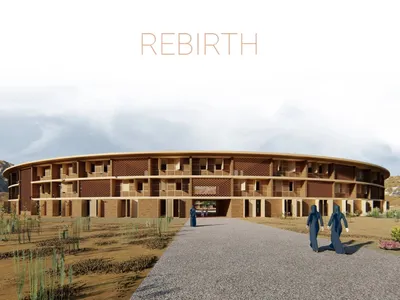
REBIRTH: A Circular Settlement Where Afghan Widows and Their Children Rebuild Life Together
A shortlisted Resile entry turns the circle into a protective ring of timber and brick, gathering homes, classrooms and gardens around a shared landscape.
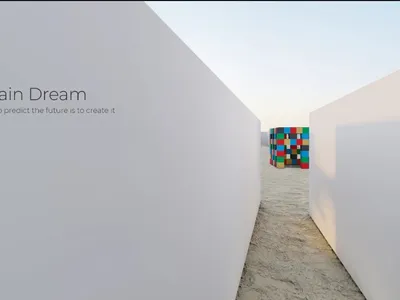
The Main Dream: A Recycled Plastic Kit That Lets Refugee Children Build Their Own Playground
Thirty-centimetre interlocking cubes that connect on three axes turn play into construction, letting children author the spaces they occupy.

Lunar Spiral: A Fibonacci-Driven Moon Settlement Rising from Shackleton Crater
Golden-spiral geometry organises buried infrastructure and orbiting habitable spheres into a lunar base designed to grow as life on the Moon expands.


Comments (0)
Please login or sign up to add comments
No comments yet. Be the first to comment!