

Sustainable School Architecture Redefining Learning Through Community and Ecology
A visionary sustainable school architecture project where farming, energy, community, and education merge into one living ecosystem.


School of Thought by Yuka Foo and Fishy Ying Xin Tan
Education is evolving rapidly. Traditional classrooms that once focused on memorization and rigid subjects are being challenged by new approaches that value adaptability, collaboration, sustainability, and experiential learning. The project School of Thought by Yuka Foo and Fishy Ying Xin Tan explores this transformation through an ambitious vision of sustainable school architecture that redefines how students learn, interact, and grow within the built environment.
Editor's Choice entry of School Of Thought 2020
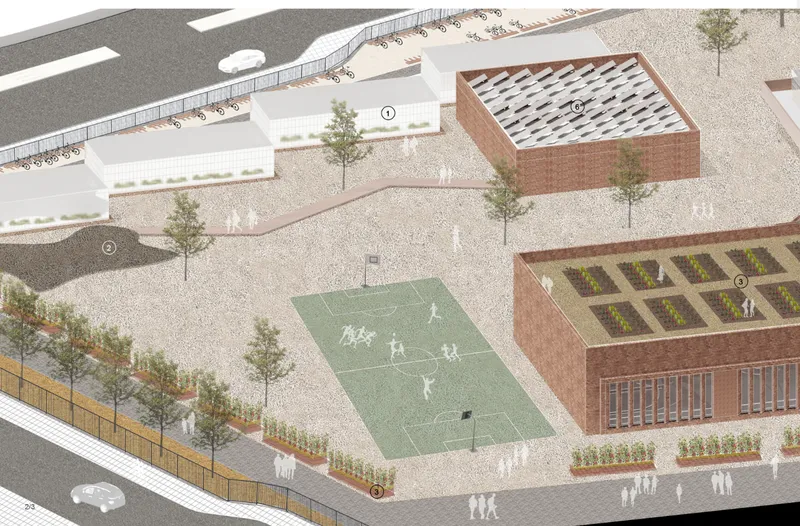
Designed as more than just an educational institution, the proposal imagines a self-sustaining ecosystem where architecture becomes an active participant in the educational process. Rather than separating learning into isolated subjects and classrooms, the project integrates agriculture, food production, energy systems, community spaces, and collaborative environments into one interconnected campus.
The result is a forward-thinking educational model where students develop practical skills, environmental awareness, and social responsibility alongside academic knowledge.
Rethinking the Future of Education Through Architecture
The central philosophy behind School of Thought is that education is not merely the transfer of information. Instead, it is the shaping of how children think, interact, solve problems, and understand their role within society.
The project critiques conventional educational systems that compartmentalize knowledge into isolated disciplines such as mathematics, science, language, and history. In response, the design proposes a holistic educational framework where learning emerges through real-world engagement and interdisciplinary experiences.
This concept is expressed architecturally through interconnected spaces that encourage collaboration, experimentation, farming, cooking, performing arts, and communal activities. Instead of conventional classrooms dominating the campus, the architecture promotes flexible learning environments where knowledge is acquired through participation and exploration.
The school becomes a miniature city where every spatial experience contributes to education.
Sustainable School Architecture as a Living Ecosystem
One of the strongest aspects of the project is its integration of sustainability directly into the educational framework. The campus is envisioned as a net-positive environment that actively produces food and energy while minimizing waste and environmental impact.
The proposal includes a series of environmentally responsive systems integrated throughout the architecture:
- Rooftop farming zones
- Greenhouses for year-round food production
- Biomass energy systems
- Rainwater harvesting infrastructure
- Filtration ponds
- Solar panel installations
- Green roofs for biodiversity and thermal performance
- Passive solar strategies for natural heating and cooling
These sustainable systems are not hidden technical components. Instead, they become educational tools that students interact with daily.
By participating in food cultivation, composting, energy production, and environmental management, students learn practical sustainability skills while understanding the ecological impact of human activity.
This approach transforms sustainable architecture from a visual aesthetic into a functioning educational mechanism.
The Greenhouse as the Social Heart of the Campus
At the center of the project lies a communal greenhouse space that acts as both an environmental and social nucleus for the school.
The greenhouse is designed as a shared learning environment where farming, collaboration, dining, and social interaction intersect. It functions as a symbolic and physical representation of interconnected learning.
Students grow food, prepare meals, exchange ideas, and participate in community-driven activities within the same architectural environment. The spatial organization encourages continuous interaction between disciplines, age groups, and members of the wider community.
This central communal space reinforces the project’s belief that education thrives through participation and collective engagement rather than isolation.
Architecture Designed Around Human Interaction
The spatial composition of School of Thought carefully balances openness with intimacy. Large masses are fragmented into smaller interconnected volumes that create varied scales of interaction throughout the campus.
Internal walkways, rooftop gardens, courtyards, bridges, and communal terraces encourage movement and spontaneous encounters. The circulation system becomes an educational experience itself, fostering exploration and social exchange.
The exploded diagrams and sectional perspectives reveal how the architecture prioritizes visual connectivity between spaces. Students remain constantly aware of activities occurring throughout the campus, reinforcing the concept of collective learning.
Natural light, ventilation, vegetation, and material warmth further contribute to an environment that feels inviting and humane rather than institutional.

Hands-On Learning as the Core Educational Model
A defining feature of the proposal is its emphasis on experiential learning.
Students do not simply study food systems theoretically. They cultivate crops in rooftop gardens and greenhouses. They do not only learn environmental science through textbooks. They actively manage water systems, composting programs, and renewable energy infrastructure.
Cooking spaces become educational laboratories. Performance areas become platforms for communication and collaboration. Farming zones become spaces for scientific experimentation and environmental stewardship.
The architecture supports a curriculum built around direct engagement with real-world systems and challenges.
This educational approach encourages problem-solving, adaptability, teamwork, and independence, qualities increasingly necessary in a rapidly changing global society.
Net-Positive Campus Design and Environmental Responsibility
The proposal positions environmental responsibility as a fundamental component of both architecture and education.
The campus is designed to minimize external dependence by generating renewable energy, recycling waste, and producing food internally. Biomass systems convert organic waste into energy, while solar panels maximize energy efficiency through passive orientation strategies.
Water management systems collect, filter, and redistribute rainwater across the campus landscape. Green roofs improve biodiversity while reducing thermal gain and enhancing environmental comfort.
Importantly, these systems are made visible within the architecture rather than concealed. Students witness sustainability in action every day, reinforcing ecological literacy through lived experience.
Community Engagement Through Educational Space
Unlike traditional educational campuses that isolate themselves from surrounding neighborhoods, School of Thought embraces community integration.
The architecture encourages interaction between students, educators, and local residents through shared public spaces and collaborative activities. Farming zones, communal kitchens, exhibition areas, and performance spaces create opportunities for broader civic participation.
This openness reflects the project’s belief that education should not exist separately from society but should actively contribute to community development and collective learning.
The school becomes a civic infrastructure that strengthens social relationships while promoting environmental awareness and knowledge exchange.
School of Thought by Yuka Foo and Fishy Ying Xin Tan presents a compelling vision for the future of educational architecture. The project challenges outdated models of institutional learning by proposing a campus where sustainability, community, and experiential education are deeply interconnected.
Through its integration of ecological systems, communal spaces, and hands-on learning environments, the project demonstrates how architecture can actively shape new educational paradigms.
Rather than functioning as a static container for instruction, the school becomes a dynamic living environment that teaches through experience, interaction, and participation.
As educational institutions worldwide continue searching for more adaptive and sustainable approaches to learning, School of Thought offers a powerful architectural model for the schools of the future.




Popular Articles
Popular articles from the community


Hill & Cross Opera: Sculptural Opera House Architecture Shaped by Tallinn’s Landscape and Identity
Hill & Cross Opera reimagines opera house architecture in Tallinn through its sculptural hill, civic plaza, glass wave and a luminous cross.

Conexión: Biophilic Design Reimagines High-Rise Living in Hong Kong
Conexión reimagines high-rise living in Hong Kong through biophilic design, green facades, shared spaces, daylight, water and nature within.

Co-life: Sustainable Architecture for Age-Friendly Community Living
Co-life reimagines sustainable architecture for seniors through courtyards, rammed earth, shared gardens, and spaces designed for belonging.

Co-Life: Senior Housing Design That Reconnects Older Adults With the City
Co-Life reimagines senior housing design through healing gardens, shared streets, workshops, and a sustainable community across generations.


Similar Reads
You might also enjoy these articles

Eco Chapel: A Green Architecture Pavilion Designed in Symbiosis with the Forest
Eco Chapel uses green architecture to weave prayer, learning and reuse into a forest pavilion shaped by modular hexagonal canopies for life.
Kaffeebühnen: Coffee Shop Architecture Designed as a Civic Stage Between Vienna’s City and Park
Kaffeebühnen turns coffee shop architecture into a civic stage, linking Vienna’s park edge, urban life, warm timber yards, and coffee craft.
Healing Façade: Sustainable Architecture for Reforestation, Community, and Sacred Ecology in Ethiopia
Healing Façade reimagines sustainable architecture as a living wall that restores soil, catches water and renews Ethiopia's forest churches.


Urban Forest: A Vertical Ecosystem for 5,000 Workers in Singapore's Changi Business Park
Radially stacked pods and layered green decks turn a 7-acre plot into 47 acres of ecological workspace projected for 2040.


Explore Architecture Competitions
Discover active competitions in this discipline



Challenge to reimagine the Iron Throne


Photograph architecture without architects


Illustrate the lost glory of Angkor Wat - Render Challenge


Design challenge to reuse E-waste
Comments (0)
Please login or sign up to add comments
No comments yet. Be the first to comment!