

Good Death Best Park: Turning Human Remains into Urban Forest
A cemetery in Shanghai's Hongkou district uses promession technology to convert the deceased into bio-fertilizer that grows city-wide tree canopy.


What if a cemetery could produce forests instead of headstones? Good Death Best Park proposes exactly that: a burial facility in one of Shanghai's densest districts where human remains are converted into bio-fertilizer through promession technology, then used to grow trees that are transplanted across the city. The dead, in this reading of urban ecology, become the literal substrate for urban greenery. It is a provocation dressed as infrastructure, and it lands with real spatial conviction.
Designed by Punchanit Nuchphongsai and Patcharin Saelai, the project was submitted as an Editor's Choice entry to the Circle of Life competition, which asked designers to rethink burial spaces for rapidly urbanizing contexts. The site sits in Hongkou, a multicultural district in Shanghai where traditional cemetery land is vanishing under development pressure. Rather than compete for scarce ground, the designers propose a system that requires no permanent grave plots at all, accommodating an unlimited number of bodies while returning ecological value to the city.
Sculptural Volumes Organized Around a Living Core
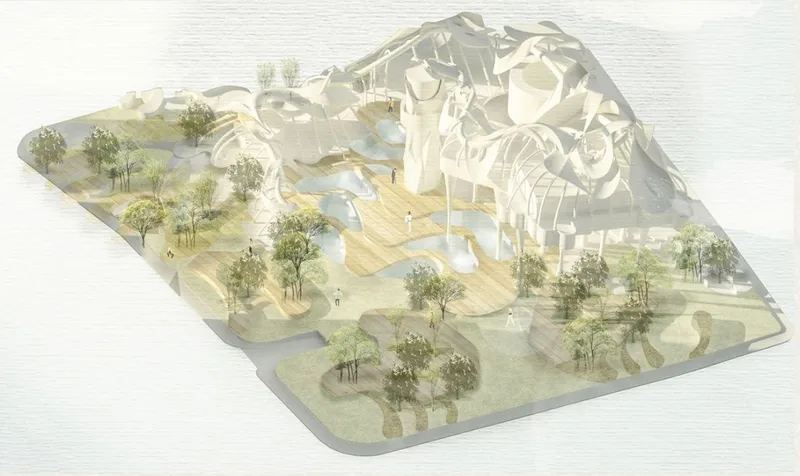
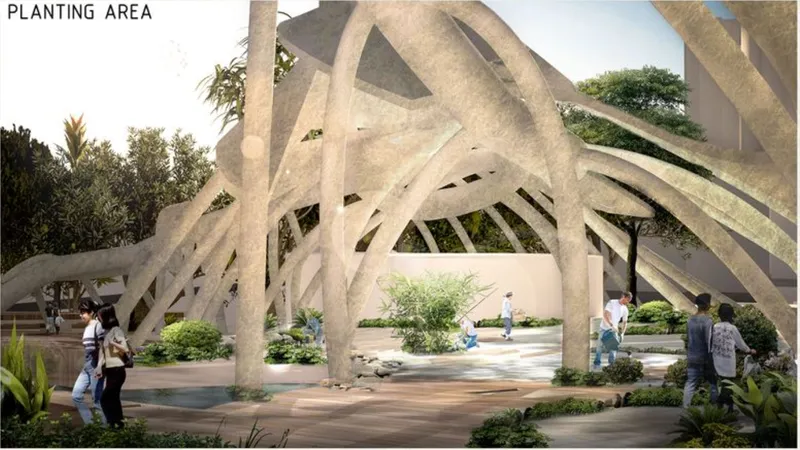
The aerial axonometric reveals the project's organizational logic: a cluster of sculptural concrete volumes arranged around a central planted plaza. These forms are not arbitrary; each houses a distinct programmatic function within the death-to-life cycle. The Exhibition Park sits at the heart of the composition, where glass tubes containing bio-fertilizer from the deceased are displayed as memorials to individual lives. Surrounding it, plantation areas serve as nurseries for trees grown from this fertilizer before they are distributed throughout Shanghai's neighborhoods.
At ground level, the covered outdoor plaza reveals how the intersecting concrete arches create generous shaded public space. Visitors walk among landscaped planting beds beneath the soaring structural canopy. The architecture reads less like a cemetery and more like a botanic garden with a deeper purpose. This is intentional: the designers want to transform the perception of burial grounds from somber, avoided places into restorative public landscapes where the living spend time willingly.
A Non-Denominational Ritual Space Framed by Concrete Ribs
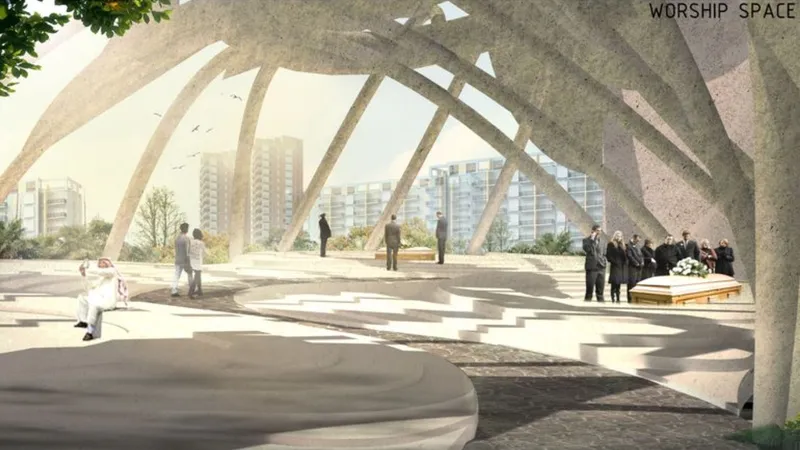
Hongkou's multicultural population demands a space where Buddhist, Christian, Muslim, and secular mourners can each perform their own rituals without friction. The ritual courtyard addresses this by stripping away all specific religious symbols, relying instead on the architecture itself to generate a sense of the sacred. Branching concrete ribs rise overhead like a structural canopy, filtering light and framing views of the city skyline beyond. The effect is cathedral-like without belonging to any single tradition.
This is one of the project's sharpest moves. Rather than attempting to represent every faith, which inevitably satisfies none, the designers create a space that is spiritually charged through material weight, vertical proportion, and the careful orchestration of natural light. The towers of Shanghai visible through the structural openings serve as a quiet reminder that this place exists within, not apart from, the living city.
Park Landscape Dissolves the Boundary Between Cemetery and City
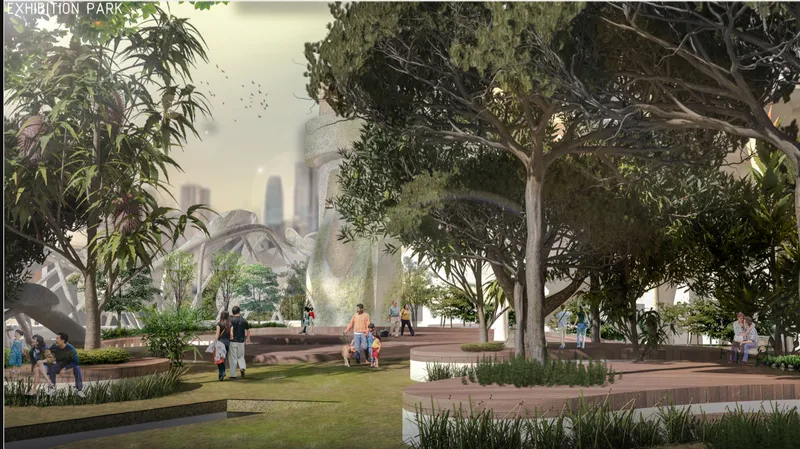
Seen through a canopy of mature trees under overcast skies, the curved sculptural roof forms settle into the landscape with surprising ease. The cemetery does not announce itself with walls or gates. Instead, the planted zones blur into the surrounding urban fabric, functioning as ecological lungs that mitigate pollution and support biodiversity. Trees cultivated here from bio-fertilizer eventually leave the site entirely, dispersed across the city to extend its green infrastructure. The cemetery, in this sense, is a production facility for urban nature.
Section Logic: Ceremony Above, Infrastructure Below
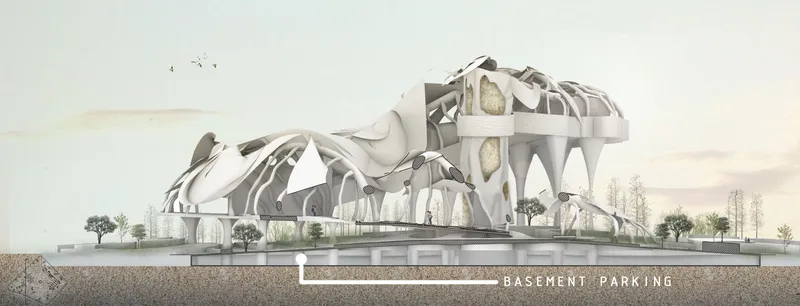
The section drawing cuts through the project's layered organization. Above ground, the arched concrete structure shelters the public and ceremonial programs. Below, a basement level accommodates parking and the promession laboratory where bodies undergo eco-friendly decomposition before being reintegrated into the ecosystem as fertilizer. Keeping the technical process underground is a deliberate spatial decision: it allows the surface to remain entirely parklike while the essential biological cycle operates quietly beneath visitors' feet.
The zero-waste, pollution-free burial process stands in stark contrast to conventional interment, which consumes permanent land and introduces embalming chemicals into the soil. Here, the section makes visible a complete closed loop. Bodies enter at the basement level, exit as fertilizer, feed trees that grow in the nursery zones above, and ultimately leave the site altogether to become part of Shanghai's expanding canopy. Death becomes, quite literally, a catalyst for urban life.
Why This Project Matters
Good Death Best Park refuses the premise that cemeteries must be land-hungry, mono-cultural, and disconnected from the living city. By building the entire program around a biological cycle rather than a static grid of plots, Nuchphongsai and Saelai sidestep the land scarcity problem that makes traditional burial untenable in megacities like Shanghai. The result is a cemetery with no expiration date: it can process an unlimited number of bodies without ever running out of space.
What elevates the project beyond clever engineering is its commitment to public life. The Exhibition Park, the interfaith ritual courtyard, and the tree nurseries are all spaces designed for the living as much as for the dead. In a district where open green space is scarce and cultural diversity is high, that dual purpose is not a bonus; it is the core argument. The designers have proposed a new typology where mourning, ecology, and urban recreation occupy the same ground, and where the most meaningful memorial a person can leave behind is a tree growing somewhere in the city.
View the Full Project
About the Designers
Designers: Punchanit Nuchphongsai, Patcharin Saelai
Enter a Design Competition on uni.xyz
uni.xyz runs architecture and design competitions year-round that reward proposals with spatial conviction and real site intelligence.
Project credits: Good Death Best Park" by Punchanit Nuchphongsai, Patcharin Saelai Circle of Life (uni.xyz).


Popular Articles
Popular articles from the community


graciastudio Turns a Viewless Tijuana Lot Inward Around a Courtyard of Concrete, Timber and Trees
In Tijuana, Jorge Gracia's GA2 House stacks a timber-clad private floor over exposed concrete and replaces a missing view with a planted interior patio.

David Ortega Stacks a Two-Story Mexico City Penthouse Around a Steel Stair and a Pergola-Shaded Roof Terrace
In Colonia Roma, a 300 m² penthouse uses oak joinery, a planted steel stair and a slatted roof pergola to make a new-build apartment feel like a house.


Opera on the Sea: Driftwood Logic Shapes a Timber Opera House on Estonia's Coast
Trevor Orgill's opera house translates the entangled drift of floating timber into a civic building where wood, water, and music converge.

FCC Arquitectura Expands a Portuguese Granite House with a Board-Marked Concrete Wing
In Portugal, JV House pairs a cleaned-up whitewashed and granite dwelling with a timber-shuttered concrete extension, courtyards and a garden pool.

Similar Reads
You might also enjoy these articles

Vereda Arquitetos Renovates a 40-Square-Meter Apartment Inside Niemeyer's Copan Building
A compact unit in São Paulo's most iconic residential tower gets a material overhaul that pairs exposed concrete with bold blue Formica.

Shakur's House: Exposed Brick as an Interior Organiser in a 168 m² Mashhad Residence
Brick moves indoors in this Mashhad residence, where masonry walls, glass partitions and teal planes sequence a compact home without closing it off.

Day and Night Park: A Time-Based Urban Newsstand in Beijing
A temporary urban newsstand in Beijing blending travel, light, and reading through poetic colors, compact form, and community-focused design.

Modernist Patio Renovation in El Masnou, Barcelona by Oliver Segura Arquitectura + Cebrià Arquitectura
Modernist patio renovation blending tradition and innovation with a movable pool, leveled floors, and Catalan materials in El Masnou.

Explore Vertical Cemetery Competitions
Discover active competitions in this discipline

Challenge to reimagine the Iron Throne

Photograph architecture without architects

Illustrate the lost glory of Angkor Wat - Render Challenge

Design challenge to reuse E-waste
Comments (0)
Please login or sign up to add comments
No comments yet. Be the first to comment!