

Swamp Capsule Camp: Prefabricated Pods That Disappear Into the Wetlands
A children's educational camp in the Tame Valley Wetlands deploys modular capsules, reedbeds, and concentric planning to tread lightly on fragile ground.


What if a building could arrive, serve its purpose, and leave no trace? Swamp Capsule Camp starts from that provocation, proposing a children's educational camp in the Tame Valley Wetlands where 100% prefabricated capsules sit lightly on the landscape, powered by small wind turbines and serviced by constructed reedbeds that process wastewater back into the ecosystem. The architecture doesn't just occupy the wetland; it participates in its cycles.
Designed by Milena Markovic and recognized as a runner-up entry in the WIC competition, the project sits at the intersection of childhood education, ecological sensitivity, and modular construction. Located in the United Kingdom's Tame Valley Wetlands, the camp addresses a real constraint: how to build in a protected, ecologically delicate zone without displacing the very thing that makes it worth visiting.
Glowing Capsules on a Flat Horizon
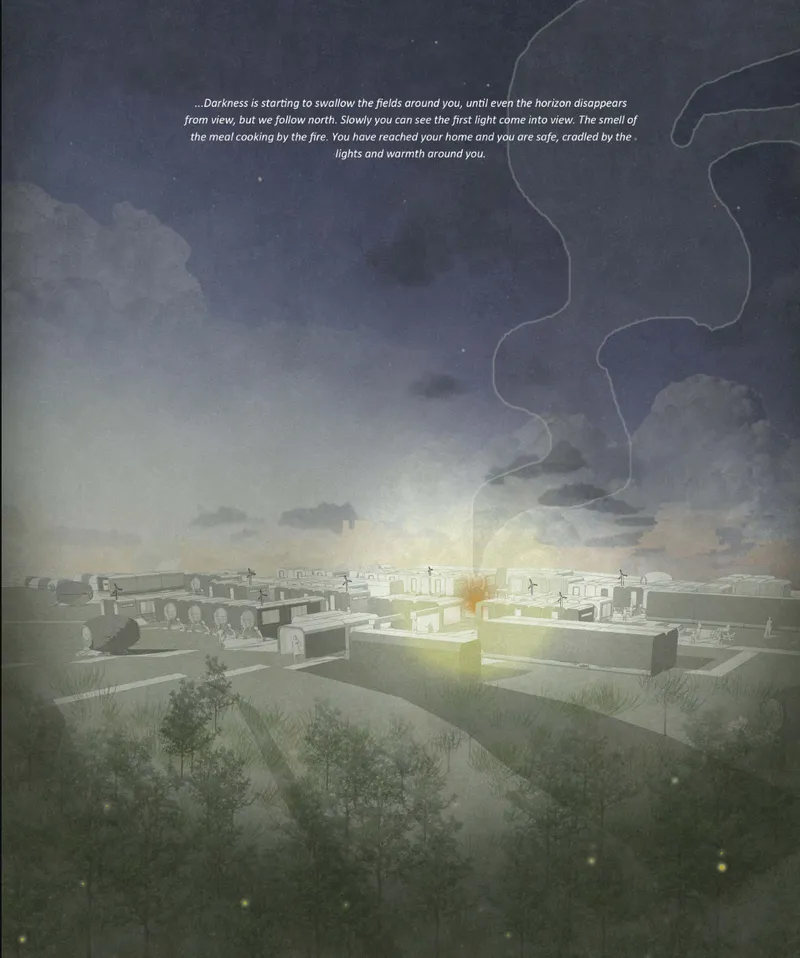
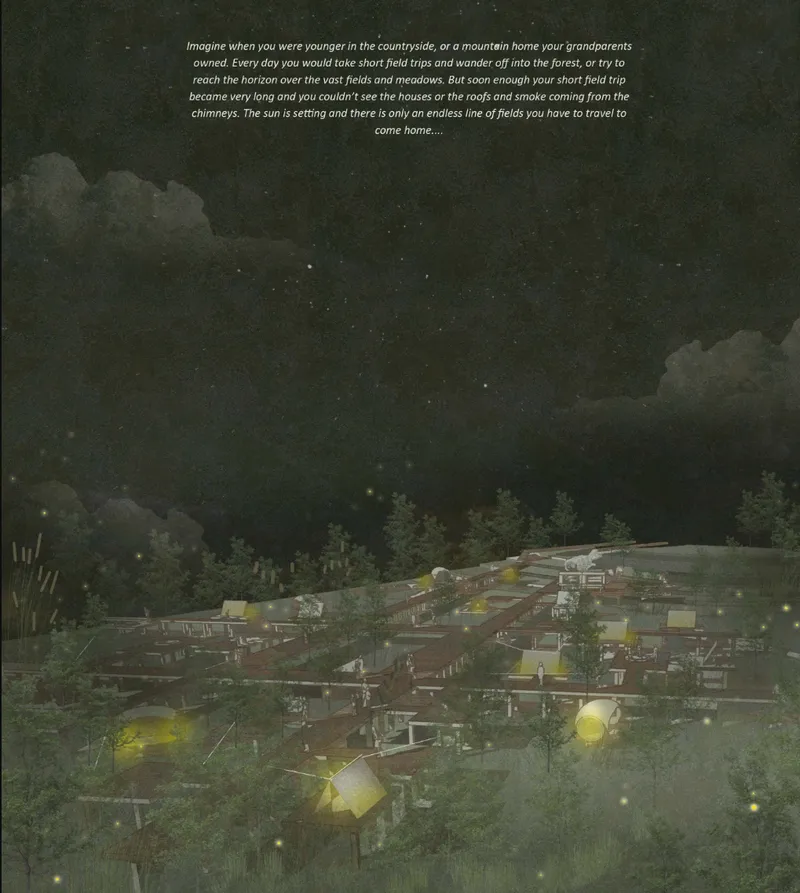
The aerial rendering reveals the camp's essential character: low-lying volumes scattered across the flat wetland landscape, their illuminated yellow interiors glowing against a dusk sky. There is no monumental gesture here, no landmark building demanding attention. Instead, the capsules read as a constellation of warm points, closer in spirit to campfires than to cabins. The second rendering shifts the mood to a hillside settlement at night, where glowing structures nestle among trees under a starlit sky, reinforcing the project's ambition to evoke the intimacy of countryside retreats and mountain villages.
Markovic cites memories of mountain homes and countryside warmth as design drivers, and these renderings make that lineage visible. The housing density decreases as one moves outward from the communal center, mimicking the organic clustering of village settlements. The further a camper walks from the campfire, the more the architecture recedes and the landscape takes over.
Concentric Circles Around a Campfire
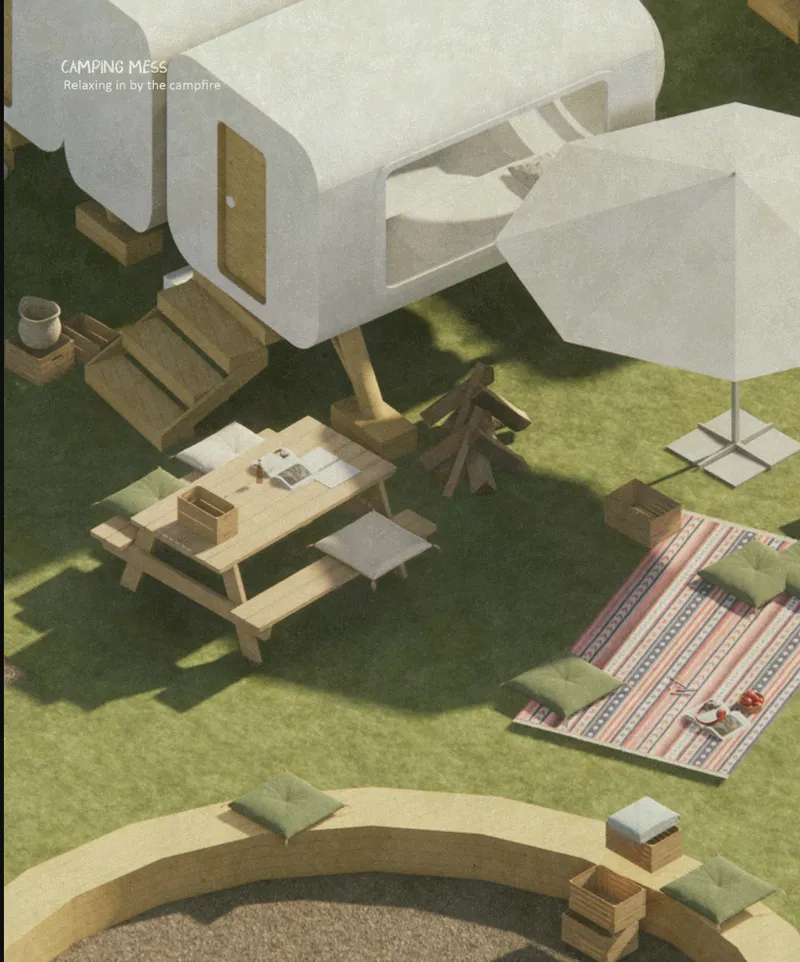
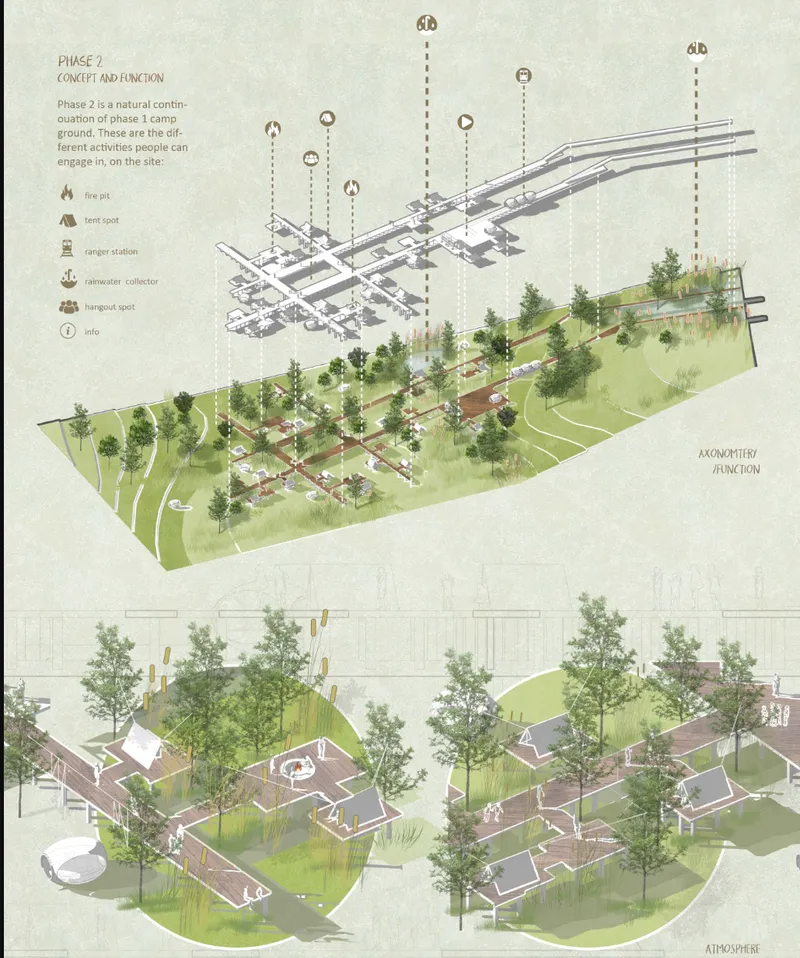
The axonometric rendering of the camping area shows the social nucleus of the project: a fire pit surrounded by picnic tables and tent-like structures on open grass. Everything orbits this communal hearth. The accompanying plan and exploded axonometric drawings make the spatial logic explicit, with concentric circles guiding the layout, landscaped berms shaping edges, and linear circulation paths connecting zones without carving up the ground.
The project unfolds in two phases. Phase 1 establishes the primary camping zone organized around those concentric rings. Phase 2 extends the experience outward through wooden trails and platforms that reach into the wetlands, a low-impact expansion that honors the existing topography. Markovic understands that architecture in a camping context is inherently adaptive: campers will repurpose meadows as sports fields, sit on logs as benches, and turn capsules into community hubs. Rather than fighting this unpredictability, the design anticipates it, treating flexibility as a structural principle rather than an afterthought.
Anatomy of an Oval Capsule
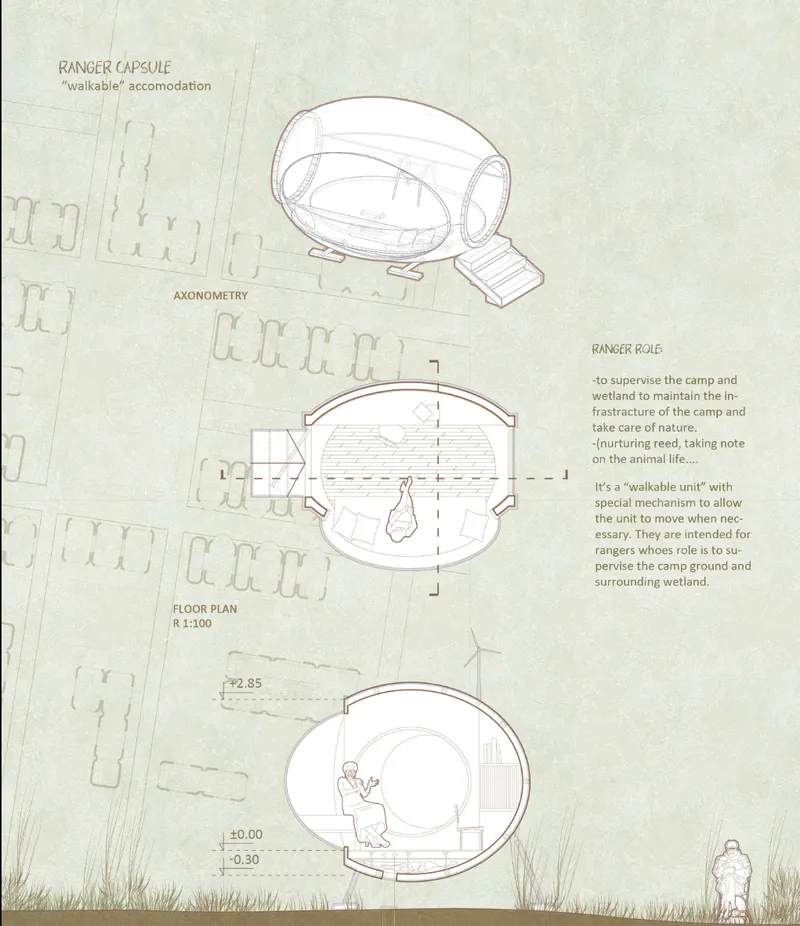
The section, floor plan, and axonometric drawings of an individual capsule unit reveal a compact, curved-roof volume with an oval footprint. The geometry is deliberate: a rounded form minimizes material use, sheds rainwater efficiently into collection gutters, and reduces wind resistance on the exposed meadow site. Each capsule is entirely prefabricated offsite, which eliminates construction waste on the wetland and allows the units to be disassembled and redeployed elsewhere when their service life at the camp ends.
Sustainability is embedded at the unit scale. Rainwater collected by gutters is reused within each capsule, with surplus directed to wetland zones to sustain the broader ecosystem. Small wind turbines power individual units, taking advantage of the site's exposed conditions. And constructed reedbeds handle wastewater processing naturally, turning a waste stream into a resource while protecting the local wetland biome. None of these systems are novel in isolation, but their integration into a single, replicable capsule module gives the project its real propositional force.
Modular Aggregation and the Logic of Repetition
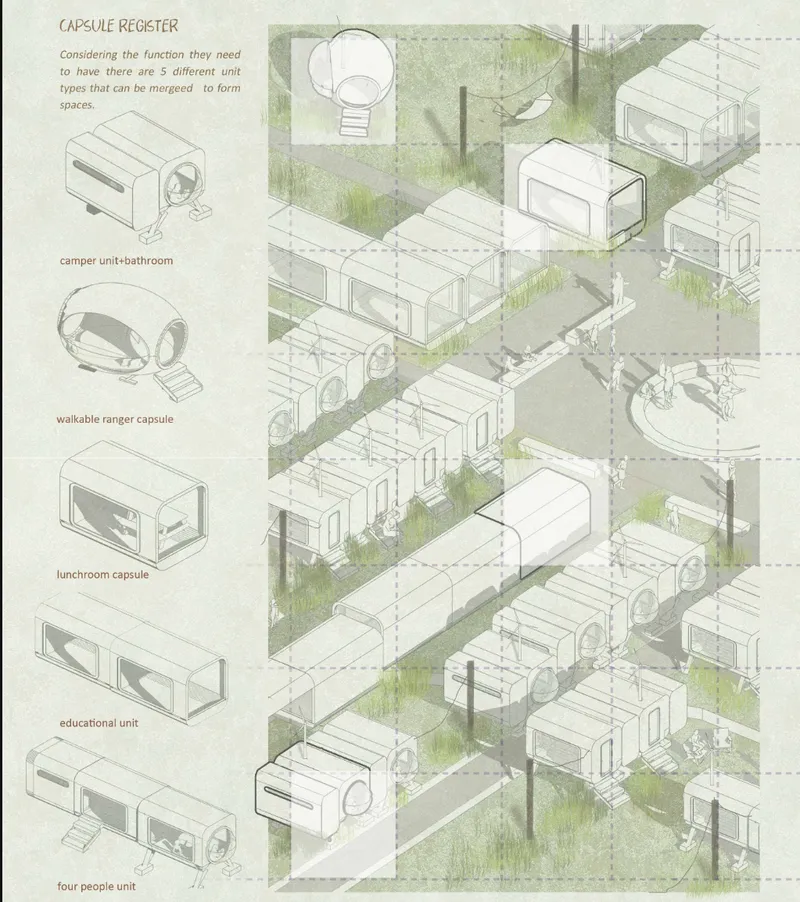
The final isometric drawing pulls back to show capsule units arranged in a grid with vegetation and circulation paths woven between them. The repetition is the point. Because each unit is identical and self-sufficient, the camp can scale up or down without redesign. New capsules slot into the grid; old ones are removed. The vegetation grows in between, softening edges and eventually reclaiming any ground the architecture vacates. The drawing makes a quiet but powerful argument: that modular architecture, when paired with genuine ecological integration, can be a form of environmental stewardship rather than a compromise.
Why This Project Matters
Swamp Capsule Camp confronts a tension that most sustainable architecture projects prefer to sidestep: the act of building in a place that arguably shouldn't be built on at all. Rather than resolving that tension with greenwashing or withdrawal, Markovic proposes a middle path where architecture becomes a temporary, reversible participant in the wetland's ecology. Prefabrication, rainwater cycling, reedbed filtration, and wind energy are not decorative add-ons here; they are the conditions that justify the camp's existence.
For a children's educational camp, that ethical framework is also a pedagogical one. Young campers don't just learn about ecology in a classroom with a green roof; they live inside a system where their wastewater feeds reedbeds, their electricity comes from the wind crossing the meadow, and their shelter can be unbolted and carried away. The architecture teaches by being itself. In a discipline saturated with sustainability rhetoric, that directness is worth paying attention to.
View the Full Project
About the Designers
Designer: Milena Markovic
Enter a Design Competition on uni.xyz
uni.xyz runs architecture and design competitions year-round that reward proposals with spatial conviction and real site intelligence.
Project credits: Swamp Capsule Camp by Milena Markovic WIC (uni.xyz).


Popular Articles
Popular articles from the community


GROUP A Strips a 1969 Rotterdam Harbor Headquarters to Its Frame and Wraps It in Timber Louvers
In Rotterdam's M4H harbor district, Ferro Offices reuses a 1969 frame, adds one timber storey and reaches BREEAM-NL Outstanding.

U.GA Architects Wraps an Oval Rooftop Pool in Curved Board-Formed Concrete on Busan's Jeollidan-gil
In Busan's Jeonpo-dong, a 454 m² mixed-use block stacks a neighborhood facility, guest rooms and an oval rooftop pool inside spiraling concrete walls.

Architekt Andreas Gruber Scatters 23 Dark Timber Chalets Across a South Tyrolean Forest Edge
In Molini di Tures, Amonti Chalets breaks a resort into a hamlet of gabled timber houses, with parking, storage and services pushed into the slope.

LT2A and OPEN Architectes Thread a Brick and Glass High School Through a Wooded Belgian Campus
In Braine-l'Alleud, a 3,000 m² wing for Collège Cardinal Mercier pairs pale brick with a glazed colonnade, deferring to a small chapel and a dense wood.

Similar Reads
You might also enjoy these articles


Vereda Arquitetos Renovates a 40-Square-Meter Apartment Inside Niemeyer's Copan Building
A compact unit in São Paulo's most iconic residential tower gets a material overhaul that pairs exposed concrete with bold blue Formica.

Shakur's House: Exposed Brick as an Interior Organiser in a 168 m² Mashhad Residence
Brick moves indoors in this Mashhad residence, where masonry walls, glass partitions and teal planes sequence a compact home without closing it off.

Day and Night Park: A Time-Based Urban Newsstand in Beijing
A temporary urban newsstand in Beijing blending travel, light, and reading through poetic colors, compact form, and community-focused design.

Modernist Patio Renovation in El Masnou, Barcelona by Oliver Segura Arquitectura + Cebrià Arquitectura
Modernist patio renovation blending tradition and innovation with a movable pool, leveled floors, and Catalan materials in El Masnou.


Comments (0)
Please login or sign up to add comments
No comments yet. Be the first to comment!