

Swayam: A Wastescape Community That Turns Nashik's Recycling Into Public Ground
A shortlisted UnIATA '24 entry that opens a 6.5-acre waste facility to workshops, repair yards and parks, making recycling a civic act.


Most cities treat waste as something to hide: trucked to the edge, buried, forgotten. Swayam, The Wastescape Community takes the opposite position. It argues that the recycling plant should sit close to where people live, that its machinery should be visible, and that the public should be invited to walk through, watch, learn and take part. The project's core idea is simple and quietly radical: if waste management becomes a shared civic space, it stops being somebody else's problem.
Designed by Neha Patil and shortlisted in UnIATA '24, the proposal responds to a pressing national figure: India produces around 62 million tons of waste every year, and a significant share of it goes untreated. Patil sets the project on Plot No. 197 in Nashik, a 6.5-acre site selected for its accessibility and its proximity to residential neighbourhoods. The central Wastescape Centre anchors a wider network of decentralised Material Recovery Facilities across the city, pairing a modular, scalable infrastructure strategy with a building that doubles as a community hub.
A Courtyard Where the Sorting Machine Is the Centrepiece

The opening render sets the tone for the whole scheme. A rotating drum sorter sits in plain view within an open courtyard, framed by walls of colourful crates, a grass-covered roof slope and an elevated walkway that lets visitors look down into the process. This is not a back-of-house service yard dressed up for presentation; the industrial equipment is treated as the room's focal object, much as a fountain or a sculpture would be in a conventional public square.
The courtyard also carries real environmental work. Patil relies on open courts and ventilated structures to keep operations odour-free and to reduce energy demand, so the space that puts the process on display is the same space that lets it breathe. The elevated walkway is the clever move here: it separates pedestrian circulation from the working floor while keeping the two in constant visual contact, which is exactly the relationship an educational facility needs.
Following the Truck: From Tipping Shed to Recovered Material


The collage strip reads almost like a storyboard of the waste's journey: a gateway, green tipper trucks, a heap of incoming material and a covered tipping shed. It maps the circular framework the project is built around. Waste arrives and is pre-sorted, both manually and mechanically, into biodegradable, recyclable and hazardous streams. Wet waste is composted on site into organic fertiliser, while dry waste, including plastics and e-waste, moves on to recycling. Segregated zones for dry, wet and hazardous material keep these flows from colliding.
The aerial view shows how that logistics chain sits within an architectural plan. Green-clad blocks gather around a central courtyard, a wavy canopy roof softens the profile, and the trucks run along the street edge rather than cutting through the public heart of the site. Placing vehicle movement on the perimeter is a sensible zoning decision for a 6.5-acre plot that has to balance heavy service traffic with exhibition halls, repair yards and green parks.
Vaulted Green Roofs Against a Taller Working Block

The elevation clarifies the project's massing strategy. A sequence of low, vaulted pavilions with green roofs sits beside a multi-storey block crowned by the wavy canopy, with trees layered behind. The contrast is legible: the low vaults read as approachable, park-like structures suited to workshops and gatherings, while the taller block signals the heavier processing programme. Rather than one monolithic shed, the facility breaks down into a family of forms that a neighbourhood can absorb.
Material choices reinforce the message. Patil specifies modular components made from recycled waste, including plastic bricks and rice husk concrete, so the building itself becomes a demonstration of what the plant produces. A centre that teaches recycling while standing on recycled matter makes its argument without needing a signboard.
A Solar-Topped Entrance That Shelters the Fleet
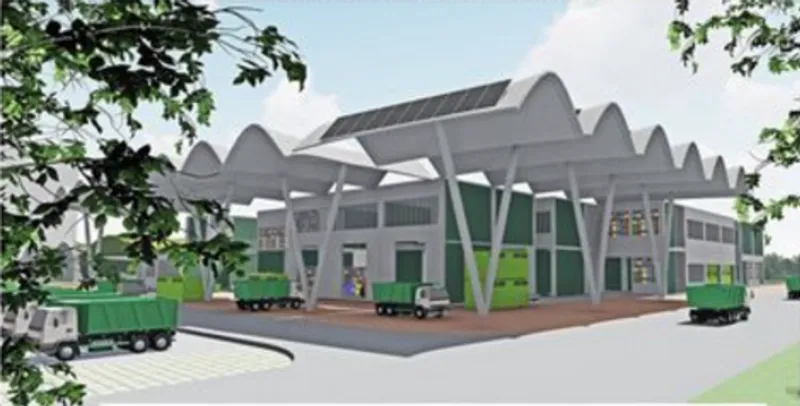
The entrance render gives the project its most memorable piece of structure: a scalloped concrete canopy carried on slender, angled columns, with solar panels laid across its top and green trucks parked beneath leafy branches. The canopy does double duty, shading the vehicle bay while harvesting the energy that powers the waste processing units. It is a modest gesture, but it turns a utilitarian parking area into a threshold with presence.
This is also where the project's collaborative ambitions become visible. Swayam positions itself alongside the government's Swachh Bharat Abhiyan mission, invites entrepreneurs to test new recycling technologies, and offers local residents hands-on workshops. An entrance that welcomes both trucks and people, under the same roof, is a fitting architectural expression of that partnership.
Why This Project Matters
Swayam's strength lies in refusing the usual separation between infrastructure and public life. By distributing Material Recovery Facilities across Nashik and linking them to a central hub that opens its courtyards, walkways and repair yards to visitors, Patil proposes a model in which waste management is something citizens see, understand and contribute to. The decentralised, modular approach also suggests the idea could scale beyond a single plot.
There are questions a fuller development would need to test: how odour control performs at peak loads, and how public and hazardous waste zones are kept safely apart. Yet as a competition proposal, the project makes a persuasive case that a recycling plant can carry civic dignity. In a country facing millions of tons of untreated waste each year, reframing the plant as a neighbourhood landmark may be as important as any piece of sorting equipment.
View the Full Project
About the Designers
Designer: Neha Patil
Enter a Design Competition on uni.xyz
uni.xyz runs architecture and design competitions year-round that reward proposals with spatial conviction and real site intelligence.
Project credits: Swayam – The Wastescape Community by Neha Patil UnIATA '24 (uni.xyz).


Popular Articles
Popular articles from the community


David Ortega Stacks a Two-Story Mexico City Penthouse Around a Steel Stair and a Pergola-Shaded Roof Terrace
In Colonia Roma, a 300 m² penthouse uses oak joinery, a planted steel stair and a slatted roof pergola to make a new-build apartment feel like a house.

Cube Design Draws an Ecological Corridor Between Two Shenzhen Hills with the Nankai Building
Beside Shenzhen's container docks, the Nankai Building pairs stacked balconies with a climbing green screen to connect two hillsides across its height.

graciastudio Turns a Viewless Tijuana Lot Inward Around a Courtyard of Concrete, Timber and Trees
In Tijuana, Jorge Gracia's GA2 House stacks a timber-clad private floor over exposed concrete and replaces a missing view with a planted interior patio.


The Amber Palace Opera: A Geological Fiction Surfaces on Tallinn's Baltic Waterfront
Pierre Brillard reimagines a Baltic legend as a public landscape, opera house, and waterfront promenade rooted in Tallinn's coastal identity.

Similar Reads
You might also enjoy these articles
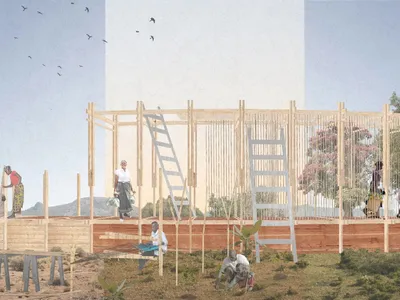
Healing Façade: A Modular Chapel System That Restores Ethiopia's Sacred Forests
Winner of the Eco-Chapel competition, this circular timber façade collects water from air to rebuild soil and reforest degraded Ethiopian landscapes.
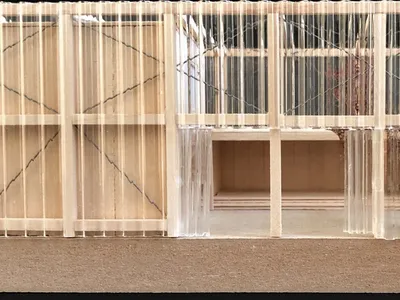
Kaffeebühnen: Where Coffee Shop Architecture Becomes a Civic Stage in Vienna
A linear sequence of timber boxes, transparent shells, and open yards turns the Viennese café tradition into a public performance space.
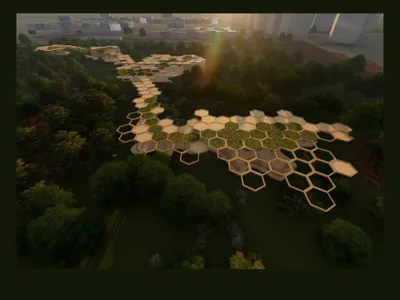
Eco Chapel: A Modular Forest Pavilion That Grows Like the Landscape It Protects
Hexagonal timber modules weave through existing trees, turning a chapel into a living system for prayer, education, and reforestation.


Urban Forest: A Vertical Ecosystem for 5,000 Workers in Singapore's Changi Business Park
Radially stacked pods and layered green decks turn a 7-acre plot into 47 acres of ecological workspace projected for 2040.

Explore Waste Management Competitions
Discover active competitions in this discipline

Challenge to reimagine the Iron Throne

Photograph architecture without architects

Illustrate the lost glory of Angkor Wat - Render Challenge

Design challenge to reuse E-waste
Comments (0)
Please login or sign up to add comments
No comments yet. Be the first to comment!