

SWITCH: A School Organised as a Heterarchy Where Students Leave Their Own Traces
A shortlisted school proposal that treats lockers, niches and courtyards as surfaces students claim, mark and reshape over time.


Most schools are still drawn as a corridor with rooms hung off either side, a diagram that has barely changed in a century. SWITCH starts by refusing that diagram. It borrows a line from Lebbeus Woods, "Design heterarchy of spaces, not hierarchy of space," and builds an entire educational proposal around it. Classrooms lose their monopoly on learning. Terraces, thresholds, courtyards and personal niches take on equal weight, and the building becomes a field of connected spaces rather than a ranked sequence of rooms.
The project was designed by Burak Nergizoğlu and ATAKAN GUNDUZ, both of TOBB University of Economics and Technology. It was shortlisted in School Of Thought 2020. Its central question is how a school can hold individual development and collective learning at the same time without letting one crowd out the other. The designers answer with layered floor plates, evolving courtyards and a cave metaphor that turns students into authors of their own environment.
Dissolving the Corridor: Circulation as Classroom
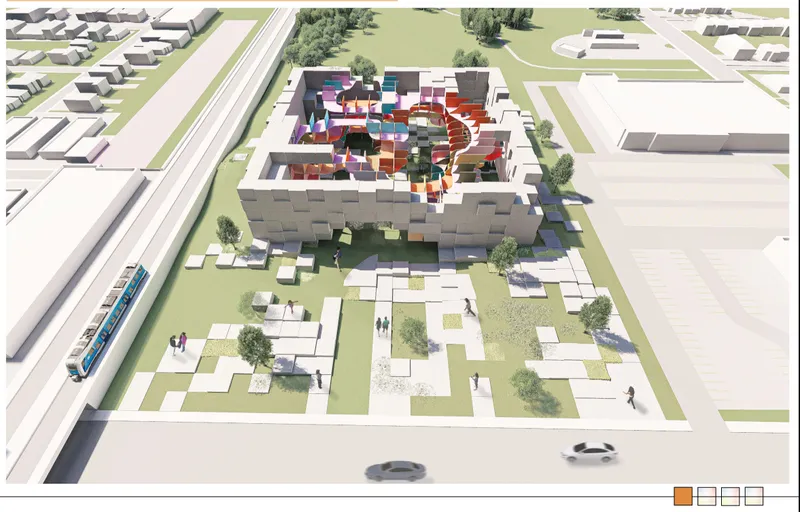
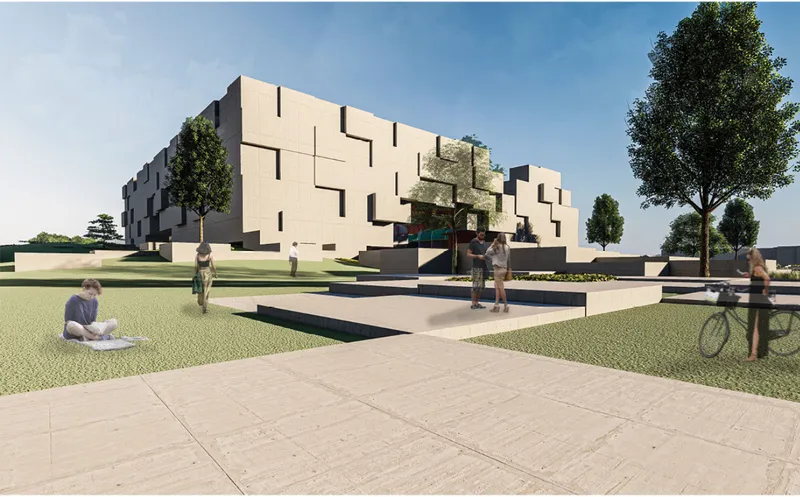
These opening drawings set out the scheme's basic refusal: no repetitive rooms threaded along a corridor. Circulation, transitional zones and terraces are treated as places where learning actually happens, not as the leftover space needed to reach a lesson. That reclassification matters. In a conventional school, roughly a third of the floor area is passage. SWITCH claims that area for teaching and for informal encounters.
The Woods reference does real work here. A heterarchy has no single top or centre, so the plan gives up the hierarchy of principal room, secondary room and service space. Students move between private reflection and group activity without a clear threshold telling them which mode they are in. The architecture, as the designers put it, becomes a framework for interaction rather than a container for instruction.
The Cave Wall Returns as a Bank of Lockers
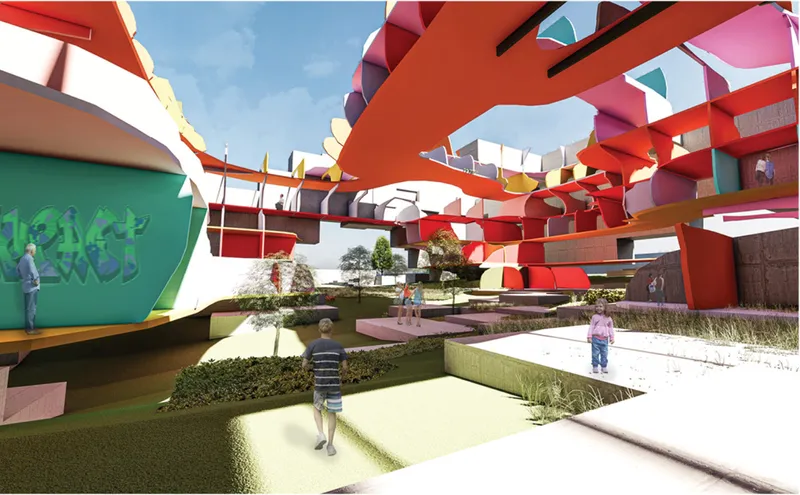
The most original move in SWITCH is its reading of the cave. Caves held some of the earliest recorded human knowledge, kept as markings, symbols and paintings that individuals left on the rock. The designers carry that idea into a school. Lockers, adaptable personal zones and flexible learning niches become the contemporary cave wall: surfaces where students register who they are and pass that on to others.
This shifts the building from a finished object to a living archive. Each student's intervention adds to the collective identity of the school, so the place changes as each cohort replaces the last. It is a modest set of elements, but it accepts something most school design avoids: that students will mark and appropriate space, and that this is worth designing for rather than against.
Private Niches That Face the Crowd
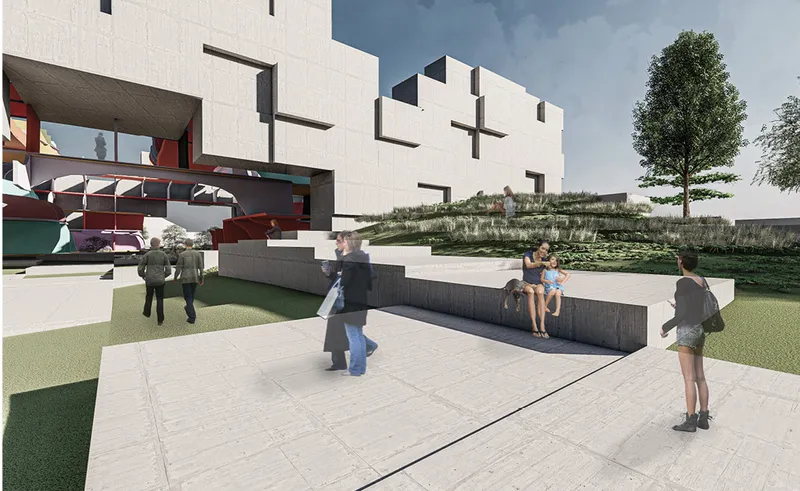

SWITCH relies heavily on lines of sight. Individual learning spaces open onto shared courtyards, so a student working alone stays visually connected to the life of the school. The project describes privacy and interaction as qualities that coexist rather than compete. In practice, the arrangement lets observation become a form of participation: watching others work, rehearse or gather is part of the curriculum the building offers.
This sets SWITCH apart from open-plan schools that give up privacy altogether. Here the niche remains a defined place to retreat to, but it never cuts the student off from the group. The building puts individual development and collective growth side by side, as neighbours.
Ribbon Floor Plates Over an Open Courtyard

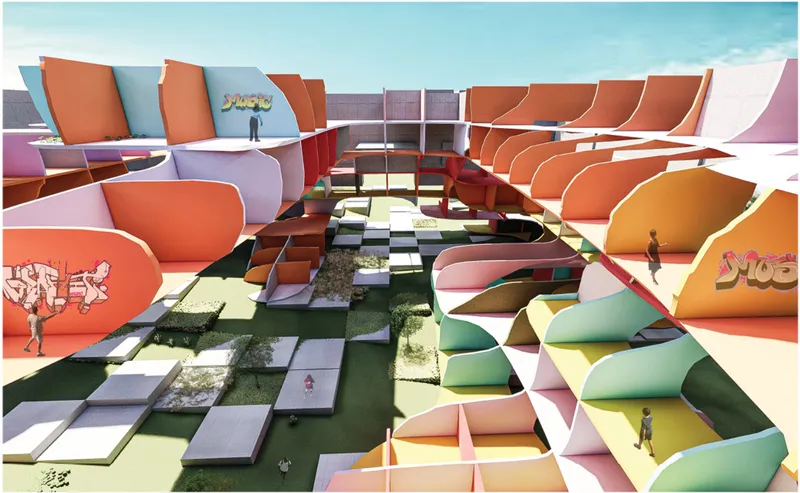
The rendering shows the project's architectural character most clearly. Layered orange and pink floor plates curve like ribbons above a paved courtyard, where people walk and sit under open sky. The courtyards sit at the heart of the scheme as social, visual and educational anchors. They are not gaps between buildings; they are zones where different layers of school activity overlap and spill over.
The stacked plates help explain why. Each level overhangs or steps back from the one below, so the edges become balconies and terraces looking down into the shared ground. Movement through the school turns into a series of vantage points. The colour, warm and assertive, signals that this is a building meant to be used and changed, not quietly maintained.
Why This Project Matters
SWITCH puts forward an argument many school briefs only gesture at: that the building itself can teach, and that students should share authorship of it. By extending Lebbeus Woods' heterarchy into a full spatial organisation, and grounding personal expression in something as ordinary as a locker, the designers turn abstract pedagogy into a set of architectural decisions that could actually be tested.
The cave metaphor is what stays with you. It reminds us that people have always learned by leaving traces and reading the traces of others. A school that makes room for those traces, and keeps them in view across courtyards and terraces, treats education as an accumulation of shared experience rather than the delivery of fixed content. For a student proposal, that is a sharp and well-defended position.
View the Full Project
About the Designers
Designers: Burak Nergizoğlu, ATAKAN GUNDUZ
Enter a Design Competition on uni.xyz
uni.xyz runs architecture and design competitions year-round that reward proposals with spatial conviction and real site intelligence.
Project credits: SWITCH by Burak Nergizoğlu, ATAKAN GUNDUZ School Of Thought 2020 (uni.xyz).


Popular Articles
Popular articles from the community


Opera by the Sea Estonia: Three Shells Dissolving Architecture into Tallinn's Coastline
A winning opera house proposal replaces monumental form with interconnected shells that blur the boundary between building, park and Baltic Sea.
Tsunami Convergenics: Turning Catastrophic Ocean Forces into Underwater Housing Infrastructure
A speculative underwater settlement off the coast of Onagawa, Japan, treats tsunamis and typhoons as energy sources rather than threats.

Singing Woman: An Opera House That Performs Before the Curtain Rises
Ovidiu Cristian Pavel's conceptual opera house translates Estonia's choral identity into a sculpted waterfront landmark facing the Baltic Sea.

Faces of the Soviet Avant-Garde: Turning Moscow's Street Names into an Open-Air Museum
A network of sculptural installations across a Moscow residential district transforms forgotten architect names into spatial encounters with cultural memor

Similar Reads
You might also enjoy these articles

Healing Façade: A Modular Chapel System That Restores Ethiopia's Sacred Forests
Winner of the Eco-Chapel competition, this circular timber façade collects water from air to rebuild soil and reforest degraded Ethiopian landscapes.
Kaffeebühnen: Where Coffee Shop Architecture Becomes a Civic Stage in Vienna
A linear sequence of timber boxes, transparent shells, and open yards turns the Viennese café tradition into a public performance space.
Eco Chapel: A Modular Forest Pavilion That Grows Like the Landscape It Protects
Hexagonal timber modules weave through existing trees, turning a chapel into a living system for prayer, education, and reforestation.


Urban Forest: A Vertical Ecosystem for 5,000 Workers in Singapore's Changi Business Park
Radially stacked pods and layered green decks turn a 7-acre plot into 47 acres of ecological workspace projected for 2040.


Comments (0)
Please login or sign up to add comments
No comments yet. Be the first to comment!