
How Much Is a Like Worth: A Vertical Prison That Trades Cells for Collaboration
Inspired by Piranesi's grotesque engravings and office tower typologies, this high-rise prison replaces isolation with transparency and shared workspaces.


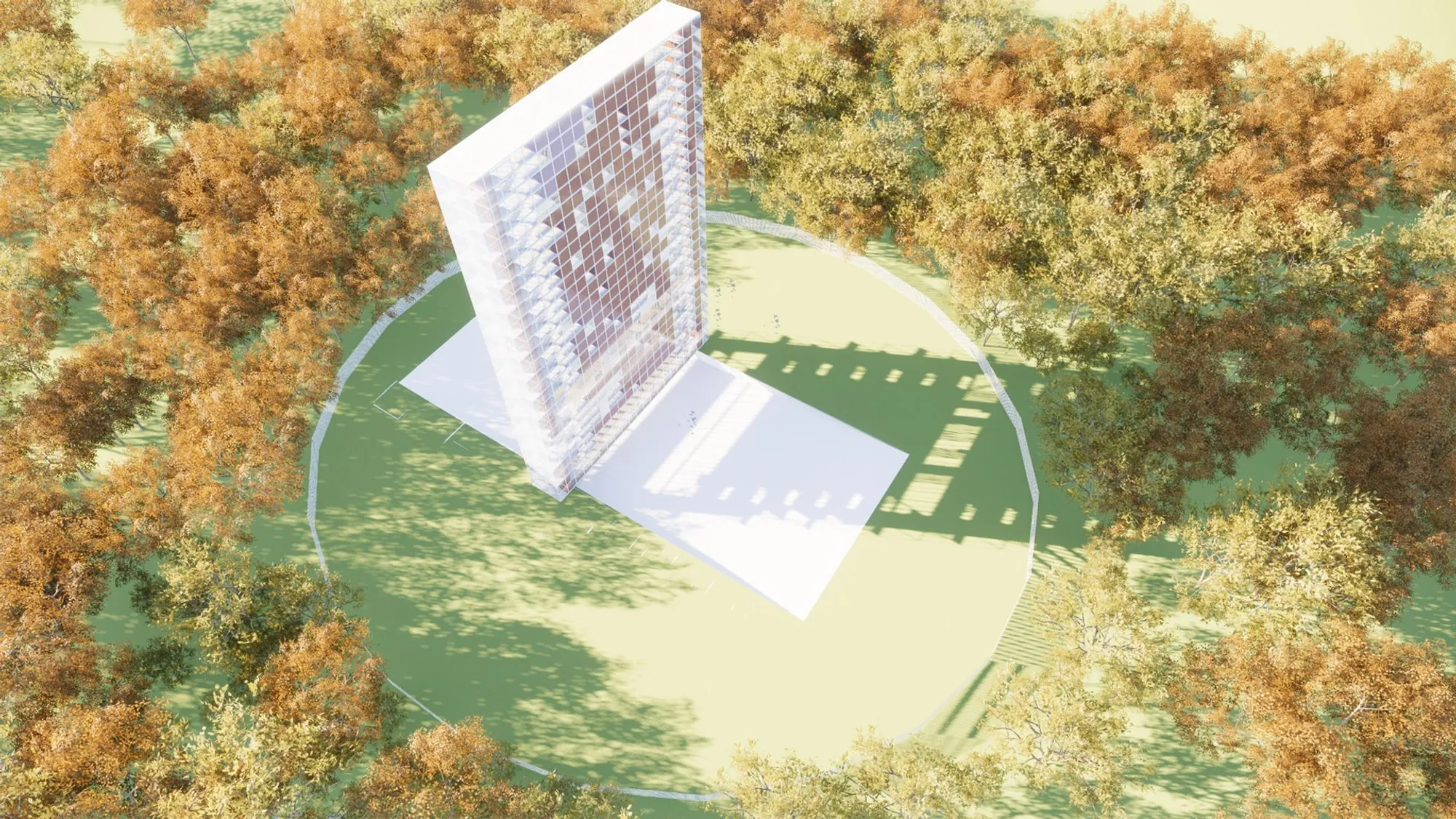
What if a prison looked less like a bunker and more like the office building you commute to every morning? That provocation sits at the center of "How Much Is a Like Worth?", a project that recasts the correctional facility as a slender glass tower, its chequered facade rising above a grove of autumn trees. Instead of sprawling wings that sort inmates by offense, the design stacks communal workspaces, open cells, and outdoor terraces into a single vertical volume, arguing that rehabilitation happens when architecture stops treating confinement as its only purpose.
Designed by Pablo Allen, this shortlisted entry for the Switching Prisons competition takes its conceptual cue from Piranesi's engravings of grotesque, airless prison interiors. Allen sees those spaces not as inherently hopeless but as intriguing volumes waiting for new ways of receiving light and communication with the outside world. The result is a tower that inverts nearly every convention of correctional architecture: minimal ground contact, maximum transparency, and a building core that functions as an eye in the sky.
A Glass Tower in a Circular Clearing
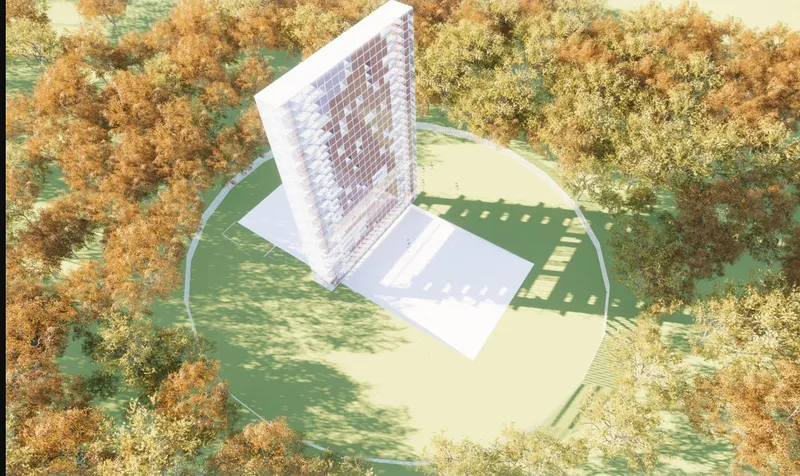
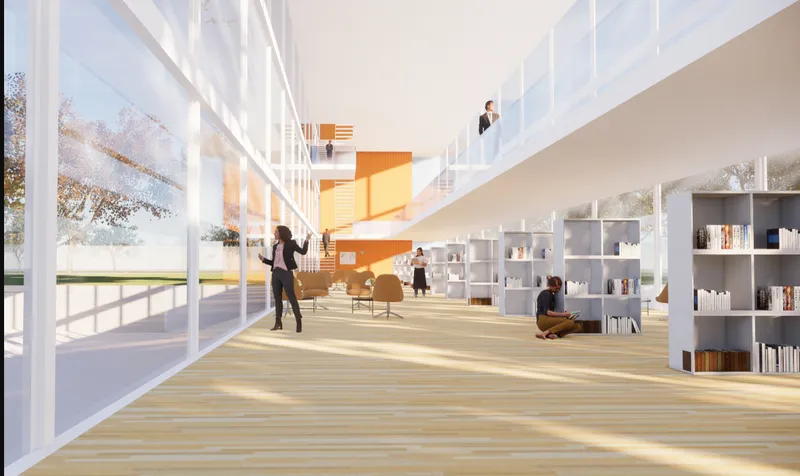
Seen from above, the tower sits within a precise circular clearing ringed by dense autumn trees, a landscape strategy that doubles as a soft security perimeter. The slender proportions and gridded facade read more like a research institute than a place of incarceration. That is deliberate. Allen draws a direct analogy to office buildings where individuals enter, leave, and perform structured tasks collectively. Inside, the double-height spaces are finished in light wood flooring and white shelving, bathed in natural light. People work at tables and along counters, an image that could be mistaken for a coworking space if not for the context.
Stacking Program: Terraces, Libraries, and Cafeterias
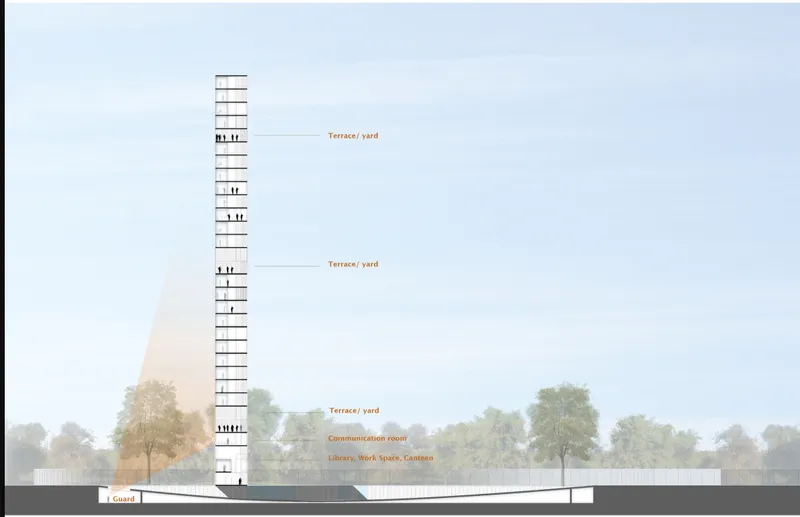
The section drawing reveals how the tower organizes its program vertically. Ground-floor spaces house a library and cafeteria, public-facing functions that anchor the building to its site. Upper levels alternate between modular cell floors and collaborative workspaces, punctuated by outdoor terraces that serve as controlled yards. Smoking balconies are integrated near shower and toilet modules on each floor, a small but significant gesture toward humane living conditions and regulated access to fresh air.
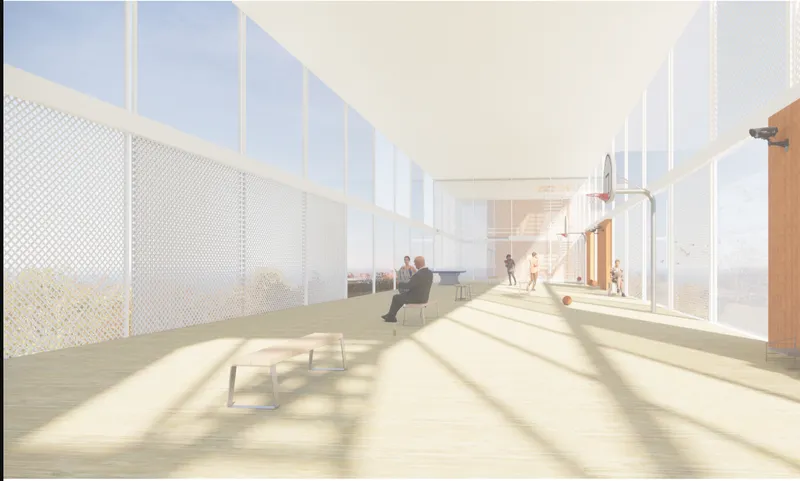
The interior lounge captured in afternoon light demonstrates how the building performs spatially. A perforated metal screen filters harsh sun into diagonal shadow patterns across the floor, while full-height glazing keeps the surrounding landscape always visible. Security is embedded in the architecture itself: fixed windows prevent escape while maximizing daylight, and two stair hubs with elevators maintain secure vertical circulation. The open-cell layout replaces segregated, closed rooms with a transparent system where continuous observation flows from the building core outward.
A Facade That Announces Accountability
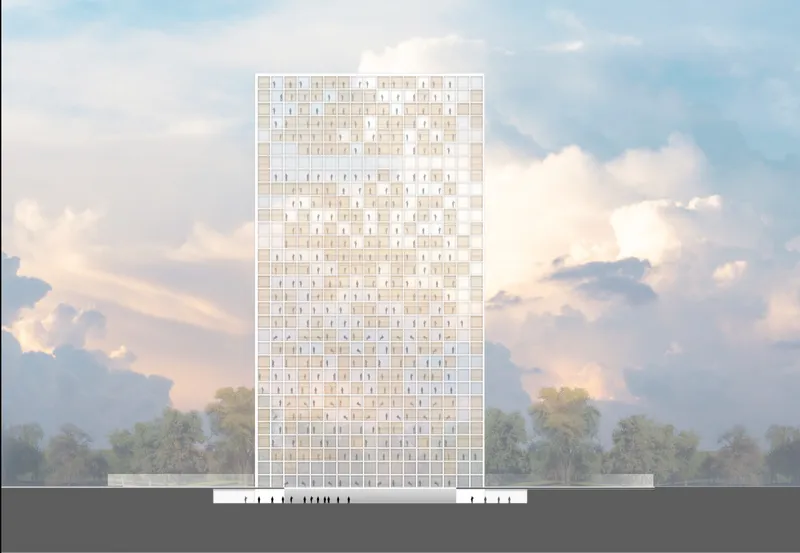
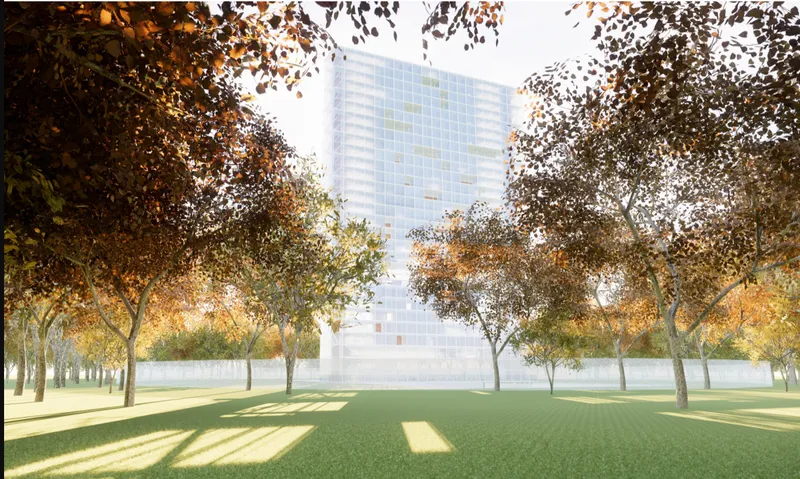
The elevation drawing isolates the tower's most striking formal decision: a chequered facade pattern that rises above the tree canopy against an overcast sky. The pattern is not decorative. It registers the alternation between opaque and transparent panels, encoding the building's negotiation between visibility and privacy at the scale of the skin. From a distance, glimpsed through the grove of autumn trees casting long morning shadows across the lawn, the tower reads as luminous and lightweight, its glass surfaces reflecting the surrounding foliage rather than projecting the heaviness typically associated with correctional architecture.
Site Logic: Containment Without Walls
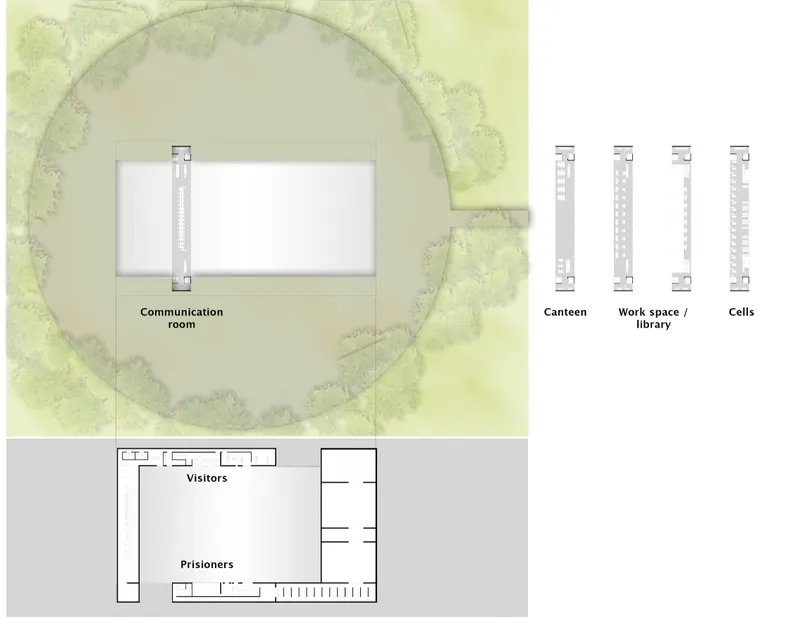
The site plan clarifies the broader organizational logic. The circular tower occupies the center of a cleared zone surrounded by dense planting, while adjacent linear structures house the canteen and additional cell blocks. The minimal ground contact of the main building reduces the perimeter that requires active surveillance, concentrating security resources at the two vertical cores. Traditional prison typologies spread risk across vast horizontal footprints with multiple wings; Allen's scheme compresses it into a single controlled volume, relying on form rather than fences.
Why This Project Matters
Allen's proposal does not pretend that a glass tower solves the systemic failures of incarceration. What it does, forcefully, is demonstrate that the spatial typology of the prison is not fixed. By borrowing the organizational logic of the office building, the material language of contemporary workplace design, and the landscape strategy of a campus rather than a compound, the project opens a credible conversation about what correctional architecture could become when rehabilitation is treated as a spatial problem rather than a policy afterthought.
The strongest move here is the refusal to differentiate. Traditional prisons classify and separate; this tower gathers. For inmates convicted of similar offenses, Allen argues, a vertical solution eliminates unnecessary differentiation, replacing it with shared routines, shared light, and shared accountability. Whether or not the tower is buildable at this level of transparency, the argument it makes about collective living under constraint is worth taking seriously.
View the Full Project
About the Designers
Designer: Pablo Allen
Enter a Design Competition on uni.xyz
uni.xyz runs architecture and design competitions year-round that reward proposals with spatial conviction and real site intelligence.
Project credits: How much is a "like" worth? by Pablo Allen Switching Prisons (uni.xyz).



Popular Articles
Popular articles from the community


Co-life: Sustainable Architecture for Age-Friendly Community Living
Co-life reimagines sustainable architecture for seniors through courtyards, rammed earth, shared gardens, and spaces designed for belonging.

The Musturak Paradise: Senior Living Architecture for a Connected Future in Temara, Morocco
The Musturak Paradise reimagines senior living architecture in Temara via private homes, social spaces, culture, community, and shared care.

Co-Life: Senior Housing Design That Reconnects Older Adults With the City
Co-Life reimagines senior housing design through healing gardens, shared streets, workshops, and a sustainable community across generations.

Conexión: Biophilic Design Reimagines High-Rise Living in Hong Kong
Conexión reimagines high-rise living in Hong Kong through biophilic design, green facades, shared spaces, daylight, water and nature within.
Similar Reads
You might also enjoy these articles

Day and Night Park: A Time-Based Urban Newsstand in Beijing
A temporary urban newsstand in Beijing blending travel, light, and reading through poetic colors, compact form, and community-focused design.

Modernist Patio Renovation in El Masnou, Barcelona by Oliver Segura Arquitectura + Cebrià Arquitectura
Modernist patio renovation blending tradition and innovation with a movable pool, leveled floors, and Catalan materials in El Masnou.

Alto Residencial Coop: Cooperative Housing Development in Santiago de Compostela by Carbajo Barrios Arquitectos
A linear cooperative housing complex blending white volumes and perforated metal façades, enhancing community living, natural light, privacy, and urban integration.

Vil Genis School by BPA ARCHITECTURE – Massy, France
Vil Genis School in Massy, France, features sustainable design, south-facing classrooms, community integration, accessible spaces, and modern educational architecture.


Comments (0)
Please login or sign up to add comments
No comments yet. Be the first to comment!