
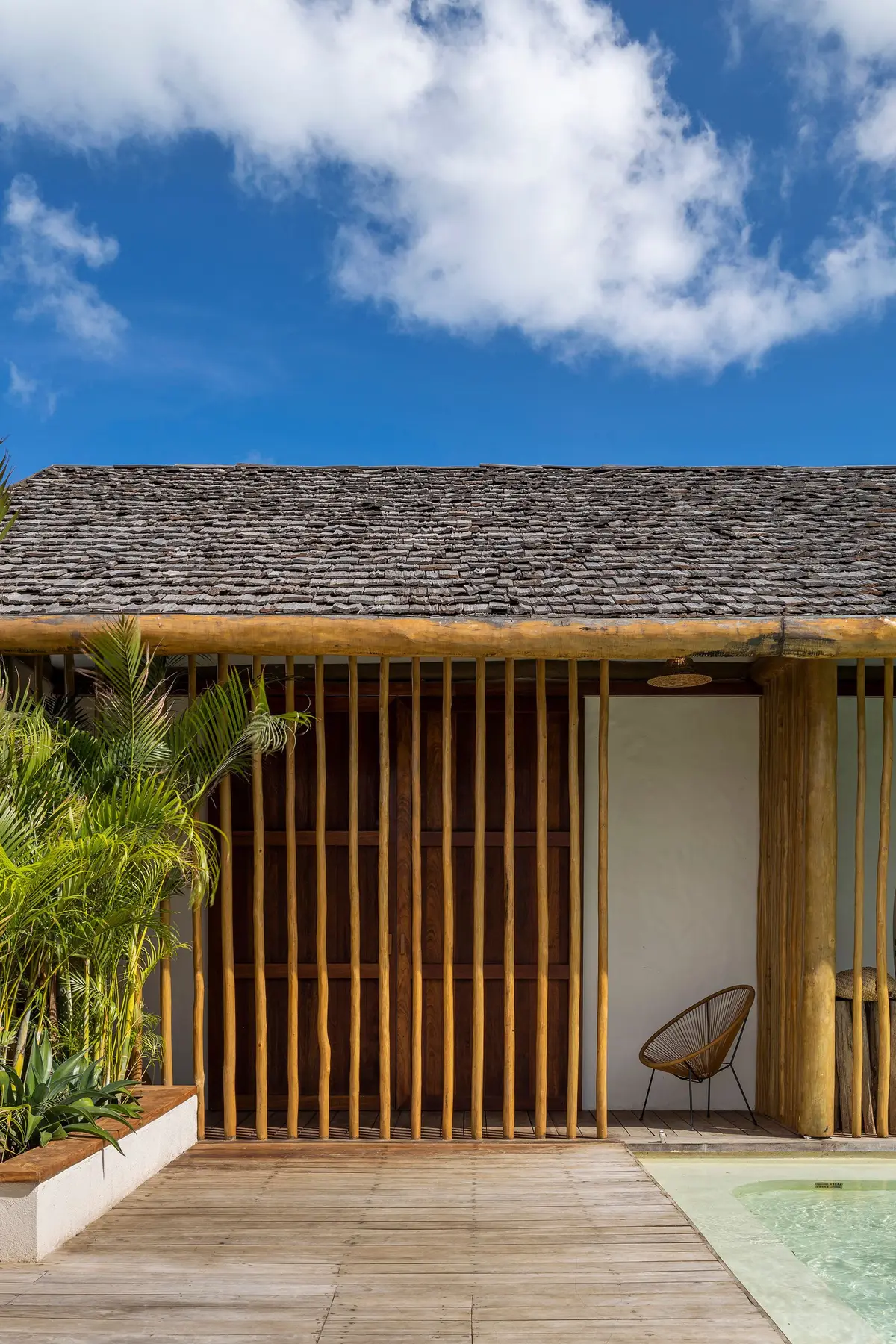
Tadu Arquitetura Transforms a Jericoacoara Nightlife Landmark into a 33-Room Coastal Hotel
Café Jeri Hotel channels the rustic construction traditions of Brazil's northeastern coast into a layered retreat between dunes and sea.


Jericoacoara began as a fishing village wedged between sand dunes on the coast of Ceará. Over the past two decades it has become one of Brazil's most magnetic beach destinations, and Café Jeri has been central to that transformation, operating as a nightlife and entertainment anchor long before it added rooms. When Tadu Arquitetura, led by João Duayer, took on the commission to expand and renovate the complex into a full hotel, the core question was not how to impose a resort aesthetic on a party venue but how to borrow the material intelligence of the northeastern coast and give 33 rooms, a rooftop bar, and a two-level pool the feeling of something that grew from the sand rather than being dropped onto it.
The result is a project that operates on two registers simultaneously. By day it functions as a quiet, shade-driven retreat organized around a curved pool, garden paths, and private verandas. By evening, the rooftop takes over, with tiered concrete seating, a mirrored disco ball catching the last light, and twin bars that serve the crowd through sunset and beyond. What holds both identities together is a consistent material language: Cariri stone underfoot, vertical timber screens filtering light and breeze, bamboo ceilings overhead, and a palette of sand, earth, and the occasional burst of yellow or pink at the bar fronts.
Timber Screens as Climate and Identity
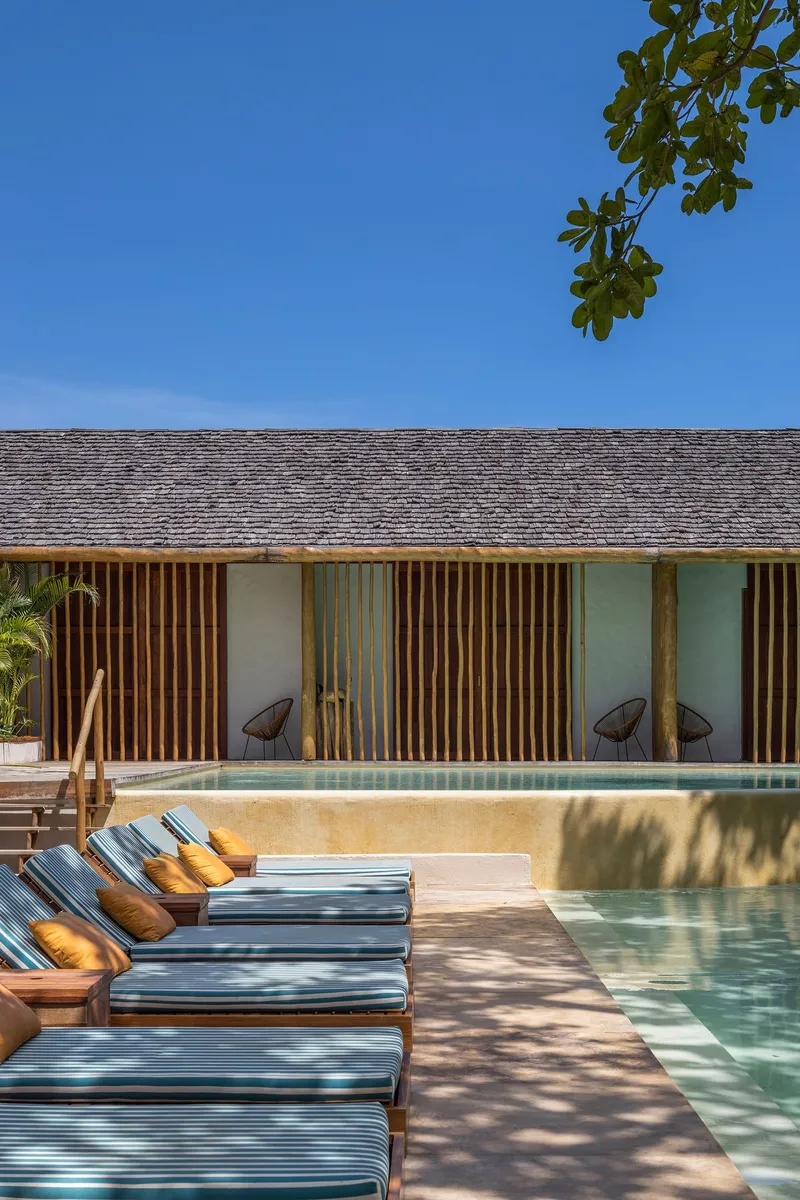
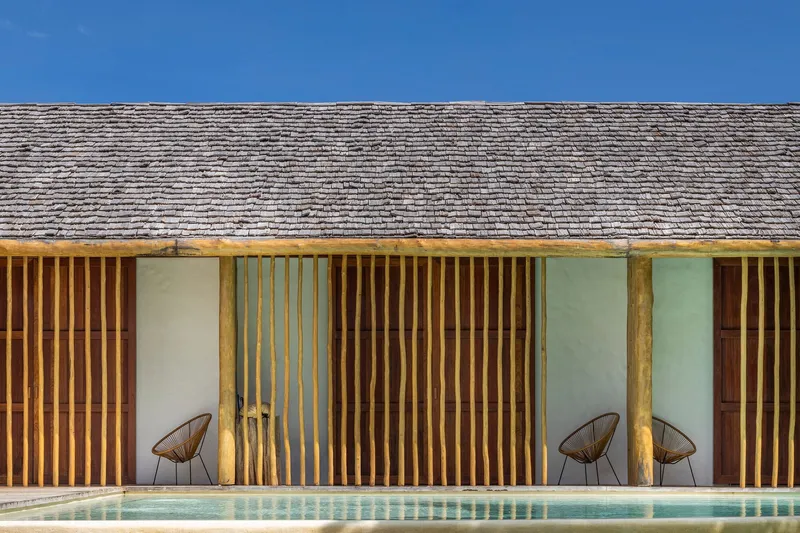

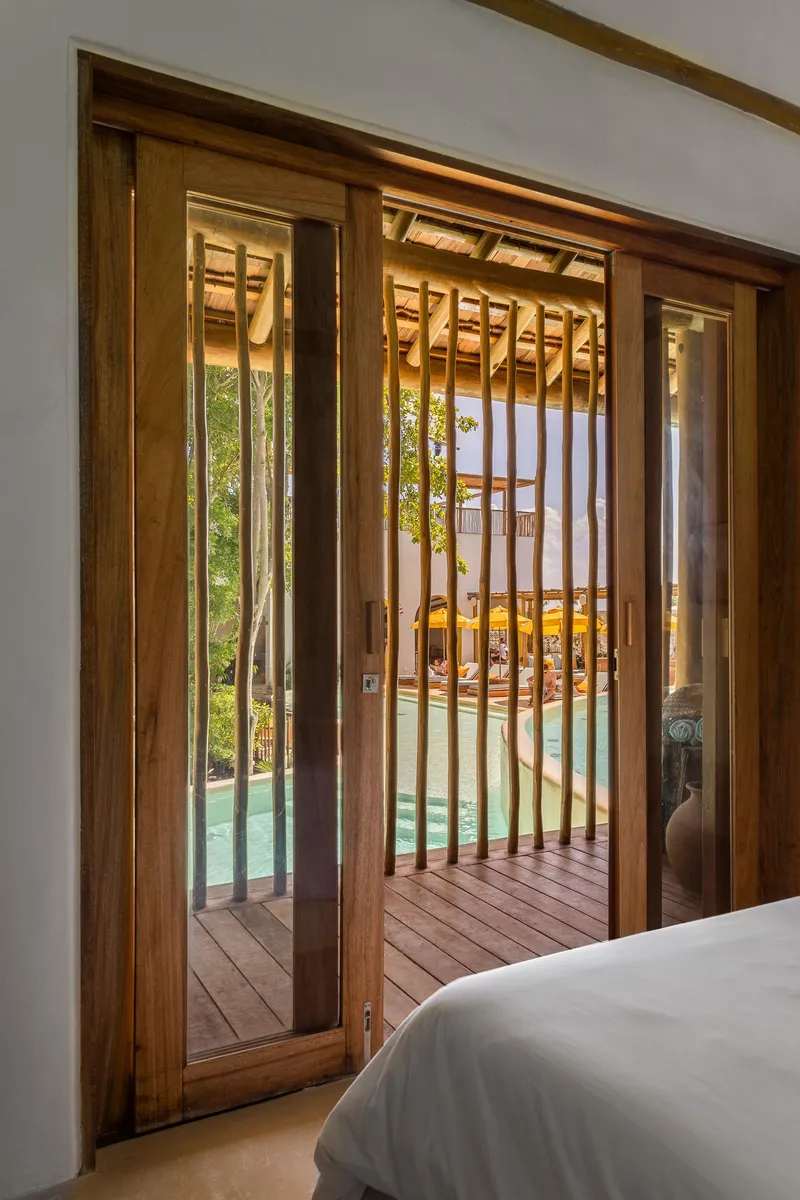
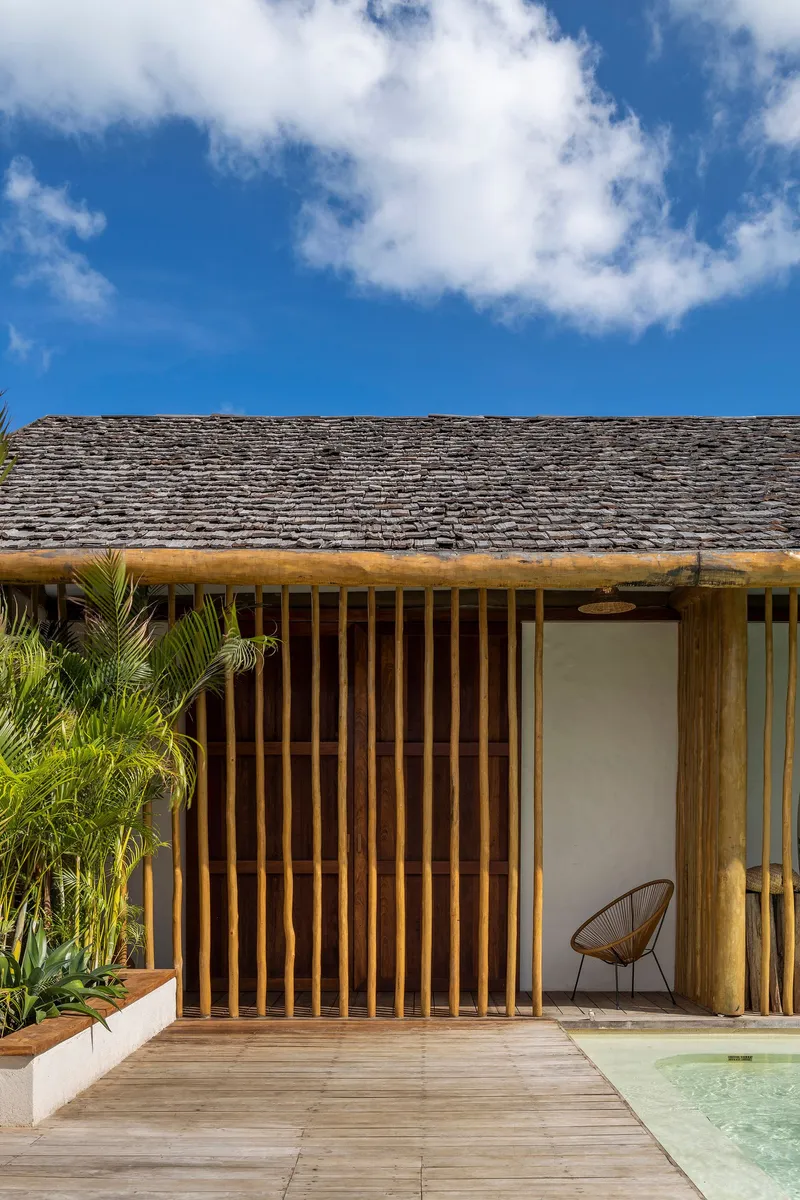
The most recognizable element across the hotel is the vertical timber louver system that wraps the poolside pavilion and punctuates the stucco facades. Built by Carpinteria Madeira Inteligente, the screens are not decorative appliqué. They mediate Jericoacoara's semi-arid sun while channeling the sea breeze that makes the climate bearable. Sliding panels allow individual rooms to open fully to the pool deck or close down for privacy, giving guests direct control over exposure.
Alternating between the timber slats and white stucco bays beneath weathered shingle roofing, the facades read as a contemporary interpretation of the region's vernacular fishing shelters. The palette stays restrained: no painted timber, no bright cladding. The wood will silver over time, the stucco will chalk, and the whole composition will settle deeper into the dune landscape it sits within.
The Curved Pool and Its Two Registers
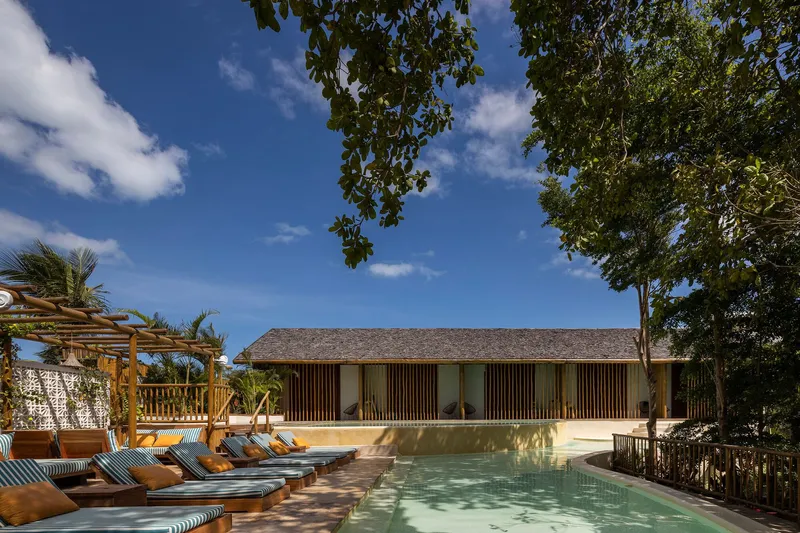
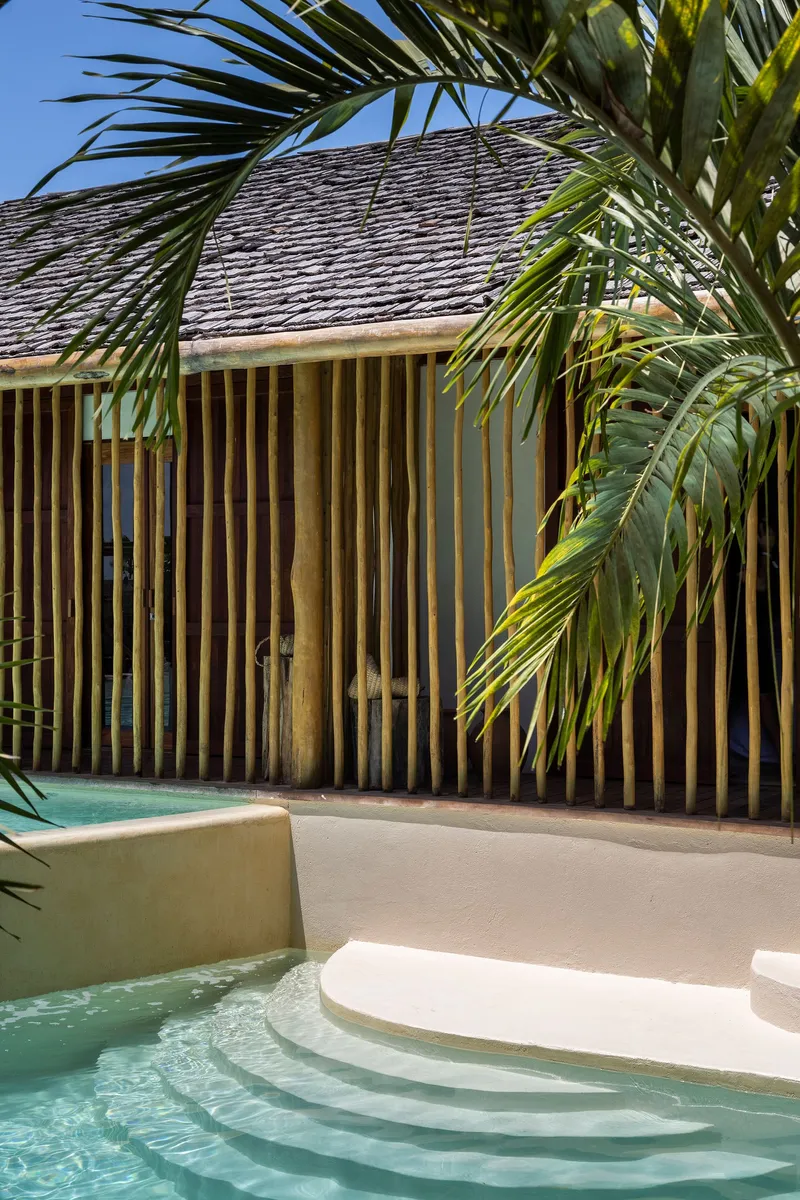
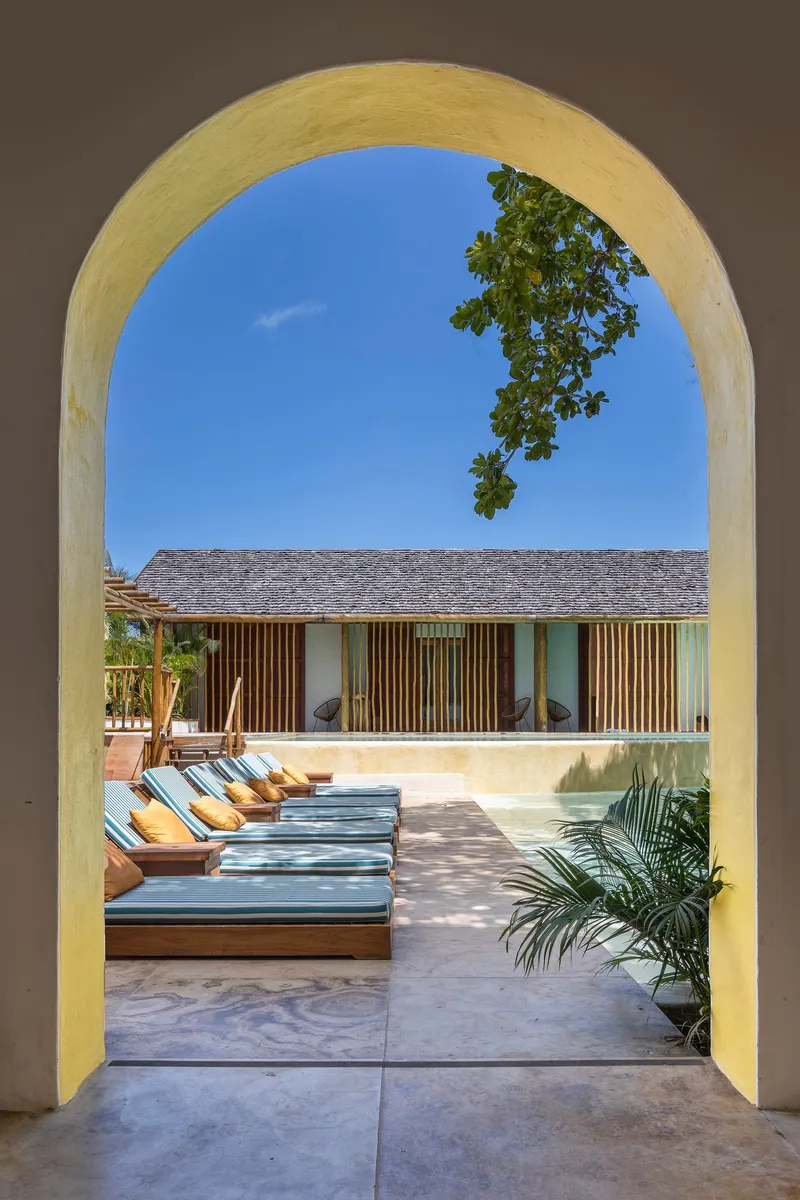
The pool is not a simple rectangle but a curved, two-level basin that splits the experience between full sun and deep shade. A pumped waterfall connects the upper level to the lower, generating constant movement and ambient sound. Striped loungers line the sun deck while pergolas and the covered pavilion shelter those who prefer dappled light. It is a smart climate diagram disguised as leisure infrastructure.
The yellow-plastered archway visible from the bar side frames a cinematic view through to the slatted pavilion, a threshold between the social zone and the water. That kind of careful framing, arch into screen into sky, recurs throughout the project. Duayer treats circulation not as corridor but as a sequence of composed moments.
Garden Paths and Layered Privacy
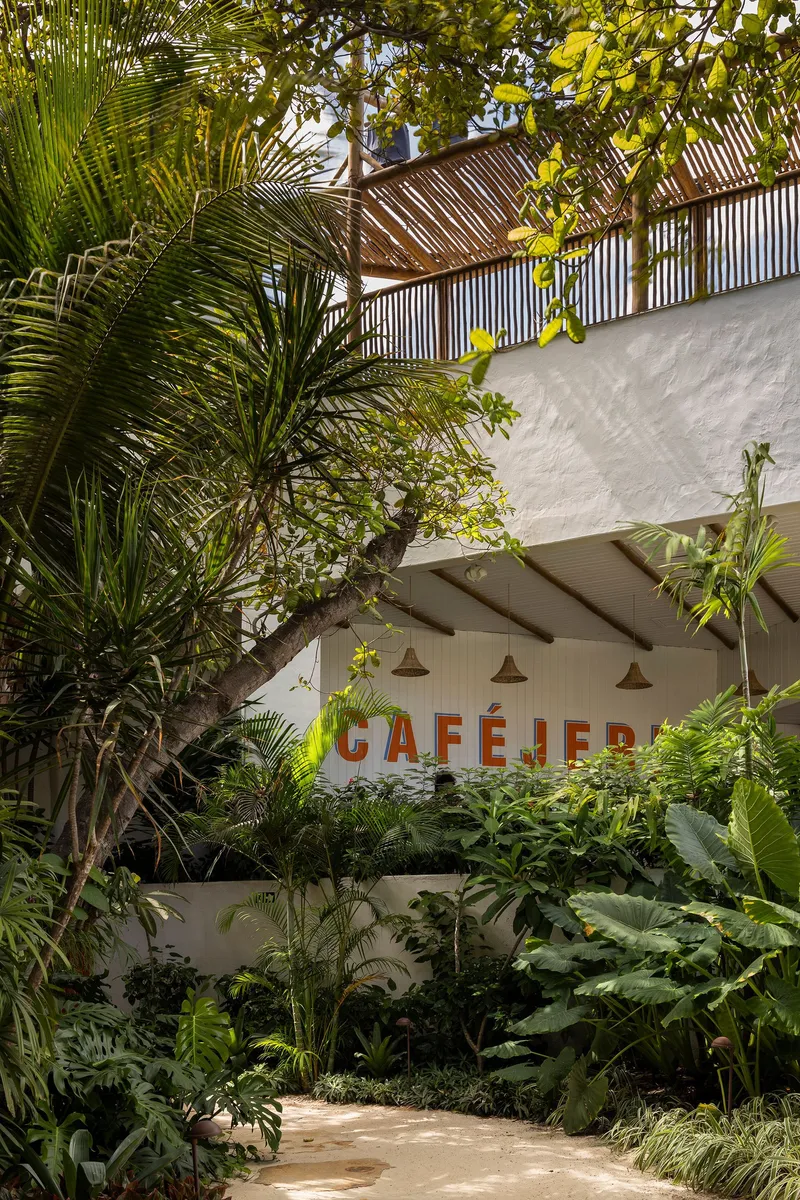
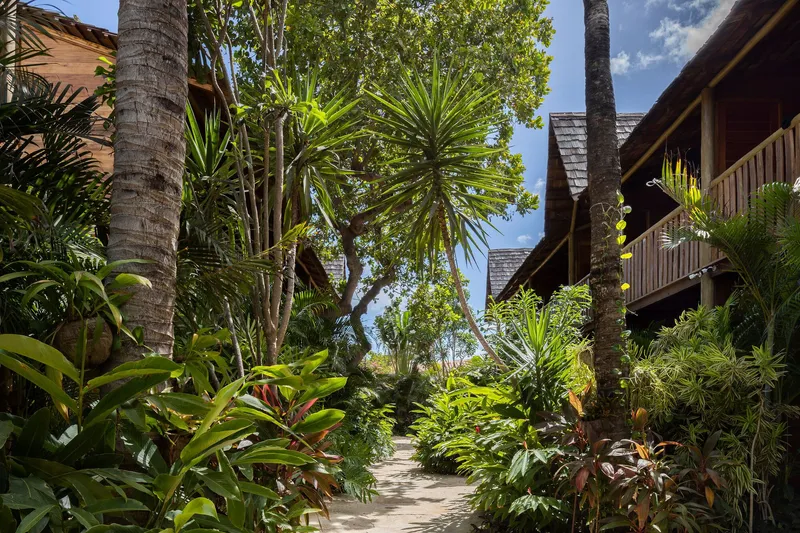
Not all rooms face the pool. A second sector of accommodations is spread over two floors along a garden organized by landscape architect Felipe Nassar. A central path branches into verandas shaded by tropical species, creating a quieter counterpoint to the poolside energy. The planting is dense enough to feel wild but clearly managed: palms, broad-leaf tropicals, and ground cover layered to create a green tunnel effect.
From the bedroom interiors, sliding timber doors open to private decks that either face the pool directly or look into the garden canopy. Exposed timber rafters overhead and Cariri stone on the floor keep the material language consistent. The rooms are simple, almost monastic in their restraint, which lets the light, the breeze, and the vegetation do the work.
Bars in Stripes and Bamboo
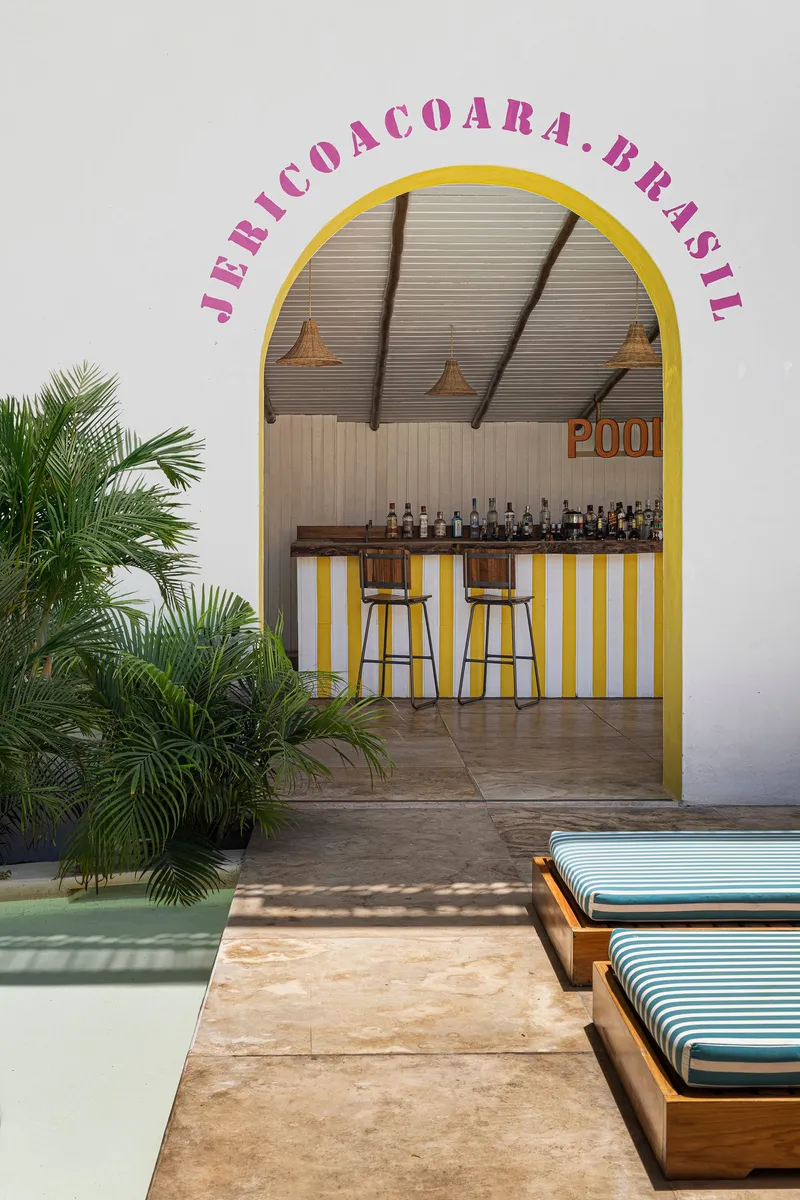
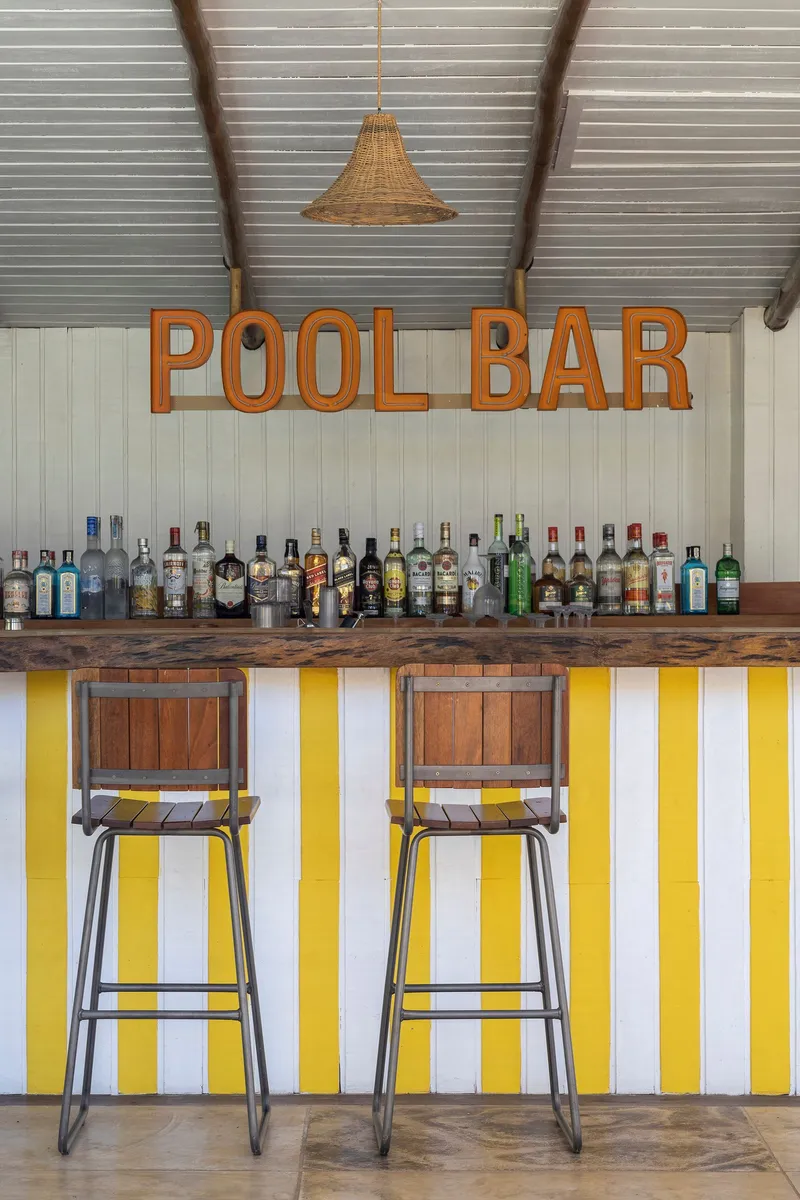
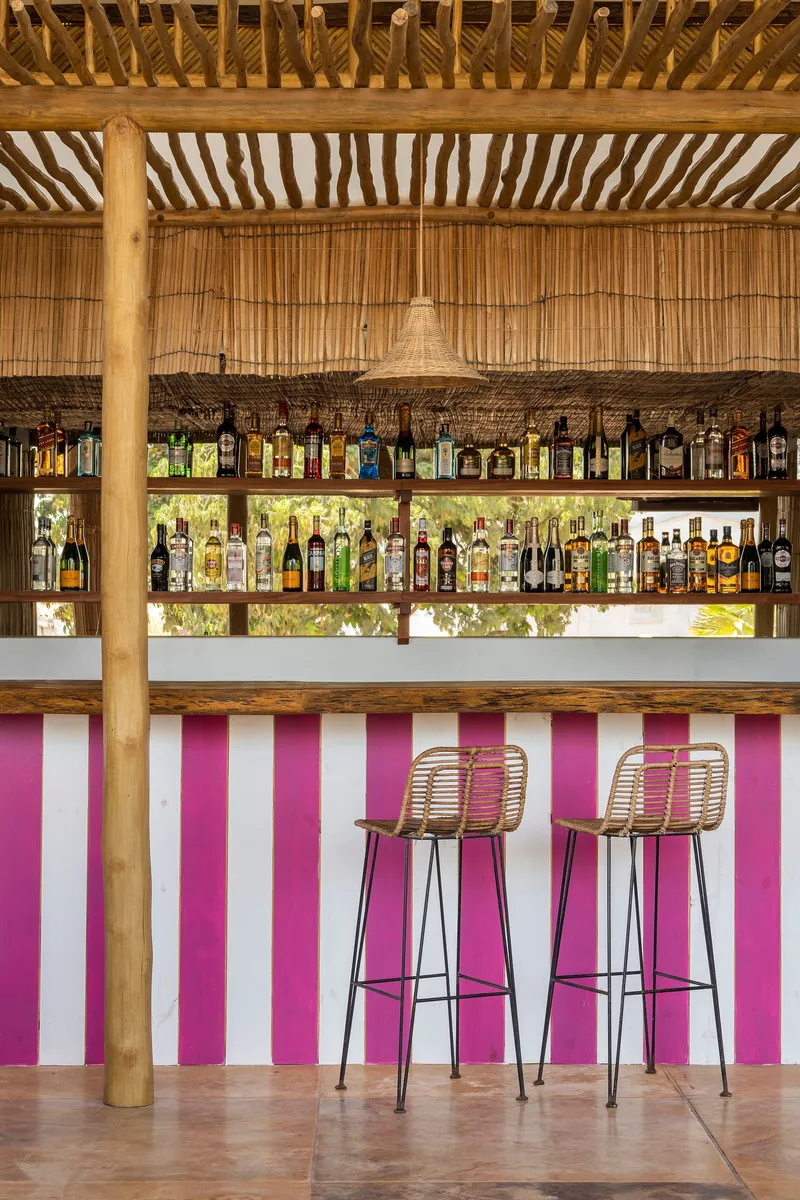
The hotel retains Café Jeri's identity as an entertainment venue, and the bar areas are where personality overrides restraint. Striped counter panels in pink and white or yellow and white inject playfulness against the neutral backdrop. Woven pendant lights hang from bamboo ceilings, and the exposed timber structure overhead stays raw and unfinished. The effect is festive without being garish.
The central covered lounge, anchored by the hotel bar, is programmed to shift throughout the day: morning coffee, afternoon shade, evening cocktails. It is the hinge between the pool sector and the garden rooms, a social attractor that keeps the ground floor active without forcing anyone into it.
The Rooftop as Event Architecture
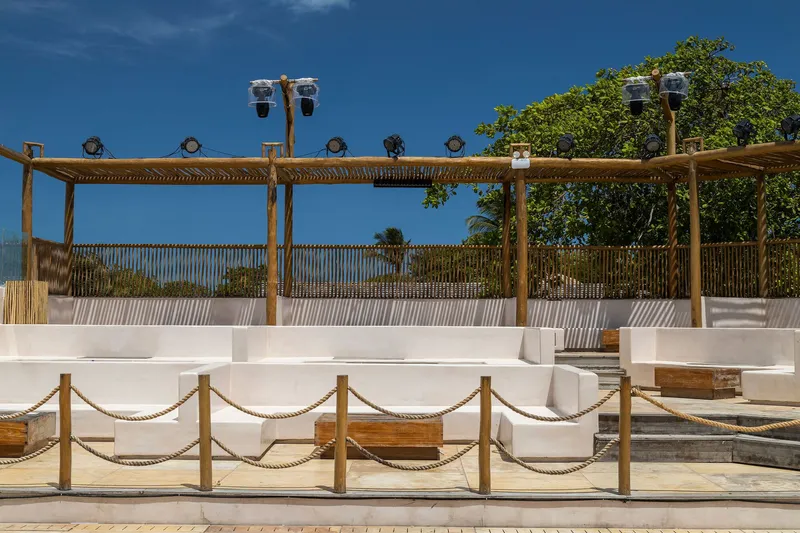
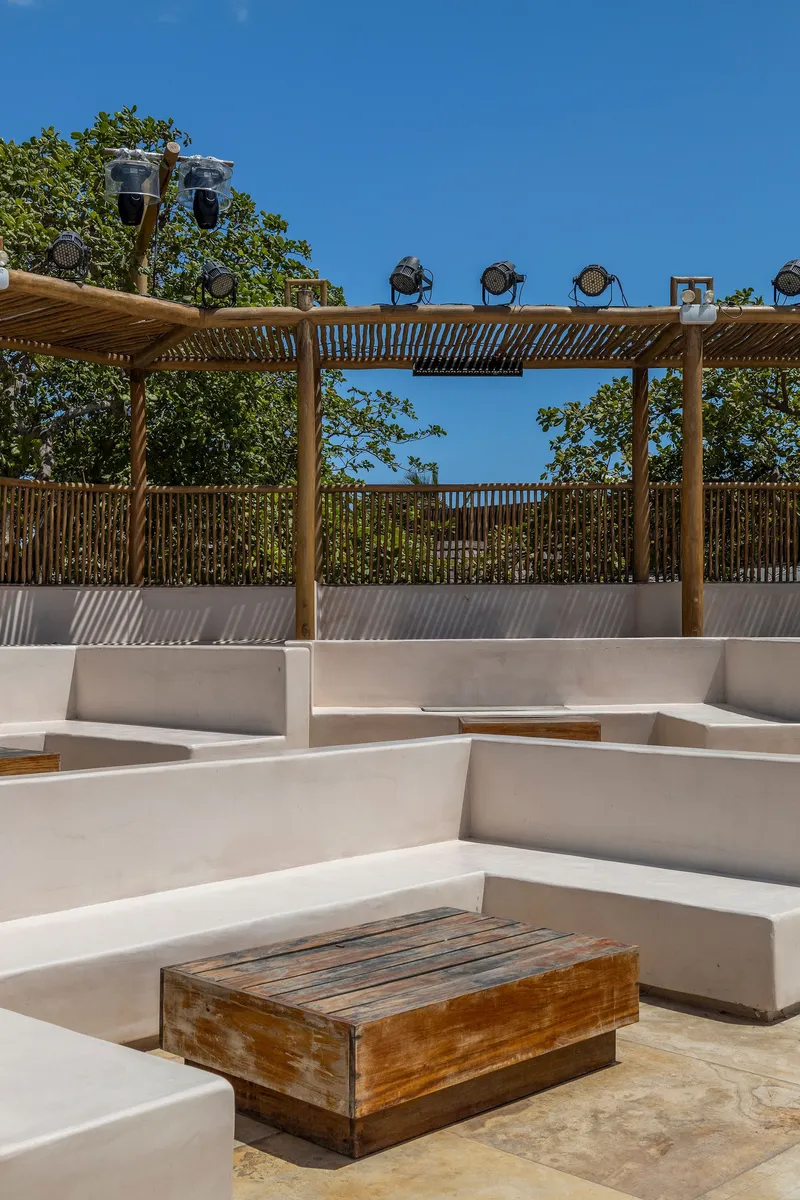

The rooftop, accessible only to hotel guests, is where the project tips into spectacle. Tiered white concrete seating with rope railings steps down toward the ocean, creating an amphitheater for sunset viewing that doubles as a party venue. Two linear bars, one public and one VIP, run along the edges. A mirrored disco ball and theatrical lighting fixtures hang from the timber pergola, making the transition from golden hour to nightlife seamless.
Reclaimed timber tables and bamboo screen backdrops ground the space in the same material vocabulary as the rest of the hotel, even as the programmatic ambition shifts to something louder. It is a clever trick: the architecture never breaks character even when the function demands a completely different mood. Speakers are integrated into the slatted bar counter rather than mounted conspicuously, a small detail that reveals a design team thinking about how a building sounds as well as how it looks.
Reception and the Bamboo Ceiling
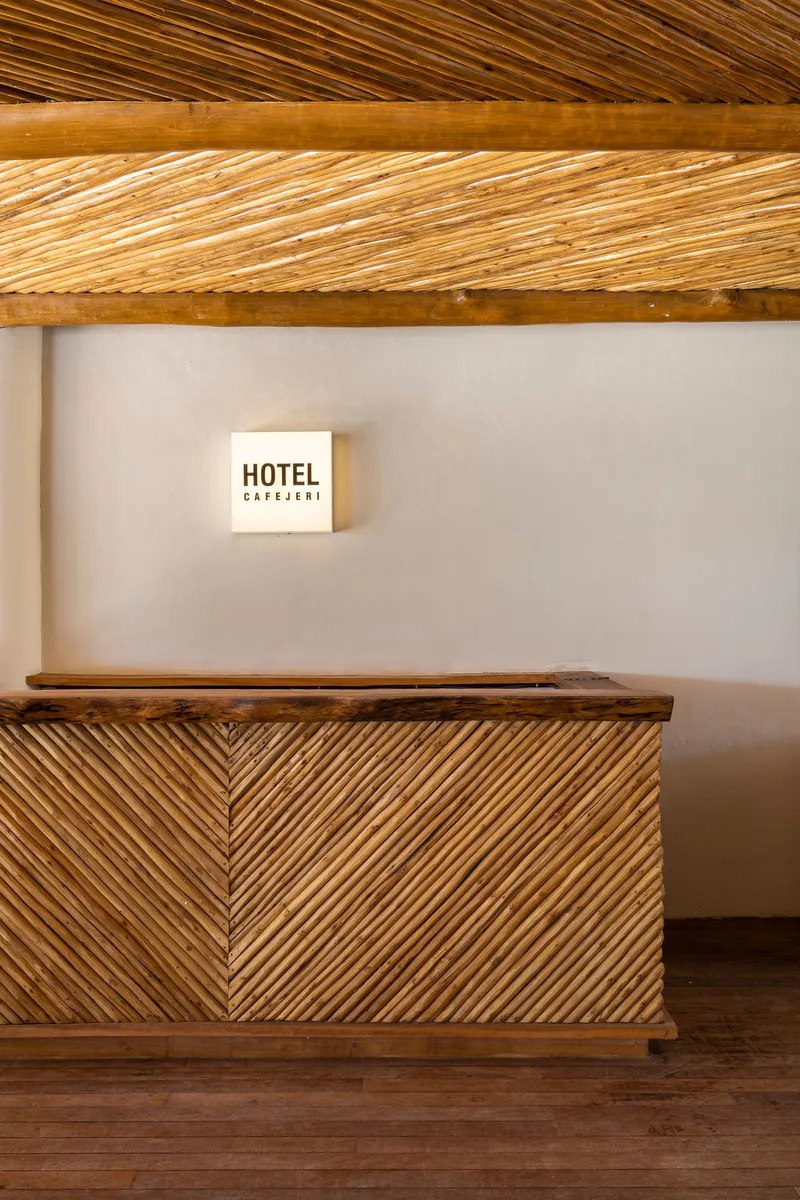

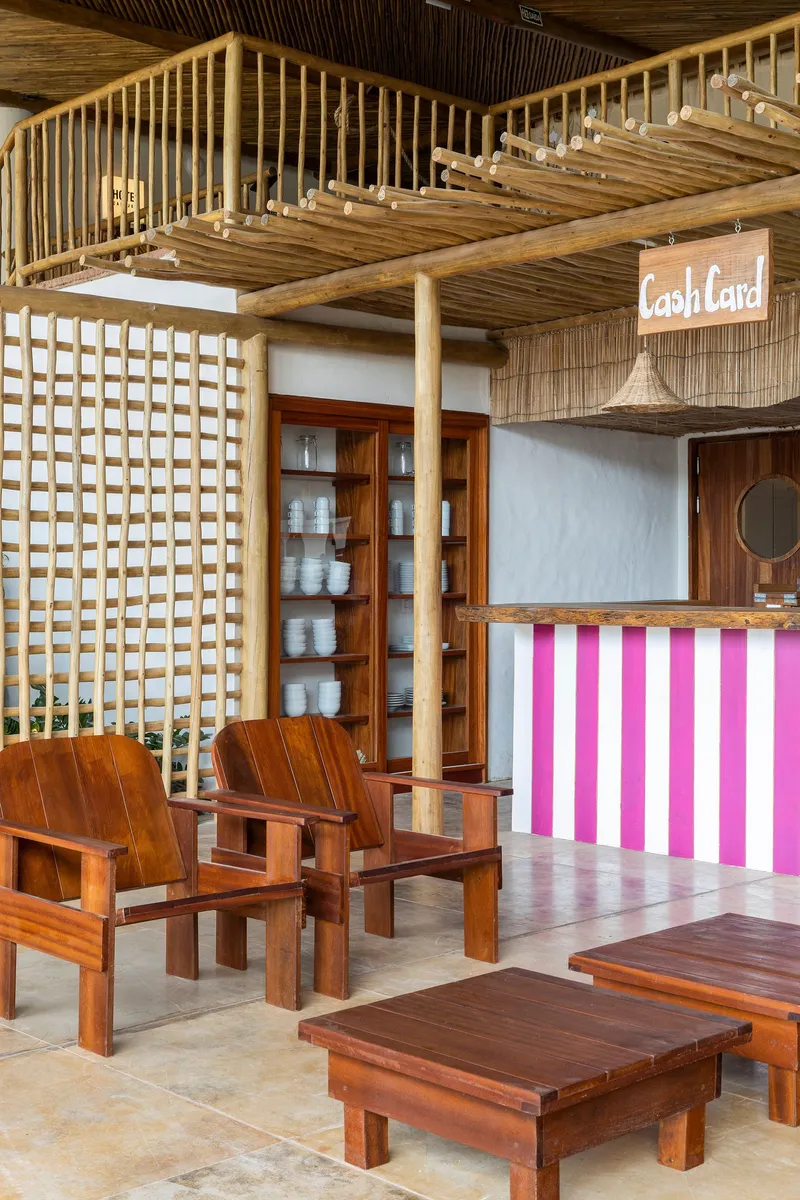
The reception desk, clad in herringbone bamboo panels beneath a diagonal slatted timber ceiling, sets the material tone from the moment of arrival. It is a compact, tightly detailed space that communicates craft without monumentality. The diagonal ceiling pattern recurs in doorway framing and terrace overhangs, generating visual rhythm across otherwise straightforward volumes.
Lattice screen walls, visible in the interior seating areas, continue the louver logic indoors, filtering light and allowing cross-ventilation. Climate design consultant Torus Engenharia worked alongside the architecture team, and the passive strategies are legible everywhere: openings aligned with prevailing breezes, shade structures scaled to solar angles, and planted buffers reducing heat gain at ground level.
Plans and Drawings
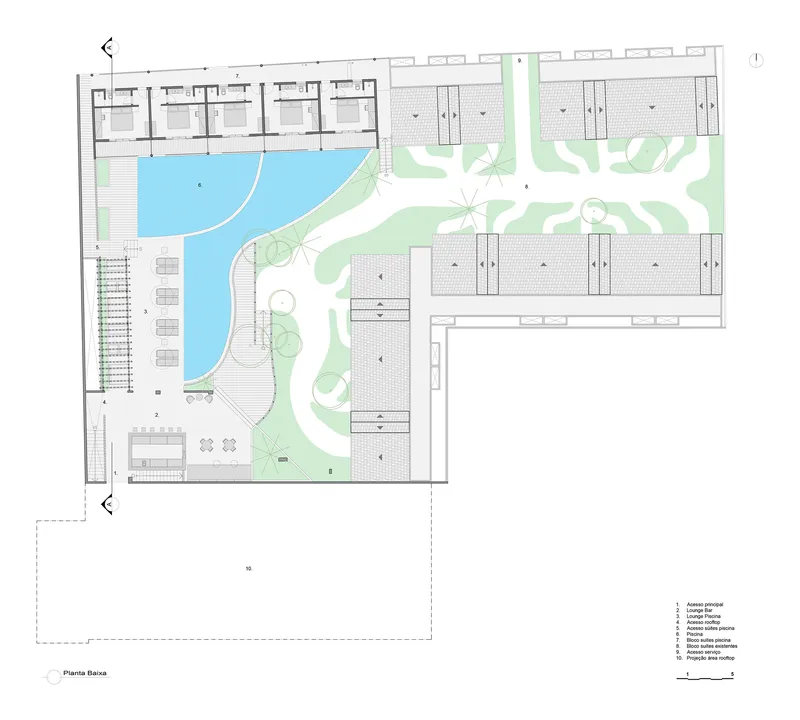
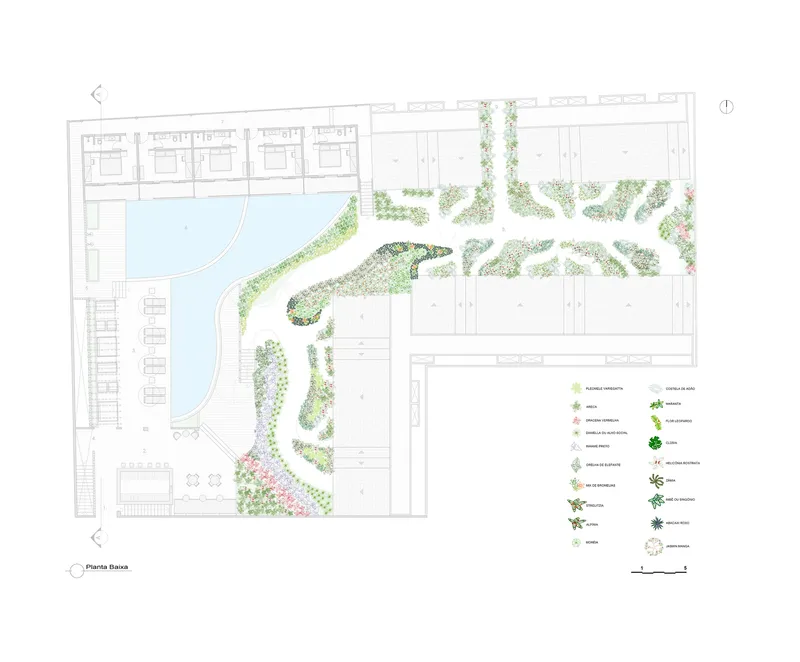
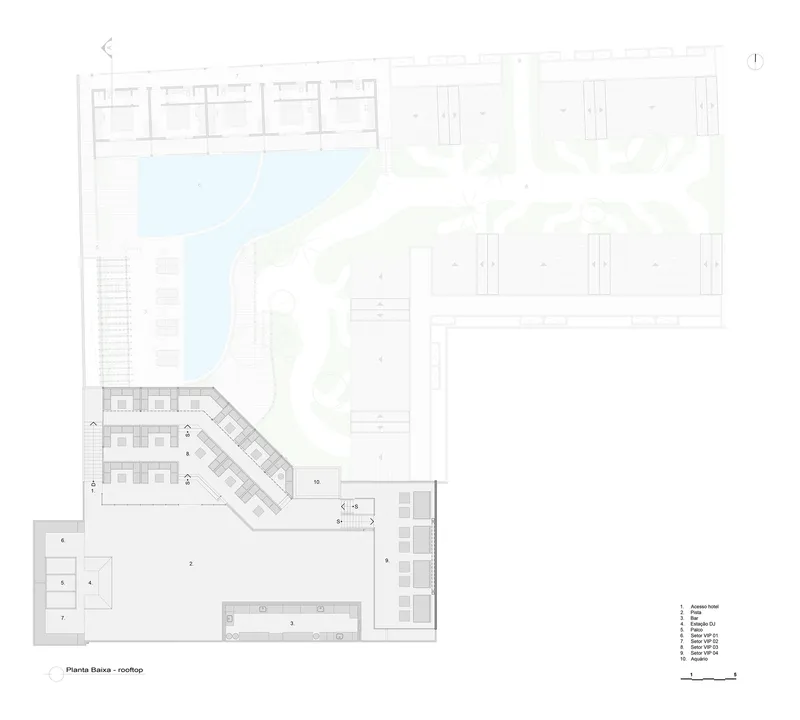
The floor plans reveal the dual organization clearly: pool-facing units along one edge with direct balcony-to-water access, garden units along the other with a branching path system. The rooftop plan shows the angled seating rows stepping toward the view, with service areas tucked behind the bars. The planting plan details the species distribution around the pool and curved pathways, confirming that the lush garden corridors are deliberate microclimate strategy rather than decorative afterthought.
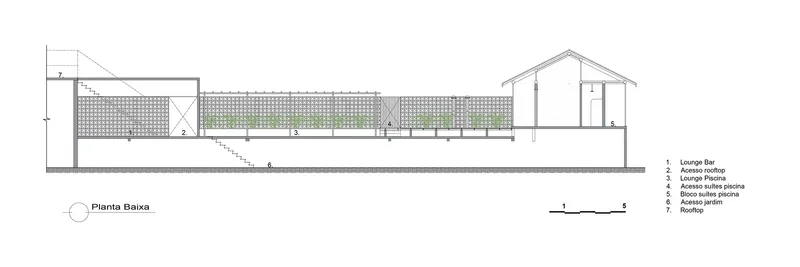
The section cut through the bar lounge and pool deck is the most revealing drawing. It exposes the level change between the two pool basins, the planted screening wall that separates the hotel from its context, and the structural timber framework that unifies the covered spaces. At nearly 45,000 square feet, the project is substantial, but the section shows how carefully it has been kept low and horizontal, deferring to the dune topography rather than competing with it.
Why This Project Matters
Hospitality projects in Brazilian beach towns often fall into two traps: either a generic international resort language that could be anywhere, or an over-romanticized rusticity that performs "local" without engaging with actual construction traditions. Café Jeri Hotel sidesteps both. Tadu Arquitetura has taken the timber, stone, and bamboo of the northeastern coast and deployed them with precision, building a hotel that is unmistakably of Ceará while operating at a level of spatial and programmatic sophistication that its nightlife-origin story might not lead you to expect.
The project's real achievement is holding two identities in one envelope. A calm, shade-driven retreat and a sunset-to-dawn event venue coexist without one undermining the other, bound together by a material palette that never wavers. In a place where the wind, the dunes, and the light already do most of the work, the smartest thing the architecture does is get out of their way while still being genuinely present.
Café Jeri Hotel, designed by Tadu Arquitetura (lead architect: João Duayer), Jericoacoara, Jijoca de Jericoacoara, Ceará, Brazil. 44,993 sq ft. Completed 2022. Photography by Felipe Petrovsky.
About the Studio
Share Your Own Work on uni.xyz
If projects like this are the kind of work you want to make, uni.xyz is a place to publish your own, find collaborators, and enter design competitions.


Popular Articles
Popular articles from the community


GROUP A Strips a 1969 Rotterdam Harbor Headquarters to Its Frame and Wraps It in Timber Louvers
In Rotterdam's M4H harbor district, Ferro Offices reuses a 1969 frame, adds one timber storey and reaches BREEAM-NL Outstanding.

Jaramillo Van Sluys Arquitectura and Urbanismo Turn a Demolished Registry Lot in Quito into an Orchard Plaza
In Quito's Centro Histórico, a 2,800 m² plaza exposes the San Agustín convent wall and redraws its lost Augustinian orchard in volcanic stone.

Architekt Andreas Gruber Scatters 23 Dark Timber Chalets Across a South Tyrolean Forest Edge
In Molini di Tures, Amonti Chalets breaks a resort into a hamlet of gabled timber houses, with parking, storage and services pushed into the slope.

David Ortega Stacks a Two-Story Mexico City Penthouse Around a Steel Stair and a Pergola-Shaded Roof Terrace
In Colonia Roma, a 300 m² penthouse uses oak joinery, a planted steel stair and a slatted roof pergola to make a new-build apartment feel like a house.

Similar Reads
You might also enjoy these articles


LAVA Architecten Gives Vocational Education a Sawtooth-Roofed Face on a Mechelen School Campus
In Mechelen, Belgium, a 2,053 m² STEM school on a 6×6 m grid turns workshops and classrooms into rooms that can be rearranged as teaching changes.

KEMA Studio Turns a Derelict Marvila Attic into a 60 m² Lighthouse Apartment Above Lisbon
In Lisbon's Marvila district, a rebuilt roof, four skylights and two plywood volumes turn an unlivable attic into a bright home facing the Tagus.

Pixel Gardens: One Repeated Module Stacked Into a Terraced Social Housing Tower for Famagusta
Salem Bader's shortlisted housing tower builds a vertical neighbourhood from one repeated module, offsetting units to carve terraces, light and air.

Bao Huynh Watercolor Atelier: A Serene Art Retreat in Hội An
Bao Huynh Watercolor Atelier in Hội An blends multifunctional art spaces, sustainable design, local materials, and family-friendly living in a serene environment.

Explore Cafe Competitions
Discover active competitions in this discipline

Challenge to design a portable theatre

Challenge to design a portable music platform

Challenge to design an open learning module for the elderly
Comments (0)
Please login or sign up to add comments
No comments yet. Be the first to comment!