
TaleBox- Competition Entry for Solace
By Liberty Chapman, Yangchuan Deng, and Valerie Victoria

For college students, reading is the principal medium of learning. However, through copious amounts of mandatory class assignments, it becomes difficult to find a space that facilitates the enjoyment of the act of reading. The exhausted homework-driven college mind seeks an environment that accommodates their endless imagination but this typology of space is scarcely found on university campuses. Nonetheless, while the necessity of reading continues to rise in the age of information, spaces that accommodate students’ daily reading can rarely be found on university campuses. A library’s public space can be intimidating and too tense for casual readers, private rooms within libraries are often too compact for comfort. On the other hand, cafes allow readers to be more relaxed, but the bustling environment can distract students from reading. Dormitories enable students to relax and read carefreely, but without the physical separation between rest and leisure space, it becomes quite confining. This vacancy of the casual reader space on campus expresses the need to introduce the transportable reading pod to the campus.
Overview
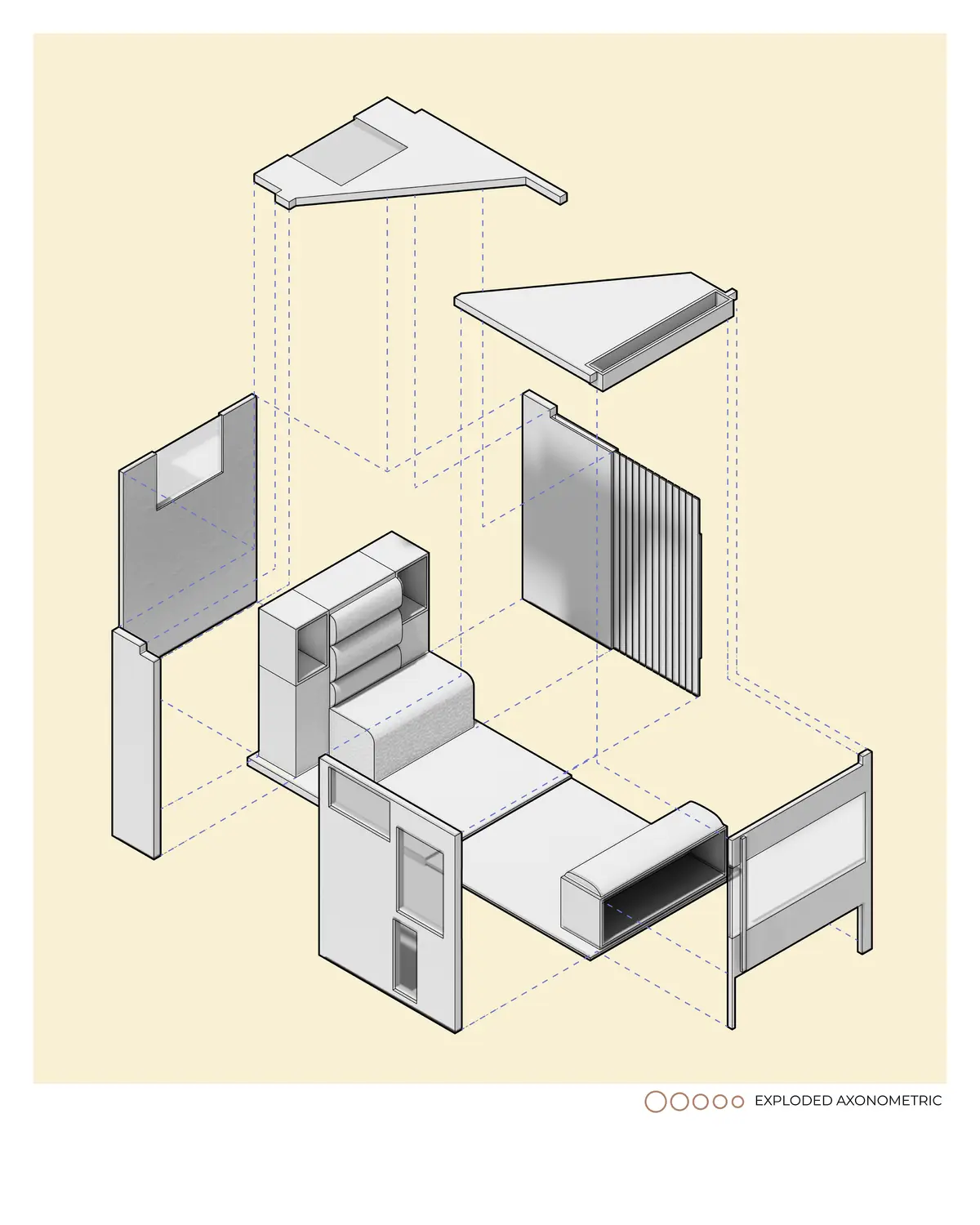
TaleBox is a reading pod aimed to provide comfort while eliminating distractions for its users. For this representation, we located the reading pods on the Main Green of Brown University. It is a typical green space where students can hang out while the density of students is not excessively high. TaleBox is 2m x 1.5m x 2m and possesses a rectangular shape that optimizes the potential interior space. The mobile reading pod on wheels includes a wooden facade, a cork interior, and glass windows made to be as lightweight and eco-friendly as possible. The pod can also be transformed from a comfortable personal reading space for one user into a semi-public open place for group discussions. The entire structure is highly compressible and straightforward for assembly. Due to the two pairs of wheels under the main form, TaleBox can be effortlessly transported both pre-construction and post-construction as one unit.
Distraction-Free
There are many obstacles that can come between a reader and their quality reading time, particularly external distractions from the surroundings.
Visual distractions can efficiently be dealt with, but it is often in a way that’s not the most user-friendly way. A common strategy applied when combating visual distractions is to enclose the user inside a 180-degree dead-end of space. It is pretty similar to an ATM booth, but the area covered will extend to the occupants’ field of view. Nonetheless, this is not comfortable since it encloses the space onto the user and induces claustrophobic reactions. In TaleBox, however, the user’s field of view will be greeted by a window in the front to let exterior space. In addition, to protect the user’s privacy and attention, there will be hydroponic creeper plants outside the window the user is facing.
Auditory distraction, on the contrary, is harder to combat in an open environment. Thus, the reading pod interior walls are made of cork that is both environmentally friendly and provides up to 40% sound insulation for the user inside.
Privacy
A public shared reading space should provide its user enough privacy to feel comfortable using the pod, while too much privacy can allow users to occupy the space for too long and interfere with the other users of the space. Thus TaleBox aims to find the delicate balance in the dilemma of privacy.
Strategically placed windows on the reading pod provide various degrees of privacy. . The windows in the front with creeper plants crawling on top give the occupant an effect similar to the window blinds. The person from inside can easily see outwards while a passerby will not be able to peer inwards. The window, situated on the back wall above 1.85 meters off the ground, sits behind the user that providing natural light into the interior space.
On the right side wall of the user, there are three smaller frosted glass panels. The people from outside and the person within the pod will be able to see silhouettes of each other. The person outside can understand if the space is currently occupied. The occupant inside will also be more self-aware of maintaining their usage of the space within a reasonable amount of time when they see others are checking the space’s availability. The pressure will accumulate the longer the person occupies the space. So if a user stays in the pod for a reasonable amount of time, they will not be influenced by the pressure. In this way, the reading pod can accommodate many individuals while not pressuring too much on its users.
Sharing
Reading is a personal habit that nurtures student lives, yet when reading knowledge is being shared in a group, the benefits of reading are multiplied. This is the core idea behind the choice of TaleBox’s ability to expand into a semi-open private space. When the pod is fully extended, the entire structure will be 3.7 meters long and accommodate up to four people sitting inside. The working board can be folded up to the front window, and the storage area under the board can serve as a sitting area for two. The space will not be fully open since the walls can still partially enclose the users. This allows the exchanging of information between a group of users, sharing their results from reading.
Comfort
The interior of TaleBox provides comfort to its users. The wood material for walls and floors provides a pleasant thermoreception on touch. The eco faux leather on the chairs provides softness as well as accessibility in terms of cleaning.

Popular Articles
Popular articles from the community


Extended Shell: Retrofitting Kolkata's Balconies as Living Urban Thresholds
A modular retrofit system recovers the social and environmental intelligence of Kolkata's historic verandas for contemporary Park Street residents.

Cloaked Colonization: A Mobile Underwater Habitat That Moves Like a Fish
Micah Abaya's shortlisted EHC Pacific entry reimagines ocean settlement as a dispersed network of self-sustaining architectural organisms.

Singing Woman: An Opera House That Performs Before the Curtain Rises
Ovidiu Cristian Pavel's conceptual opera house translates Estonia's choral identity into a sculpted waterfront landmark facing the Baltic Sea.

Faces of the Soviet Avant-Garde: Turning Moscow's Street Names into an Open-Air Museum
A network of sculptural installations across a Moscow residential district transforms forgotten architect names into spatial encounters with cultural memor

Similar Reads
You might also enjoy these articles

The Rhythm of Seasons
A Farmers' Market Connecting Nature and the City

More Than a Building-Designing a Living System
More Than a Building-Designing a Living System
Base Beyond
DESERT COMPOUND ARID: TOURISM OF ABSENCE AND ABUNDANCE

Comments (0)
Please login or sign up to add comments
No comments yet. Be the first to comment!