
Tara Lal and T_M.space Coil a Rammed Earth Spiral Around a Sacred Forest Clearing in Delhi
The Aranyani Pavilion channels Vedic reverence for the forest through curving earthen walls, bamboo vaults, and ritual water in a New Delhi park.


Named for Aranyani, the Rigvedic goddess of the forest, this pavilion in New Delhi does not sit in nature so much as coil around it. Designed by Tara Lal and T_M.space, the structure spirals outward from a central courtyard, its rammed earth walls rising and falling in a continuous gesture that refuses corners, axes, or any rectangular logic. The result is a building that reads as landscape: a planted ridge erupting from the lawn, perforated by arched openings that frame sky, trees, and weathered stone.
What makes the Aranyani Pavilion genuinely interesting is not that it invokes ecological themes, a move common enough to be almost meaningless, but that it commits to a material and spatial discipline that enacts those themes. Rammed earth, bamboo lattice, boulders, gravel, reflecting pools, an oculus open to the rain: every element carries weight, both literal and symbolic. The pavilion is less a building to occupy than a sequence to pass through, a controlled dissolution of enclosure into garden, earth into sky.
An Earthen Wall That Refuses to Be a Wall
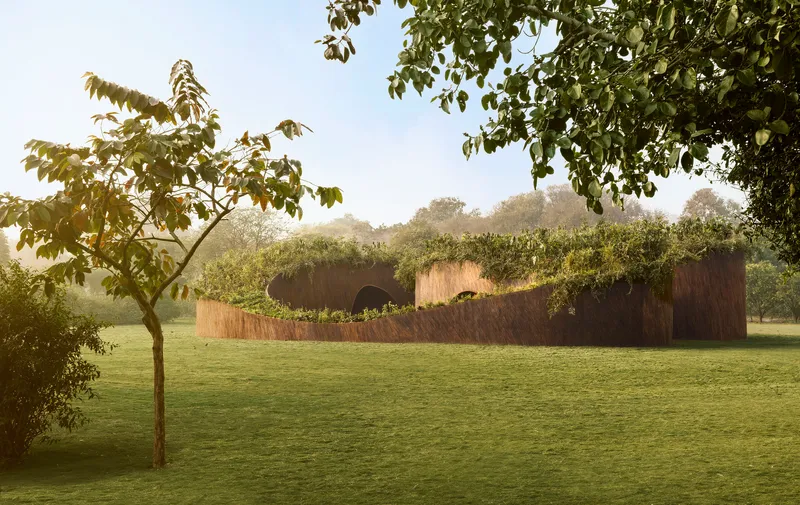


The defining formal move is the continuous rammed earth wall, which curves, rises, and dips as it wraps the pavilion's spiral plan. From the outside it looks geological, closer to a berm or an eroded cliff than conventional architecture. The planted green roof reinforces this reading: grasses and wildflowers blur the top edge, making it genuinely difficult to determine where structure ends and terrain begins.
The arched openings punctuating the wall are generous and irregular, framing views outward to the parkland and inward to the courtyard. They introduce a sense of porosity that keeps the mass from feeling fortified. You see through the pavilion before you enter it, which is critical: the building telegraphs its hospitality from a distance.
The Aerial Read: Spiral as Organizing Principle


Seen from above, the pavilion reveals itself as a tight spiral, green-roofed and embedded in its park setting. The distant haze and the dome visible on the horizon anchor the structure within Delhi's civic landscape. It is a small building in a big city, but the aerial perspective makes its ambition legible: a continuous loop that generates interior space without recourse to rooms.
From ground level across the lawn, the profile is lower and more ambiguous. The weathered surfaces and planted edge make the pavilion nearly disappear into the tree canopy. The spiral form is not gratuitous geometry. It produces a gradient of enclosure, from the most protected interior core to the most open threshold, without any abrupt transitions.
Bamboo Vaults and the Light Inside


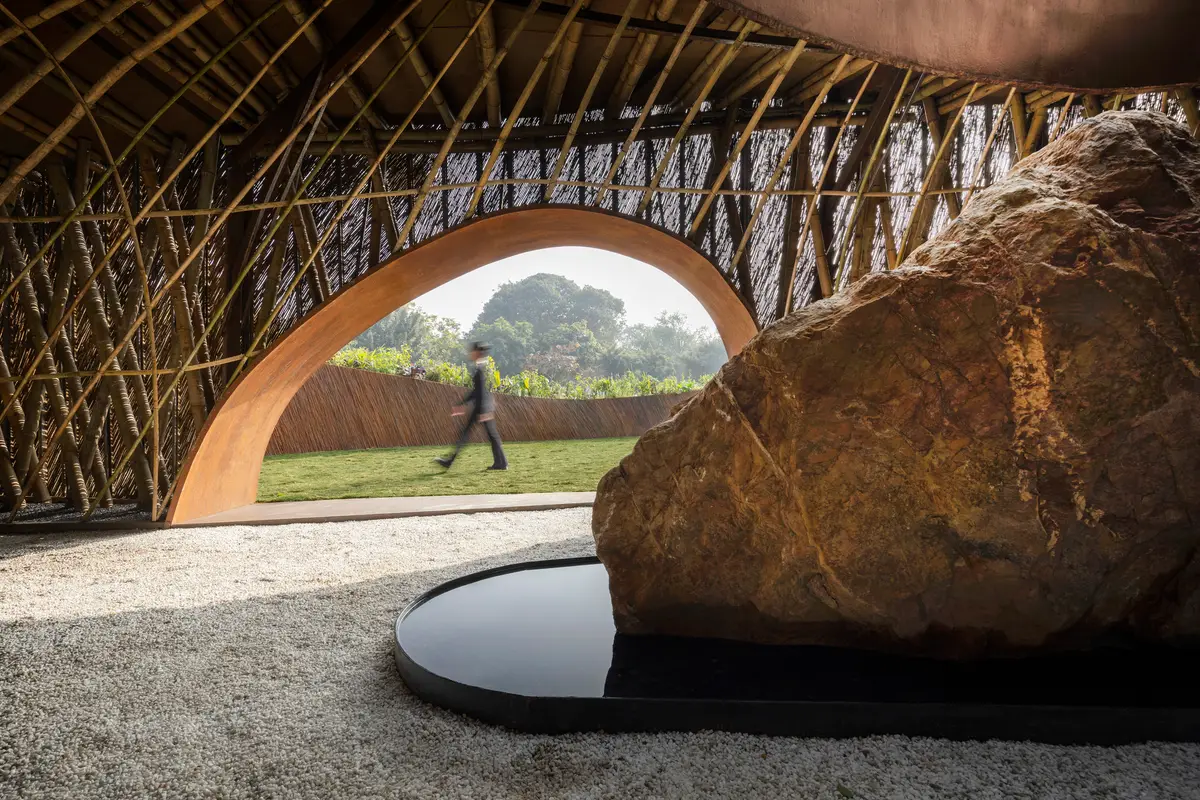
Step inside and the material register shifts entirely. The rammed earth gives way to an intricate bamboo lattice that forms the pavilion's vaulted ceiling. The structure is legible and expressive: each member radiates from oval roof openings that function as oculi, pulling sunlight down in columns of dappled light. It is simultaneously tent and temple.
The dusk photograph of the illuminated interior reveals a spiral relief pattern incised into the inner wall surface, a decorative register that echoes the plan's curvilinear logic at a finer grain. Between the warm glow of the earthen walls and the intricate shadow play of the bamboo overhead, the interior achieves a density of atmosphere rarely found in pavilion architecture, where lightness is usually the whole point.
Stone, Water, and the Ritual Core

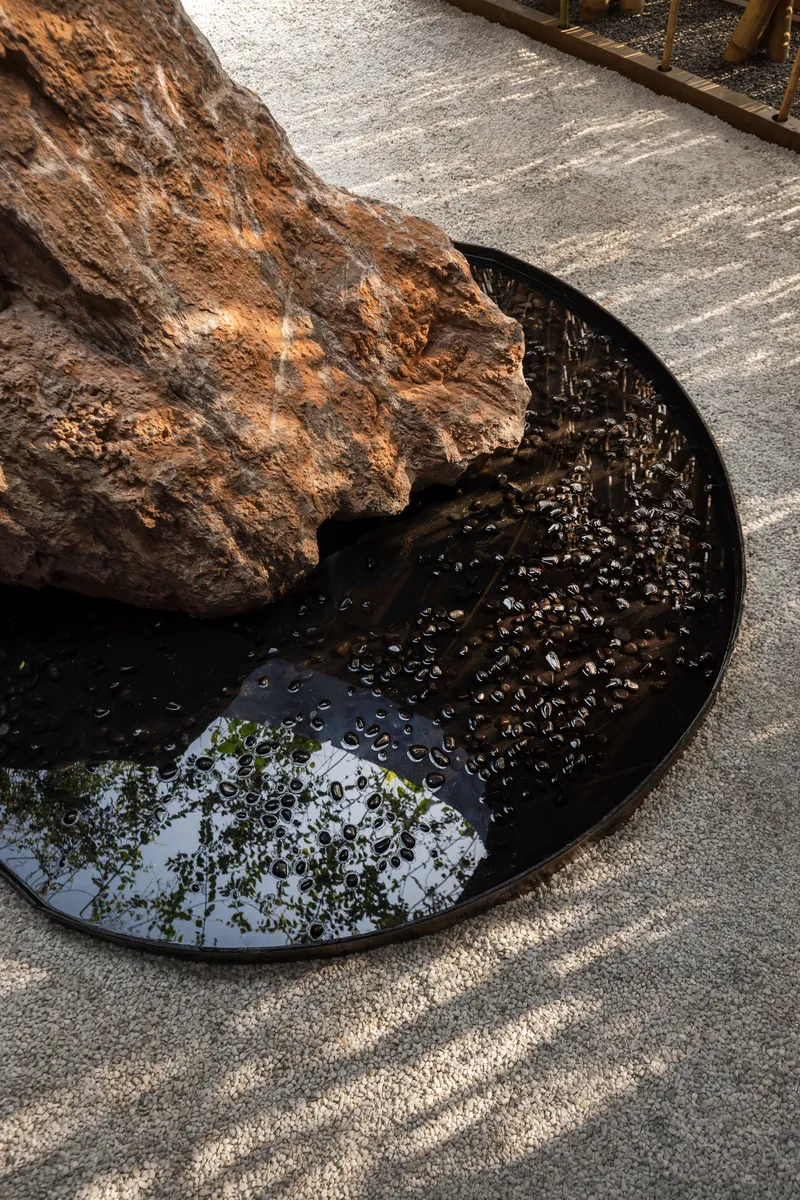

At the heart of the spiral sits a weathered boulder, massive and irreducible, resting on a circular black reflecting pool. The pairing is deliberate and loaded: the stone is ancient, the water still, the gravel floor raked clean. It reads as a sacred precinct, a clearing within a clearing. The boulder is not decorative. It is the center of gravity around which everything else orbits.
The reflecting pool catches rippled light that plays across the gravel floor and the underside of the bamboo canopy. Visitors pass through the arched openings and encounter this ensemble almost by surprise, because the spiral plan delays the reveal. The architects clearly understand that sequence matters more than spectacle: the experience of arriving at the center is the architecture.
Thresholds and the Garden Edge
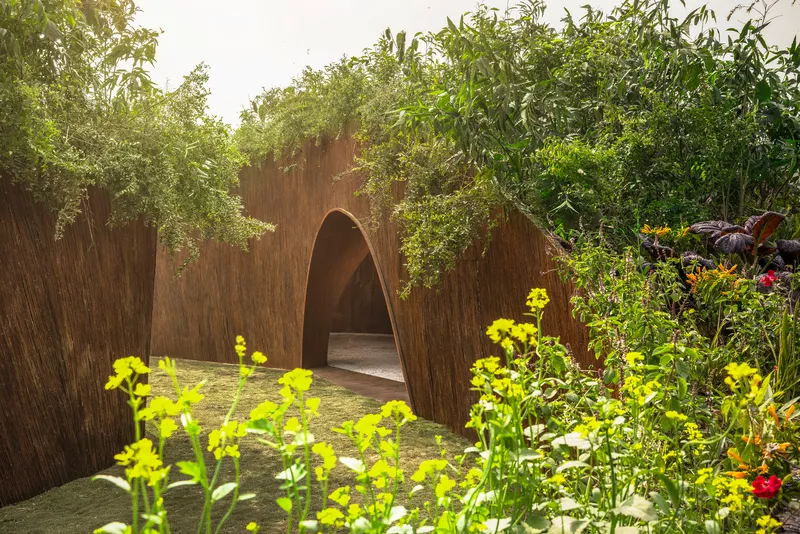
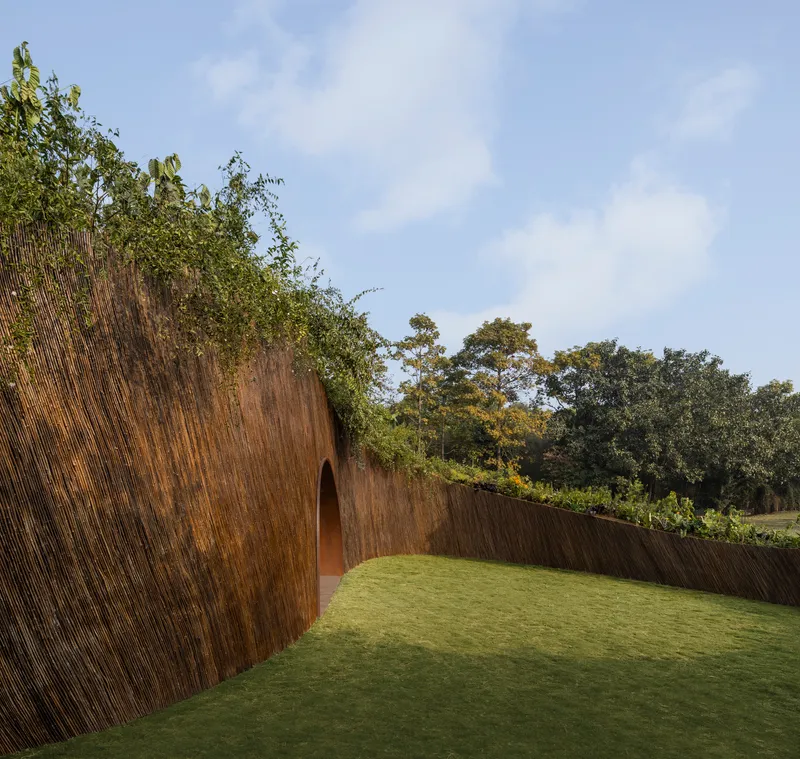
The arched passages where interior meets exterior are among the pavilion's most carefully considered moments. Timber-framed openings and bamboo lattice screens modulate the transition, filtering light and framing vegetation. Flowering plants crowd the base, and overhanging trees contribute a canopy that merges with the planted roof. The boundary between inside and outside is not a line but a zone, thick and inhabited.
The courtyard enclosed by the curved bamboo wall functions as a second interior, open to the sky but sheltered from the city. Cropped lawn contrasts with the wilder planting on the roof, establishing a controlled gradient from cultivated to untamed. It is a pavilion that wants to be a garden, or perhaps a garden that has learned to enclose itself.
Plans and Drawings

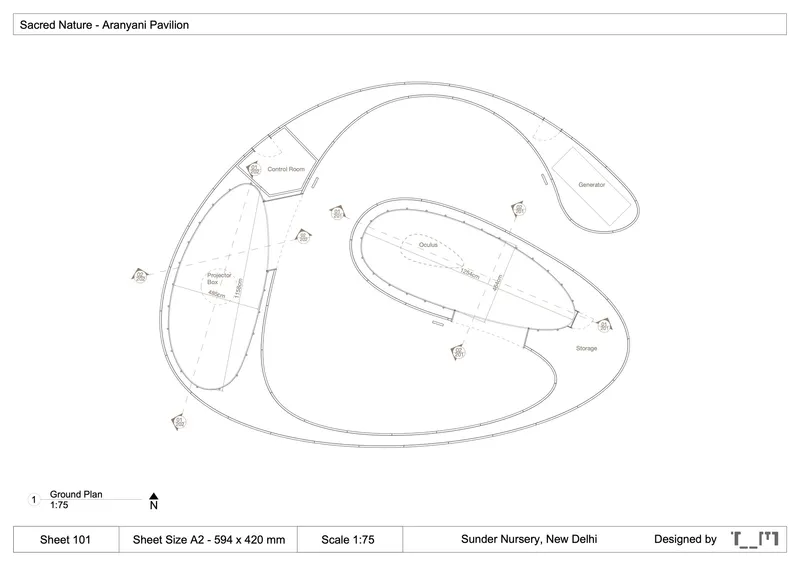

The site plan confirms what the aerial photo suggests: an organic, shell-like footprint set within a landscape of perimeter trees and loose planting. The ground floor plan reveals the logic more precisely, showing how curvilinear walls generate a sequence of thresholds around a central courtyard. There are no orthogonal references anywhere. The roof plan maps solid against void, making legible the relationship between the planted earth canopy and the bamboo-latticed openings that bring light into the interior.
What the drawings make clear is that the spiral is not a single gesture but a nested set of enclosures, each one slightly more intimate than the last. The plan is doing real spatial work, not just producing a striking silhouette. It is the kind of drawing set that rewards careful reading, because the experiential richness of the built pavilion is already present in the lines.
Why This Project Matters
The Aranyani Pavilion is a convincing argument that sustainability in architecture means more than material specifications and energy metrics. Tara Lal and T_M.space have built a structure whose ecological commitment is inseparable from its spatial experience: rammed earth walls that breathe, a green roof that insulates and biodiversifies, bamboo structure that grows back faster than it was harvested, and a design that treats rainwater and sunlight as participants rather than problems. None of these choices are novel in isolation. Together, tuned to a spiral plan that choreographs the body through a series of revelations, they become something more than a checklist.
In a city as dense and contested as New Delhi, carving out a space devoted to slowness and sensory attention is itself a political act. The pavilion does not lecture about the forest. It reconstructs the experience of entering one: the gradual dimming of light, the compression of space, the surprise of a clearing, the stillness of water around stone. That the architects achieved this with a modest footprint and a vocabulary of ancient, local materials makes the project not just relevant but replicable, a prototype for what sacred public space might look like in contemporary India.
Aranyani Pavilion by Tara Lal and T_M.space. New Delhi, India. Completed 2026. Category: Installations & Structures, Pavilion, Sustainability.
About the Studio
Share Your Own Work on uni.xyz
If projects like this are the kind of work you want to make, uni.xyz is a place to publish your own, find collaborators, and enter design competitions.


Popular Articles
Popular articles from the community


Cube Design Draws an Ecological Corridor Between Two Shenzhen Hills with the Nankai Building
Beside Shenzhen's container docks, the Nankai Building pairs stacked balconies with a climbing green screen to connect two hillsides across its height.

David Ortega Stacks a Two-Story Mexico City Penthouse Around a Steel Stair and a Pergola-Shaded Roof Terrace
In Colonia Roma, a 300 m² penthouse uses oak joinery, a planted steel stair and a slatted roof pergola to make a new-build apartment feel like a house.


The Amber Palace Opera: A Geological Fiction Surfaces on Tallinn's Baltic Waterfront
Pierre Brillard reimagines a Baltic legend as a public landscape, opera house, and waterfront promenade rooted in Tallinn's coastal identity.

FCC Arquitectura Expands a Portuguese Granite House with a Board-Marked Concrete Wing
In Portugal, JV House pairs a cleaned-up whitewashed and granite dwelling with a timber-shuttered concrete extension, courtyards and a garden pool.

Similar Reads
You might also enjoy these articles

LAVA Architecten Gives Vocational Education a Sawtooth-Roofed Face on a Mechelen School Campus
In Mechelen, Belgium, a 2,053 m² STEM school on a 6×6 m grid turns workshops and classrooms into rooms that can be rearranged as teaching changes.

KEMA Studio Turns a Derelict Marvila Attic into a 60 m² Lighthouse Apartment Above Lisbon
In Lisbon's Marvila district, a rebuilt roof, four skylights and two plywood volumes turn an unlivable attic into a bright home facing the Tagus.

Pixel Gardens: One Repeated Module Stacked Into a Terraced Social Housing Tower for Famagusta
Salem Bader's shortlisted housing tower builds a vertical neighbourhood from one repeated module, offsetting units to carve terraces, light and air.

Bao Huynh Watercolor Atelier: A Serene Art Retreat in Hội An
Bao Huynh Watercolor Atelier in Hội An blends multifunctional art spaces, sustainable design, local materials, and family-friendly living in a serene environment.

Explore Pavilion Competitions
Discover active competitions in this discipline

Challenge to design a portable theatre

Challenge to design a portable music platform

Challenge to design an open learning module for the elderly

Design challenge to reuse E-waste
Comments (0)
Please login or sign up to add comments
No comments yet. Be the first to comment!