
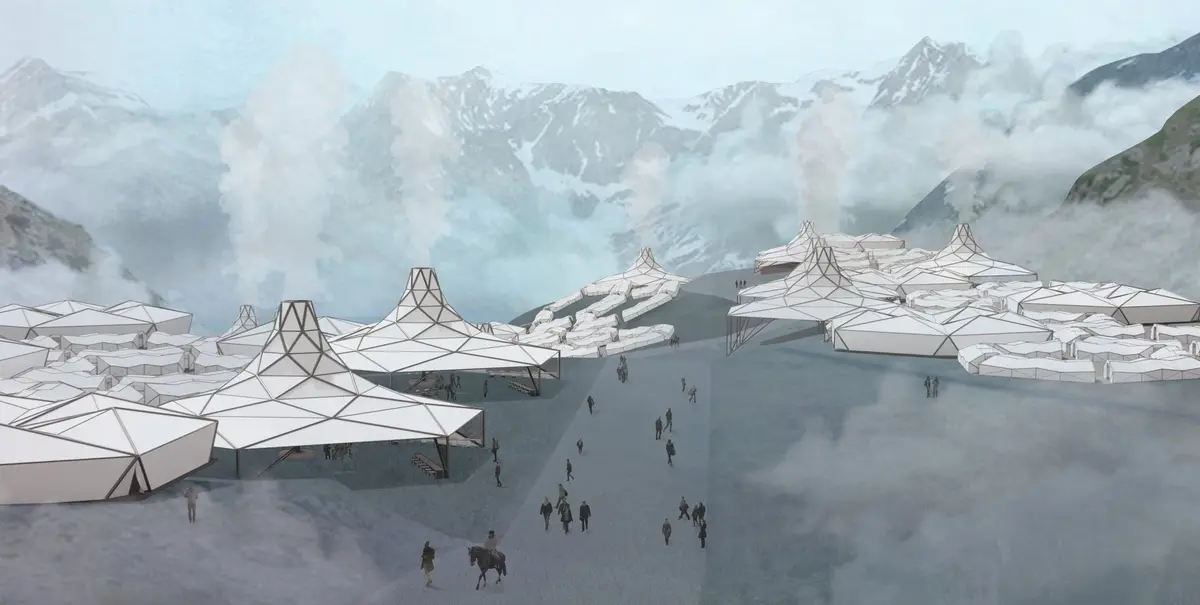
Temporal Parasols: Folding Hexagonal Shelters That Bring Order to the Amarnath Yatra
An Encamp-winning system of airlifted, origami-inspired modules that unfold into dwellings, hearths and sanitation across the Himalayan pilgrimage route.


Every summer, thousands of pilgrims climb into the Himalaya for the Amarnath Yatra, and every summer the settlements that receive them are improvised: tents pitched wherever the ground allows, sanitation as an afterthought, circulation left to chance. Temporal Parasols starts from a sharp diagnosis of that condition. The trouble is not a shortage of shelter. It is the absence of architectural organisation, which produces inefficient movement, poor waste management and a fragmented social experience. The answer here is a kit of folding, hexagonal modules that open like parasols, sit lightly on the mountain and close again when the pilgrimage window ends.
Designed by Cutler Patierno, the project was named a winner of Encamp, a uni.xyz competition that asked designers to rethink temporary camps for pilgrims. The site poses severe constraints: rugged topography, harsh weather and a transient population that peaks for only a short period each year. Patierno responds with a system rather than a building, combining origami folding techniques and parasol mechanics into three interconnected unit types for accommodation, community and services. The intervention is explicitly non-permanent, built to follow cycles of occupation and to leave as little trace as possible once it is gone.
Sleeping Quarters That Trade the Tent for a Spatial Hierarchy

The accommodation module is where the project most directly challenges the conventional pilgrim tent. In the rendering, steel-framed benches line the interior. One traveller rests, another unpacks, and a hiker sits beside a glazed wall that frames the landscape outside. The scene reads as a room, not a canvas shelter, and that distinction matters. Patierno organises each unit across three levels, creating a layered hierarchy that houses large numbers of people while keeping a measure of dignity and privacy, something improvised camps rarely manage.
Because the units are modular, the number deployed can rise and fall with occupancy. That is a pragmatic response to a pilgrimage whose population swells and drains within weeks, and it avoids the waste of overbuilding for the peak.
A Hearth Beneath a Faceted Canopy

If the accommodation units provide privacy, the community units provide the reason to leave them. A faceted tensile roof on steel struts rises over a central fire pit, and pilgrims gather around it under an open sky. The plan is open, so the same space can serve dining, gathering and prayer, while the hearth gives the structure a centre of gravity. Set across the site, these canopies become focal nodes, points of orientation in a landscape that otherwise offers few.
The parasol idea is most literal here. The community units use retractable systems driven by tension cables and crank mechanisms, so the canopy that shelters a crowd can collapse efficiently for storage. The architecture is designed to be performed twice: once when it opens, and again when it folds away.
Sanitation Treated as Infrastructure, Not Afterthought

The service module is the least photogenic part of any camp and the one Patierno calls its backbone. The rendering shows a long table with folding chairs alongside toilet cubicles, while travellers in down jackets pass through in soft daylight. Placing logistics and hygiene inside a considered, daylit interior is a quiet argument that these functions deserve the same design attention as sleeping and gathering.
The strategy is distributive. Rather than concentrating facilities at one overloaded point, the service units are spread across the site to improve access and day-to-day operation. A rigid base and adjustable footing system let them sit level on uneven Himalayan ground, which is essential for anything that has to hold plumbing and waste systems steady.
The Hexagon as a Shared Grammar

The plan drawings show why the system holds together. Accommodation, community and service units are all drawn as hexagons, and the section below sets them against a snowy mountain backdrop. Patierno derives every module from a hexagonal tessellation, a choice that pays off in several ways at once: the units pack efficiently, expand predictably and can be reconfigured into clusters without awkward leftover space.
The geometry also brings legibility. Three programmes share one formal language, so the settlement reads as a coherent whole rather than a collection of unrelated structures. The tessellation supports structural stability too, which matters for lightweight, foldable forms exposed to mountain weather.
Airlifted, Unfolded, Gone
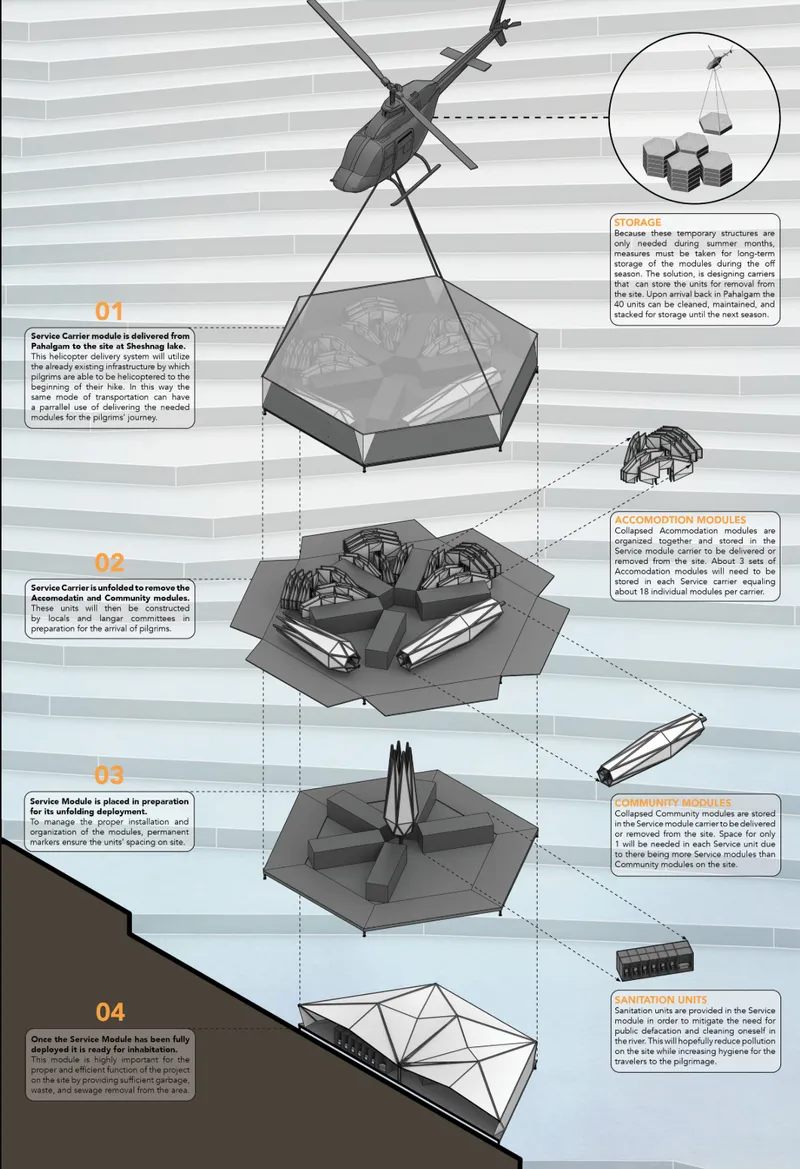
The exploded axonometric captures the project's most persuasive idea. Across four stacked stages, a helicopter lifts a hexagonal service carrier, sets it down, and the carrier unfolds into modules and sanitation units. Patierno designs deployment as part of the architecture rather than a problem left for contractors. Modules arrive by air and open on site with minimal intervention, which cuts construction time, reduces reliance on labour in difficult terrain and limits disturbance to the ground.
This is where the project's environmental position becomes concrete. Treating the camp as a reversible intervention means its impact is set not only by what it builds but by what it leaves behind. A settlement that folds up and flies out avoids the slow accumulation of debris and scarred ground that semi-permanent camps tend to leave.
Why This Project Matters
Temporary architecture often gets less design attention because it is temporary. Temporal Parasols reverses that logic: because the settlement is short-lived and sits in a fragile landscape, every decision about packing, deployment and removal carries more weight. Patierno's achievement is coherence. One geometric rule, one folding logic and one logistics chain serve three very different programmes, and the result reads as a deliberate place rather than an emergency response.
The proposal also understands that a pilgrimage is a social and spiritual experience as well as a logistical one. Placing hearths at the centre of community canopies, giving sleepers some privacy and dignifying sanitation are choices about how pilgrims feel, not only how they are housed. For anyone working on mass gatherings in remote terrain, the project offers a useful model: organise the temporary city with the same care as a permanent one, then design it to disappear.
View the Full Project
About the Designers
Designer: Cutler Patierno
Enter a Design Competition on uni.xyz
uni.xyz runs architecture and design competitions year-round that reward proposals with spatial conviction and real site intelligence.
Project credits: Temporal Parasols by Cutler Patierno Encamp (uni.xyz).


Popular Articles
Popular articles from the community


David Macias Steps a Doorless Stone and Plaster House Down a Tropical Colombian Hillside
In the humid hills of Colombia, Threshold House replaces the front door with an open void and terraces its 850 m² down the slope instead of fighting it.

Juan García Correa, John González and Claudia Rueda Sink a Circular Amphitheater into a Manizales Engineering Building
On the La Nubia campus in Manizales, Colombia, the S1 Building folds labs and offices into a hillside of ramped lawns that double as a campus route.

David Ortega Stacks a Two-Story Mexico City Penthouse Around a Steel Stair and a Pergola-Shaded Roof Terrace
In Colonia Roma, a 300 m² penthouse uses oak joinery, a planted steel stair and a slatted roof pergola to make a new-build apartment feel like a house.

Jaramillo Van Sluys Arquitectura and Urbanismo Turn a Demolished Registry Lot in Quito into an Orchard Plaza
In Quito's Centro Histórico, a 2,800 m² plaza exposes the San Agustín convent wall and redraws its lost Augustinian orchard in volcanic stone.

Similar Reads
You might also enjoy these articles
Healing Façade: A Modular Chapel System That Restores Ethiopia's Sacred Forests
Winner of the Eco-Chapel competition, this circular timber façade collects water from air to rebuild soil and reforest degraded Ethiopian landscapes.
Kaffeebühnen: Where Coffee Shop Architecture Becomes a Civic Stage in Vienna
A linear sequence of timber boxes, transparent shells, and open yards turns the Viennese café tradition into a public performance space.
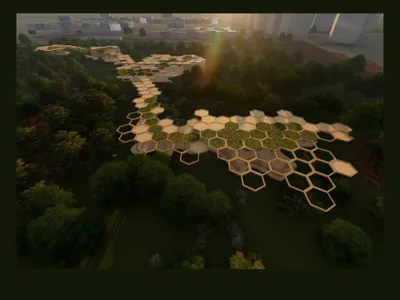
Eco Chapel: A Modular Forest Pavilion That Grows Like the Landscape It Protects
Hexagonal timber modules weave through existing trees, turning a chapel into a living system for prayer, education, and reforestation.


Urban Forest: A Vertical Ecosystem for 5,000 Workers in Singapore's Changi Business Park
Radially stacked pods and layered green decks turn a 7-acre plot into 47 acres of ecological workspace projected for 2040.

Explore Prefabricated Architecture Competitions
Discover active competitions in this discipline

Challenge to design a portable theatre

Challenge to design a portable music platform

Challenge to design an open learning module for the elderly

Challenge to reimagine the Iron Throne
Comments (0)
Please login or sign up to add comments
No comments yet. Be the first to comment!