
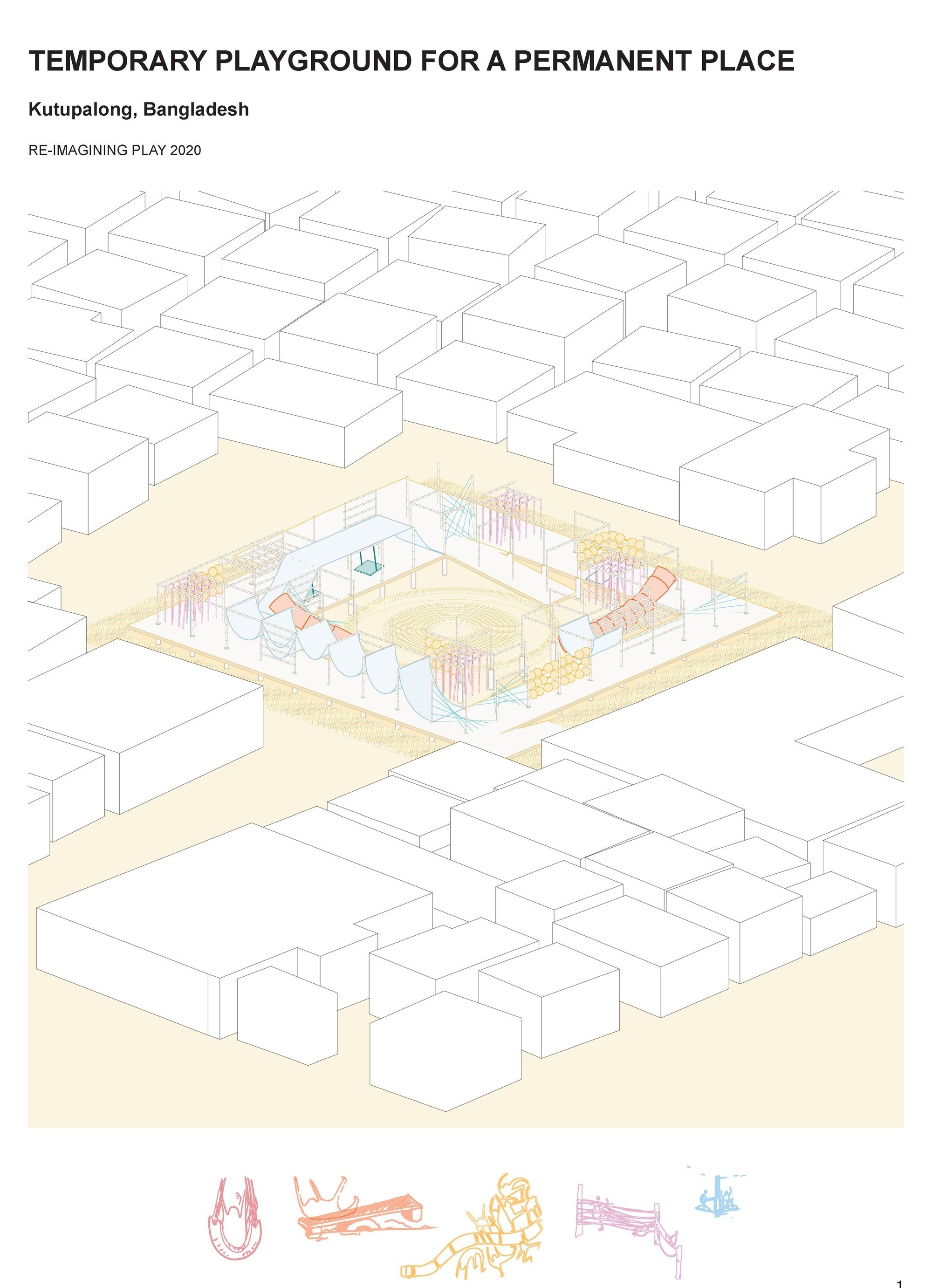
Temporary Playground For A Permanent Place by Lily Whitehouse, Katarzyn
A sustainable playground architecture proposal transforming refugee camp spaces through sensory learning, resilience, nature, and play.

Play is one of the most powerful tools for childhood development, yet millions of children living in displaced communities have limited access to safe and stimulating environments. Temporary Playground For A Permanent Place, an Editor's Choice entry in the Re-imagining Play 2020 competition, explores how playground architecture can become a catalyst for education, social interaction, confidence building, and environmental awareness.
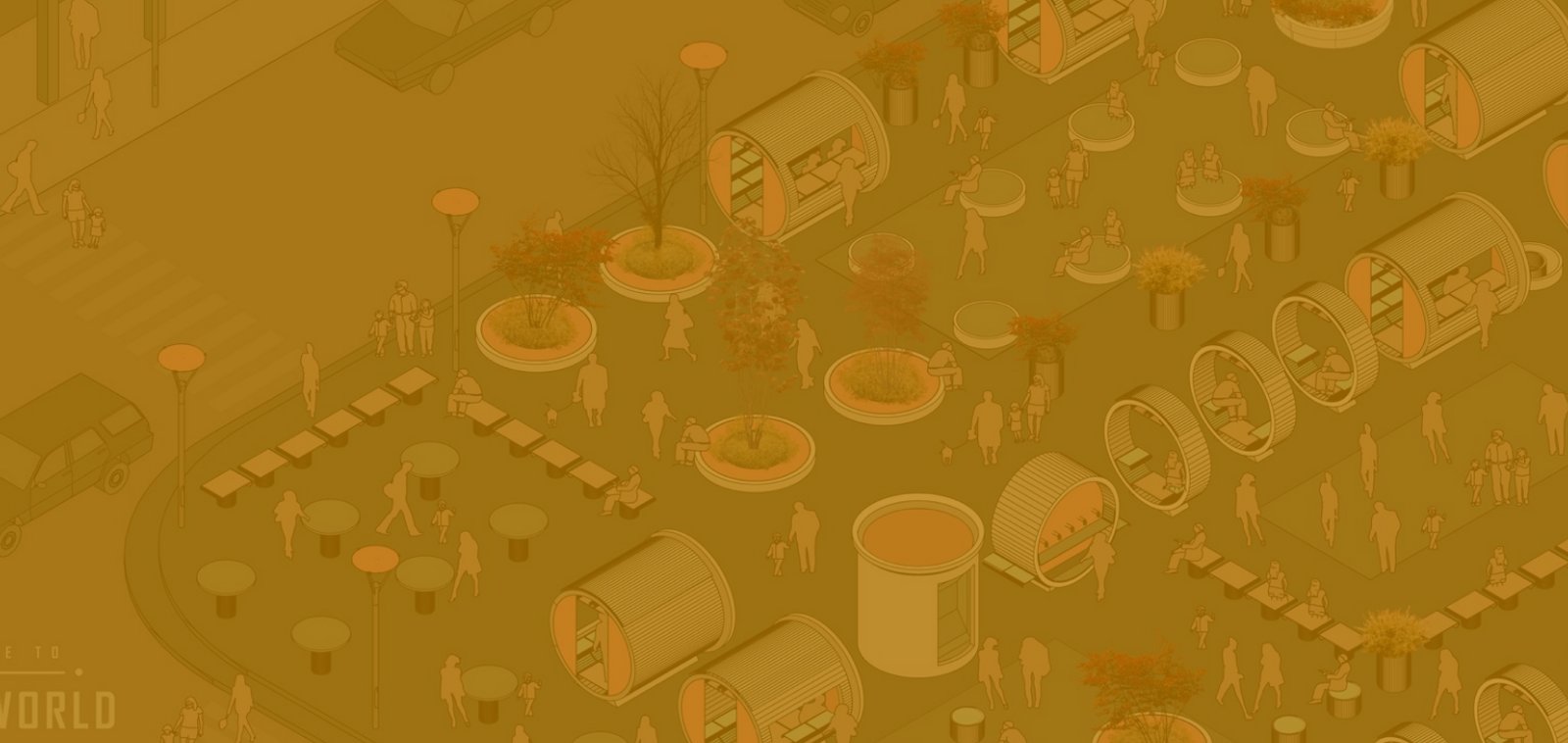
Designed by Lily Whitehouse, Katarzyna Antoszyk, and Zoe H, the proposal creates a flexible and inclusive sensory playground within the Kutupalong refugee settlement in Bangladesh. The project demonstrates how architecture can provide children with opportunities to learn, explore, and thrive while responding directly to challenging environmental conditions.
Designing for an Unstable Environment
The site is located within one of the world's largest refugee settlements, where seasonal monsoon rains, flooding, muddy terrain, overcrowding, and limited infrastructure create difficult living conditions.
Rather than treating these challenges as obstacles, the design embraces them as opportunities for architectural intervention. The proposal introduces a raised and accessible playground environment that offers safety, comfort, and engagement while responding to the realities of the site.
The architecture is carefully integrated into the surrounding urban fabric, creating a protected space where children can escape daily hardships and reconnect with curiosity, creativity, and play.
A Playground Built Around Sensory Exploration
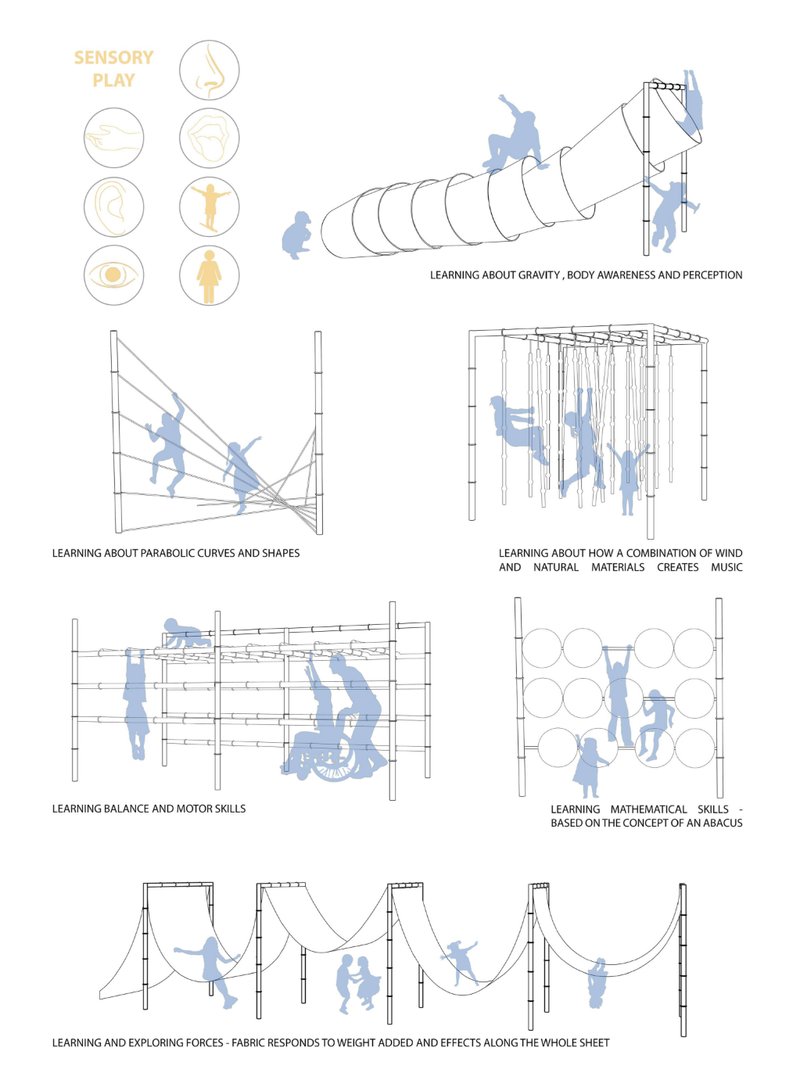
At the heart of the project is the concept of sensory play, an educational approach that encourages children to engage with their surroundings through touch, sight, sound, movement, balance, and spatial awareness.
The playground incorporates a series of interactive elements designed to transform learning into a physical experience. Children can climb, slide, crawl, swing, balance, and navigate through structures that challenge both body and mind.
Each component serves a dual purpose. Beyond recreation, every play element teaches a specific concept related to movement, mathematics, sound, gravity, or environmental awareness.
This integration of education and recreation transforms the playground into an open-air learning environment where discovery occurs naturally through play.
Architecture as a Framework for Learning
The proposal explores how architecture can become a teaching tool rather than simply a physical structure.
A tubular slide introduces concepts of gravity, body movement, and perception. Rope structures demonstrate geometric forms and parabolic curves through active participation. Musical installations respond to wind and movement, helping children understand sound and natural forces.
Other elements encourage the development of motor skills, coordination, problem-solving abilities, and mathematical thinking through interactive experiences inspired by familiar educational tools such as the abacus.
These interventions create an environment where learning is embedded into every spatial encounter.
Local Materials and Contextual Design
A defining strength of the proposal lies in its use of locally available and recycled materials. The designers carefully studied construction practices and resources available within the refugee settlement to ensure the project could be built economically and sustainably.
The primary structural framework uses bamboo, one of the most accessible construction materials in the region. Bamboo columns and beams create a lightweight yet adaptable structure capable of evolving alongside community needs.
Additional materials include:
- Recycled construction netting
- Repurposed construction chutes
- Local brick paving
- Sand and earth landscaping
- Rainwater collection components
This material strategy not only reduces costs but also strengthens the project's connection to its cultural and environmental context.
Climate-Responsive Playground Architecture
The design responds directly to the harsh climatic conditions of the site.
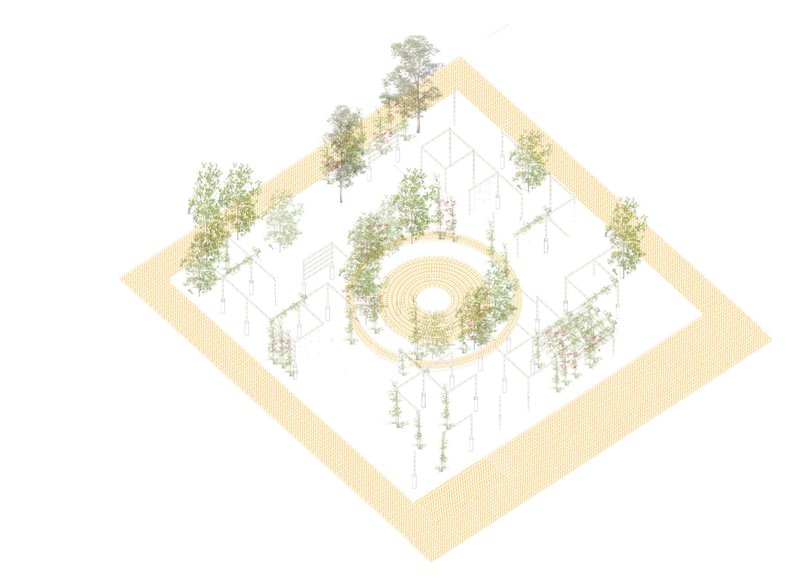
Heavy monsoon rainfall and frequent flooding are addressed through elevated circulation systems and carefully designed ground treatments. A brick-paved landscape mimics existing road conditions while improving accessibility and reducing muddy surfaces.
The proposal introduces a circular garden at its center, helping stabilize soil conditions while contributing to flood mitigation. Over time, the vegetation becomes an educational resource where children can learn about plant growth, ecology, nutrition, and medicinal uses.
The garden transforms environmental infrastructure into a learning opportunity, demonstrating how landscape architecture can support both resilience and education.
Water as an Interactive Educational Element
Rainwater becomes one of the project's most innovative design features.
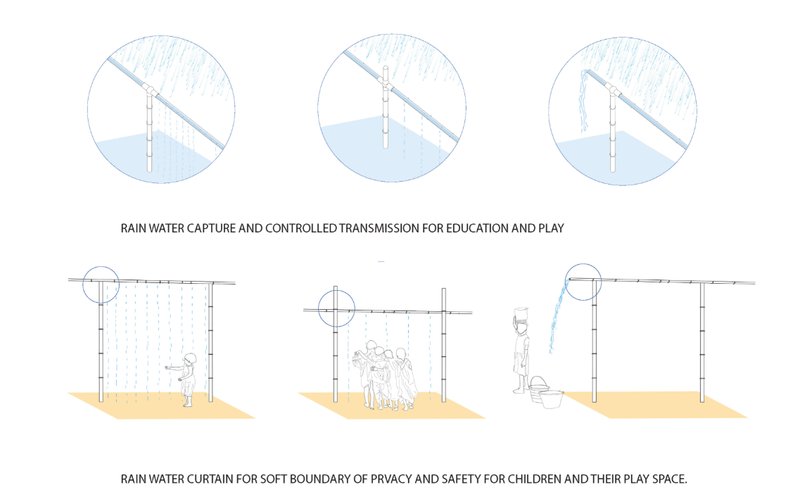
Instead of diverting rainfall away from the site, the architecture captures and celebrates it. Bamboo poles and specially designed openings guide water through controlled pathways, creating interactive rain curtains and water features.
Children can observe, collect, and engage with rainwater as it moves through the structure. These seasonal installations transform climate conditions into memorable learning experiences while teaching concepts related to water management and environmental systems.
The rain curtains also provide soft boundaries that help create privacy, security, and playful interaction zones within the playground.
Accessibility and Inclusive Design
Inclusivity is a central component of the proposal.
The playground incorporates ramps, accessible walkways, and adaptable circulation routes to ensure children of varying abilities can participate in activities throughout the site.
The spatial arrangement encourages social interaction while maintaining flexibility for different age groups and play styles. Open-ended play environments allow children to invent their own games and experiences, fostering creativity and personal agency.
By removing barriers to participation, the project promotes equality and shared ownership of public space.
Flexibility for a Growing Community
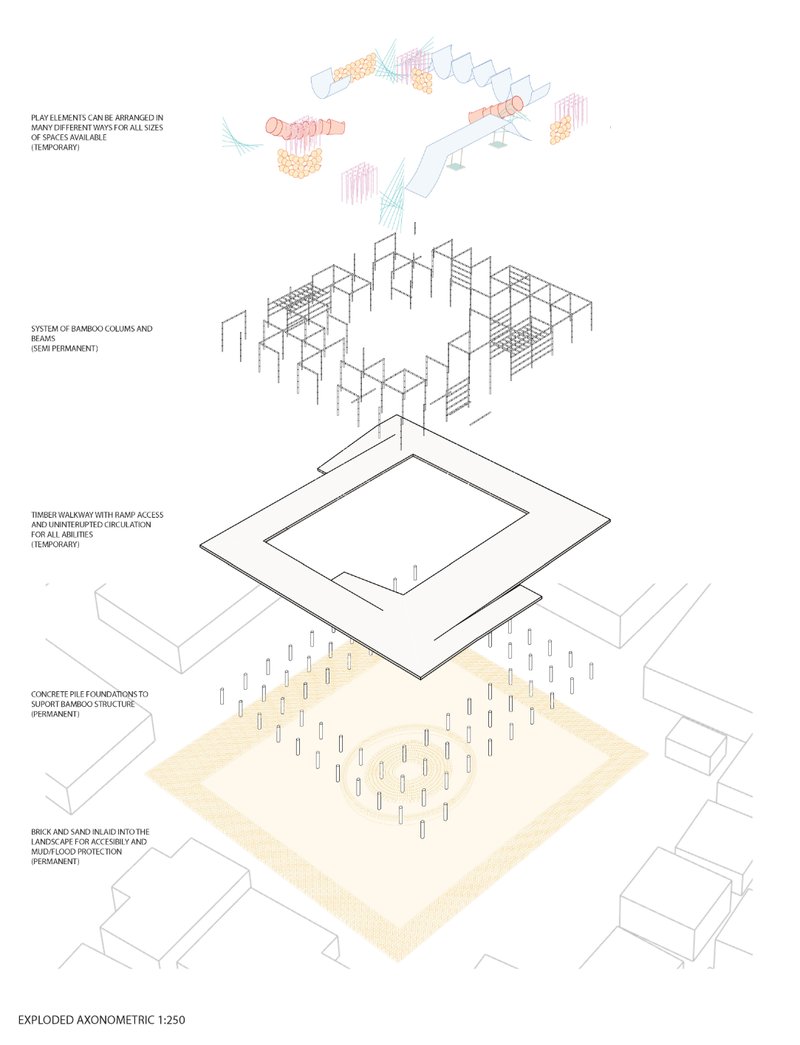
Recognizing the temporary and evolving nature of refugee settlements, the designers developed a modular framework capable of adaptation over time.
Permanent elements such as foundations, landscape interventions, and primary circulation routes establish long-term stability. Semi-permanent bamboo structures support changing spatial configurations, while temporary play installations can be rearranged according to community needs.
This layered approach allows the playground to grow, evolve, and respond to changing circumstances without losing its identity or purpose.
Creating a Permanent Sense of Place
Perhaps the most powerful aspect of Temporary Playground For A Permanent Place is its ability to create permanence through experience rather than construction.
For children living with uncertainty, the playground offers consistency, belonging, and ownership. It becomes a place where memories are formed, friendships are strengthened, and confidence is developed.
The project demonstrates that thoughtful playground architecture can extend far beyond recreation. It can become a tool for healing, education, empowerment, and community building.
By combining local materials, environmental responsiveness, sensory learning, and inclusive design, the proposal establishes a meaningful model for creating child-centered spaces in some of the world's most challenging contexts.
In doing so, Lily Whitehouse, Katarzyna Antoszyk, and Zoe H present a compelling vision of architecture as a catalyst for resilience, transforming temporary conditions into opportunities for long-term growth and human connection.



Popular Articles
Popular articles from the community

R/URBAN DESIGN OFFICE Carves a Communal Living Room from a Tokyo Corporate Dormitory
In Shinagawa's Oi district, a 35-year-old reinforced concrete tower becomes a 49-unit rental residence with shared spaces that redefine cohabitation.
Noue Studio Organizes a Swiss Restaurant Around a Single Concrete Wall
In Granges-Paccot, Switzerland, a 216-square-meter renovation turns raw materials and a central spine into a legible dining experience.
ONA Threads Four Board-Formed Concrete Cabins Along a 260-Meter-Deep Site in Mendoza
At the edge of Argentina's wine country, a set of curved concrete lodges negotiate a razor-thin parcel between city and mountain.

The Flow: Coffee Shop Interior Design Where Time, People, and Process Intertwine
The Flow reimagines Viennese coffee culture through arched forms, warm interiors, music, reading, work, and social gathering.


Similar Reads
You might also enjoy these articles


Urban Forest: A Vertical Ecosystem for 5,000 Workers in Singapore's Changi Business Park
Radially stacked pods and layered green decks turn a 7-acre plot into 47 acres of ecological workspace projected for 2040.
interACT: A Wearable Transit Object That Turns Commuting Into Social Infrastructure
A backpack-mounted foldable device transforms walking, waiting, and riding into moments of shared comfort across Jakarta's transit network.
Lean On Barrier System: Where Traffic Safety Meets Chai Culture in Ahmedabad
A modular steel barrier doubles as informal seating and lean-on furniture at one of Ahmedabad's busiest intersections, keeping vendors in place.

The Black Bagh: A Living Monument Built from Water, Light, and Memory
On the banks of the Yamuna, two designers replace the myth of a marble mausoleum with a regenerative landscape of reflection and ritual.

Explore Conceptual Architecture Competitions
Discover active competitions in this discipline




The International Standard for Design Portfolios


The Global Benchmark for Architecture Dissertation Awards


The Global Benchmark for Graduation Excellence


Challenge to reimagine the Iron Throne
Comments (0)
Please login or sign up to add comments
No comments yet. Be the first to comment!