

TERRAZAS: A Terraced Housing Plugin That Steps Down the Hillside
Locally sourced timber, open-air terraces, and passive ventilation shape a compact dwelling that treats the slope as structure.


What if the hillside itself became the organizing principle of a home? TERRAZAS takes a simple provocation and builds an entire residential system around it: stacked floor plates stepping down a vegetated slope, each one offset to create deep terraces that double as living space, thermal buffer, and garden. The result is a compact housing unit that refuses to flatten its site, instead letting topography dictate section, orientation, and airflow.
Designed by Santiago Zendejas Urquiza and Alejandro Emiliano Domínguez Yáñez, TERRAZAS was entered in the Plugin Housing Challenge 2020, where it received an Institutional Excellence Award. The competition asked participants to rethink the residential unit as a pluggable, adaptable module. Rather than proposing a generic box that could land anywhere, Zendejas Urquiza and Domínguez Yáñez responded with a design that only makes sense on a slope, arguing that site specificity and sustainability are inseparable.
Timber Thresholds and the Ground Plane
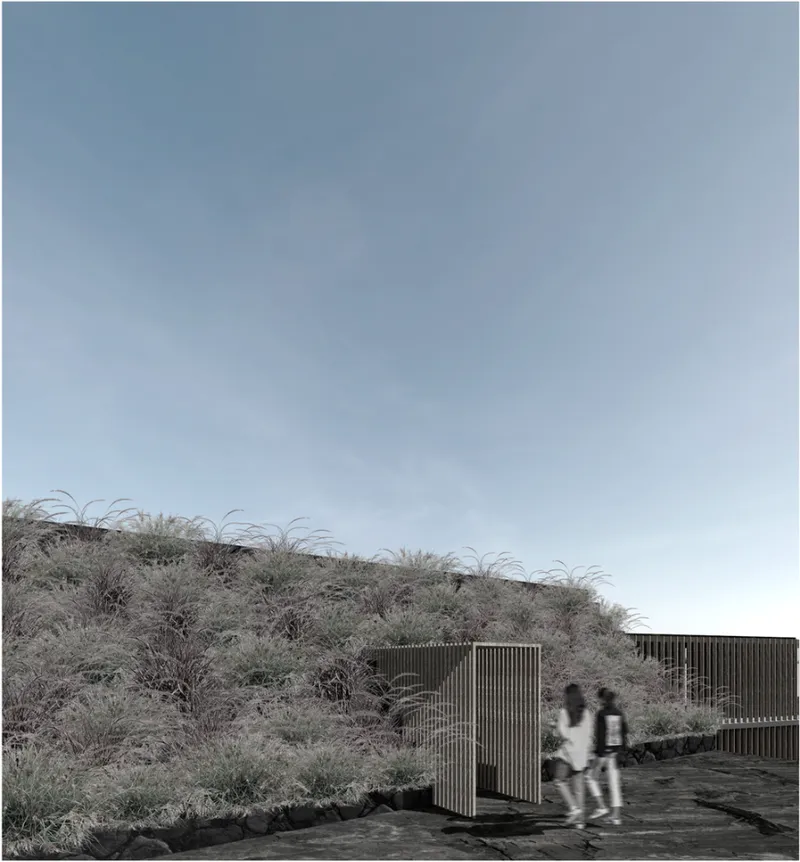
The entry sequence sets the tone. A timber-slatted gateway frames a concrete terrace that meets the vegetated hillside at grade, blurring the line between built surface and landscape. Two figures pass through the portal, their scale confirming the intimacy of the threshold: this is not a grand entrance but a calibrated transition from exterior to interior. The use of locally sourced timber slats introduces a material language that recurs throughout the project, filtering light and air while keeping the structure visually permeable.
Stepping Down: The Terraced Section
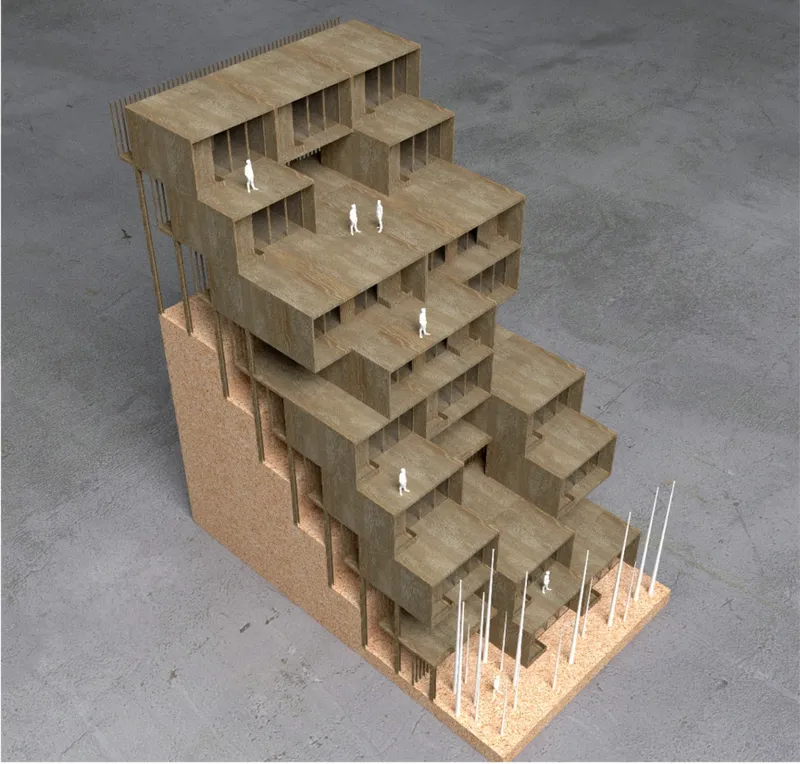
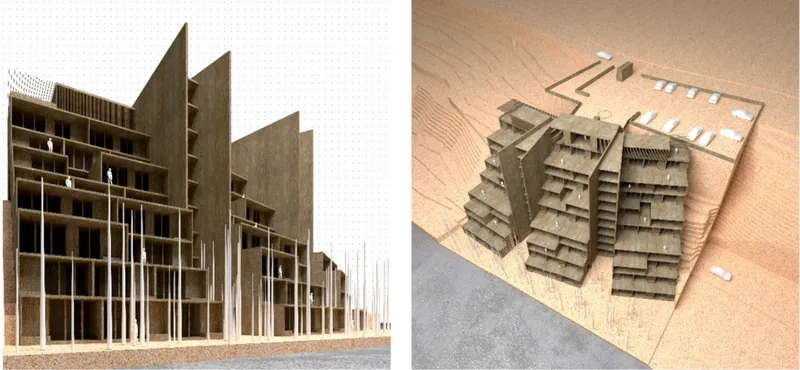
The axonometric model reveals the core move. Terraced volumes cascade down the slope, each floor plate shifted back to expose the roof of the level below as a usable outdoor terrace. Beneath the lowest tier, exposed timber pilotis lift the structure off the ground, allowing water and air to pass freely underneath. The logic is straightforward: the slope provides the section, the offsets provide the terraces, and the pilotis provide ventilation beneath the building mass.
A sectional model and roof plan further clarify the spatial strategy. Stacked floor plates are organized around a central courtyard that pulls daylight deep into the plan, while the stepped massing ensures that every unit has direct access to an outdoor terrace. The courtyard also functions as a stack ventilation chimney, drawing hot air upward and replacing it with cooler air from the shaded lower levels. Every element is doing double duty.
Vertical Fins and a Facade That Breathes
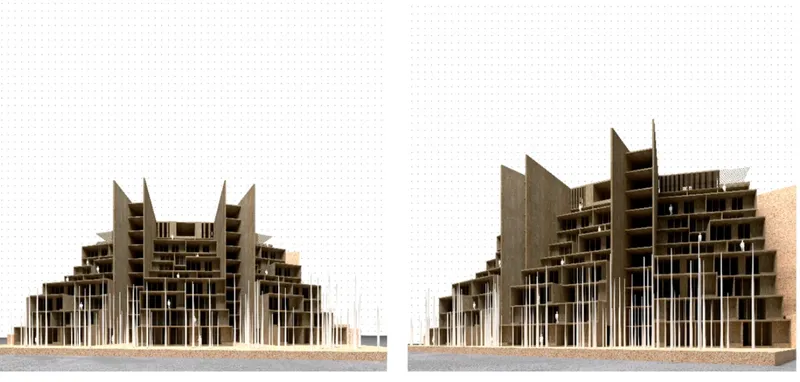
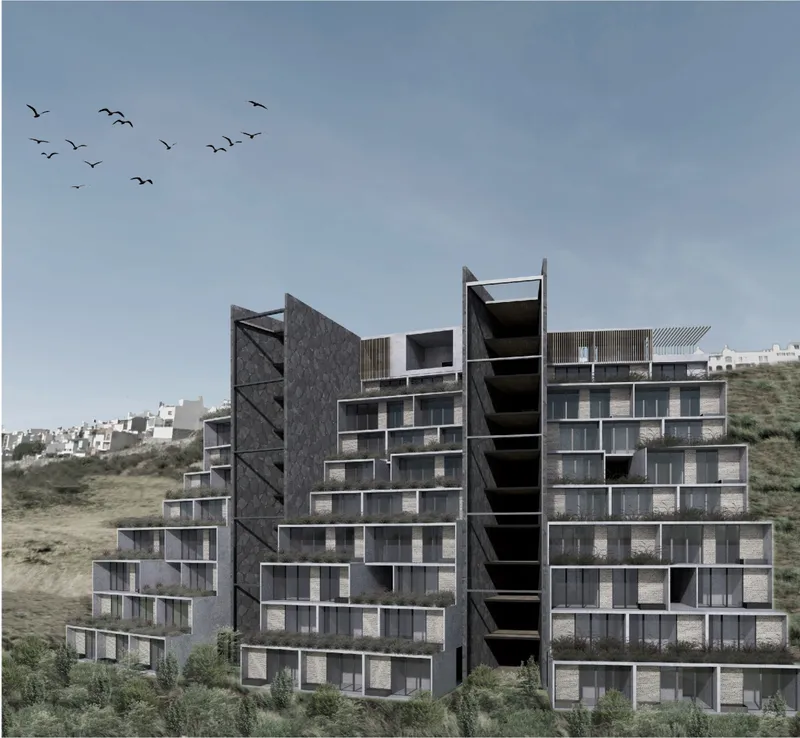
Elevation studies show a stepped facade articulated with vertical timber fins. These fins are not decorative: they control solar gain on the exposed faces while maintaining views and ventilation. At ground level, the pilotis create a porous base that keeps the building connected to the landscape rather than sealed off from it. The two elevation views confirm that the stepping is consistent on both the uphill and downhill facades, giving every dwelling unit an equivalent relationship to sky and ground.
A rendered view places the housing block in its hillside context, and the effect is striking. The building reads less as an object imposed on the land and more as a geological formation that has been inhabited. Birds overhead and dense vegetation on either side reinforce the sense that this is architecture designed to coexist with its ecosystem rather than displace it. The passive design strategies, from maximizing natural light to enhancing cross-ventilation through strategic openings, are legible in the facade itself.
Reading the Landscape: Site Section and Water Strategy
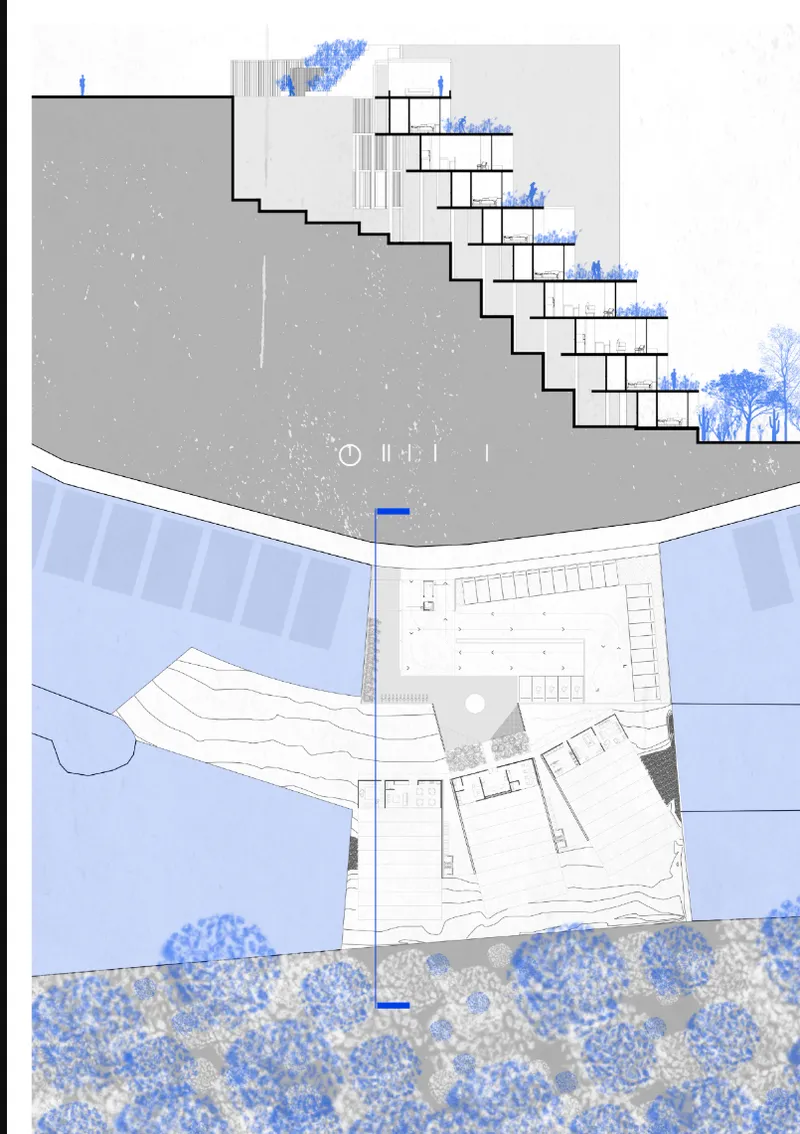
The site section and plan drawing pulls back to show the full relationship between building and terrain. Terraced volumes descend the slope in a staggered rhythm, with water bodies and dense vegetation woven into the gaps between structures. These water features are not ornamental; they serve as thermal sinks that cool the surrounding air before it enters the living spaces. The drawing also reveals how the designers preserve existing vegetation patterns, routing the building mass around mature trees rather than clearing the site.
What holds the scheme together is its refusal to separate landscape strategy from architectural strategy. The green spaces, terraces, water bodies, and timber structure are all part of one integrated system. Space is optimized rather than maximized: every square meter serves a functional purpose, whether as a planting bed that regulates temperature, a terrace that extends the living area outdoors, or a piloti zone that enables natural drainage beneath the building.
Why This Project Matters
TERRAZAS demonstrates that the plugin housing concept does not require generic, site-agnostic modules. Zendejas Urquiza and Domínguez Yáñez show that a modular logic can emerge from topography itself: the repeating unit is a terraced floor plate, and the slope determines how many plates stack, how far they offset, and where the courtyards and water features land. The approach is replicable on any hillside site without being interchangeable, which is a far more useful definition of adaptability than a box that plugs into a grid.
At a moment when housing discourse often polarizes between high-tech prefab solutions and romantic vernacular revivals, TERRAZAS occupies productive middle ground. Its passive ventilation, locally sourced timber, and integrated green spaces are rooted in traditional wisdom, but the sectional ambition, the courtyard typology, and the piloti structure are unmistakably contemporary. The project earned its Institutional Excellence recognition by proving that sustainability and spatial generosity are not competing goals. They are the same goal, expressed through section.
View the Full Project
About the Designers
Designers: Santiago Zendejas Urquiza, Alejandro Emiliano Domínguez Yáñez
Enter a Design Competition on uni.xyz
uni.xyz runs architecture and design competitions year-round that reward proposals with spatial conviction and real site intelligence.
Project credits: TERRAZAS by Santiago Zendejas Urquiza, Alejandro Emiliano Domínguez Yáñez Plugin Housing Challenge 2020 (uni.xyz).


Popular Articles
Popular articles from the community


The Amber Palace Opera: A Geological Fiction Surfaces on Tallinn's Baltic Waterfront
Pierre Brillard reimagines a Baltic legend as a public landscape, opera house, and waterfront promenade rooted in Tallinn's coastal identity.
Extended Shell: Retrofitting Kolkata's Balconies as Living Urban Thresholds
A modular retrofit system recovers the social and environmental intelligence of Kolkata's historic verandas for contemporary Park Street residents.

Temporary Home for Dogs: A Reversed Zoo Rethinks Animal Shelter Architecture
In Bucharest, a sinuous corridor and freed landscape flip the logic of containment, designing a shelter that works to make itself unnecessary.

Opera on the Sea: Driftwood Logic Shapes a Timber Opera House on Estonia's Coast
Trevor Orgill's opera house translates the entangled drift of floating timber into a civic building where wood, water, and music converge.

Similar Reads
You might also enjoy these articles

Shakur's House: Exposed Brick as an Interior Organiser in a 168 m² Mashhad Residence
Brick moves indoors in this Mashhad residence, where masonry walls, glass partitions and teal planes sequence a compact home without closing it off.

Day and Night Park: A Time-Based Urban Newsstand in Beijing
A temporary urban newsstand in Beijing blending travel, light, and reading through poetic colors, compact form, and community-focused design.

Modernist Patio Renovation in El Masnou, Barcelona by Oliver Segura Arquitectura + Cebrià Arquitectura
Modernist patio renovation blending tradition and innovation with a movable pool, leveled floors, and Catalan materials in El Masnou.

Alto Residencial Coop: Cooperative Housing Development in Santiago de Compostela by Carbajo Barrios Arquitectos
A linear cooperative housing complex blending white volumes and perforated metal façades, enhancing community living, natural light, privacy, and urban integration.


Comments (0)
Please login or sign up to add comments
No comments yet. Be the first to comment!