
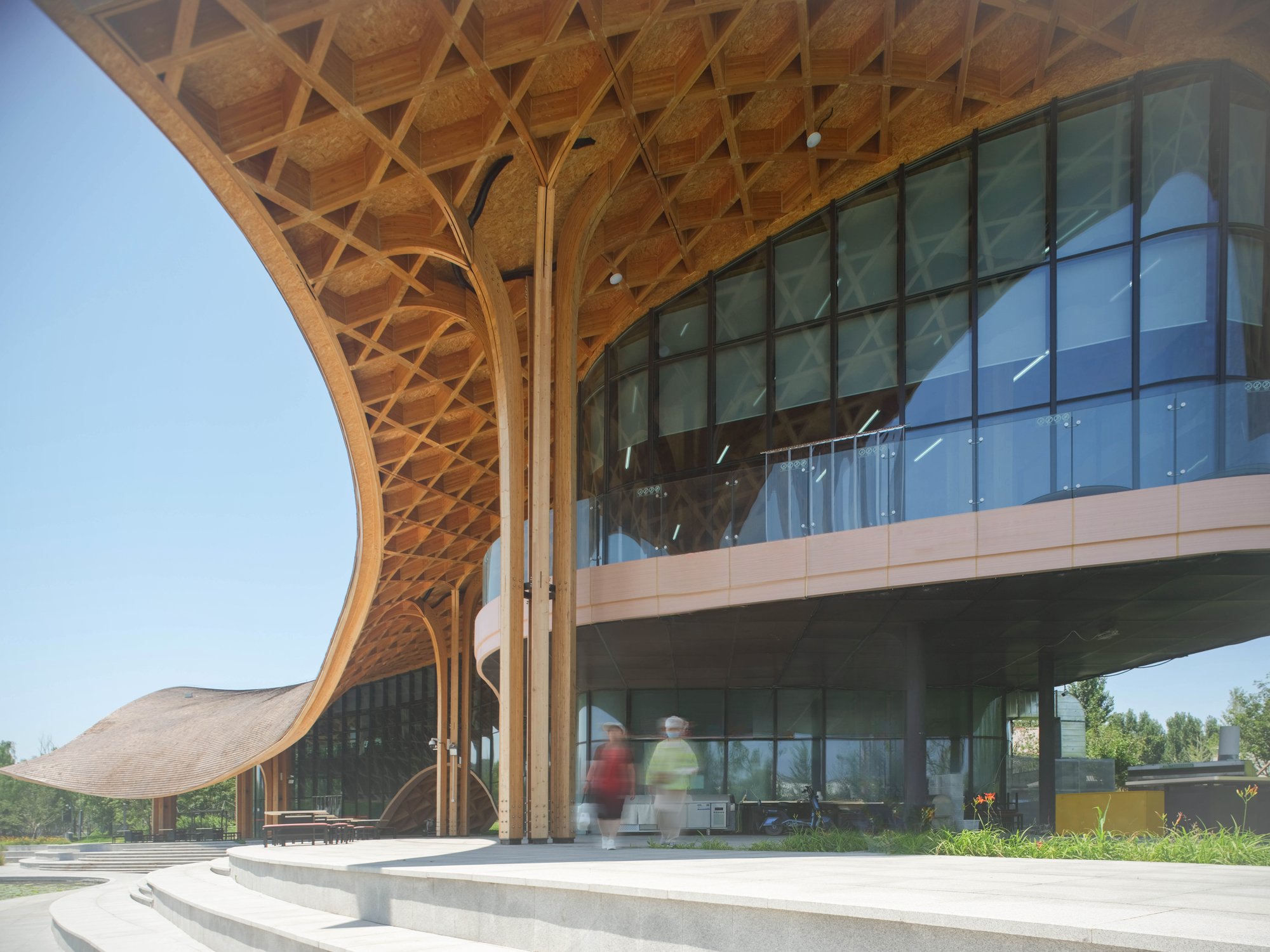
THAD SUP Atelier Weaves a Timber Canopy into a Lakeside Restaurant at Dingzhou's Garden Expo
A woven wooden gridshell unfurls along a curved shoreline in Baoding, China, turning a dining hall into a forest clearing.

There is a familiar instinct in park architecture to disappear into the landscape, to flatten a building until it reads as little more than topography with plumbing. The Lakeside Restaurant at Silk Road Friendship Park, designed by THAD SUP Atelier and led by principal architects Song Yehao and Chen Xiaojuan, takes a different route. It announces itself. The building's undulating timber gridshell canopy rolls along the curved shoreline of the Dingzhou Garden Expo's central lake like a wave frozen mid-crest, its coffered underside casting patterned shadows across a glass curtain wall. At 2,400 square meters, it is not a small gesture, yet its material warmth and structural logic keep it from feeling overbearing.
What makes this project genuinely interesting is how the architects collapsed a conventional restaurant program into a single, legible structural idea. The woven wooden shell does almost everything at once: it shelters, it shades, it creates the interior atmosphere, and it defines the public realm underneath. The result is a building that reads differently at every scale. From across the lake, it is a sinuous landform. From beneath its overhangs, it is a forest canopy. At the dinner table, it is an intricate timber ceiling. That kind of telescoping experience, where one structural move delivers spatial variety without formal gymnastics, is hard to pull off.
A Roof That Does the Talking
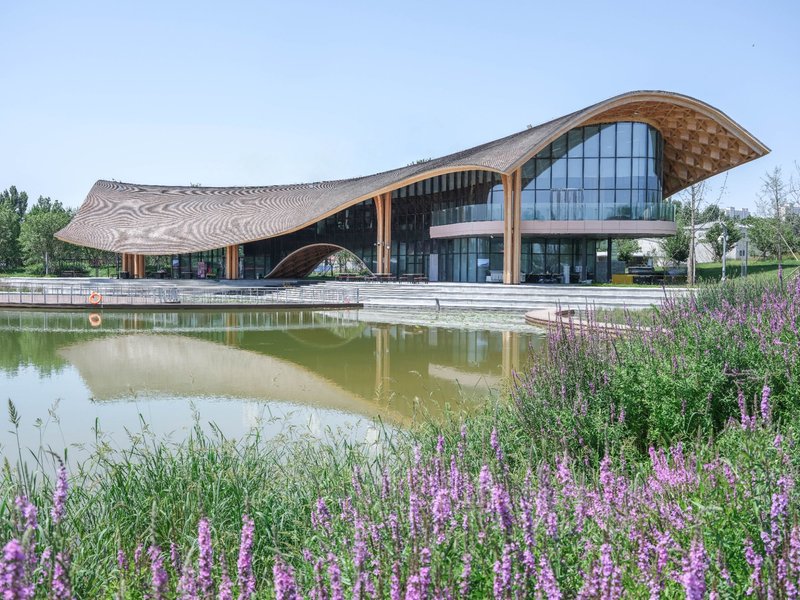
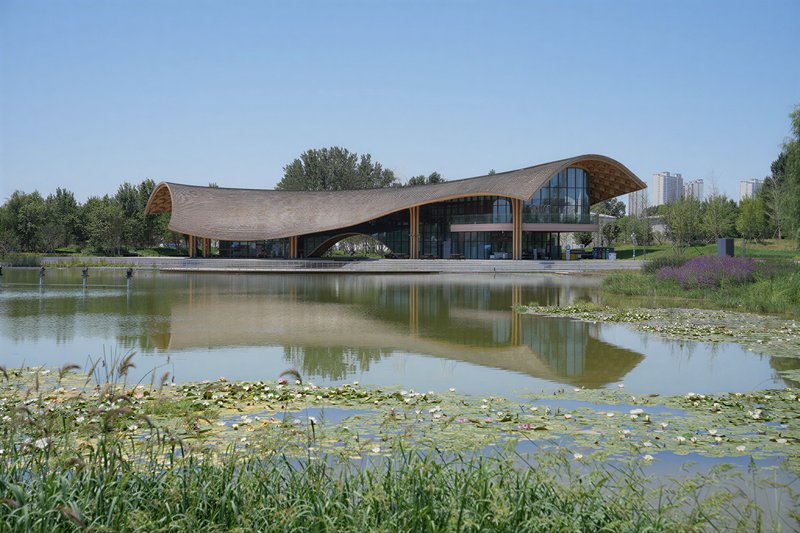
Seen from across the lily-covered pond, the restaurant registers primarily as a roof. The undulating timber shell rises and dips along the shoreline, its geometry following the curve of the water's edge rather than imposing a rigid footprint on it. The patterned underside of the canopy is visible even at a distance, giving the building a layered texture that shifts with the light. Distant residential towers and parkland trees frame the composition without competing with it.
The architects drew their visual language from two sources: the forest canopy above and the lake surface below. The curved form echoes both. Purple flowering plants along the near shore further soften the boundary between water, planting, and building, a calibrated gradient that makes the structure feel settled rather than imposed.
Approaching Through Water and Light
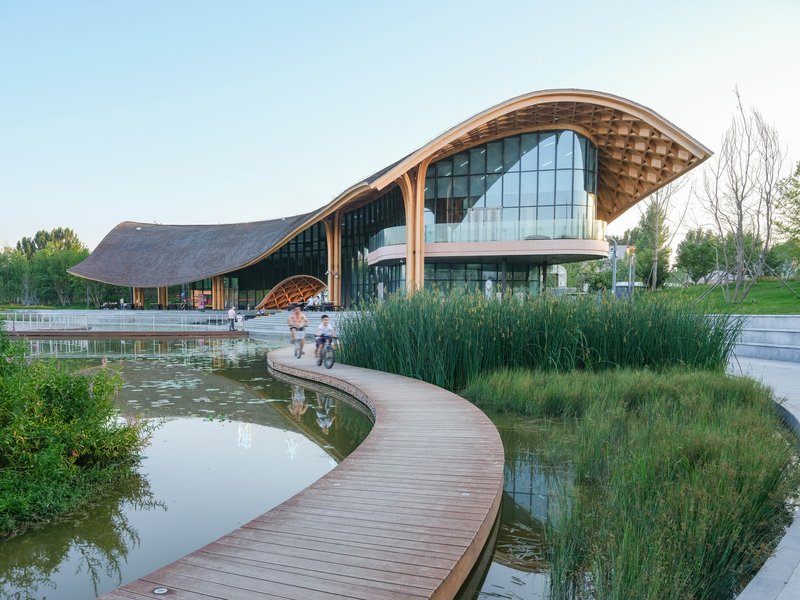
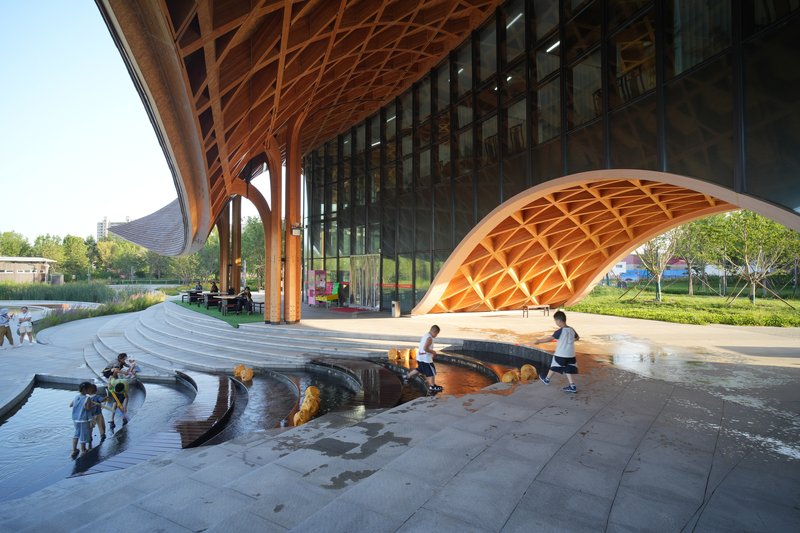
The arrival sequence is deliberately slow. A curved timber boardwalk threads through planted wetland grasses, leading visitors toward a vaulted glass entrance that glows at dusk. The building slopes gently from south to north along the shoreline, so the approach never feels like a confrontation with a facade. Instead, the roof seems to lower itself toward you as you walk, drawing you under its shelter.
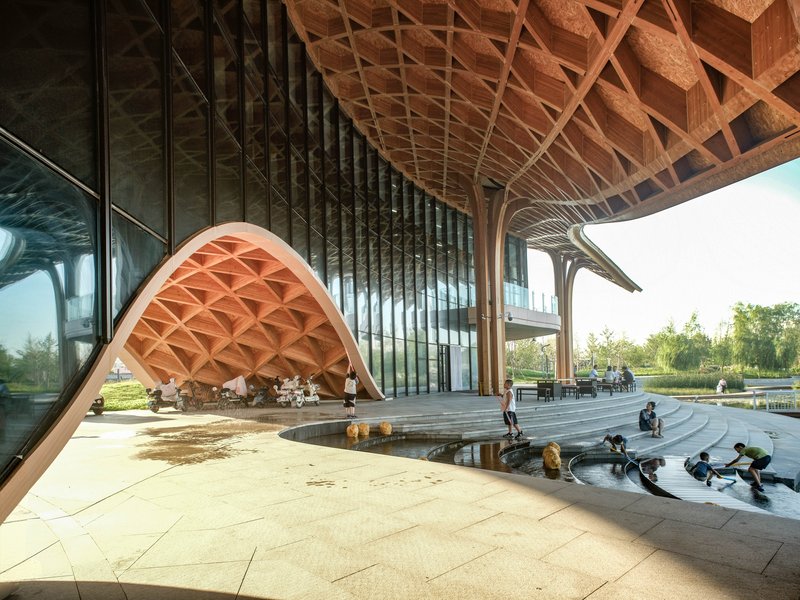
Beneath the canopy, a generous sheltered plaza opens up around a shallow water feature where children wade and play. This is one of the project's smartest moves: programming the ground level as a public gathering space rather than reserving all the real estate for paying diners. The coffered timber roof and reflective glass curtain wall overhead create a sense of enclosure without walls, an outdoor room that feels covered but never enclosed. The sequence the architects describe, arrival, view, lingering, is legible in the way people actually use the space.
The Woven Gridshell Up Close
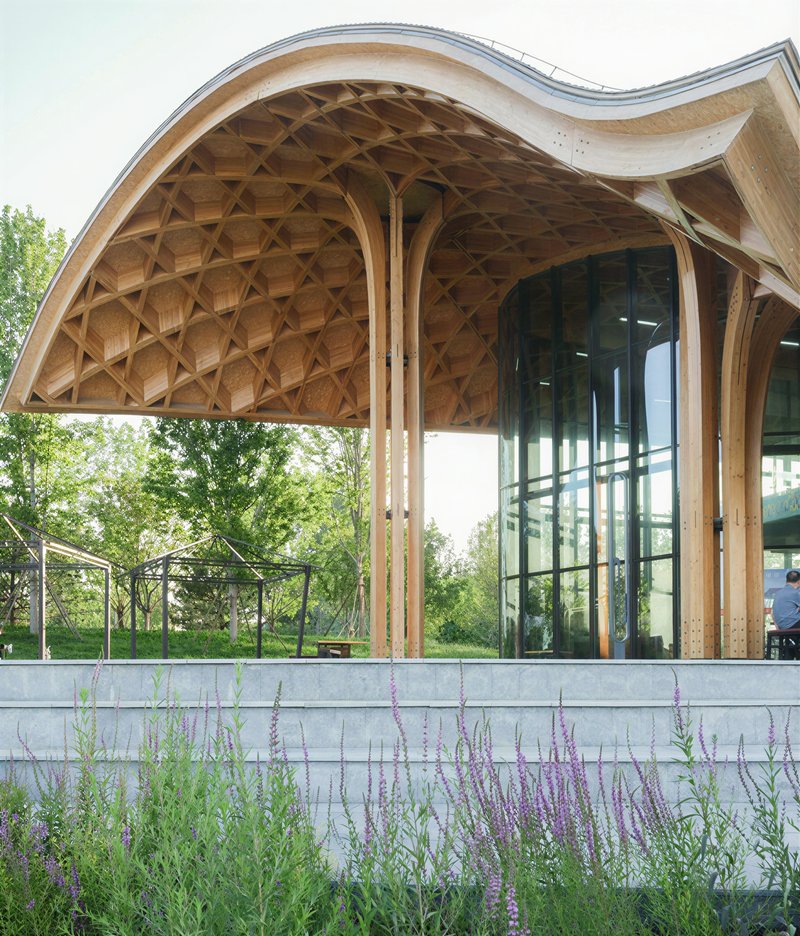
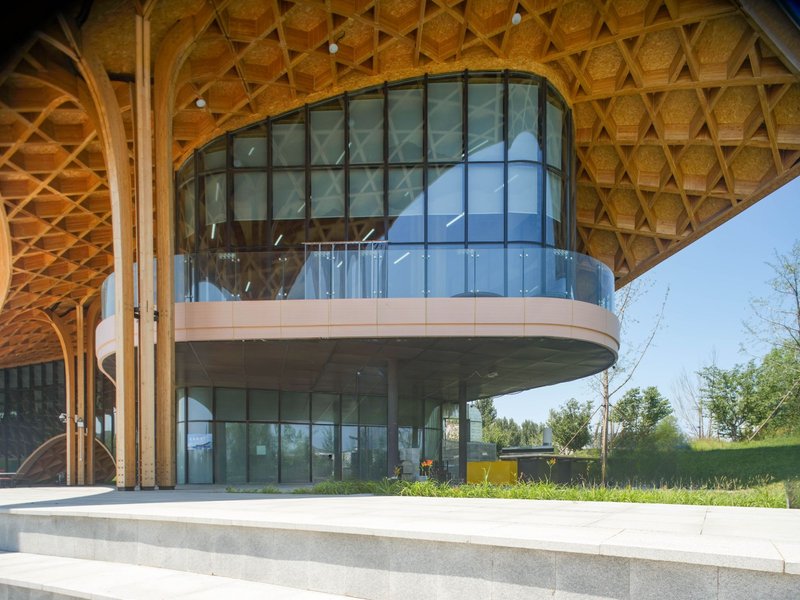
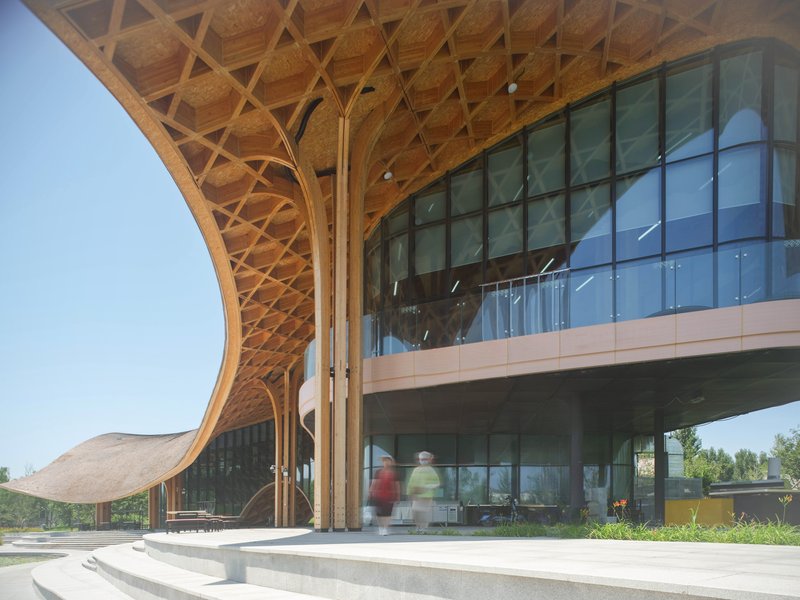
At closer range, the structural ambition of the project becomes clear. The timber gridshell is not simply decorative cladding over a steel frame. Branching wooden columns rise from the terrace level and fan outward into the triangulated lattice of the canopy, a structural logic that mirrors the way tree trunks split into branches. The geometry is free-form and curved, yet every member is doing real work. Where the canopy cantilevers over the terrace edge, the lattice tightens, concentrating material where the stresses are highest.
The interplay between timber and glass is carefully managed. Floor-to-ceiling glazing wraps the upper level, while the lattice projects a shifting pattern of shadows across the glass surface throughout the day, a passive shading strategy that also gives the interior a forest canopy effect. It is an honest detail: the structure does the shading, and the result is both performative and atmospheric.
Dining Under the Canopy
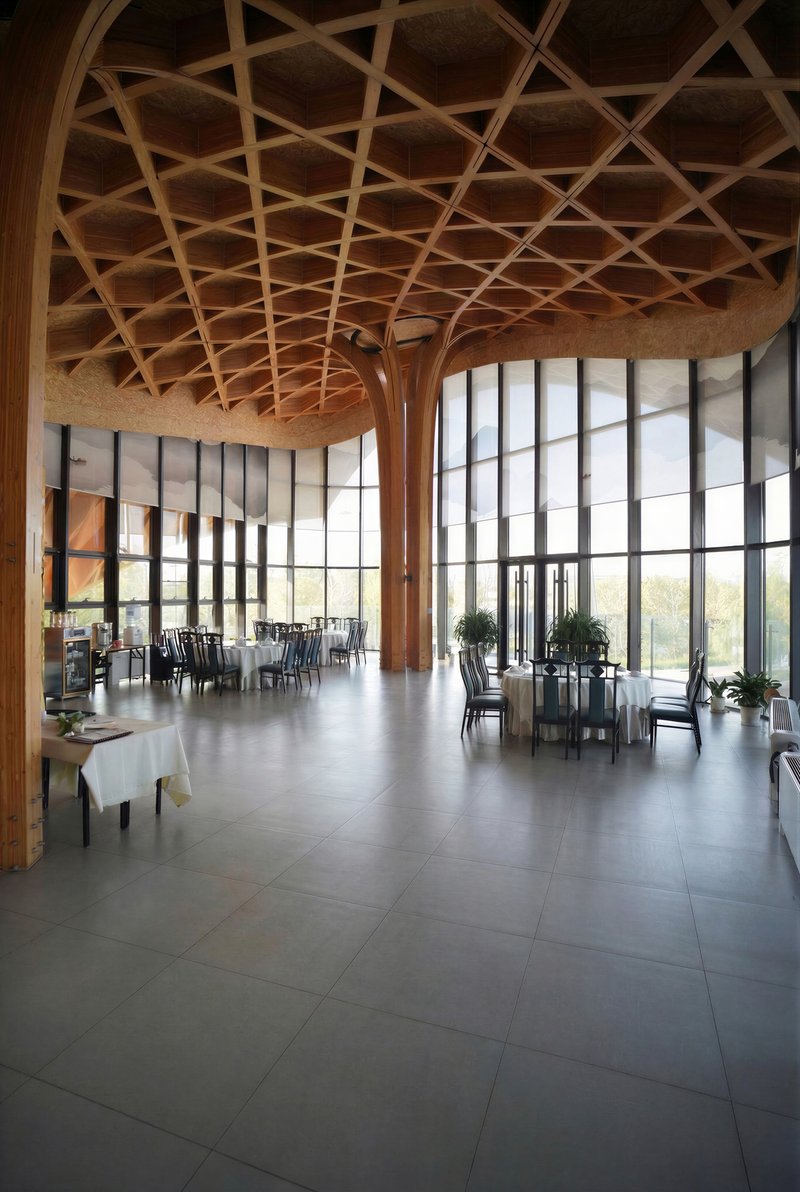
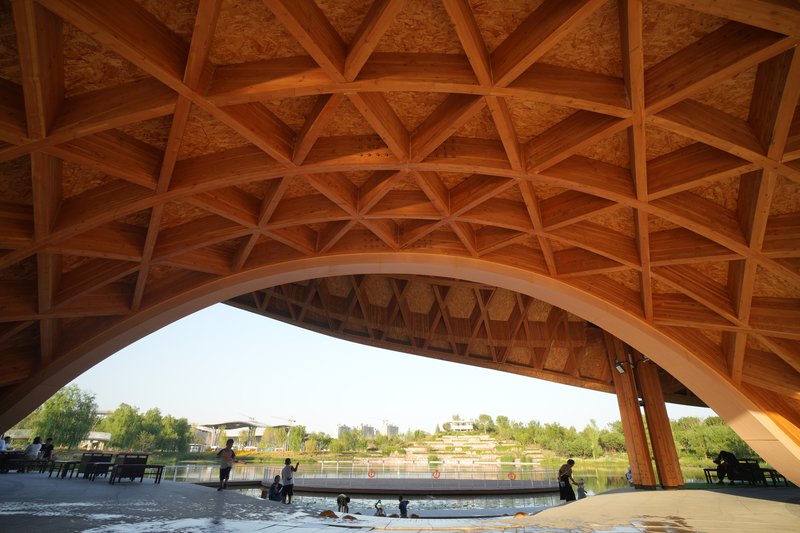
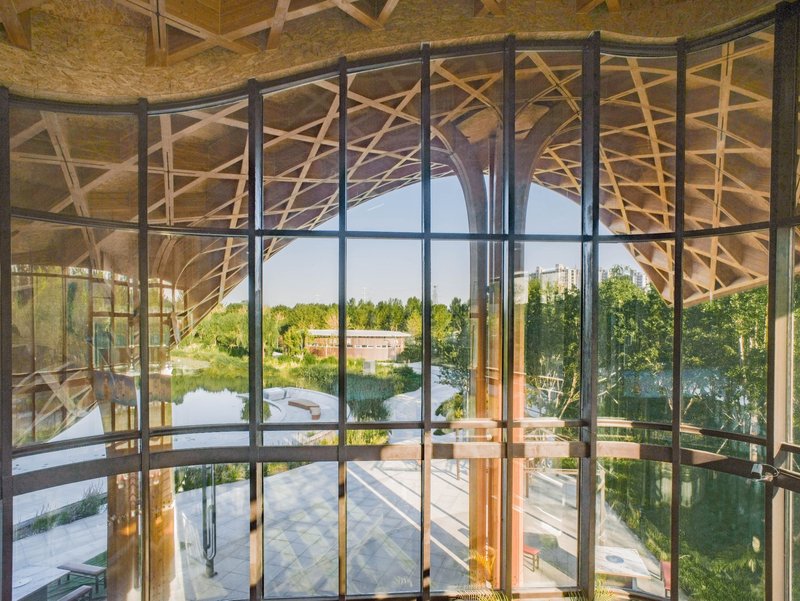
Inside, the timber lattice ceiling dominates. The coffered gridshell overhead is continuous from exterior to interior, so the transition from terrace to dining room feels seamless. Branching wooden columns punctuate the space at irregular intervals, reinforcing the forest metaphor without overdoing it. The curtain wall disappears visually, leaving diners with an uninterrupted panorama of the pond and the planted landscape beyond.
Three sides of the building open toward the lake, while the west facade is relatively closed, concealing the kitchen and back-of-house areas. This asymmetry is smart: it concentrates the views where they matter and keeps the service infrastructure invisible. The result is an interior that feels expansive and oriented rather than uniformly glazed. Steel-framed mullions reflect the timber lattice above, creating a doubling effect that deepens the visual field.
Terrace, Threshold, Reflection
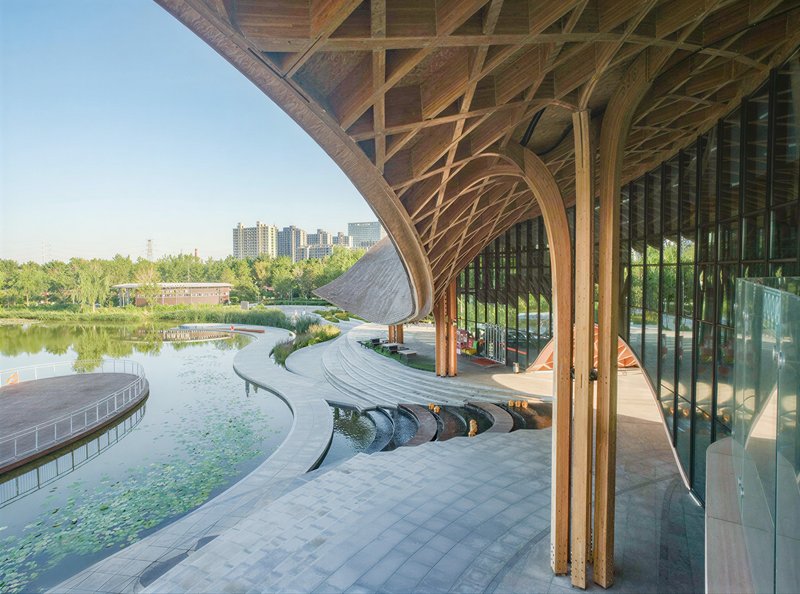
The covered terrace is the building's social heart. Timber columns and the lattice roof frame views outward toward a shallow reflecting pool, while the overhanging canopy creates a layered corridor space that serves as both circulation and pause. You can sit, eat, or simply stand and watch the water. The generous depth of the overhang means this zone is usable in rain and in strong sun, a practical consideration that also produces the building's most atmospheric moments: light filtering through timber, shadows pooling on water.
The reflecting pool at grade is a quiet masterstroke. It extends the lake's presence right up to the building's edge, blurring the threshold between architecture and landscape. When still, the water doubles the canopy above. When children splash through it, the whole composition comes alive.
Plans and Drawings
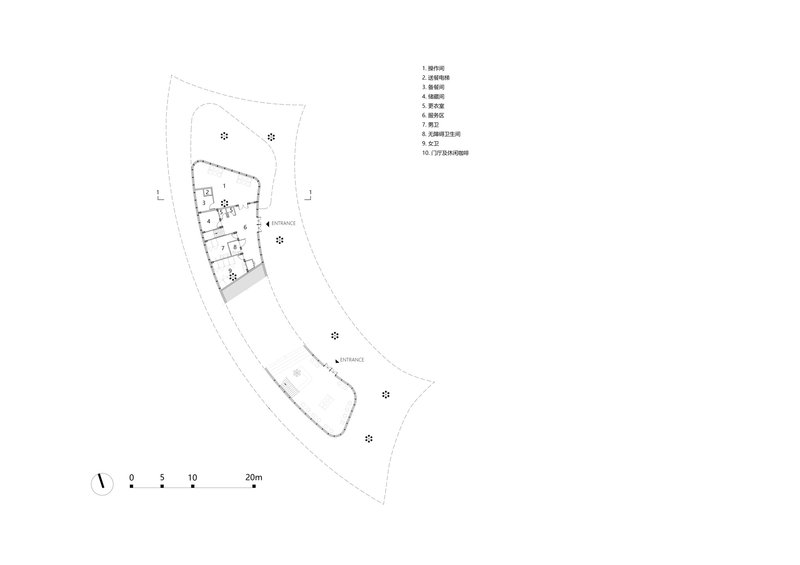
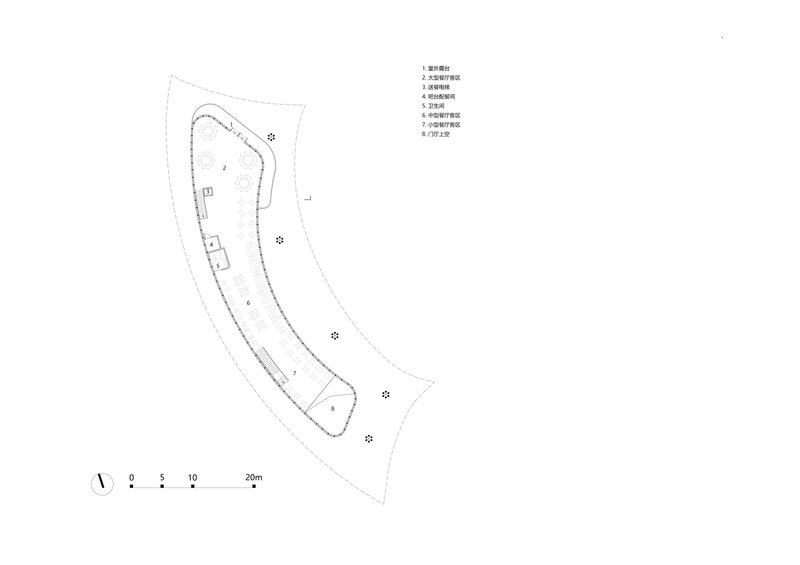
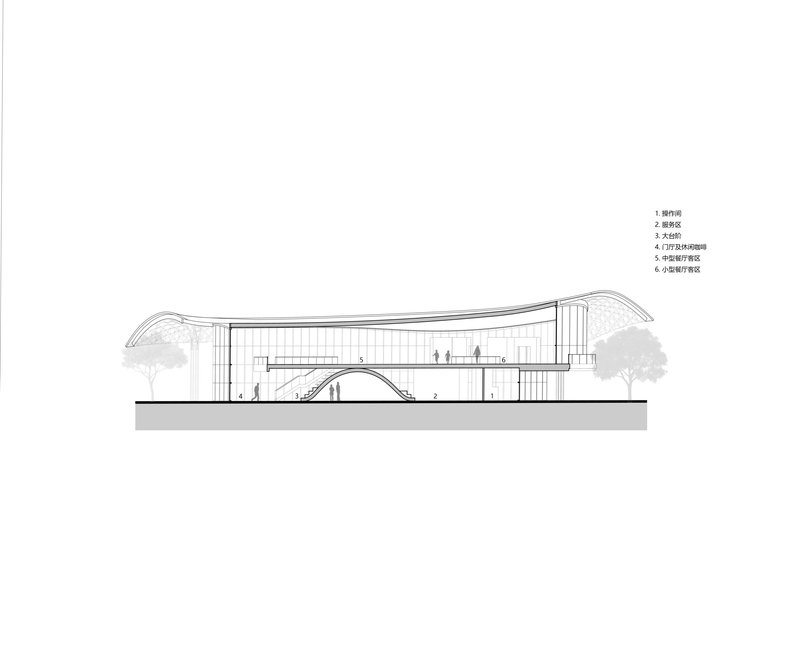
The site plan reveals the building's elongated, curved footprint, a slender volume that hugs the lake's edge within a larger landscape boundary. The floor plan shows rooms arranged along one side of this curving spine, with the open dining and public areas occupying the lakeside face and the service functions tucked into the closed western edge. It is a simple, linear organization that the roof's exuberance might lead you not to expect.
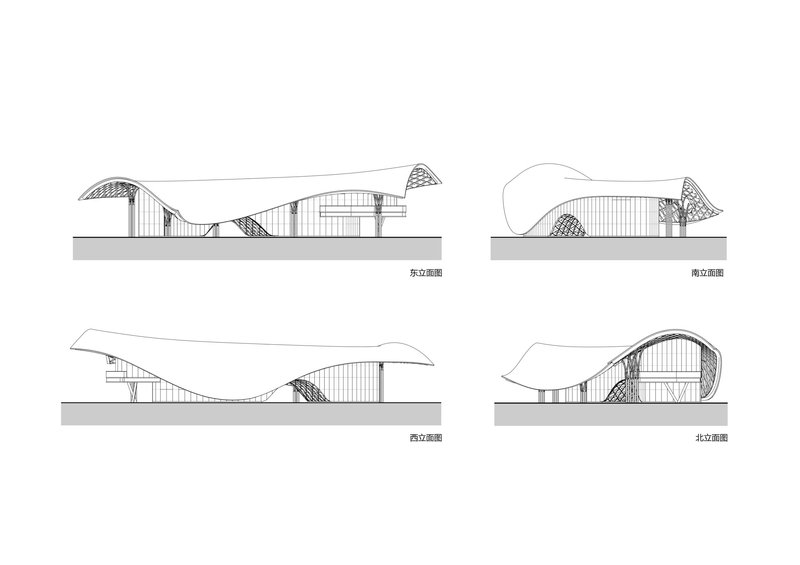
The elevations and section are where the roof's drama reads most clearly. The undulating profile rises to double-height volumes at key moments, creating spatial peaks that correspond to the main dining hall and the central arch opening at ground level. Vertical fenestration patterns between the timber members give the facades a rhythmic texture, while the section confirms the generous overhang depths that make the terrace zones so habitable. Human figures in the section drawing underscore the scale: this is a building that towers overhead at its peaks yet meets the ground gently.
Why This Project Matters
Expo pavilions and park restaurants are easy to get wrong. They either overperform, reaching for iconic shapes that age badly once the event fades, or they underperform, offering bland service boxes that no one remembers. The Lakeside Restaurant threads this needle by investing everything in one structural idea, the woven timber gridshell, and letting that idea generate the plan, the section, the environmental strategy, and the public space simultaneously. The restraint is in the palette: wood, glass, water, and not much else.
THAD SUP Atelier has built a restaurant that works harder than its category suggests. It is a public plaza, a shading device, a landscape gesture, and a dining room, all held together by a canopy that looks like a forest but behaves like a machine. In a cultural park layered with the historical significance of the Silk Road, the building does not lean on iconography or nostalgia. It offers something more durable: a structure that feels inevitable on its site, as though the trees along the shore simply decided to reorganize themselves into architecture.
Lakeside Restaurant at Silk Road Friendship Park by THAD SUP Atelier (principal architects Song Yehao and Chen Xiaojuan). Baoding (Dingzhou), China. 2,400 m². Completed 2025. Photography by Xinxing Chen and Xiaoqing Guan.
About the Studio
Share Your Own Work on uni.xyz
If projects like this are the kind of work you want to make, uni.xyz is a place to publish your own, find collaborators, and enter design competitions.




Popular Articles
Popular articles from the community

Reincarnation Weaves a Three-Story Retreat into the Green Landscape of Rural Bangladesh
Ara Manor in Narsingdi dissolves the line between domestic architecture and its lush surroundings through screens, courtyards, and planted rooftops.

Milan Crossover: Sustainable Architecture for a New Fashion Culture in Milan
Milan Crossover transforms fashion culture through sustainable architecture, linking material libraries, remake studios, and public runways.
The Faith: Modular Architecture for Play, Learning, and Hope in Kutupalong Refugee Camp
A modular playground architecture project in Bangladesh where play, learning, safety, and hope rebuild childhood inside a refugee camp anew.
Kaffeebühnen: Coffee Shop Architecture Designed as a Civic Stage Between Vienna’s City and Park
Kaffeebühnen turns coffee shop architecture into a civic stage, linking Vienna’s park edge, urban life, warm timber yards, and coffee craft.


Similar Reads
You might also enjoy these articles
Freebird Residence by Alexis Dornier: A Tropical Modernist Sanctuary in Bali
Floating living pavilion above pool anchors H-shaped tropical villa, blending Japanese minimalism, sustainable strategies, lush landscape, and sculptural interiors.
127af Flips a Tiny Bagnolet Rowhouse Upside Down with a Handcrafted Roof Extension
A 55-square-meter terraced house on the edge of Paris gains a luminous upper living floor through lightweight timber and steel.
1.61 Design Workshop Wraps a 600-Square-Meter Café in Vietnam in Sculptural Burgundy Drama
Reden Café & Bistro pairs a helical staircase, mosaic floors, and deep red interiors to rethink Vietnamese hospitality space.

The Unbound Brain: A School Shaped by Cognitive Architecture
Cylindrical learning pods radiate like neurons from a central cortex, turning the floor plan into a spatial model of human thought.




Comments (0)
Please login or sign up to add comments
No comments yet. Be the first to comment!