
The Alp Cocoons
/ an oasis from urban buzz

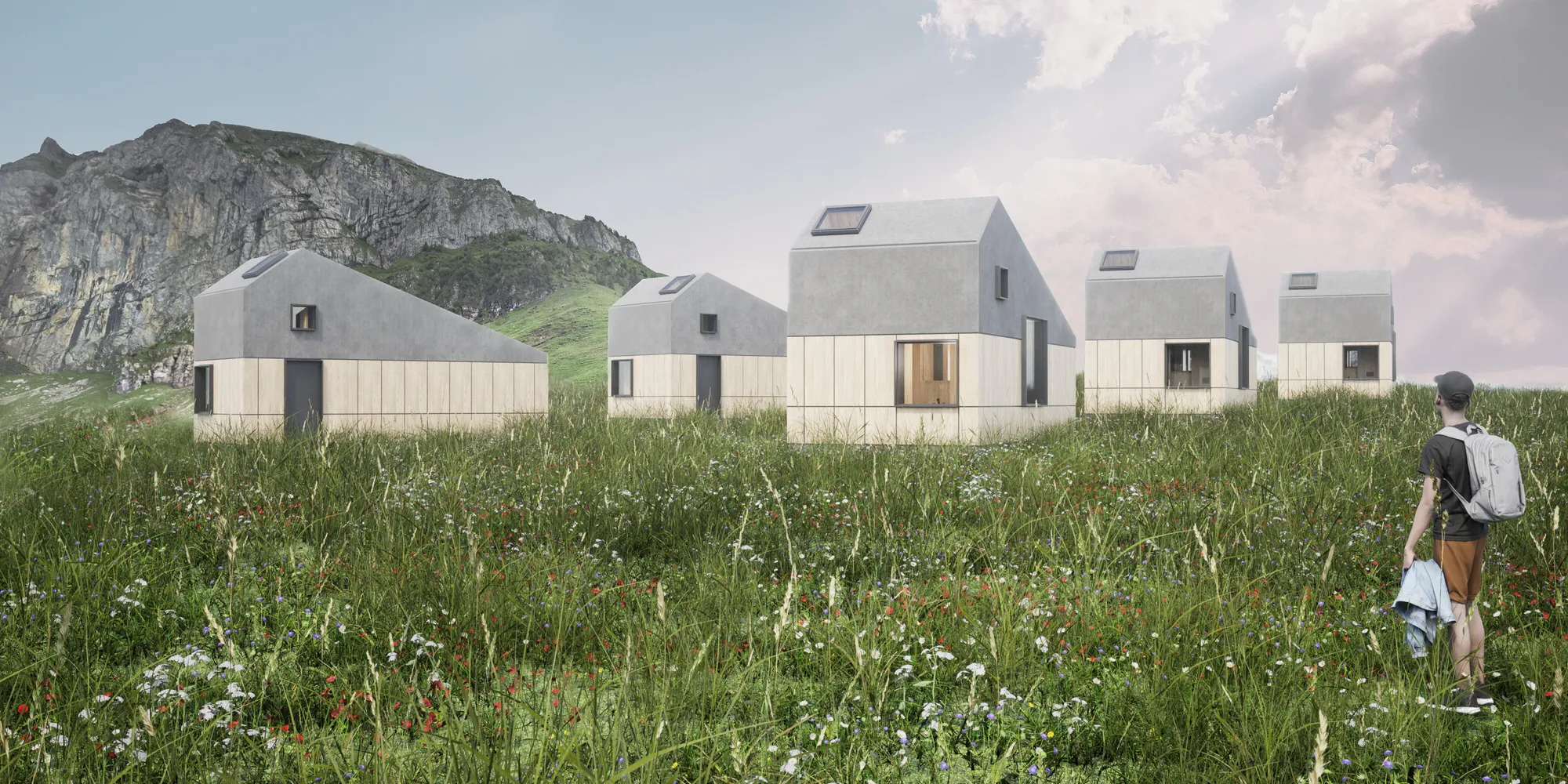
Nowadays in fast, overstimulated mundane everyone is looking for a quiet space which gives possibilities to regenerate and hide from an urban buzz. People are paying more and more attention to their well-being and appreciate spending free time in the quiet and beautiful natural surroundings. Mountains, for plenty of people, are this kind of oasis where every problem disappears and you can focus on the magnificent landscape and on yourself. Following those crucial aspects the alp cocoons were designed.
Site for those pods has been chosen next to the Morgenberghorn which is a Bernese Mountains peak in the Bernese Oberland. It is located north of Schwalmere at the northernmost point of the chain, between the valleys of Frutigen and Lauterbrunnen. It is one of the most picturesque and recognizable mountains. While the Morgenberghorn Climb is a strenuous walk with a 1300-meter incline, and the panoramic point which offers the greatest view of Lake Thun in the area.
Comfortable pods in famously scenic settings not only bring hikers and tourists a peaceful hideaway, but also provide facilities which enrich visitors' experiences and offer them a place to stay for a while.
the idea
Designing process has been started from determining main view directions: on The Morgenberghorn mountain, Thun lake and outstanding Alps panorama. Then six pods have been located on the site respectfully to each other’s view axes. In the middle, alongside development the social integration zone has been naturally formed. Additionally a pathway leading towards each cocoon has been designed which connects the alps cocoon village with mountain shelter nearby.
The buildings have been designed to be as compact as possible but still including every necessary function such as the vestibule, kitchen, bedroom upstairs, living room and bathroom which are specifically targeted to observe and admire marvelous nature around. In the pod there is implemented a lot of hidden storage which could be used for pantry or skiing/hiking equipment.
The main idea was to create a feeling of coziness and sense of space by dividing all of the pods into three segments differing in state of openness. Thanks to this solution we obtain various levels of privacy:
SEGMENT 1 CLOSED
- one closed with vestibule and bathroom filled with wide range of storage
SEGMENT 2 SEMI CLOSED
- with bedroom and a space for reading or relaxing while admiring the vast view of the alps panorama
SEGMENT 3 OPEN
- with a kitchen and a living room equipped with enormous windows inviting the landscape inside the pod
In addition, the part of the segment 3 with the living room is designed under ground level, in order to use ground thermal properties to warm the building and reduce the heat loss.
functional system and construction
Distribution of specific functions is inspired by a vernacular alps houses i.e. entrance with closed vestibule and storage, kitchen in the central position and dormitory upstairs. Moreover, the form of the building is maintained in a regular, rectangular shape and volume, to minimize difficulties related to placing the building on inclined terrain. Roof is typically two-pitched but with contemporary touch, made from irregular stone slabs. Facades are finished with a combination of stone and wood and for insulation is used natural material in the form of sheep’s wool which is a traditional technique.
Construction is made of prefabricated SWISS KRONO MAGNUMBOARD® OSB modules which enable rapid assembly of the entire building from individual wall, roof and ceiling modules. The company which provides the modules is from Switzerland and stands for local sustainable resources and low carbon footprint in the whole design process.
form of building merged with the landscape
The shape of the pod not only refers to the vernacular architecture but also to the mountainous landscape. The idea was to form a small village embedded in the terrain in that manner that the buildings merge with the ground and compose one united entity. The pitched roofs are covered with various species of local plants that create new hills in the surrounding area.
the roof
As mentioned above, the roof of the pod is pitched and designed in a way that provides space for a photovoltaic solar system on the south and greenery on the north side. The photovoltaic system ensures the electricity and hot water inside of each pod, whereas the green part thanks to natural biomass provides cooling and reduces air conditioning costs during summer and during winter decreases heat loss, which saves energy needed for heating. An additional advantage of a green roof is the suppression of noise inside the building, and most importantly, the improvement of people's mental health and wellbeing.


Popular Articles
Popular articles from the community


The Earth Pod: 3D Printed Homes for Resilient Refugee Communities
The Earth Pod reimagines refugee housing through 3D printed homes made from clay, combining resilience, self-sufficiency, and rapid shelter.

Riyadh For All: Intergenerational Urban Design for Active Aging in Rabat
Riyadh For All reimagines urban design in Rabat with intergenerational co-living, adaptive courtyards, and Moroccan cultural exchange today.

Hill & Cross Opera: Sculptural Opera House Architecture Shaped by Tallinn’s Landscape and Identity
Hill & Cross Opera reimagines opera house architecture in Tallinn through its sculptural hill, civic plaza, glass wave and a luminous cross.

Co-Life: Senior Housing Design That Reconnects Older Adults With the City
Co-Life reimagines senior housing design through healing gardens, shared streets, workshops, and a sustainable community across generations.

Similar Reads
You might also enjoy these articles

The Rhythm of Seasons
A Farmers' Market Connecting Nature and the City

More Than a Building-Designing a Living System
More Than a Building-Designing a Living System
Base Beyond
DESERT COMPOUND ARID: TOURISM OF ABSENCE AND ABUNDANCE

Explore Interior Design Competitions
Discover active competitions in this discipline


Challenge to design luxury tourism on rails


Challenge to reimagine the Iron Throne


Photograph architecture without architects


VR headsets Storefront design competition
Comments (0)
Please login or sign up to add comments
No comments yet. Be the first to comment!