
The Broken Tomb: A Fractured Monolith of Grief Opposite the Taj Mahal
A dark, perforated tower across the Yamuna River reimagines Shah Jahan's unbuilt monument through Mughal geometry and emotional void.


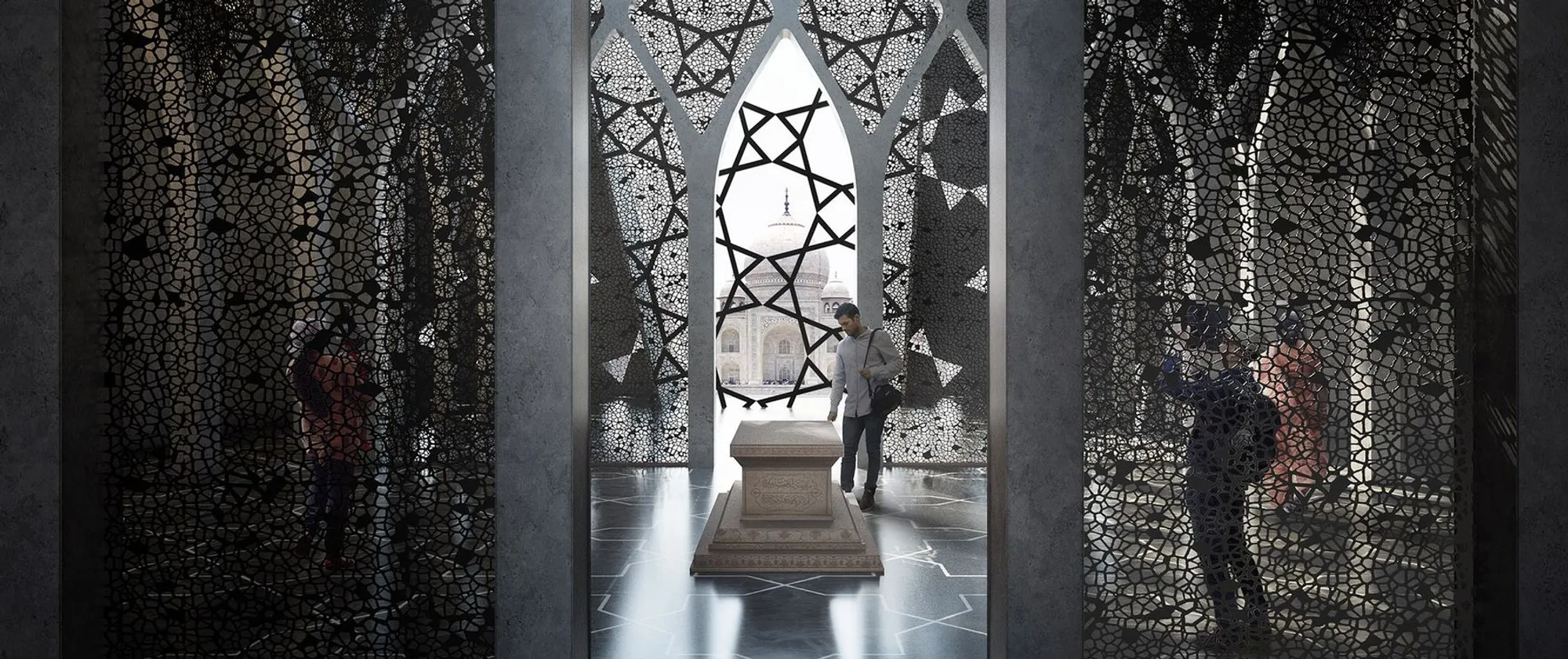
What if the greatest love story in architecture had a second chapter, written not in white marble but in dark stone and shadow? Positioned directly across the Yamuna River from the Taj Mahal, The Broken Tomb proposes a fractured monolith that gives physical form to Shah Jahan's grief. A vertical crack splits the tower open, creating a void that frames a perpetual sightline toward Mumtaz Mahal's resting place. It is a building designed not to celebrate death, but to embody the ache of survival.
Designed by Marta and Chiara, the project received an Honorable Mention in the The Black Taj competition. The brief challenged participants to envision a legendary counterpart to the Taj Mahal, a monument rumored but never built. This entry responds with a tower that draws on Mughal cosmic geometry, wraps itself in a contemporary mashrabiya skin, and organizes its interior as an emotional ascent from burial chamber to panoramic terrace.
A Cracked Heart Carved in Stone
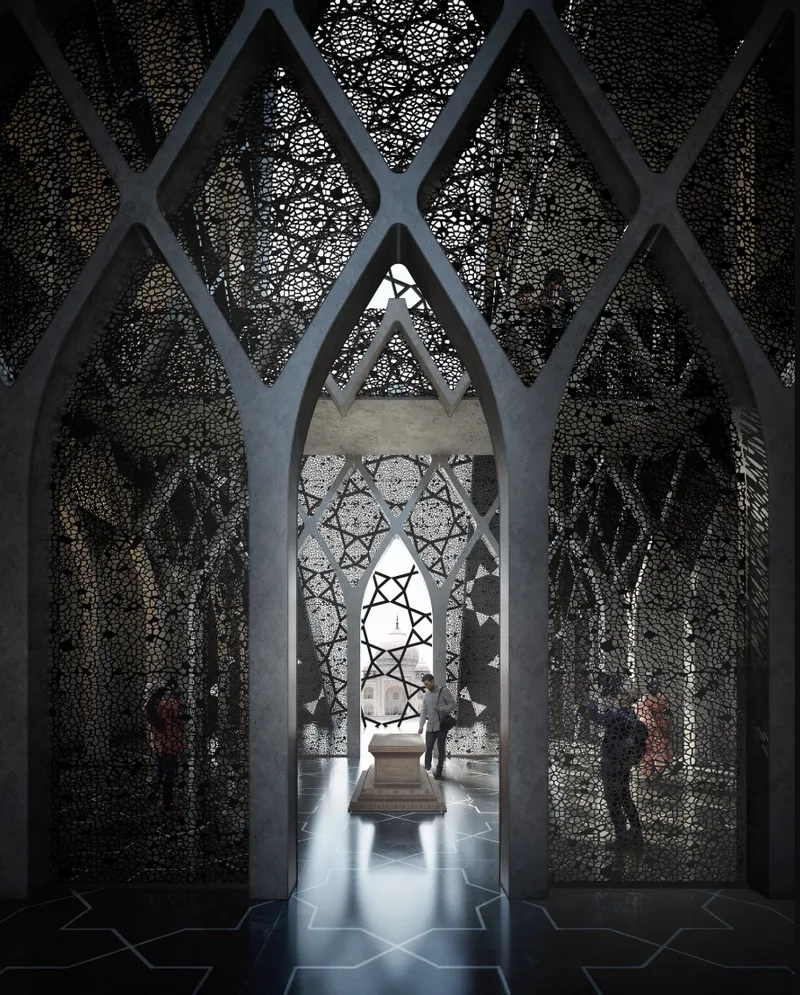
The interior view through layered pointed arches reveals the project's central spatial idea: light filtered through perforated screens, dissolving solid walls into veils of pattern and shadow. The central prayer space at the core of the tower reads less as a room and more as a threshold between worlds. Mughal precedent is unmistakable in the arched silhouettes and geometric ceiling, yet the restrained palette of dark surfaces and diffused illumination shifts the atmosphere from devotional splendor to meditative grief.
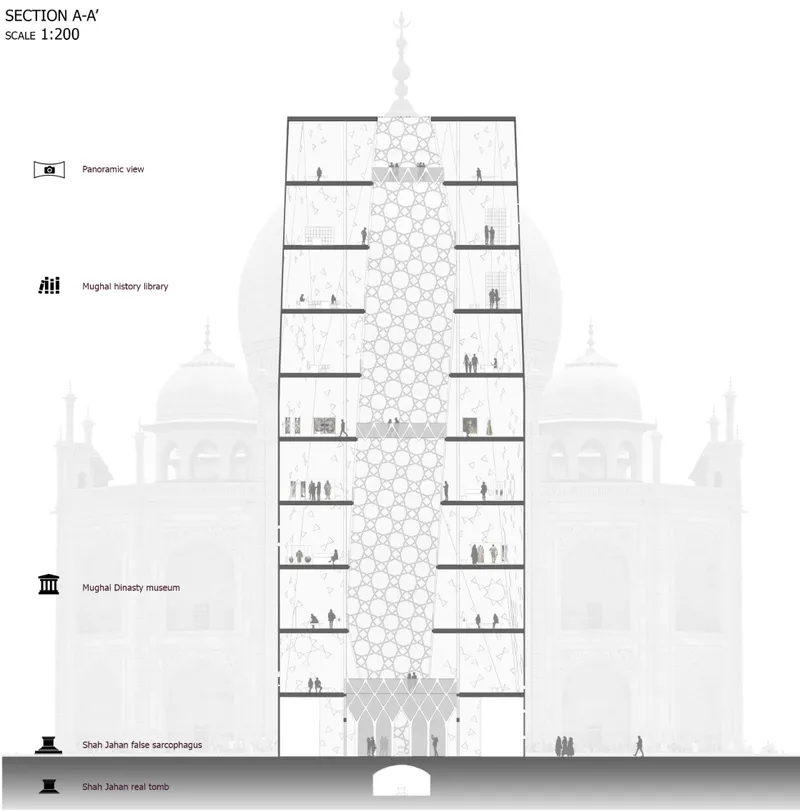
The sectional drawing makes the vertical logic explicit. A multi-story tower organized around a patterned central core rises through distinct programmatic layers. Lower levels contain Shah Jahan's false sarcophagus and real tomb, a silent burial core representing the depths of loss. Mid-levels house a Mughal Dynasty Museum and History Library, preserving the heritage of the empire. Upper levels open to panoramic terraces that complete the visual dialogue with the Taj Mahal across the river. The spatial rhythm moves from enclosed chambers to open sky, mapping an emotional journey from pain to remembrance to transcendence.
Cosmic Geometry Translated into Plan
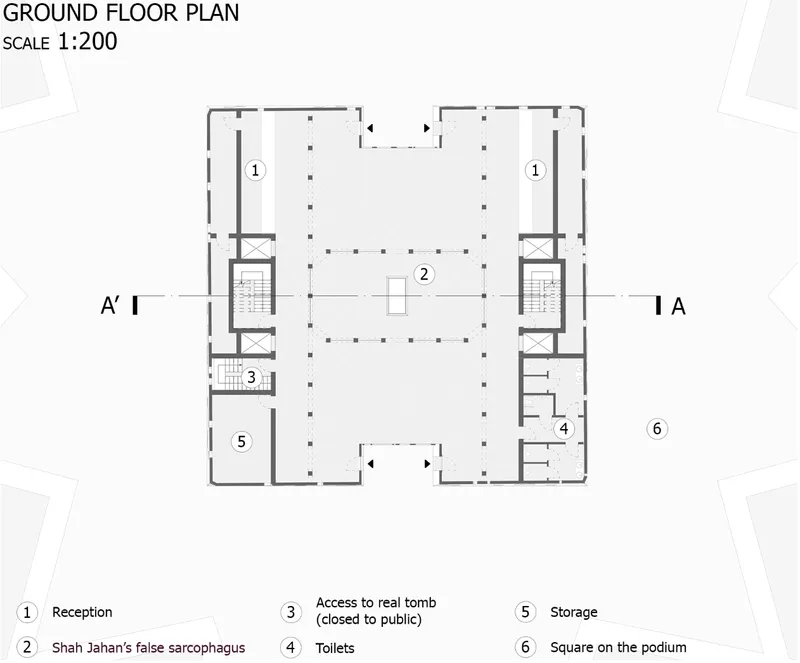
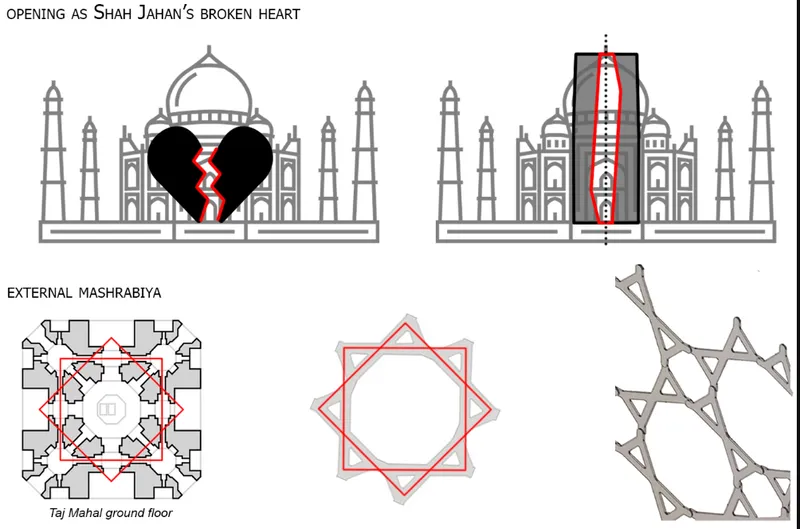
The ground floor plan reveals a rigorous symmetry anchored by a central court with corner circulation cores. This layout extends the Mughal charbagh tradition, the quartered garden that orders paradise into quadrants, into a built form that mirrors the Taj complex's own spatial discipline. The plan is aligned precisely opposite the Taj Mahal, maintaining identical proportions and elevation, so that the two monuments read as halves of a whole divided by water.
The diagram set illustrating the facade pattern derivation is where the project's intellectual ambition becomes most legible. Mughal architecture blended three sacred geometries: the square representing the earthly world, the octagon for the human realm, and the circle for divinity. Each level of the Black Taj transitions through these forms, creating an architectural ascension from material to spiritual. The facade's intricate mashrabiya lattice is derived from these same geometric operations, morphing traditional Islamic patterns into a contemporary perforated skin that breathes and shifts under changing sunlight. It is ornament with structural and environmental logic, not merely decorative.
Dark Materiality Against a Luminous Horizon
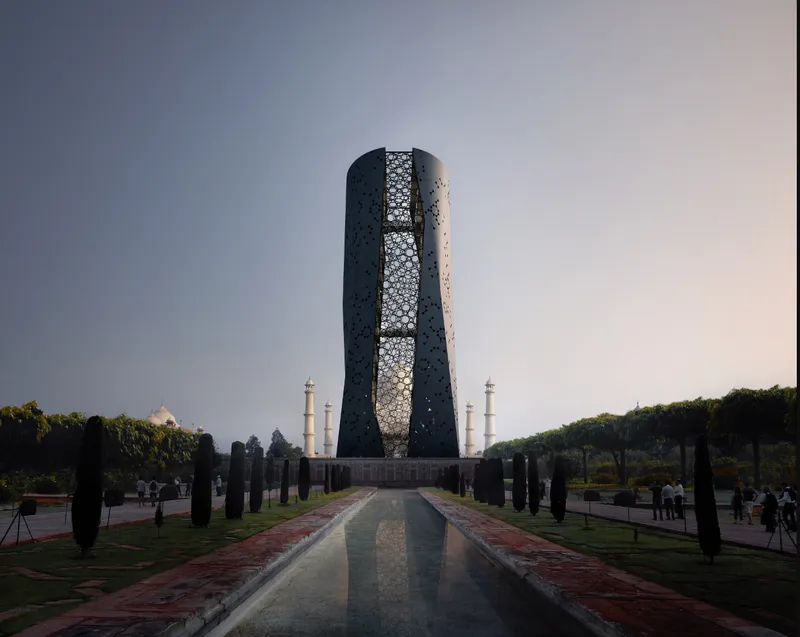
The dusk view along the formal garden axis captures the full emotional force of the proposal. The perforated black tower rises above a Mughal-inspired garden path, its dark stone and metal skin absorbing the last light of day rather than reflecting it. Where the Taj Mahal glows, this monument recedes. The contrast is deliberate: white marble for Mumtaz's eternal rest, dark matter for the emperor's enduring sorrow. Reflective surfaces and water channels at the base mirror the Taj complex's own symmetry, extending the idea of reflection from a physical phenomenon into an act of memory.
Constructed with dark stone and perforated metal, the building's atmosphere depends on transience. Filtered light penetrates the patterned openings throughout the day, casting ephemeral shadow geometries that animate the tomb interior. These shifting patterns represent the passage of time, memory fading and returning. It is an architecture that changes hour by hour, season by season, never quite the same, much like the act of remembering itself.
Why This Project Matters
The Broken Tomb succeeds because it refuses to compete with the Taj Mahal on its own terms. Rather than proposing another monument of radiant perfection, Marta and Chiara have designed its negative: a building of absorption, fracture, and filtered light. The central void that cracks the tower open is not a failure of form but the entire point, an architectural wound that keeps the sightline to Mumtaz's tomb permanently open. The programmatic organization, layering tomb, museum, library, and terrace into a single vertical sequence, gives the monument a civic life beyond symbolism.
What elevates the work beyond romantic gesture is its disciplined engagement with Mughal geometric traditions. The square-to-octagon-to-circle progression, the charbagh site plan, the mashrabiya screen derived from Islamic pattern logic: these are not stylistic references but structural principles that organize every scale of the project, from the overall massing to the aperture of a single perforation. The result is a contemporary monument that speaks the language of its historical counterpart fluently enough to hold a conversation across the river.
View the Full Project
About the Designers
Enter a Design Competition on uni.xyz
uni.xyz runs architecture and design competitions year-round that reward proposals with spatial conviction and real site intelligence.
Project credits: The Black Taj - The Broken Tomb - PUVM49 by Marta, Chiara The Black Taj (uni.xyz).


Popular Articles
Popular articles from the community


The Musturak Paradise: Senior Living Architecture for a Connected Future in Temara, Morocco
The Musturak Paradise reimagines senior living architecture in Temara via private homes, social spaces, culture, community, and shared care.

Hill & Cross Opera: Sculptural Opera House Architecture Shaped by Tallinn’s Landscape and Identity
Hill & Cross Opera reimagines opera house architecture in Tallinn through its sculptural hill, civic plaza, glass wave and a luminous cross.

Co-Life: Senior Housing Design That Reconnects Older Adults With the City
Co-Life reimagines senior housing design through healing gardens, shared streets, workshops, and a sustainable community across generations.

The Ocean Hive: Sustainable Architecture for a Self-Sufficient Civilization at Sea
The Ocean Hive imagines sustainable architecture at sea, where modular habitats, algae, wave power and ocean waste sustain a growing colony.


Similar Reads
You might also enjoy these articles

Lunar Spiral: Space Architecture Shaped by the Mathematics of the Universe
Lunar Spiral reimagines space architecture through Fibonacci geometry, lunar regolith, levitating habitats, and self-sustaining Moon living.
The Main Dream: Modular Architecture for Play, Learning, and Community
A modular playground turns recycled plastic into adaptable spaces where refugee children can play, build, learn, and reconnect.

Play: Fragments of Their World
Familiar architecture becomes modular playground design, creating safe spaces where displaced children can learn, connect, imagine and play.

Wadi Rum Observatory: Desert Architecture Designed for the Night Sky
Wadi Rum Observatory turns desert architecture into a quiet instrument for astronomy, hiding research spaces under Jordan's starlit terrain.
Explore The Black Taj Competitions
Discover active competitions in this discipline



Challenge to reimagine the Iron Throne


Photograph architecture without architects


Illustrate the lost glory of Angkor Wat - Render Challenge


Bring back Drive In's
Comments (0)
Please login or sign up to add comments
No comments yet. Be the first to comment!