
The Ghost Taj: Giving Form to an Empire's Unbuilt Twin Through Reflection and Void
An honorable mention entry reimagines the mythic Black Taj Mahal as a phantom landscape of mirrored corridors, dark pavilions, and holographic memory.


What does it mean to design something that was never meant to exist? Across the Yamuna River from the Taj Mahal, history whispers of a twin that never materialized: the Black Taj, a mirror image in dark marble that Emperor Shah Jahan allegedly planned before his empire crumbled around him. Whether myth or thwarted ambition, the story has haunted architects for centuries. In The Ghost Taj, that haunting becomes the architecture itself. Rather than reconstructing a lost monument in stone, the project treats absence as the primary building material, crafting a landscape where negative space, water, and holographic projection converge to give shape to something that can only be perceived, never possessed.
Designed by Jon and Viraj Pardesi, this entry received an Honorable Mention in The Black Taj competition on uni.xyz. The brief asked participants to speculate on the myth of Shah Jahan's unbuilt monument, and Jon and Viraj responded not with a replica but with a phantom: a cinematic sequence of dark pavilions, subterranean paths, and mirrored corridors positioned across the Yamuna from the existing Taj Mahal. The result is less a building than a meditation on impermanence, political collapse, and the stubborn persistence of memory.
A Hexagonal Pool Anchors the Phantom Twin
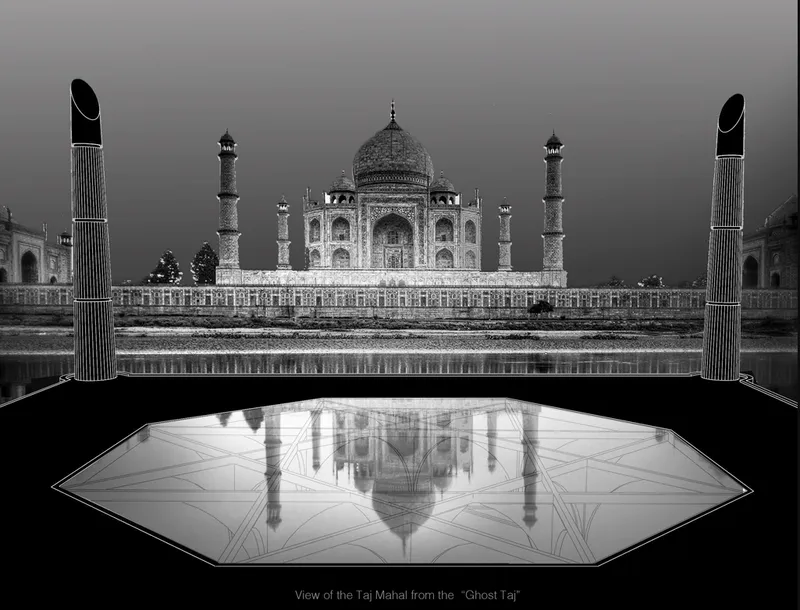
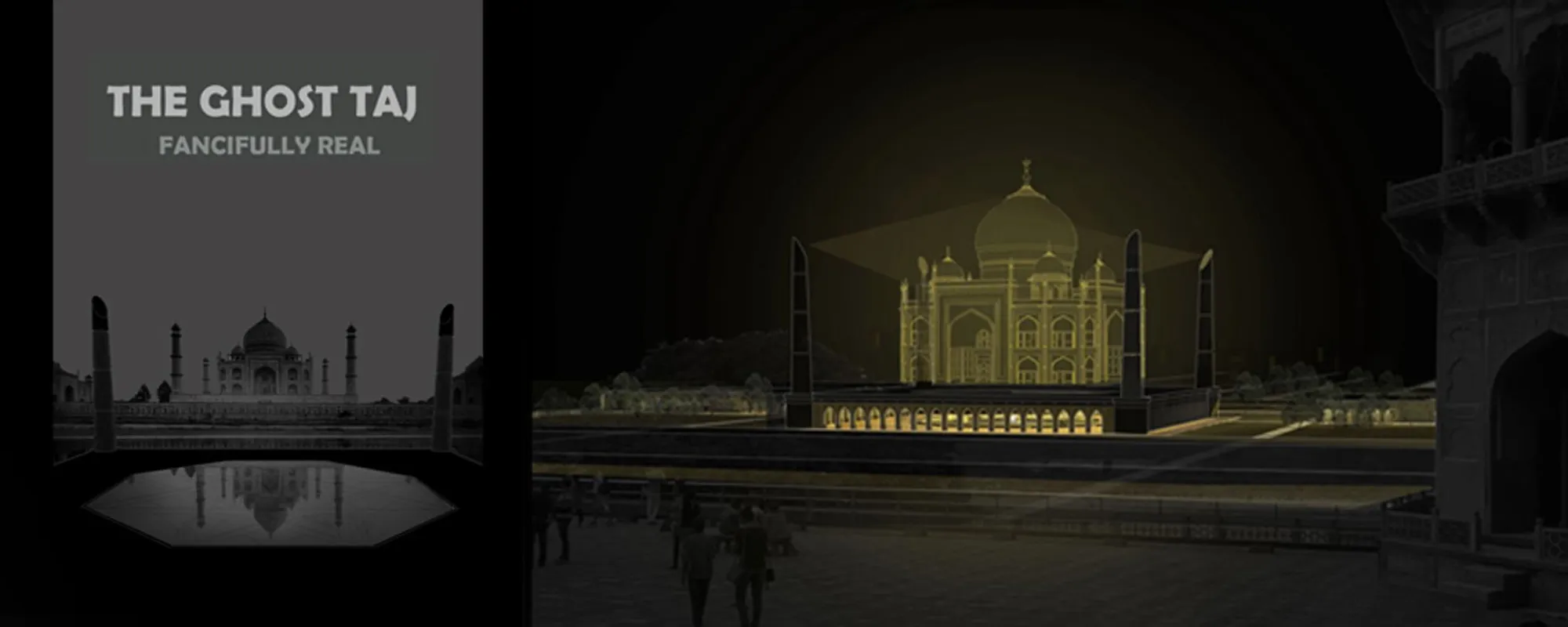
The central composition announces its intent immediately: a hexagonal reflecting pool flanked by striped towers, framing a domed mausoleum that reads as a dark echo of the Taj Mahal. The overcast sky in the rendering is a deliberate atmospheric choice, stripping away the sun-drenched grandeur typically associated with the original monument and replacing it with a muted, almost spectral quality. The pool is not merely ornamental. It functions as the primary instrument of the design, turning the water's surface into a threshold between presence and absence, between the white Taj that exists and the black one that never did.
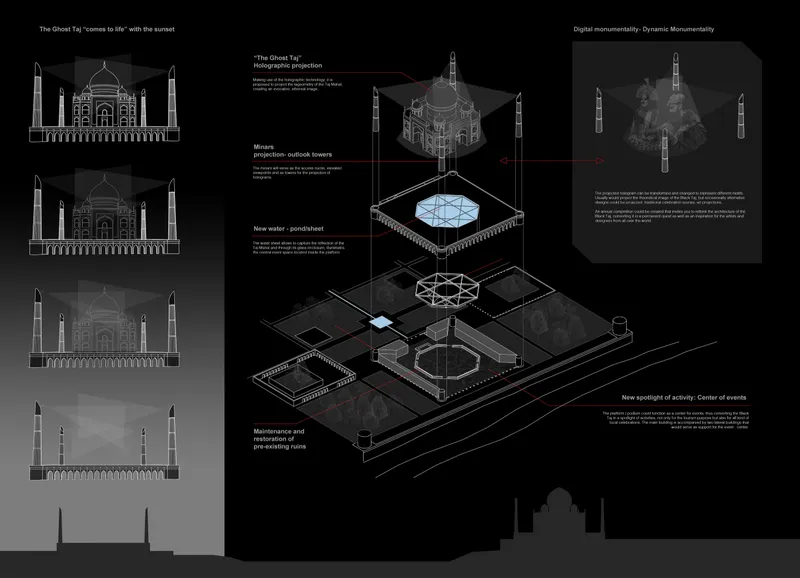
The axonometric drawing reveals the full ambition of the layered platform system. A central pool sits within a series of terraced platforms, and above the domed structure, a holographic projection emerges. This is the project's most striking conceptual move: the Black Taj does not stand as solid architecture but appears as a projected apparition, floating above the physical infrastructure. The layering of water, stone, and light creates a vertical narrative that moves from the tangible to the immaterial, a spatial translation of the myth's own uncertain status between history and folklore.
A Symmetrical Garden Distorted by Time
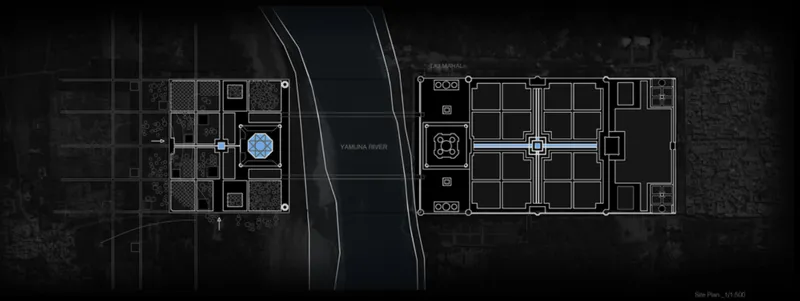
The site plan positions the design on the northern bank of the Yamuna, directly across from the existing Taj Mahal complex. Symmetrical garden layouts flank the river, and central pavilions are highlighted as the primary spatial anchors. Jon and Viraj reinterpret the Mughal charbagh (fourfold garden) not as a faithful replica of paradise geometry but as an allegory of rebirth distorted by the ripples of time. The grid warps and fragments, acknowledging that this garden belongs to an empire that never completed its vision. The Yamuna itself becomes a sacred threshold, the line between life and afterlife, between the monument that stands and the one that only exists in reflection.
There is a political argument embedded in this plan. Shah Jahan's later years were defined by imprisonment, rebellion, and decay. The designers draw a parallel between the collapse of Mughal authority and the death of creative ambition, positioning the unbuilt garden as a space where beauty and power parted ways. The symmetry of the plan is not celebratory; it is elegiac, a formal arrangement that acknowledges the gap between intention and execution.
The Elevation as Twilight Apparition
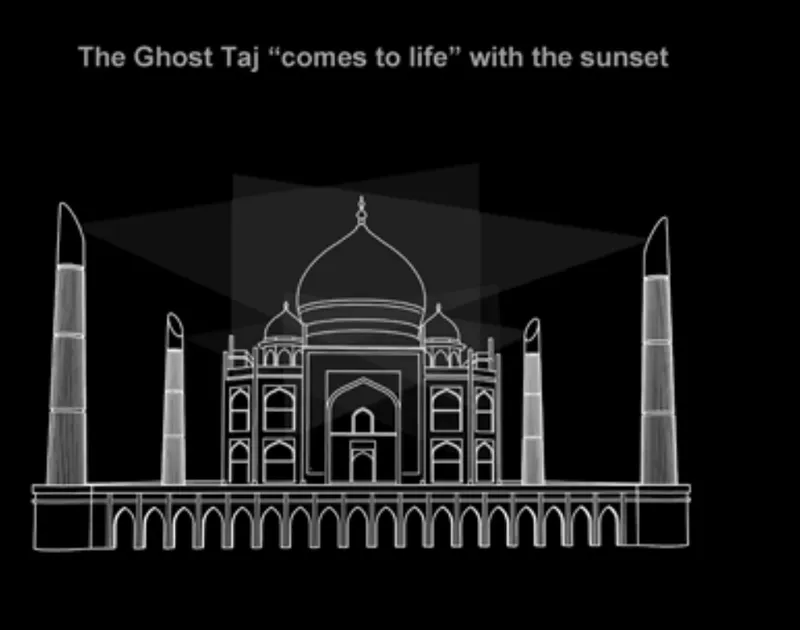
Rendered in white line work against a twilight gradient, the elevation drawing presents the domed structure and its four minarets as a silhouette dissolving into the sky. The choice to draw in white lines on a dark ground is significant: it reverses the visual logic of the original Taj Mahal, where white marble asserts itself against blue sky. Here, the architecture seems to emerge from darkness rather than light, a ghost seen only at the edges. The four minarets maintain the formal vocabulary of Mughal architecture, but their thinness in the drawing gives them an almost fragile quality, as if the entire structure could vanish if the light shifted.
The use of black marble, referenced throughout the project, signifies mourning and eternal memory. Against the luminous white of the original Taj, the material contrast becomes the project's central symbolic axis. The twin domes, never touching yet eternally facing each other across the river, represent what the designers describe as the paradox of love and loss: unity divided by destiny. The elevation crystallizes this idea into a single image.
Holographic Projection as Architectural Memory
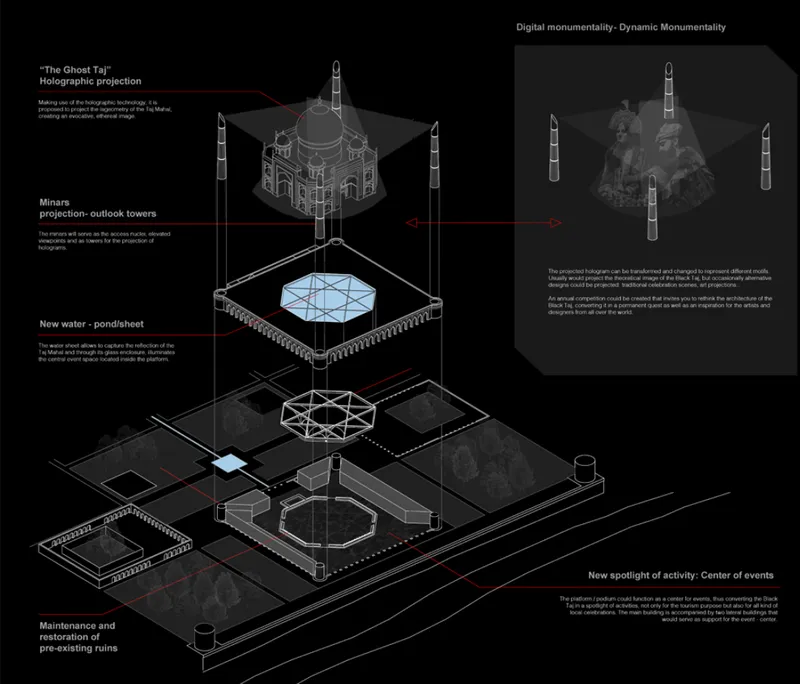
The exploded axonometric diagram reveals the technical backbone of the project's most provocative idea: a holographic projection system integrated into the terraced water features. The layered diagram separates the physical infrastructure of pools and platforms from the immaterial projection that hovers above them, making visible the conceptual distinction between the built and the remembered. Water features at multiple levels serve both as reflective surfaces and as cooling mechanisms that shape the atmosphere around the projection, giving the holographic apparition a misty, unstable quality.
This is where the project moves beyond architectural speculation into something closer to installation art or spatial theater. The Ghost Taj does not ask visitors to believe in the myth; it asks them to experience the feeling of a myth. Dark pavilions, mirrored corridors, and subterranean paths create a choreographed sequence where reality and imagination blur. Each frame captures fragments of the Taj's reflection, turning the river into an instrument of remembrance. The holographic system is the culmination of this sequence: a phantom that materializes only under specific conditions of light and water, and then dissolves.
Why This Project Matters
Competitions that ask designers to speculate on historical myths run a common risk: the entries become illustrations rather than arguments. Jon and Viraj avoid this trap by refusing to reconstruct the Black Taj as a physical object. Instead, they build the conditions under which the myth can be felt. The holographic projection, the mirrored corridors, the hexagonal reflecting pool: these are not decorative gestures but spatial strategies for making absence tangible. The project argues that architecture's power lies not only in what it builds but in what it frames, reflects, and withholds.
There is also a sharper critique running through the work. By linking the unbuilt monument to Shah Jahan's political downfall, the designers question whether beauty can survive when stripped of freedom, and whether memory can rebuild what politics destroyed. That question resonates well beyond Agra. In a discipline that so often celebrates the finished object, The Ghost Taj makes a compelling case for the architecture of what might have been, and for the emotional weight that unbuilt projects carry across centuries.
View the Full Project
About the Designers
Designers: Jon, Viraj Pardesi
Enter a Design Competition on uni.xyz
uni.xyz runs architecture and design competitions year-round that reward proposals with spatial conviction and real site intelligence.
Project credits: The Black Taj - The Ghost Taj - VTKI53 by Jon, Viraj Pardesi The Black Taj (uni.xyz).




Popular Articles
Popular articles from the community


Play: Fragments of Their World
Familiar architecture becomes modular playground design, creating safe spaces where displaced children can learn, connect, imagine and play.

Co-Life: Senior Housing Design That Reconnects Older Adults With the City
Co-Life reimagines senior housing design through healing gardens, shared streets, workshops, and a sustainable community across generations.

The Musturak Paradise: Senior Living Architecture for a Connected Future in Temara, Morocco
The Musturak Paradise reimagines senior living architecture in Temara via private homes, social spaces, culture, community, and shared care.

Conexión: Biophilic Design Reimagines High-Rise Living in Hong Kong
Conexión reimagines high-rise living in Hong Kong through biophilic design, green facades, shared spaces, daylight, water and nature within.


Similar Reads
You might also enjoy these articles

Lunar Spiral: Space Architecture Shaped by the Mathematics of the Universe
Lunar Spiral reimagines space architecture through Fibonacci geometry, lunar regolith, levitating habitats, and self-sustaining Moon living.
The Main Dream: Modular Architecture for Play, Learning, and Community
A modular playground turns recycled plastic into adaptable spaces where refugee children can play, build, learn, and reconnect.
Play: Fragments of Their World
Familiar architecture becomes modular playground design, creating safe spaces where displaced children can learn, connect, imagine and play.

Wadi Rum Observatory: Desert Architecture Designed for the Night Sky
Wadi Rum Observatory turns desert architecture into a quiet instrument for astronomy, hiding research spaces under Jordan's starlit terrain.

Explore The Black Taj Competitions
Discover active competitions in this discipline



Challenge to reimagine the Iron Throne


Photograph architecture without architects


Illustrate the lost glory of Angkor Wat - Render Challenge


Bring back Drive In's
Comments (0)
Please login or sign up to add comments
No comments yet. Be the first to comment!