
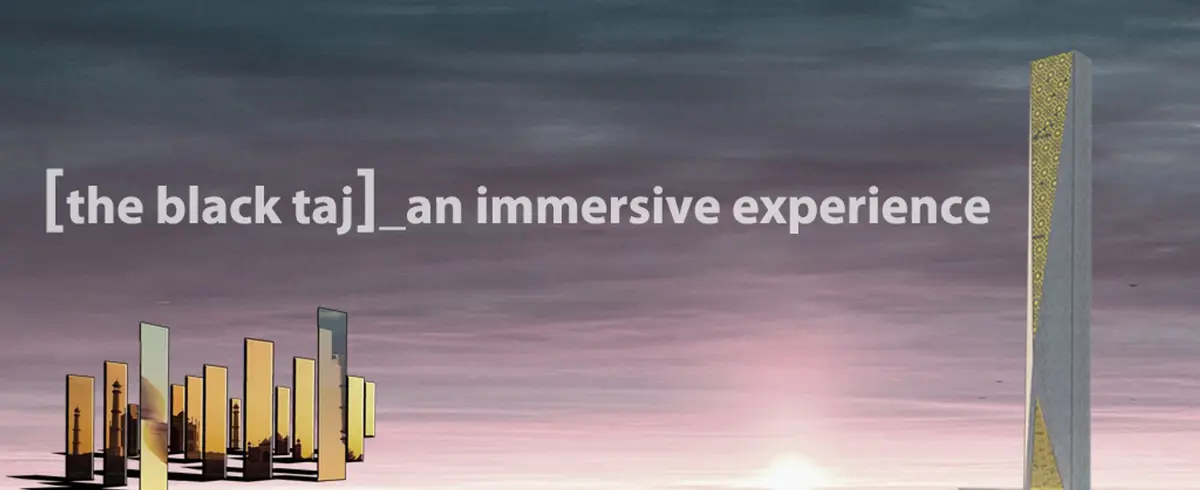
The Black Taj Time Loop: Where Mughal Geometry Becomes a Portal Through Time
A floating installation near Mehtab Bagh reinterprets jaali screens, axial planning, and reflective surfaces as an immersive temporal experience.


What if a building could function as a time machine? Not through mechanical gears or science fiction contrivances, but through light, geometry, and water? That is the provocation at the center of Time Loop, an installation sited across the Yamuna from the Taj Mahal near Mehtab Bagh. The project takes the spatial principles of Mughal architecture and runs them through a contemporary filter: perforated screens cast shifting shadow patterns, reflective water surfaces dissolve the boundary between monument and sky, and holographic overlays layer historical narrative onto physical form. The result is architecture that treats time itself as a buildable dimension.
Designed by Soumya and Sujeen, this shortlisted entry for The Black Taj competition reimagines the mythologized counterpart to the Taj Mahal not as a replica or a ruin, but as an immersive sequence of vantage points. The design merges two primary mediums: water, through floating landscapes that mirror the sky and surrounding monuments, and land, through interactive pavilions that frame new perspectives of the Taj. Rather than replicating Mughal ornamentation, the designers deconstruct its geometric logic and reassemble it into minimal, glowing volumes that hover between reality and illusion.
A Canopy That Casts Time in Light and Shadow
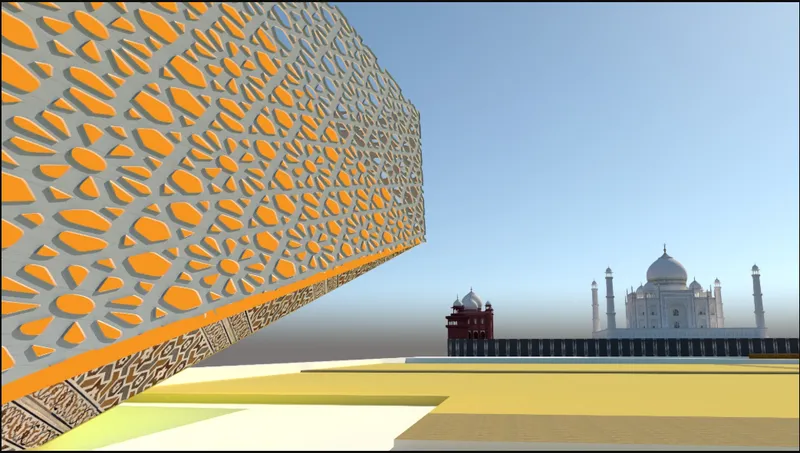
The cantilevered canopy is perhaps the project's most arresting moment. A perforated screen, inspired by the intricate jaali work of Mughal tradition, glows with warm amber light and throws geometric shadows across a yellow plaza terrace below. The effect is cinematic: as the sun moves and artificial lighting shifts, the shadow patterns transform continuously, making the floor itself a kind of temporal diagram. The designers describe this as a "celestial membrane," and the term fits. Light is not decorative here; it is the primary storytelling medium, encoding the passage of time into the visitor's bodily experience of walking through the space.
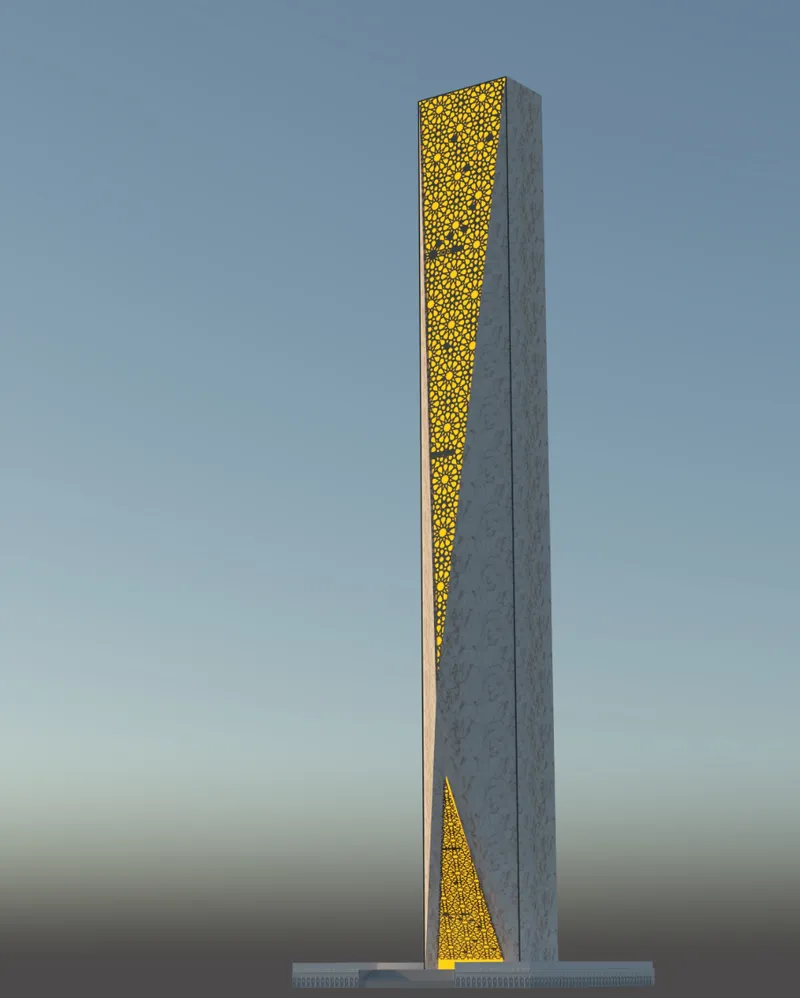
Adjacent to this canopy, a slender concrete tower rises with tapering vertical slits that catch and release amber twilight. Its proportions recall the minarets of Mughal complexes, but stripped to an elemental form. There is no dome, no arch, only the rhythm of narrow openings against a monolithic surface. The tower functions as both a landmark and a framing device, directing the eye toward the Taj Mahal across the river while asserting its own quiet presence on the skyline.
A Folded Volume Glowing at Dusk

The physical model reveals how the project's massing strategy works at an intimate scale. A folded volume wraps around a yellow-lit interior wedge, its perforated shell filtering orange light outward into the dusk. The form is minimal but not austere: it reads as a lantern, a threshold, a moment of warmth against the cooling sky. The designers' concept of "simple massing" is evident here. These are not monumental gestures competing with the Taj; they are carefully scaled enclosures that frame spatial experiences rather than dominate them. The wedge of interior light suggests a passage, an invitation to move through and beyond.
Deconstructing Mughal Axiality into a Contemporary Journey

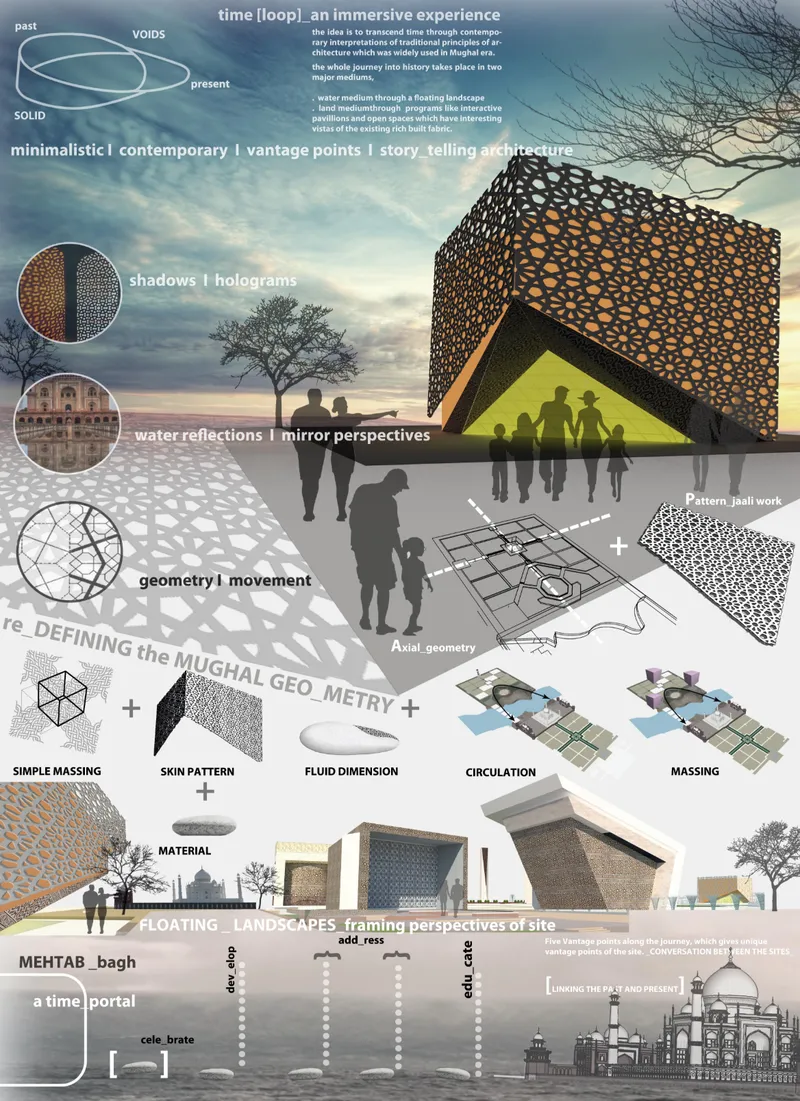
The presentation boards lay out the analytical backbone of the project. Site plan diagrams map circulation pathways that reinterpret Mughal axial planning: rather than a single monumental axis terminating in a focal point, the design creates a rhythmic sequence of aligned perspectives and reflective surfaces. Axonometric renderings show how pavilions, water features, and open vantage points are distributed to generate a looping journey, each turn offering a different framing of the Taj Mahal and its surrounding heritage fabric. The design strategy is clear: visitors are not led to a single climactic view but guided through a series of revelations.
The conceptual collage board digs deeper into the geometric logic. Massing diagrams trace the evolution from traditional Mughal symmetry to the project's abstracted forms. Pattern studies show how jaali motifs are deconstructed into contemporary perforated screen designs, while perspective views with silhouetted figures beneath the canopy establish the human scale of the intervention. The organic transitions between light and space, what the designers call the "fluid dimension," are mapped as gradients rather than hard boundaries. It is a vocabulary that respects its source material without being captive to it.
Water as Mirror, Land as Stage
The duality of water and land is central to the project's poetic framework. Floating landscapes mirror the sky and reflect surrounding monuments, symbolizing the ephemeral and ever-changing nature of time. These water surfaces are not ornamental pools; they are active architectural elements that dissolve the perceived boundary between the installation and the Taj Mahal across the Yamuna. On land, interactive pavilions and open terraces create carefully positioned vantage points. Together, the two mediums establish what the designers describe as a dialogue between the tangible and the transient, between memory and imagination. The visitor's journey alternates between grounded solidity and liquid ambiguity, never quite settling into one mode.
Why This Project Matters
Heritage sites too often become frozen exhibits, cordoned off behind interpretive signage and respectful distances. Time Loop pushes against that tendency by proposing that the best way to honor historical architecture is to keep arguing with it. The project does not mimic Mughal forms; it interrogates their underlying logic of symmetry, axiality, and ornamental filtration, then translates that logic into perforated screens, reflective water planes, and holographic overlays. The architecture becomes a medium for experiencing history as a living continuum rather than a fixed artifact.
What makes this entry compelling within The Black Taj brief is its refusal to produce a monument. Instead, Soumya and Sujeen have designed a journey: a looping sequence of light, shadow, reflection, and framing that asks visitors to actively construct meaning from their own movement through space. In a context haunted by one of the world's most photographed buildings, the project's greatest achievement may be its insistence that there is no single correct view. Every step reveals a new relationship between geometry, nature, and memory.
View the Full Project
About the Designers
Enter a Design Competition on uni.xyz
uni.xyz runs architecture and design competitions year-round that reward proposals with spatial conviction and real site intelligence.
Project credits: The Black Taj - Time Loop: An immersive experience" by Soumya, Sujeen The Black Taj (uni.xyz).


Popular Articles
Popular articles from the community


GROUP A Strips a 1969 Rotterdam Harbor Headquarters to Its Frame and Wraps It in Timber Louvers
In Rotterdam's M4H harbor district, Ferro Offices reuses a 1969 frame, adds one timber storey and reaches BREEAM-NL Outstanding.

U.GA Architects Wraps an Oval Rooftop Pool in Curved Board-Formed Concrete on Busan's Jeollidan-gil
In Busan's Jeonpo-dong, a 454 m² mixed-use block stacks a neighborhood facility, guest rooms and an oval rooftop pool inside spiraling concrete walls.

David Macias Steps a Doorless Stone and Plaster House Down a Tropical Colombian Hillside
In the humid hills of Colombia, Threshold House replaces the front door with an open void and terraces its 850 m² down the slope instead of fighting it.

Cube Design Draws an Ecological Corridor Between Two Shenzhen Hills with the Nankai Building
Beside Shenzhen's container docks, the Nankai Building pairs stacked balconies with a climbing green screen to connect two hillsides across its height.

Similar Reads
You might also enjoy these articles

Yenisei Monitoring Center: A Sun-and-Moon Sphere Anchors a Research Campus on Siberia's Great River
In Krasnoyarsk, shifting square blocks, a glazed central sphere and descending window rhythms turn river science into a public spectacle on the Yenisei.
Andretta Artist's Village: A Node-Based Masterplan That Lets the Hills Write the Plan
A cultural landscape strategy for Palampur's artist colony threads studios, residences and stages along a porous spine shaped by the Dhauladhar terrain.
Street Children Rehabilitation Center: A Brick Campus That Eases Children From Street to Safety
A low-rise courtyard campus where learning streets, uthans and shaded verandahs stage a gradual passage from street into protective, family-scale life.

The NEON Culture: A Field of Pavilions Built for the 24-Hour City
Smaran Alva spreads galleries, stages, clubs and markets across a varied site, treating light, sound and ramped movement as the real building materials.

Explore Architecture Of Time Competitions
Discover active competitions in this discipline

Challenge to reimagine the Iron Throne

Photograph architecture without architects

Illustrate the lost glory of Angkor Wat - Render Challenge

Bring back Drive In's
Comments (0)
Please login or sign up to add comments
No comments yet. Be the first to comment!