

The Bloom Weaves a Hilltop Coffee Pavilion into the Highlands of Central Vietnam
Nguyen Coffee perches on a forested ridge near Bảo Lộc, sheltering visitors under a woven bamboo canopy that barely touches the land.


There is a genre of Vietnamese coffee shop that has matured rapidly since the pandemic: the nature café, planted on the edge of a hillside road, promising panoramic views and a dose of highland air. Most of them are forgettable. The Bloom's Nguyen Coffee, completed in 2022 on a forested ridge near Bảo Lộc in Lâm Đồng province, is not. At 1,100 square meters, it is large enough to hold crowds, yet its woven bamboo canopy and raw timber structure register as something closer to a landscape intervention than a building.
What makes the project genuinely interesting is its refusal to leave a permanent mark. Lead architect Dinh Anh Tuan and the design team conceived the pavilion so that it sits on the existing terrain without reshaping the ecosystem beneath it. If every column were removed, the hillside would remain largely as it was. The architecture functions as a temporary canopy, a three-layered roof assembly that mediates rain, glare, and noise while framing a view of the Đá Bàn Stream below. It is less a building than a negotiated truce between program and topography.
Landing on the Ridge
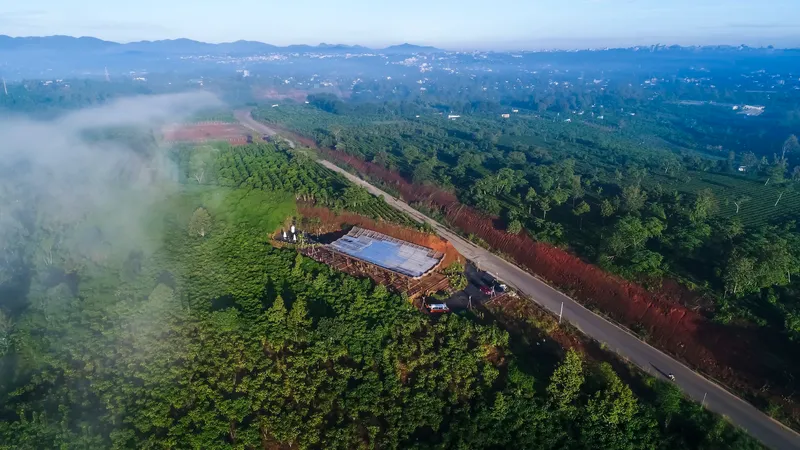
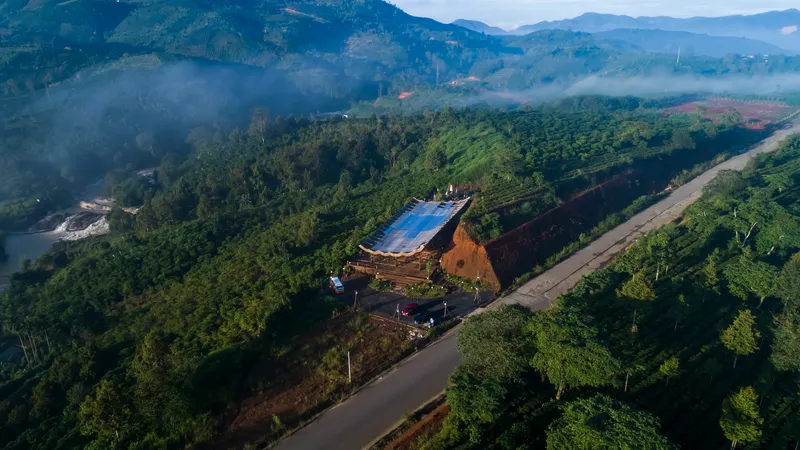

Seen from the air, Nguyen Coffee reads as a long, low form tucked into the crease between agricultural plots and dense forest canopy. Morning mist fills the valley below, and the structure's sinuous roof edge echoes the contour lines of the hillside rather than imposing a geometry of its own. The compound occupies a stretch of ridgeline along an alternative national road, a siting decision that gives every seat in the house a prospect across layered green peaks.
The dawn aerial, with fog erasing everything below the canopy, makes the case most forcefully: the building is designed to hover. Its timber columns are slender enough to read as vegetation from a distance, and the woven bamboo surface merges with the surrounding tree crowns. There is no grand entrance, no paved forecourt. You simply arrive at the edge of the ridge and descend into the structure.
A Roof in Three Layers
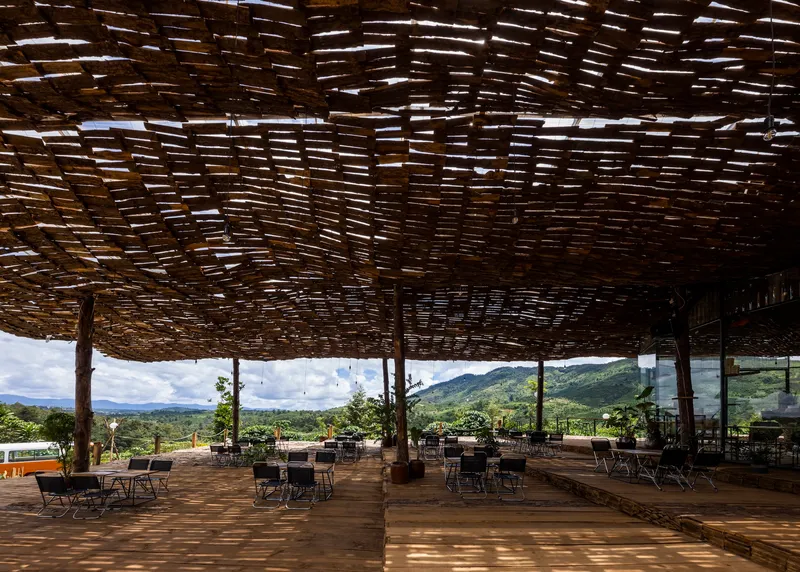


The roof is the project's core invention, and it earns its complexity. A first layer of transparent corrugated sheeting admits daylight while stripping it of glare. Above that, corrugated iron screens excess rain and sun. Beneath both, a ceiling of natural wood panels absorbs sound, insulates against heat, and creates patterns of filtered light through minute perforations between the panels. The result, visible clearly in the underside views, is a softly luminous canopy that shifts in color and intensity as the sun moves.
The undulating edge of the roof, scalloped like a woven basket turned on its side, is not decorative whimsy. It follows the structural logic of the bamboo and timber lattice, rising where spans are shortest and dipping where the canopy extends furthest over the terraces below. At dusk, with integrated lighting tracing these curves, the roof becomes the primary visual experience, a glowing, wavelike surface suspended on thin columns.
Timber, Earth, and the Ground Plane
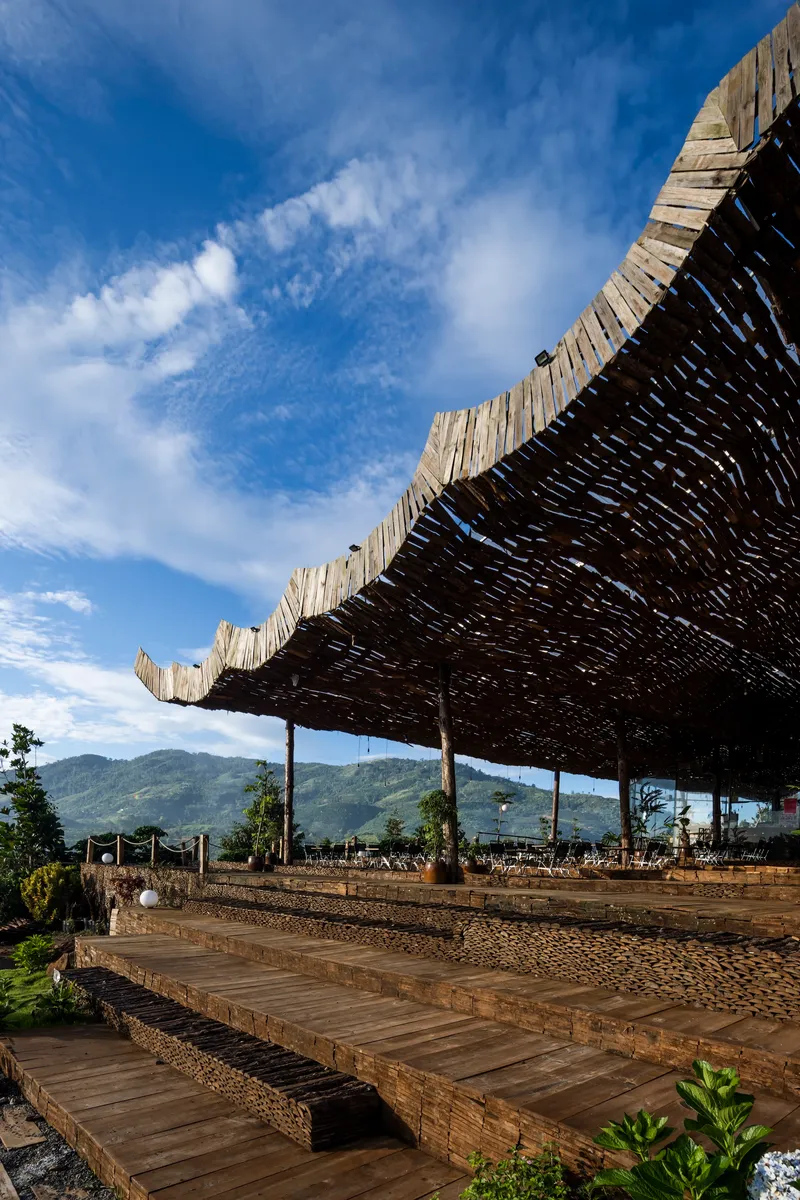
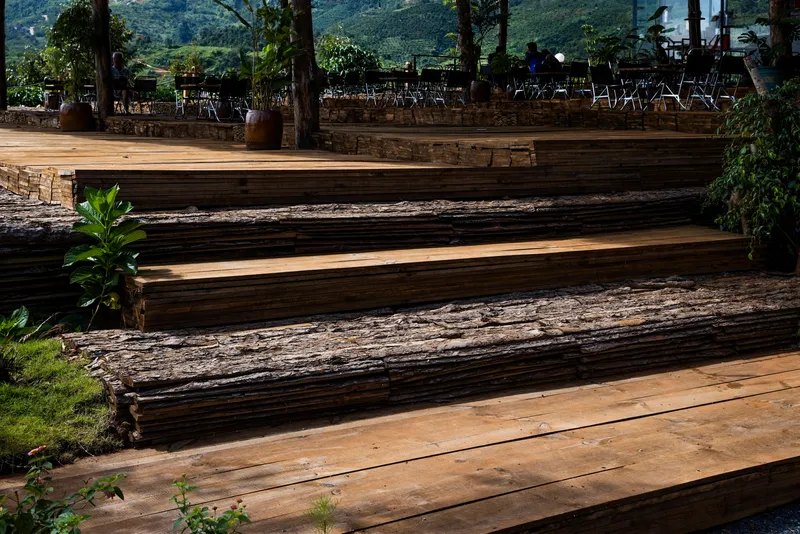

Solid natural wood runs through the entire column system and floor structure, combining a structural core with a wooden shell. The effect is deliberately rustic, evoking the mountainous vernacular of the central highlands rather than the polished teak surfaces you might find in a resort. Rough-hewn log risers form the staircase treads, and the bamboo decking is split and layered over timber beams with visible joinery. Nothing is hidden.
The stepped platforms follow the slope of the natural terrain, creating a cascading sequence of levels that avoids the need for heavy earthworks or retaining structures. Where retaining is necessary, woven bamboo walls hold back the red clay hillside, turning a structural requirement into a material motif. The gravel-and-timber pathways that connect the platforms reinforce the sense that you are walking through a landscape, not entering a building.
The Glass Volume and the Bar

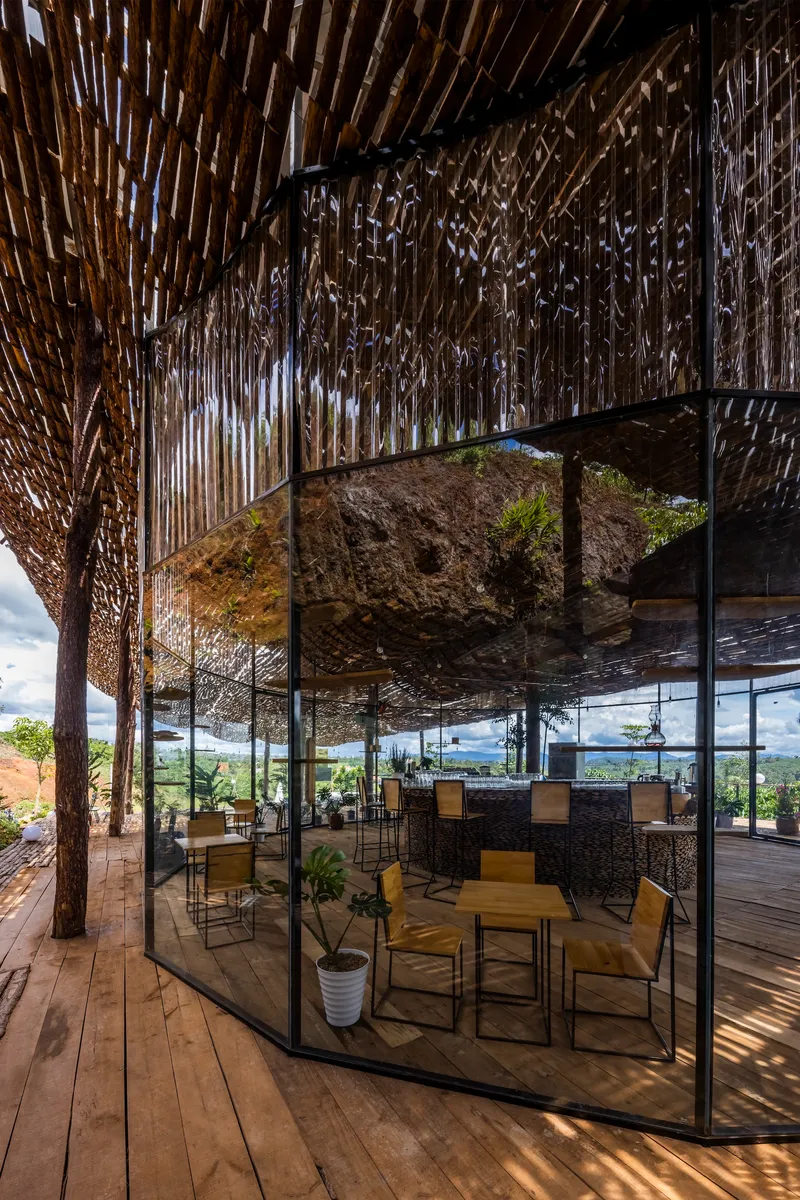

At the center of the open plan sits a glass-enclosed bar volume, the one element that asserts architectural precision against the surrounding rawness. Wrapped in a round glass array that divides space into half-closed and half-open zones, the bar functions as the spatial anchor around which all movement circulates. From inside the glass enclosure, the mountain vista is uninterrupted. A suspended rock feature hangs within one of the glazed lounge areas, a theatrical gesture that nods to the geology of the site without overplaying it.
The woven bamboo ceiling curves overhead, and the reception counter below it is finished in the same tonal palette as the columns. The interiors are deliberately minimal: no applied finishes, no accent walls. The materials do all the talking, and the view does the rest.
Open Air and the View
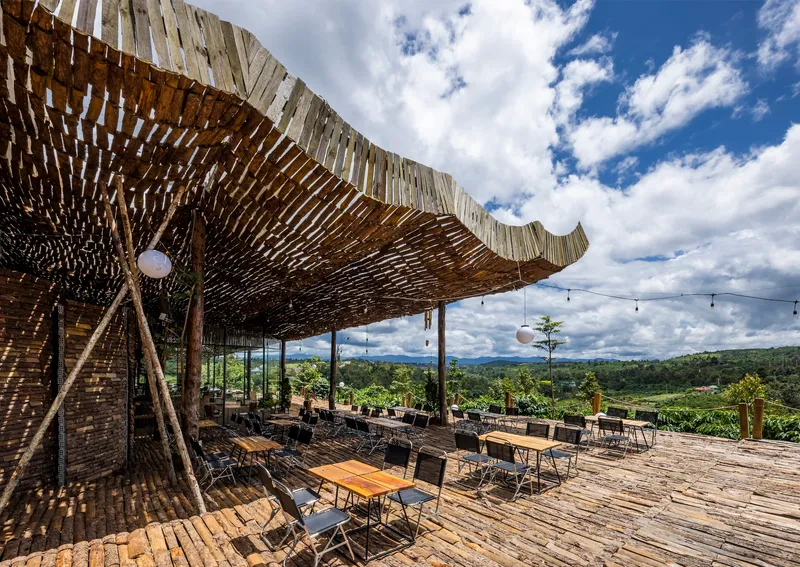
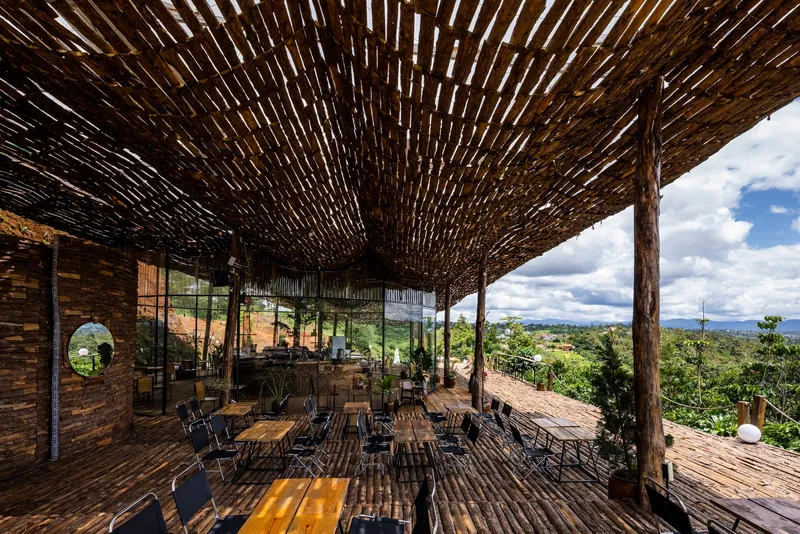
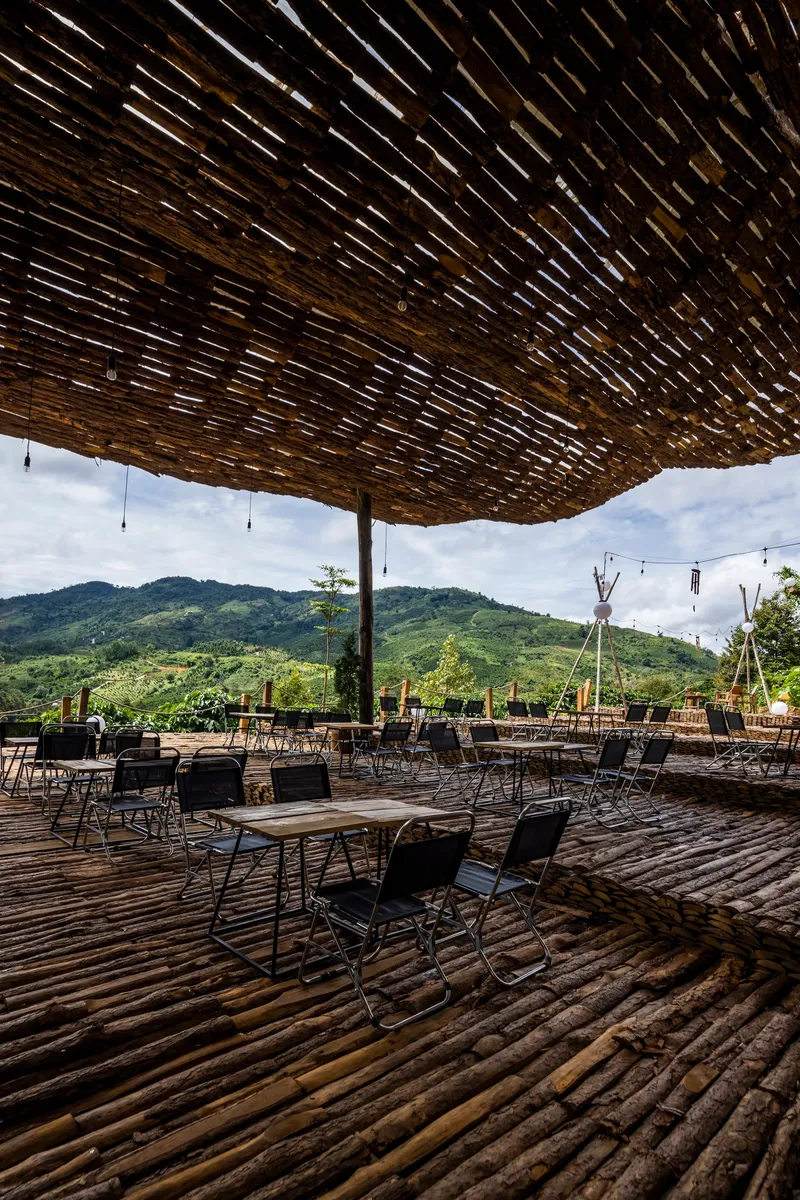
The dining areas, spread across multiple terraces, operate as outdoor rooms. Timber columns carry the woven canopy overhead, but the perimeter is open to wind, birdsong, and the smell of the surrounding forest. Seating runs from casual bamboo-decked platforms to more conventional tables beneath the lattice roof, all oriented toward the same southern valley prospect. The spatial organization is radically simple: every path leads toward the view, and the canopy provides just enough shelter to keep rain off your coffee.
The open-plan strategy works because the climate allows it. Bảo Lộc sits at elevation in the highlands, cooler and less humid than lowland Vietnam. The three-layered roof tempers heat gain, and the absence of walls lets cross-ventilation do the rest. Mechanical cooling is unnecessary, which is both an ecological and an experiential win: you hear the landscape, not the air conditioning.
Terraces at Twilight
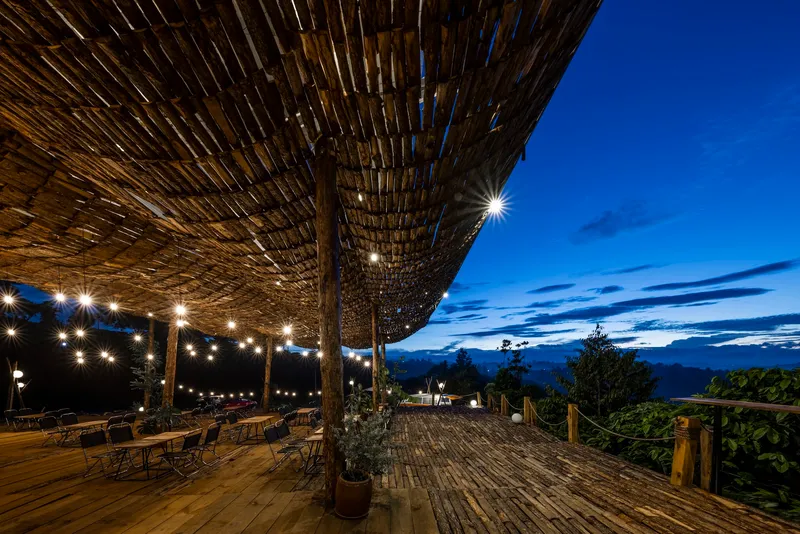
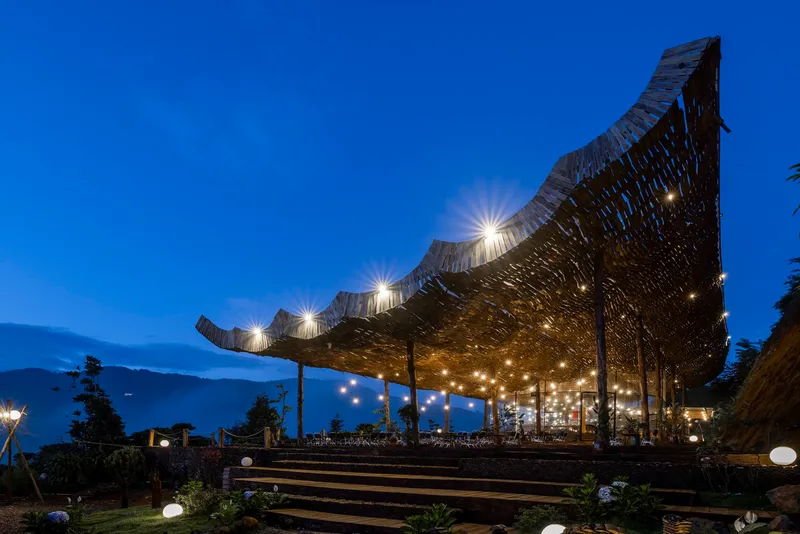

The project reveals a second personality after dark. String lights trace the canopy edge, and the integrated lighting within the roof structure transforms the woven bamboo into a lantern visible from the valley below. The amphitheater-like terraced seating, backed by a planted bed and the misty hillside, suggests that the space was always intended for gathering, not just for individual contemplation. It is a social landscape.
The dusk photographs capture the building at its most seductive, but they also expose its structural logic most clearly. With daylight gone, the silhouettes of the timber columns and the wavelike roof profile become graphic, almost diagrammatic. You can read exactly how the canopy is supported, how it rises and falls, and where the loads transfer to the ground. Honesty and atmosphere, it turns out, are not mutually exclusive.
Edges, Paths, and Thresholds


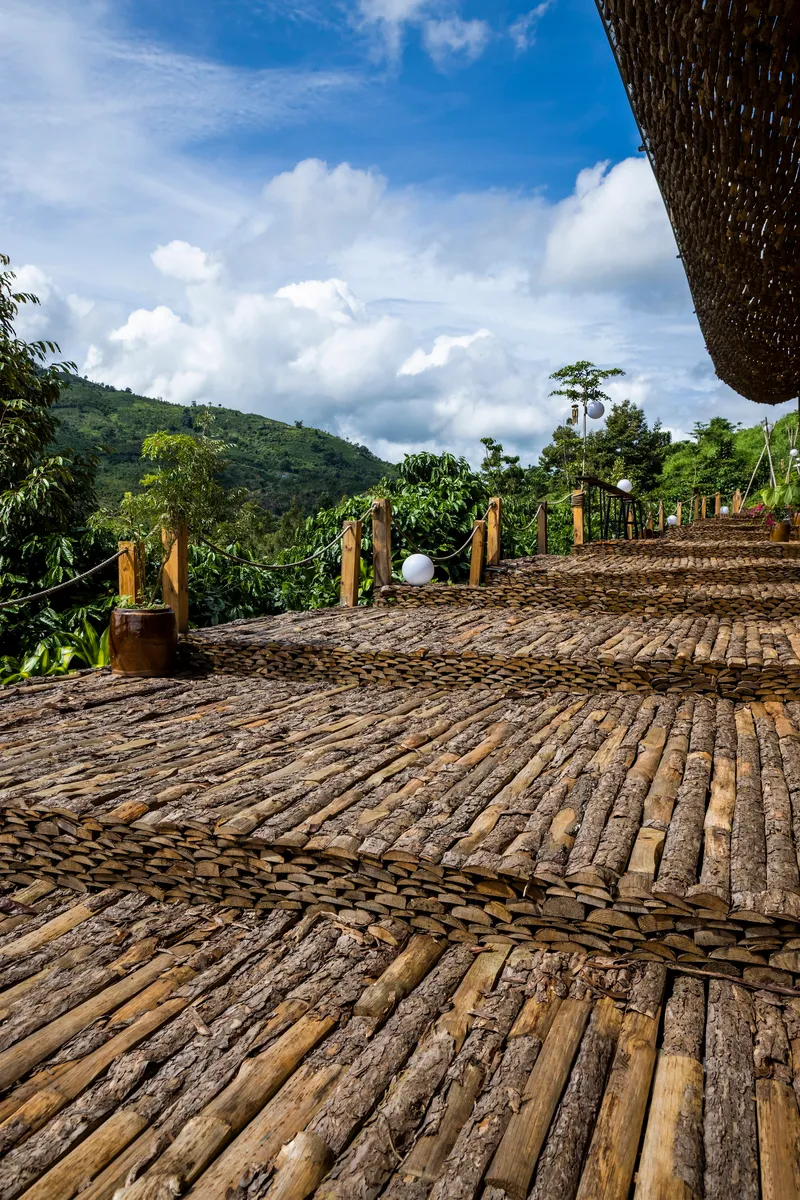
The transitions between landscape and structure are handled with care. Timber plank walkways on gravel, wide deck platforms bordered by woven bamboo walls, curved bamboo decking with simple timber post railings: each threshold condition is slightly different, calibrated to the terrain it crosses. There is no single entrance sequence, and the informality is the point. You wander in from the hillside, and the canopy gradually envelops you.
The landscape design, credited to The Natural Scenery, integrates planted pockets into the stairways and retaining structures, blurring the boundary between what is built and what is growing. Over time, the vegetation will likely subsume more of the structure, pulling it further into the hillside. The architects have anticipated this. The building was designed to age, not to resist aging.
Plans and Drawings


The site plan confirms what the aerials suggest: the structure is an elongated linear form that follows the ridgeline contour, bending gently to maintain its relationship with the terrain. Tree canopies are drawn at full size, and the building reads as one element among many in a composed landscape, not as the dominant figure on the site.
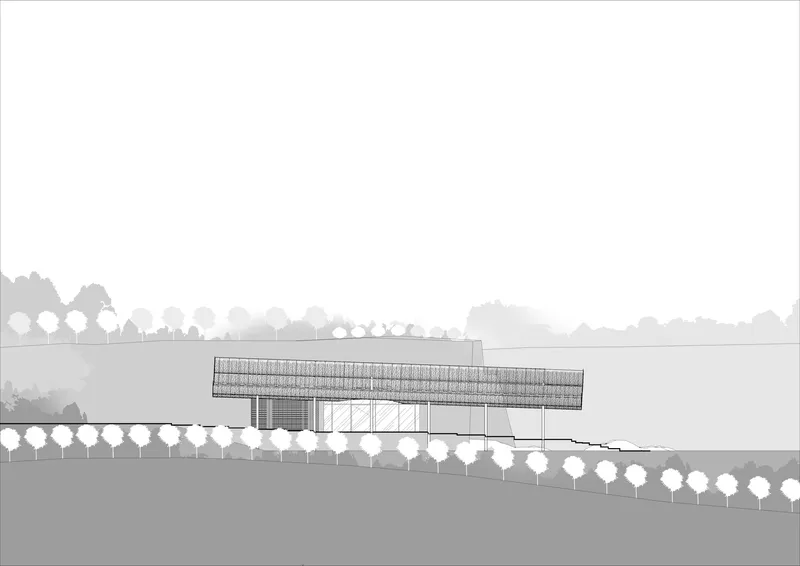
The section drawing is the most revealing of the three. It shows the terraced platforms stepping down the slope beneath undulating roof canopies, with the glazed lower level tucked into the hillside. The gap between the corrugated layers and the wood panel ceiling is clearly visible, confirming the passive ventilation and light-filtering strategy described in the design concept. The elevation drawing, by contrast, emphasizes the lightness of the trussed roof, which appears to float above the landscape on its forest of slender timber columns.
Why This Project Matters
Nguyen Coffee matters because it takes a typology that is often treated as disposable, the roadside nature café, and gives it architectural intelligence without sacrificing accessibility. The three-layered roof is a genuine climatic innovation, not a gimmick. The commitment to reversibility, building on the terrain without altering it, challenges the assumption that permanence is a prerequisite for serious architecture. And the material palette, all natural wood and woven bamboo, demonstrates that low-tech construction can produce spatial richness that rivals anything achieved with steel and glass.
More broadly, the project is a model for how architects can operate in sensitive landscapes without retreating into timidity. The Bloom did not minimize the building; 1,100 square meters is a substantial program. They minimized its impact. The distinction matters. Nguyen Coffee is large, generous, and socially ambitious, yet it wears its ambitions lightly. If dismantled tomorrow, the hillside would carry on without it. That is the highest compliment you can pay a building in a landscape like this.
Nguyen Coffee by The Bloom, lead architect Dinh Anh Tuan. Bảo Lộc, Lâm Đồng, Vietnam. 1,100 m², completed 2022. Landscape design by The Natural Scenery. Photography by Hiroyuki Oki.
About the Studio
Share Your Own Work on uni.xyz
If projects like this are the kind of work you want to make, uni.xyz is a place to publish your own, find collaborators, and enter design competitions.


Popular Articles
Popular articles from the community


Manzana Morphosis: Stretching Barcelona's Grid into a Living Landscape for 2050
A radical reworking of the Eixample manzana turns density into a tool for generous public space, vertical ecology, and environmental performance.

Extended Shell: Retrofitting Kolkata's Balconies as Living Urban Thresholds
A modular retrofit system recovers the social and environmental intelligence of Kolkata's historic verandas for contemporary Park Street residents.

Faces of the Soviet Avant-Garde: Turning Moscow's Street Names into an Open-Air Museum
A network of sculptural installations across a Moscow residential district transforms forgotten architect names into spatial encounters with cultural memor

Singing Woman: Contemporary Architecture Inspired by Estonia’s Voice and the Sea
Singing Woman turns Estonia’s song culture into flowing opera house architecture, blending public life, landscape, sea, and national memory.

Similar Reads
You might also enjoy these articles

Bao Huynh Watercolor Atelier: A Serene Art Retreat in Hội An
Bao Huynh Watercolor Atelier in Hội An blends multifunctional art spaces, sustainable design, local materials, and family-friendly living in a serene environment.

Atelier Macri Concept Store Interior Design by CASE-REAL
Atelier Macri store features a "ko" counter, walnut wood details, cork displays, blending retail, gallery, and seamless customer experiences.

Manuel Vargas Izquierdo Stadium and High-Performance Sports Center: Architectural Excellence in Jalpa de Méndez
The Manuel Vargas Izquierdo Stadium blends sustainable design, inclusive sports facilities, and cultural-inspired architecture, revitalizing Jalpa de Méndez’s public spaces.

KAKR Buluh Awar Hall: Revitalizing Community and Ecology Through Bamboo Architecture
Community built bamboo hall revitalizes Buluh Awar village, empowering youth, restoring ecology, celebrating vernacular craftsmanship through sustainable architecture and culture.

Explore Coffee Chair Competitions
Discover active competitions in this discipline

Challenge to reimagine the Iron Throne

Photograph architecture without architects

Illustrate the lost glory of Angkor Wat - Render Challenge

Design challenge to reuse E-waste
Comments (0)
Please login or sign up to add comments
No comments yet. Be the first to comment!