
The Chapel in the City: Sustainable Architecture Between Ethiopian Tradition, Community, and Urban Forest
A chapel in Ethiopia where rammed earth, sacred axes, forest gardens, and community life meet through sustainable architecture design today.


The Chapel in the City is a sustainable architecture proposal that reimagines the chapel as both a spiritual anchor and an environmental mediator. Designed by Muauz Weldu Gebru, the project positions the chapel between the city and its urban forest, creating a sacred threshold where community life, ecological awareness, and Ethiopian architectural memory meet.
Rather than treating the chapel as an isolated religious object, the design expands it into a civic and environmental system. It includes spaces for worship, learning, residence, community gathering, gardening, storage, baptism, and forest care. Through this layered programme, the project becomes more than a place of prayer. It becomes a living framework for social connection, environmental stewardship, and cultural continuity.
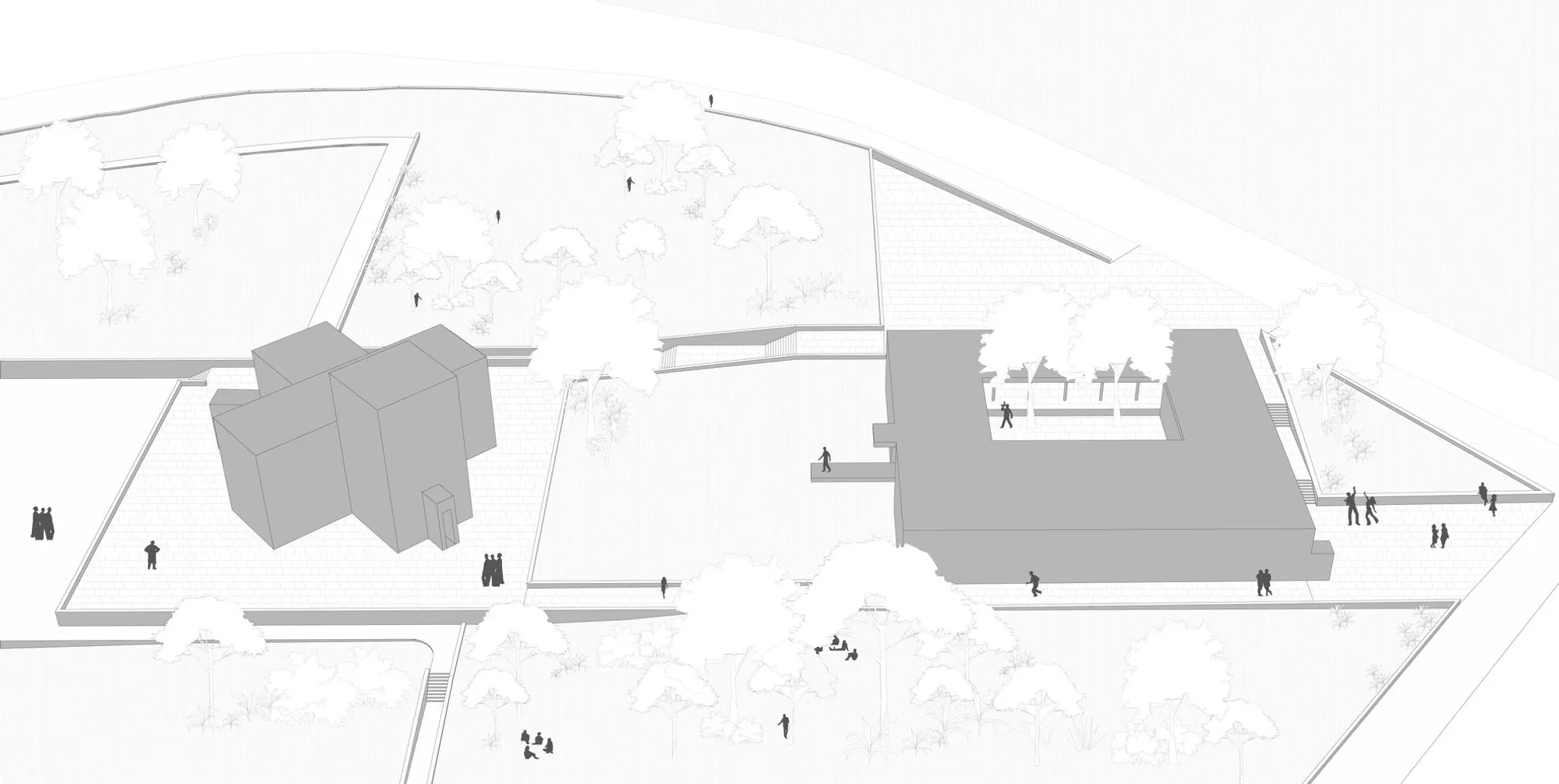
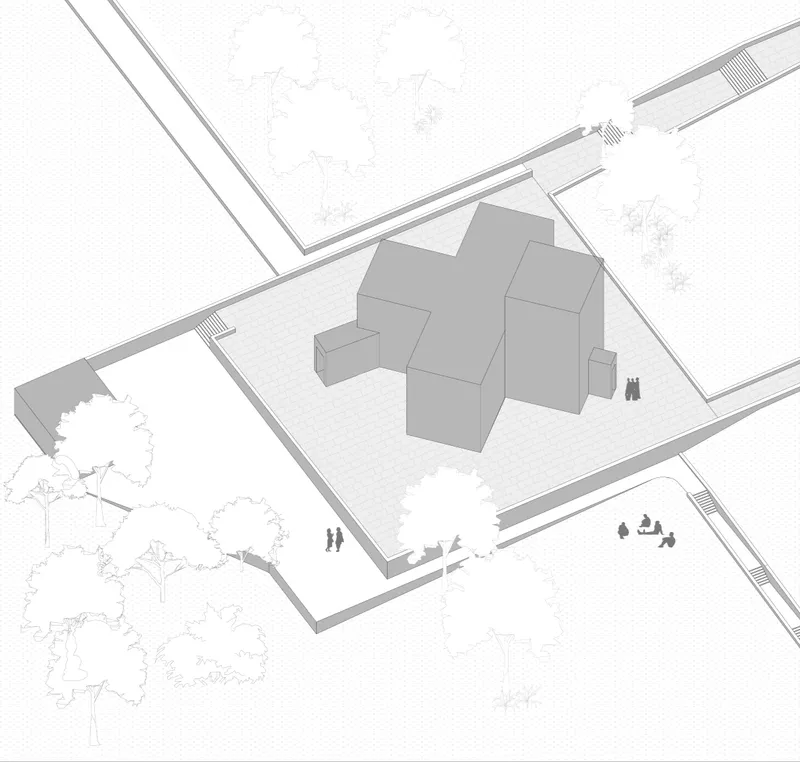
The chapel stands at the intersection of several axes. These axes organize movement from different directions of the site, making the complex accessible and legible. At the centre, the chapel works as a mediator between two contrasting conditions: the active, public realm of the community centre and the quiet, contemplative realm of the forest and priest’s residence.
A Chapel as a Mediator
The central concept of the project begins with a stable form placed at the meeting point of intersecting axes. These axes are not only circulation lines. They represent gathering, accessibility, and the symbolic act of coming together.
On one side of the axis lies the community centre, a louder and more active space intended for public programmes, education, dining, and social exchange. On the other side are the priest’s residence and forest areas, which are quieter, more private, and more contemplative. Between these two spatial characters, the chapel becomes a balanced centre.
This central positioning gives the chapel a dual role. It is a sacred space for worship, but it is also an architectural bridge between public activity and spiritual stillness. The building does not dominate the site. Instead, it organizes the relationship between people, landscape, and ritual.
Inspired by Ethiopian Architecture
The design draws from the long history of Ethiopian religious architecture, particularly the country’s renowned rock-hewn churches. The form of the chapel is referenced as a historical metaphor for classical and rich Ethiopian architecture.
This inspiration is visible in the chapel’s compact, grounded massing. The form appears solid, quiet, and carved, giving it a sense of permanence. Instead of relying on excessive ornamentation, the architecture uses volume, proportion, and placement to evoke sacredness.
The result is a contemporary chapel that respects religious tradition without copying it directly. It translates Ethiopian architectural memory into a modern spatial language suited for a community-based ecological setting.
Sustainable Architecture Through Rammed Earth
The project’s primary sustainable strategy is material selection. Rammed earth is proposed as the main construction material, connecting the design to both ecological responsibility and local building traditions.
Rammed earth is one of the oldest construction methods in the world. In the Ethiopian context, the use of earth as a building material has strong cultural relevance, as many communities have historically used earth-based construction for houses and local structures.
By using rammed earth in a public and sacred building, the project creates an important architectural statement. It suggests that traditional construction methods can still support contemporary design, larger public buildings, and spiritual architecture.
This material choice also helps engage the local community in the construction process. Rammed earth carries associations of handcraft, labour, and shared making. It becomes both a sustainable construction method and a social tool, allowing local inhabitants to participate in the realization of the chapel complex.
Site Planning and Environmental Integration
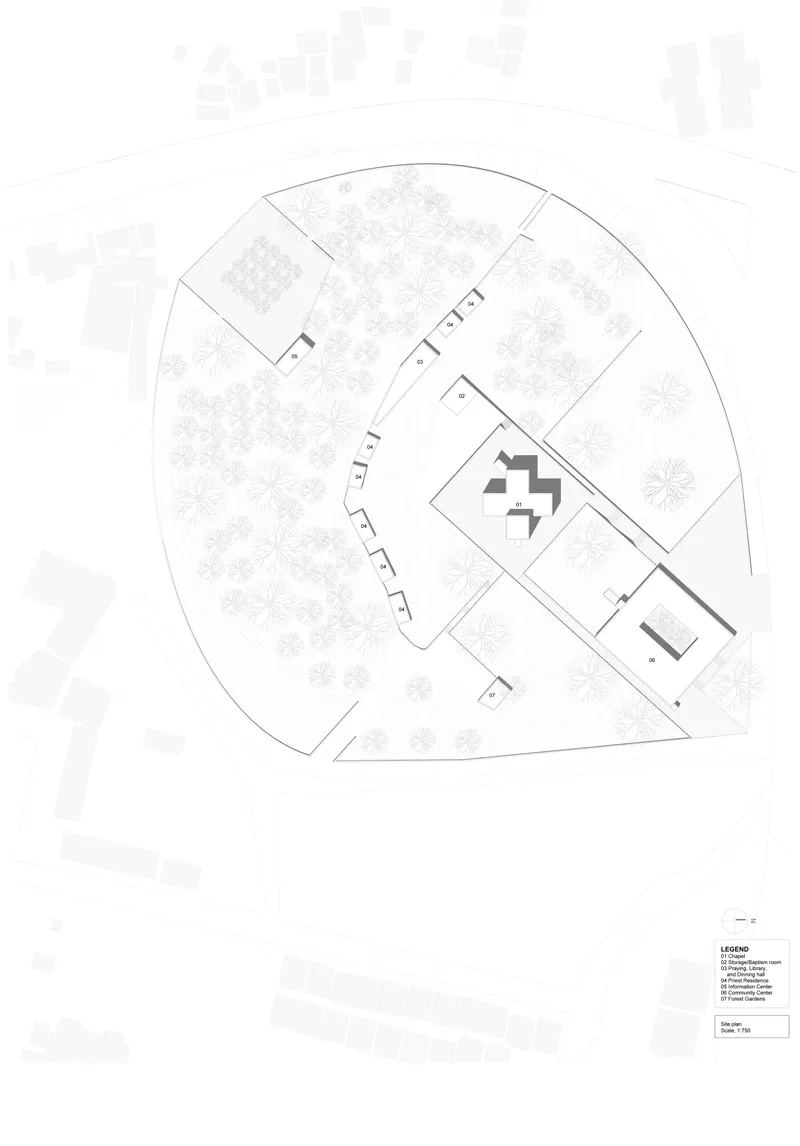
The project is carefully shaped by the topography of the site. The more active programmes, including the chapel and community centre, are placed on the relatively less hilly and more accessible areas. The quieter elements, including the priest residences, forest nursery, and contemplative gardens, are positioned deeper within the forested and sloped areas.
This approach reduces unnecessary disturbance to the landscape. Instead of imposing one large building footprint, the design distributes smaller architectural elements across the site. This allows the forest to remain present and continuous.
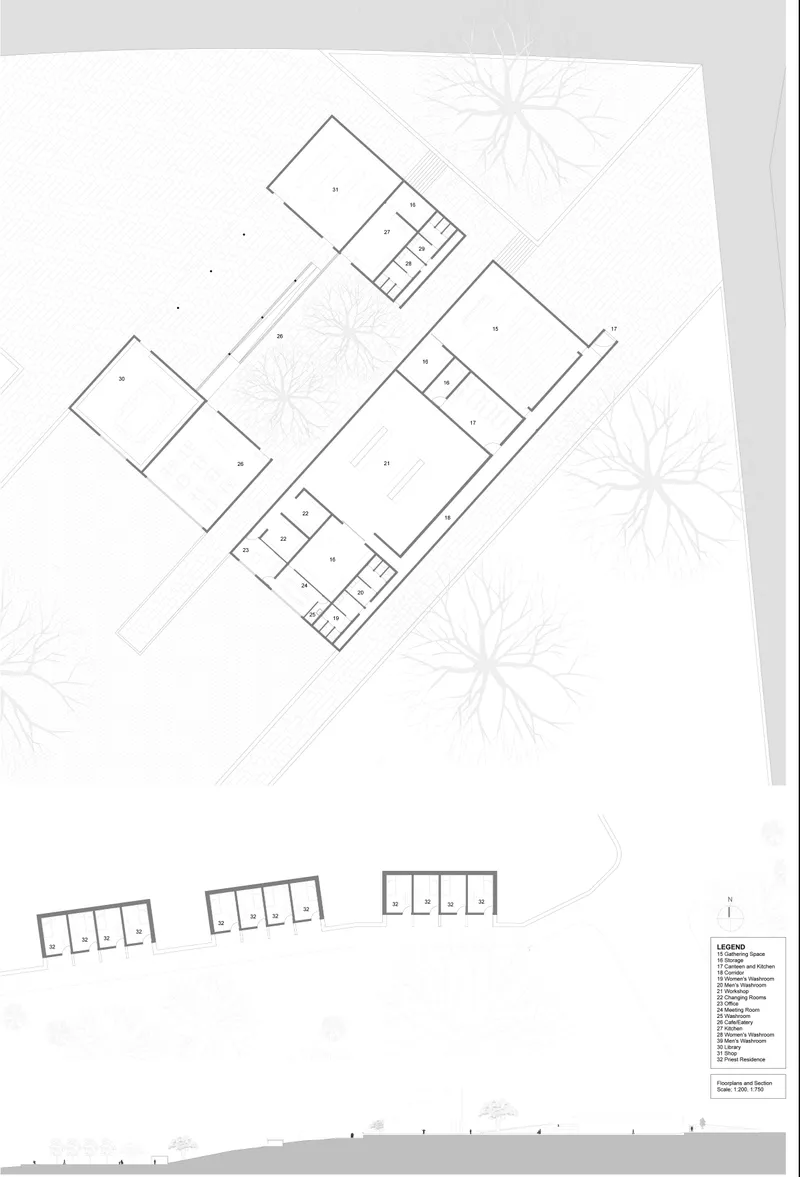
The site plan includes several key functions: the chapel, storage and baptism room, praying library, dining hall, priest residences, information or community centre, and forest gardens. These components are organized as a network rather than a single block. Pathways, courtyards, gardens, and thresholds connect the different programmes.
The design therefore treats landscape as an active part of the architecture. Trees, gardens, slopes, paths, and open spaces are not background elements. They shape how people move, gather, pray, and experience the site.
Community Centre and Public Dialogue
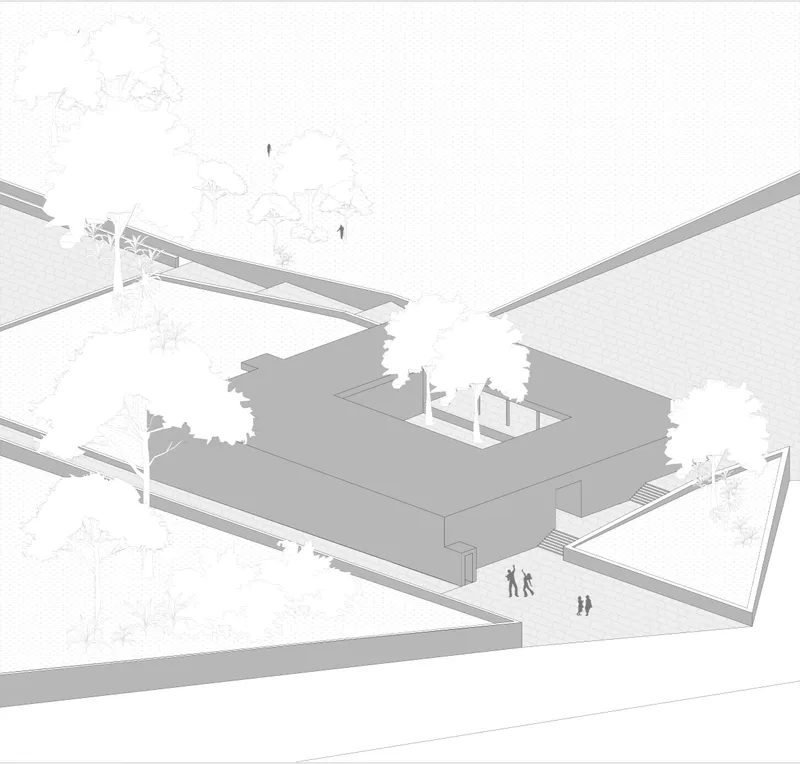
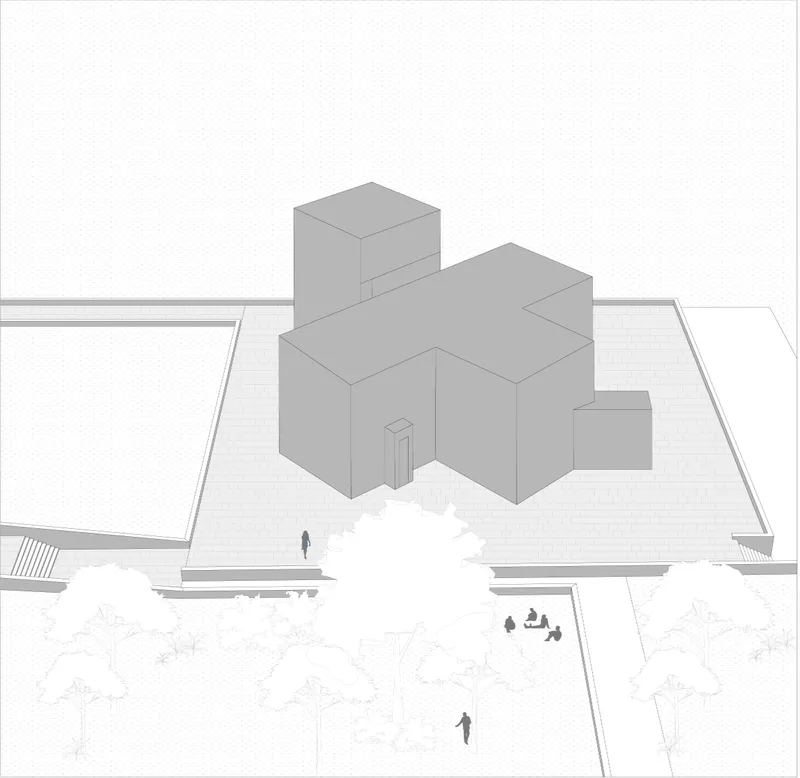
One of the project’s strongest ideas is the spatial dialogue between the chapel and the community centre. The open space between these two elements works as a raised platform, creating a visual connection from the courtyard of the community centre toward the chapel.
This platform is not simply an outdoor leftover space. It acts as a civic threshold where religious life and community life overlap. From this point, people can experience the chapel visually before entering it physically.
The community centre supports public and educational programmes, including dining, library, meeting areas, café functions, kitchens, changing rooms, and washrooms. These spaces extend the project beyond worship and make it useful for everyday community engagement.
Through this arrangement, the chapel remains sacred but not isolated. It stays in constant dialogue with social life.
Priest Residences as Forest Watchers
The priest residences play a meaningful role in the overall forest system. They are placed within the forested area and are designed with private gardens nearby. These gardens allow residents to grow vegetables, herbs, and small plants, creating a direct relationship between daily life and cultivation.
The priest residences also act as forest watchers. Their position within the forest gives them a quiet responsibility toward the surrounding ecology. They are not only living quarters but also guardianship points within the larger landscape strategy.
This makes the residences part of the ecological and spiritual identity of the project. They support a lifestyle connected to land, ritual, care, and observation.
Chapel Orientation and Religious Sensitivity
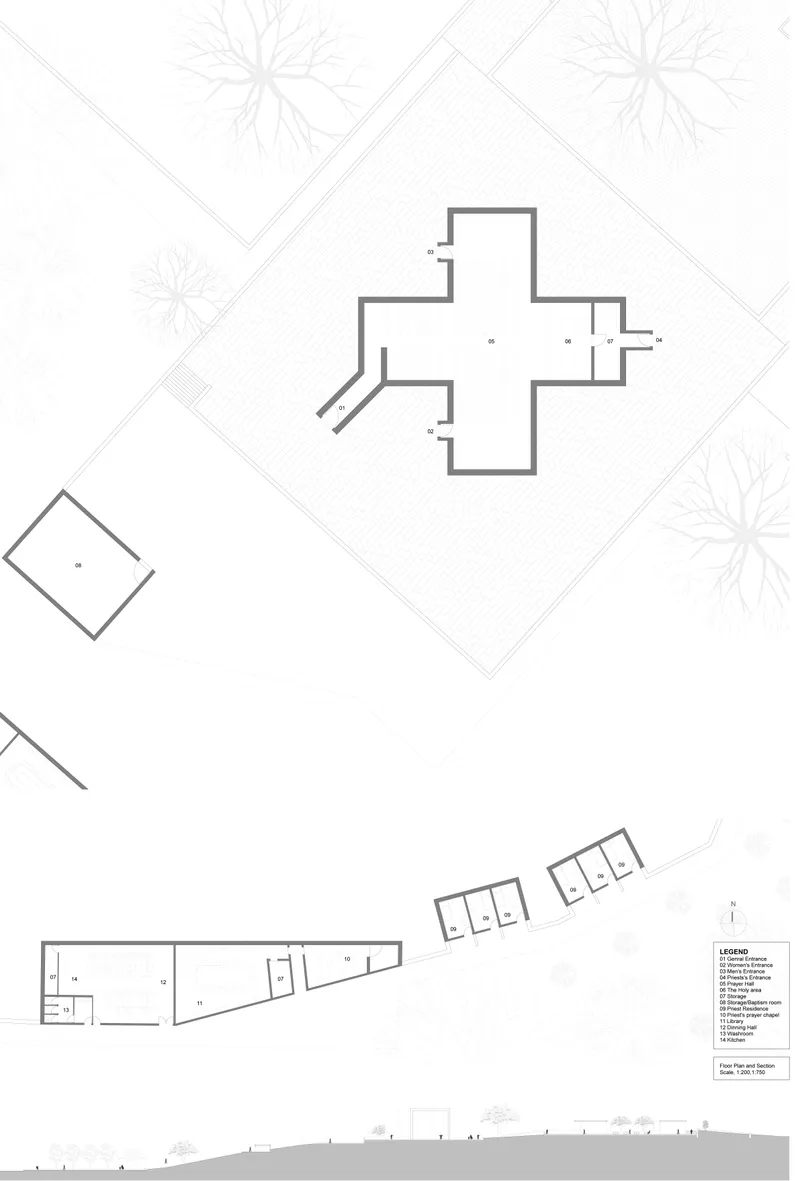
The chapel is oriented in the west-east direction, following an important religious logic. This orientation gives the chapel the primary rule in the site plan, reinforcing its sacred importance within the complex.
The design is also sensitive to the religious beliefs and norms of Ethiopian communities. The chapel is placed at the centre as the most celebrated, quiet, and hidden space of the complex. Supporting functions such as storage and baptism areas are arranged around it.
The plan includes separated entrances and gendered access points, reflecting the spatial needs of religious practice. The chapel’s internal arrangement respects ritual procession, gathering, and sacred hierarchy.
Forest Gardens and Ecological Education
The forest gardens are an important part of the project’s sustainable architecture approach. They transform the site into a place of environmental learning and daily ecological practice.
The gardens create opportunities for cultivation, reflection, and public awareness. They also soften the relationship between built form and forest. Instead of separating architecture from nature, the project allows the two to overlap.
This ecological layer is especially important because the chapel is not only presented as a building but as part of a wider forest system. The architecture becomes a framework for caring for the site.
A Quiet Architectural Language
The drawings show a restrained architectural language. The plans, sections, and axonometric views emphasize clarity, mass, circulation, and landscape. The chapel form is solid and compact, while the surrounding buildings are distributed with sensitivity to the terrain.
The minimal visual tone of the presentation reinforces the project’s conceptual calmness. The architecture avoids spectacle and instead focuses on hierarchy, balance, and connection.
The chapel’s massing feels grounded, while the site layout allows movement to unfold gradually. This gives the project a contemplative atmosphere, suitable for religious architecture and ecological retreat.
Why This Project Matters
The Chapel in the City is significant because it brings together three major architectural concerns: tradition, sustainability, and community.
As a work of sustainable architecture, it uses rammed earth and smaller building footprints to reduce environmental impact. As a religious project, it responds to Ethiopian Orthodox traditions, sacred orientation, and historical architectural references. As a community project, it creates spaces for gathering, learning, dining, gardening, and everyday public life.
The project does not treat sustainability as a technical checklist. Instead, sustainability is embedded in material choice, landscape response, cultural memory, and social participation.
Designed by Muauz Weldu Gebru, The Chapel in the City presents a thoughtful model for sustainable architecture rooted in Ethiopian context. It imagines the chapel as a mediator between city and forest, public life and private contemplation, tradition and contemporary ecological responsibility.
Through its use of rammed earth, its respect for topography, its integration of community programmes, and its reference to Ethiopian religious architecture, the project creates a sacred environment that is both culturally grounded and environmentally conscious.
The chapel becomes more than a building. It becomes a centre of gathering, a forest threshold, a place of worship, and a metaphor for the enduring relationship between architecture, nature, and community.




Popular Articles
Popular articles from the community


Play: Fragments of Their World
Familiar architecture becomes modular playground design, creating safe spaces where displaced children can learn, connect, imagine and play.

The Earth Pod: 3D Printed Homes for Resilient Refugee Communities
The Earth Pod reimagines refugee housing through 3D printed homes made from clay, combining resilience, self-sufficiency, and rapid shelter.

Conexión: Biophilic Design Reimagines High-Rise Living in Hong Kong
Conexión reimagines high-rise living in Hong Kong through biophilic design, green facades, shared spaces, daylight, water and nature within.

Riyadh For All: Intergenerational Urban Design for Active Aging in Rabat
Riyadh For All reimagines urban design in Rabat with intergenerational co-living, adaptive courtyards, and Moroccan cultural exchange today.


Similar Reads
You might also enjoy these articles

Eco Chapel: A Green Architecture Pavilion Designed in Symbiosis with the Forest
Eco Chapel uses green architecture to weave prayer, learning and reuse into a forest pavilion shaped by modular hexagonal canopies for life.
Kaffeebühnen: Coffee Shop Architecture Designed as a Civic Stage Between Vienna’s City and Park
Kaffeebühnen turns coffee shop architecture into a civic stage, linking Vienna’s park edge, urban life, warm timber yards, and coffee craft.
Healing Façade: Sustainable Architecture for Reforestation, Community, and Sacred Ecology in Ethiopia
Healing Façade reimagines sustainable architecture as a living wall that restores soil, catches water and renews Ethiopia's forest churches.


Urban Forest: A Vertical Ecosystem for 5,000 Workers in Singapore's Changi Business Park
Radially stacked pods and layered green decks turn a 7-acre plot into 47 acres of ecological workspace projected for 2040.


Comments (0)
Please login or sign up to add comments
No comments yet. Be the first to comment!