
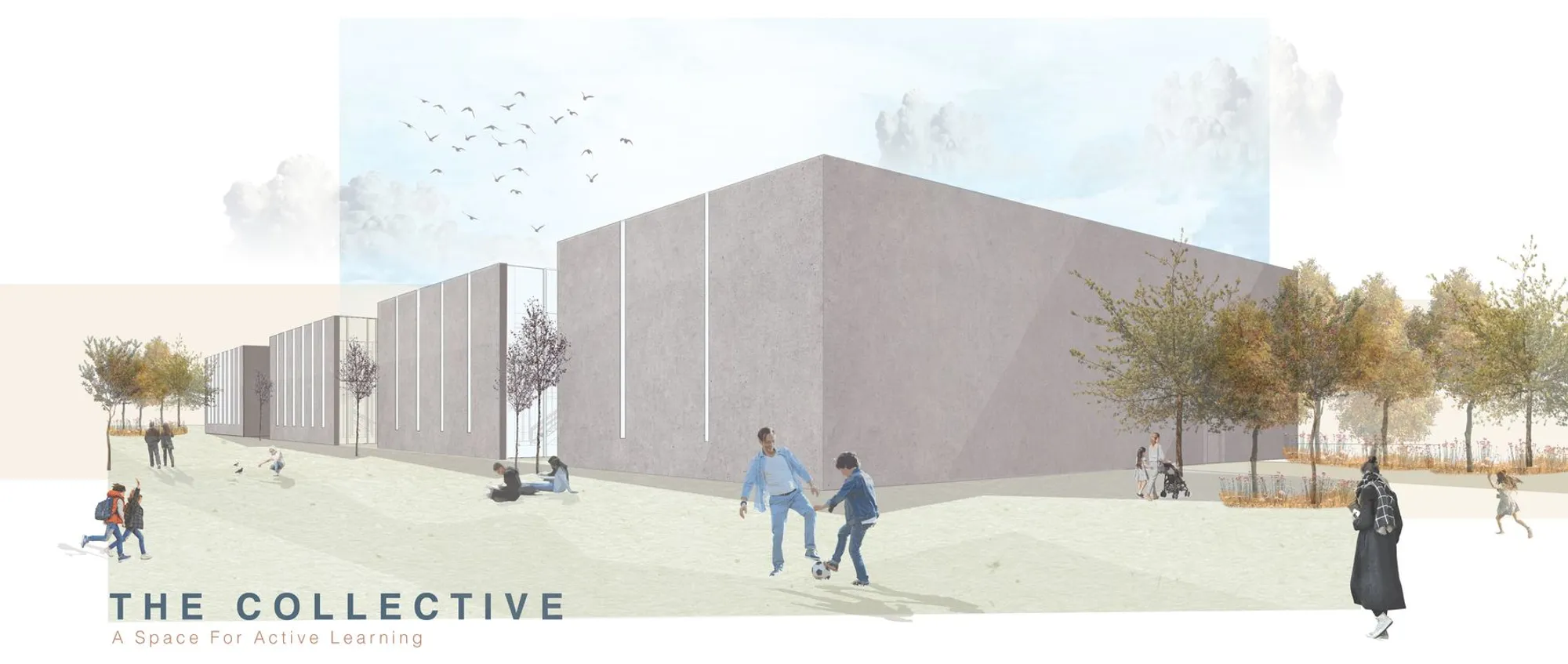
The Collective: A Library That Rewrites Itself Every Month
Kendra Yoshizawa's People's Choice winning entry for Libgen 2019 turns architecture into a rotating curriculum of sensory learning.


What if a library had no fixed identity? What if its walls changed color, its rooms shifted atmosphere, and its very purpose was renegotiated every thirty days? The Collective takes the idea of a knowledge institution and strips it of permanence, replacing static shelves and silent reading halls with a spatial system that breathes, transforms, and invites participation. It is not a building that houses information; it is a building that performs it.
Designed by Kendra Yoshizawa, The Collective won the People's Choice Award in Libgen 2019, a competition that asked entrants to reimagine the future of the library. Yoshizawa's response rejects the notion of the library as a repository and instead proposes a living system: an inclusive knowledge hub organized around monthly themes curated by invited "experts in residence." These experts, who range from artists and scientists to chefs and historians, occupy the building and reprogram its spaces through immersive installations and events. The architecture does not merely accommodate these shifts; it is designed from the ground up to enable them.
Twelve Months, Twelve Identities: The Exhibition Hall
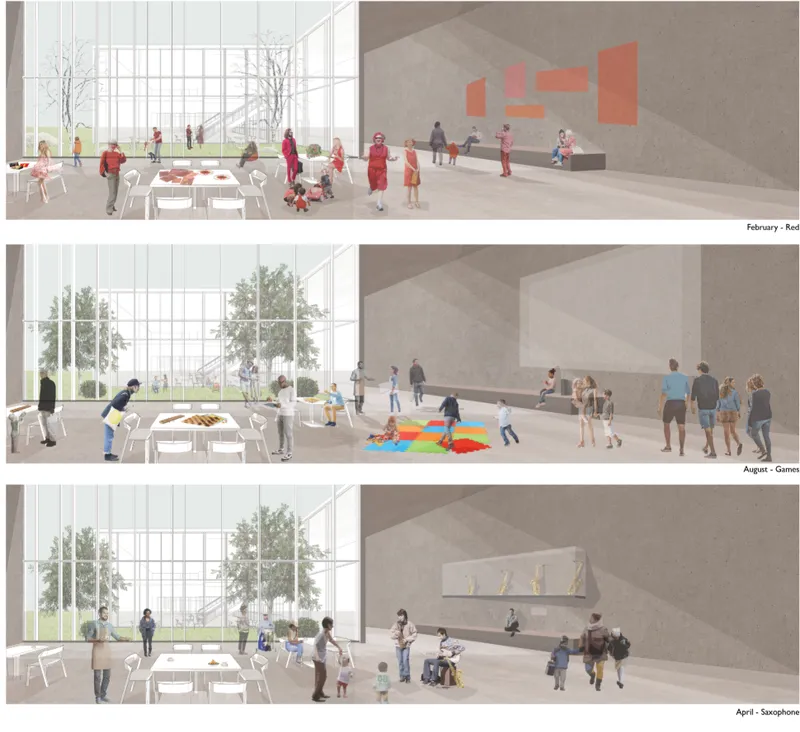
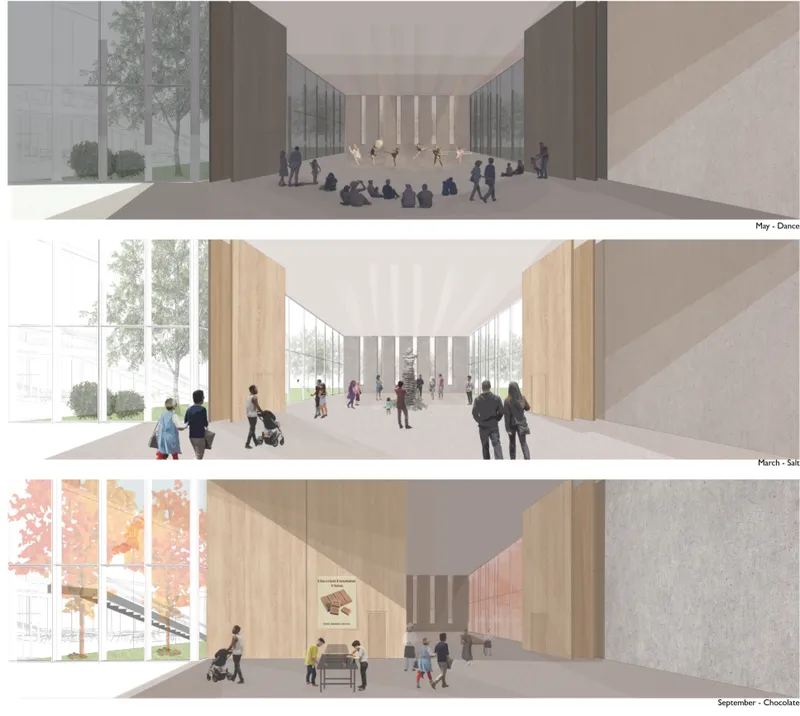
The exhibition hall and entrance corridor reveal the core mechanism of The Collective: a single space rendered three ways across different seasonal programs. Floor-to-ceiling glass pulls daylight deep into the interior, while open-plan layouts and flexible furnishings allow each month's expert in residence to radically reconfigure the room. In February, a bold red color installation takes over the café zone, championing visceral expression. By April, the same space hosts smooth saxophone performances that slow the tempo entirely. August fills it with games and community play. The architecture holds still while the life inside it shifts.
The entrance corridor, clad in warm timber and framed by glazed passages, serves as a threshold between the street and this rotating world. Visitors walking through it encounter the month's theme before they even reach the main spaces. Sightlines between rooms are deliberately generous, encouraging spontaneous overlap between programmatic zones and allowing curiosity to pull people from one experience into the next.
A Reading Room That Moves Beyond the Written Word
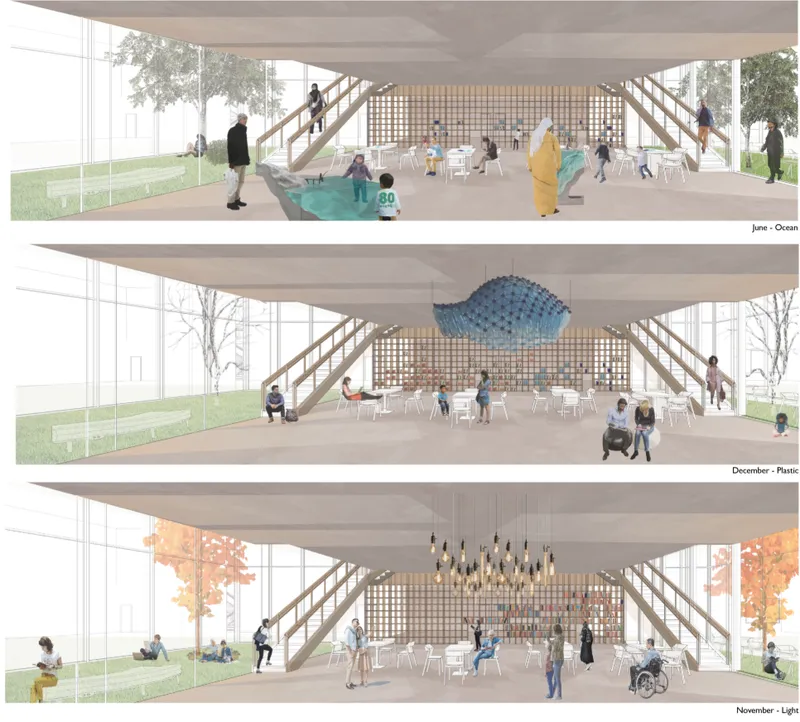
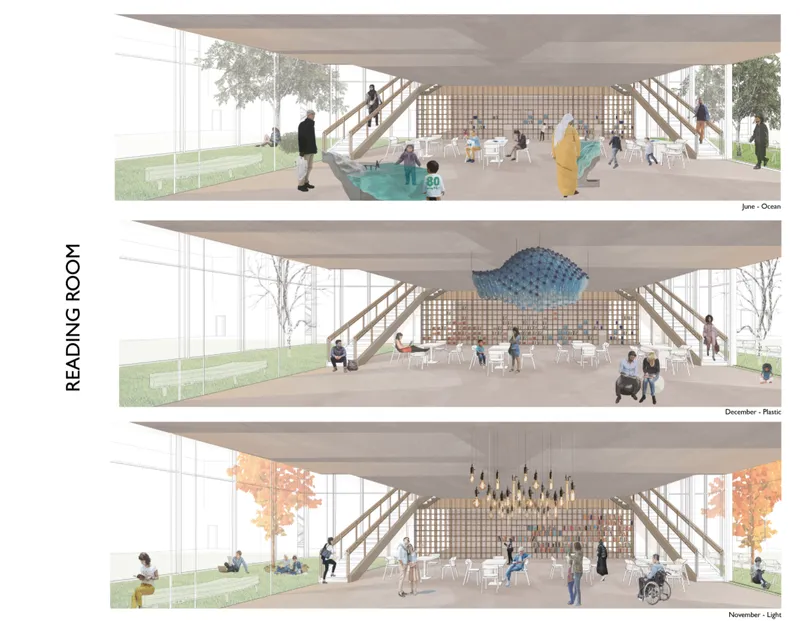
The reading room is perhaps the project's most provocative space. Two section renderings show it from slightly different vantage points, and both reveal a powerful spatial structure: diagonal staircases flanking a bold checkered wall, with seasonal installations suspended overhead. In June, ocean-inspired textures infiltrate the room, turning reading into a sensory encounter with water. December brings a plastic awareness sculpture, reframing the space as a site of environmental confrontation. November fills the overhead volume with luminous storytelling installations. The double-height volume is critical here; it gives each month's intervention room to breathe and ensures that the architecture itself reads as framework rather than finished product.
The checkered wall and timber stairs provide a visual anchor across all twelve iterations. No matter how drastically the installation changes, the architectural bones remain legible. This is a careful balance: enough spatial identity to feel grounded, enough openness to absorb radical transformation. The reading room moves well beyond the written word, positioning learning as something that happens through texture, light, and physical presence.
Living In the Curriculum: The Residence as Immersive Experience
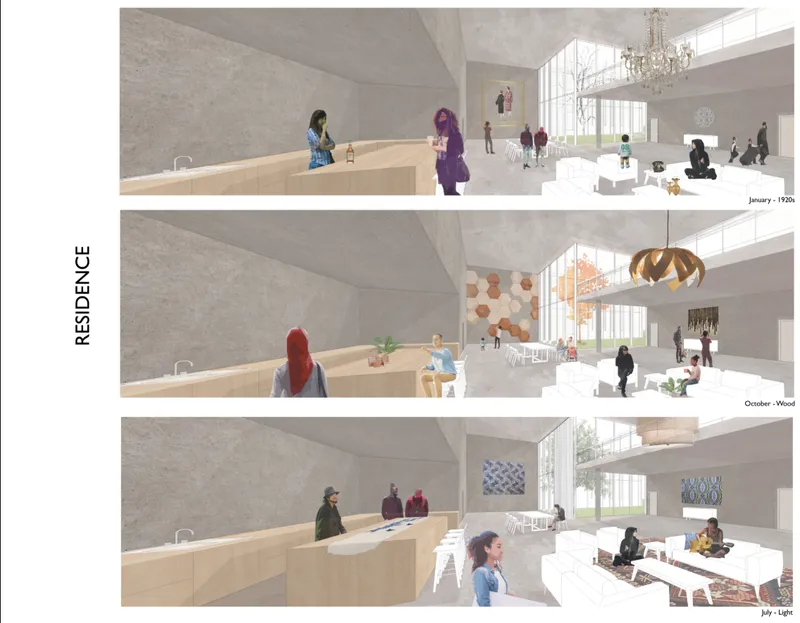
The residential zone completes the loop. Where most libraries end at the threshold of the personal, The Collective extends its rotating curriculum into the space of dwelling. Three seasonal views of the residence show a timber service counter and pendant lights holding steady while the atmosphere around them shifts completely. January wraps the room in 1920s glamour, October foregrounds the materiality of wood, and July softens everything with cozy ambient lighting. The expert in residence does not just teach in this building; they live inside the theme they are curating, and visitors are invited into that domestic world.
This decision to include a residence is what elevates the project from an exhibition venue to a genuine knowledge ecology. The atrium, too, functions as a civic theater, hosting dance performances in May, hands-on chocolate-making sessions in September, and a meditative salt installation in March. Together, these spaces form a constellation, each programmed to a different frequency of engagement but all unified by the month's overarching theme.
Why This Project Matters
The Collective matters because it treats architecture as a verb, not a noun. In a moment when technology increasingly mediates how we access knowledge, Yoshizawa insists on the power of shared physical presence: learning through doing, through being in a room with other people, through the sensory charge of a space that has been deliberately reshaped to provoke a response. The building is not a container for content; it is the content.
What resonated with the Libgen 2019 audience, and what continues to resonate, is the simplicity of the underlying proposition. A rotating cast of experts. A building designed for transformation. A community that returns each month to find a familiar place made strange. Yoshizawa's project challenges architects to design not for permanence but for participation, and it challenges educators to consider what happens when the classroom itself becomes the lesson.
View the Full Project
About the Designers
Designer: Kendra Yoshizawa
Enter a Design Competition on uni.xyz
uni.xyz runs architecture and design competitions year-round that reward proposals with spatial conviction and real site intelligence.
Project credits: The Collective by Kendra Yoshizawa Libgen 2019 (uni.xyz).



Popular Articles
Popular articles from the community


The Earth Pod: 3D Printed Homes for Resilient Refugee Communities
The Earth Pod reimagines refugee housing through 3D printed homes made from clay, combining resilience, self-sufficiency, and rapid shelter.

Hill & Cross Opera: Sculptural Opera House Architecture Shaped by Tallinn’s Landscape and Identity
Hill & Cross Opera reimagines opera house architecture in Tallinn through its sculptural hill, civic plaza, glass wave and a luminous cross.

Co-Life: Senior Housing Design That Reconnects Older Adults With the City
Co-Life reimagines senior housing design through healing gardens, shared streets, workshops, and a sustainable community across generations.

Riyadh For All: Intergenerational Urban Design for Active Aging in Rabat
Riyadh For All reimagines urban design in Rabat with intergenerational co-living, adaptive courtyards, and Moroccan cultural exchange today.


Similar Reads
You might also enjoy these articles

Day and Night Park: A Time-Based Urban Newsstand in Beijing
A temporary urban newsstand in Beijing blending travel, light, and reading through poetic colors, compact form, and community-focused design.

Modernist Patio Renovation in El Masnou, Barcelona by Oliver Segura Arquitectura + Cebrià Arquitectura
Modernist patio renovation blending tradition and innovation with a movable pool, leveled floors, and Catalan materials in El Masnou.

Alto Residencial Coop: Cooperative Housing Development in Santiago de Compostela by Carbajo Barrios Arquitectos
A linear cooperative housing complex blending white volumes and perforated metal façades, enhancing community living, natural light, privacy, and urban integration.

Vil Genis School by BPA ARCHITECTURE – Massy, France
Vil Genis School in Massy, France, features sustainable design, south-facing classrooms, community integration, accessible spaces, and modern educational architecture.


Explore Experiential Architecture Competitions
Discover active competitions in this discipline



Challenge to design locus for the upliftment of human rights


Challenge to design public laboratory


Design challenge to reuse E-waste
Comments (0)
Please login or sign up to add comments
No comments yet. Be the first to comment!