

The Cross Point: A Rehabilitation Centre That Rebuilds Aleppo Through Memory and Landscape
Blast craters become ecological pockets and war ruins become spatial references in a layered proposal for post-conflict healing in Aleppo.


Bomb craters do not disappear when the fighting stops. In Aleppo, circular voids left by blasts have slowly filled with wild growth since 2014, turning scars in the earth into accidental gardens. The Cross Point takes this uncanny transformation as its founding premise: architecture that does not erase trauma but metabolises it, converting the physical residue of conflict into a rehabilitation centre for Syrians returning to a fractured city.
Designed by Doaa Salaheldin and published on uni.xyz, the project positions itself at the seam between Aleppo's eastern and western halves, bridging the two across a landscape spine that references the city's ancient citadel axis. The programme serves children, adults, and families through therapeutic, educational, and communal spaces, while the architecture itself operates as a vessel for collective memory, reinterpreting the destroyed Grand Serial through layered elevations of ruin, reconstruction, and renewal.
An Ancient Urban Axis Extended into a War-Torn Site


The site plan reveals how Salaheldin traces Aleppo's historic spine, the route from the citadel's bridge tower to its mosque, and extends it into the project's organisation. Building footprints orient themselves along this axis, framing courtyards and planted areas that register the positions of significant war-damaged structures: Khan Ash-Shouneh, Al-Khosrowiyah Mosque, Al-Sultania School, the Grand Serial, and Hammam Yalbougha Al Nasri. These are not decorative references. Each ruin becomes a spatial coordinate that shapes the plan's geometry.
The axonometric view clarifies the relationship between the gridded courtyard at the complex's heart and the surrounding urban fabric. Palm trees punctuate a ground plane that stitches together pre-existing volumes, war scars, and new construction into a continuous corridor. The design reads as a negotiation between the organic pattern of post-war nature reclaiming land and the deliberate orthogonal order of the rehabilitation programme, neither dominating the other.
Blast Craters Turned Ecological Pockets
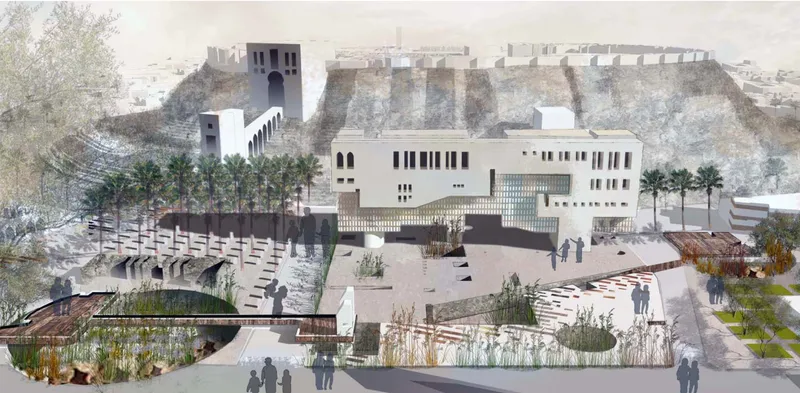
The plaza rendering shows what this symbiotic landscape strategy looks like at ground level. Water features and native planting fill spaces that were once defined by destruction, creating public zones where pedestrians move between therapy buildings and open courtyards. The approach is not cosmetic greening; it leverages the ecological succession that has already occurred since 2014, when wild nature began reclaiming bombed terrain. Salaheldin frames these pockets as evidence that the land itself has begun healing, and the architecture follows its lead.
Linking open courtyards, green areas, and public zones, the landscape spine functions as a pedestrian connector across the fractured site. It absorbs the irregular geometries left by conflict while maintaining a legible sequence of spaces that guide users from arrival to the centre's therapeutic interiors. The Citadel's monumental presence anchors the whole composition, visible as a constant reference point along the corridor's length.
Three Layers of the Grand Serial, Rebuilt in a Single Facade
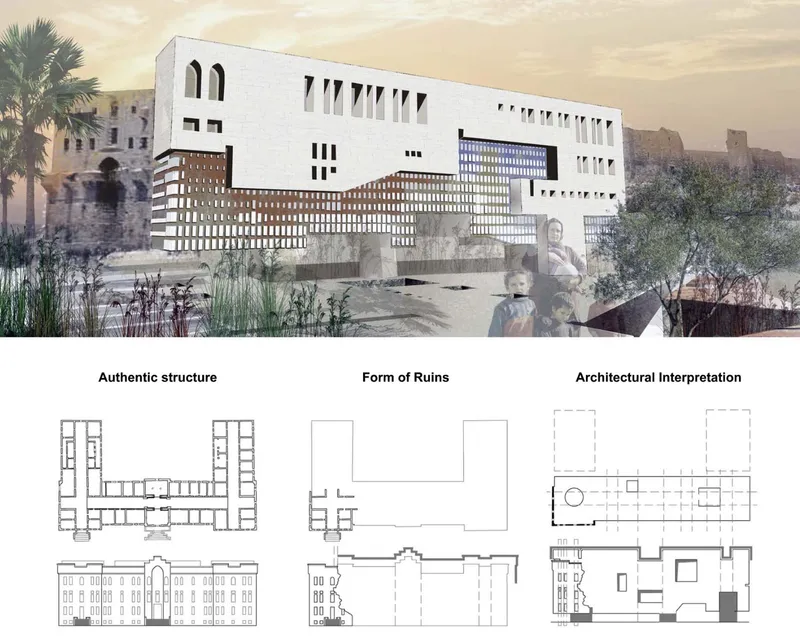
The elevation rendering is where The Cross Point's conceptual ambition becomes most legible. Salaheldin studied the Grand Serial's underground tunnels, collapsed facades, and remaining fragments, then distilled the building's lifecycle into three superimposed architectural layers. Level one represents the authentic historic structure: foundation grids and original spatial arrangements. Level two registers the form of ruins, making absence and collapse visible through expressive voids. Level three introduces reconstruction, using contemporary glass and Aleppo stone to reinterpret the 1928 facade.
The diagram adjacent to the elevation makes this reading explicit, comparing the authentic structure against its new interpretation. The result is a facade that communicates loss and possibility simultaneously. Patterned screens filter light into the interior while encoding the building's history into its skin, turning the elevation into a public document of what Aleppo was, what it lost, and what it might become.
A Perforated Screen Against the Hillside Ruins

At street level, the perforated facade screen meets the pedestrian eye with a tactile, human-scaled presence. The rendering frames the building against hillside ruins visible in the distance, collapsing the temporal gap between ancient destruction and contemporary construction into a single sightline. Pedestrians pass through a zone that feels simultaneously protective and open, an architectural quality Salaheldin reinforces with practical survival features: evacuation-safe underground levels, food silos, and water reservoirs designed for a context where peace remains uncertain.
The programme behind this facade serves children through safe classrooms, therapeutic play spaces, and psychiatric therapy rooms. Adults and families access physiological treatment, communal gathering spaces, and elevated gardens. The building is a rehabilitation centre in the fullest sense, addressing psychological, emotional, and physical recovery while operating as a resilient urban structure prepared for future conflict. Architecture here is not a monument to optimism; it is infrastructure for survival.
Why This Project Matters
Post-conflict architecture often falls into one of two traps: nostalgic reconstruction that pretends destruction never happened, or tabula rasa modernism that ignores everything that came before. The Cross Point refuses both. By reading blast craters as ecological potential and collapsed facades as layered palimpsests, Salaheldin proposes a third way where the damage is neither hidden nor fetishised but integrated into a living urban system that serves its inhabitants' recovery.
The project's strength lies in its specificity. Every design decision maps back to a real condition in Aleppo: the citadel axis, the destroyed Grand Serial, the wild growth that took root after 2014, the ongoing threat of violence that demands underground refuge. For student work, this level of contextual depth is remarkable. The Cross Point argues that healing a city and healing its people are the same project, and that architecture, when it listens carefully enough to ruin and regrowth alike, can do both.
View the Full Project
About the Designers
Designer: Doaa Salaheldin
Enter a Design Competition on uni.xyz
uni.xyz runs architecture and design competitions year-round that reward proposals with spatial conviction and real site intelligence.
Project credits: The Cross Point by Doaa Salaheldin.


Popular Articles
Popular articles from the community


Juan García Correa, John González and Claudia Rueda Sink a Circular Amphitheater into a Manizales Engineering Building
On the La Nubia campus in Manizales, Colombia, the S1 Building folds labs and offices into a hillside of ramped lawns that double as a campus route.

David Macias Steps a Doorless Stone and Plaster House Down a Tropical Colombian Hillside
In the humid hills of Colombia, Threshold House replaces the front door with an open void and terraces its 850 m² down the slope instead of fighting it.

LT2A and OPEN Architectes Thread a Brick and Glass High School Through a Wooded Belgian Campus
In Braine-l'Alleud, a 3,000 m² wing for Collège Cardinal Mercier pairs pale brick with a glazed colonnade, deferring to a small chapel and a dense wood.

U.GA Architects Wraps an Oval Rooftop Pool in Curved Board-Formed Concrete on Busan's Jeollidan-gil
In Busan's Jeonpo-dong, a 454 m² mixed-use block stacks a neighborhood facility, guest rooms and an oval rooftop pool inside spiraling concrete walls.

Similar Reads
You might also enjoy these articles


Aquadapt: An Underwater Habitat That Rewrites Its Rooms by the Hour
Curved modules ring the seabed while one shell shifts from breakfast room to cinema, farm and football pitch as residents' needs change.

Play: Fragments of Their World: Remembered Architecture Rebuilt as a Modular Playground for Refugee Camps
Tom Gardner abstracts domes, arches and towers from the homelands of displaced families into a kit of child-scaled play parts for camp settlements.
REBIRTH: A Circular Settlement Where Afghan Widows and Their Children Rebuild Life Together
A shortlisted Resile entry turns the circle into a protective ring of timber and brick, gathering homes, classrooms and gardens around a shared landscape.
The Main Dream: A Recycled Plastic Kit That Lets Refugee Children Build Their Own Playground
Thirty-centimetre interlocking cubes that connect on three axes turn play into construction, letting children author the spaces they occupy.

Explore Architecture Competitions
Discover active competitions in this discipline

Challenge to reimagine the Iron Throne

Photograph architecture without architects

Illustrate the lost glory of Angkor Wat - Render Challenge

Design challenge to reuse E-waste
Comments (0)
Please login or sign up to add comments
No comments yet. Be the first to comment!