The Diversification Platform: Reimagining Future-Ready School Architecture Through Adaptive Learning SpacesThe Diversification Platform: Reimagining Future-Ready School Architecture Through Adaptive Learning Spaces

The Diversification Platform: Reimagining Future-Ready School Architecture Through Adaptive Learning Spaces

UNI Editorial
UNI Editorial published Results under Architecture, Conceptual Architecture on

Project by Alexandra Shilova

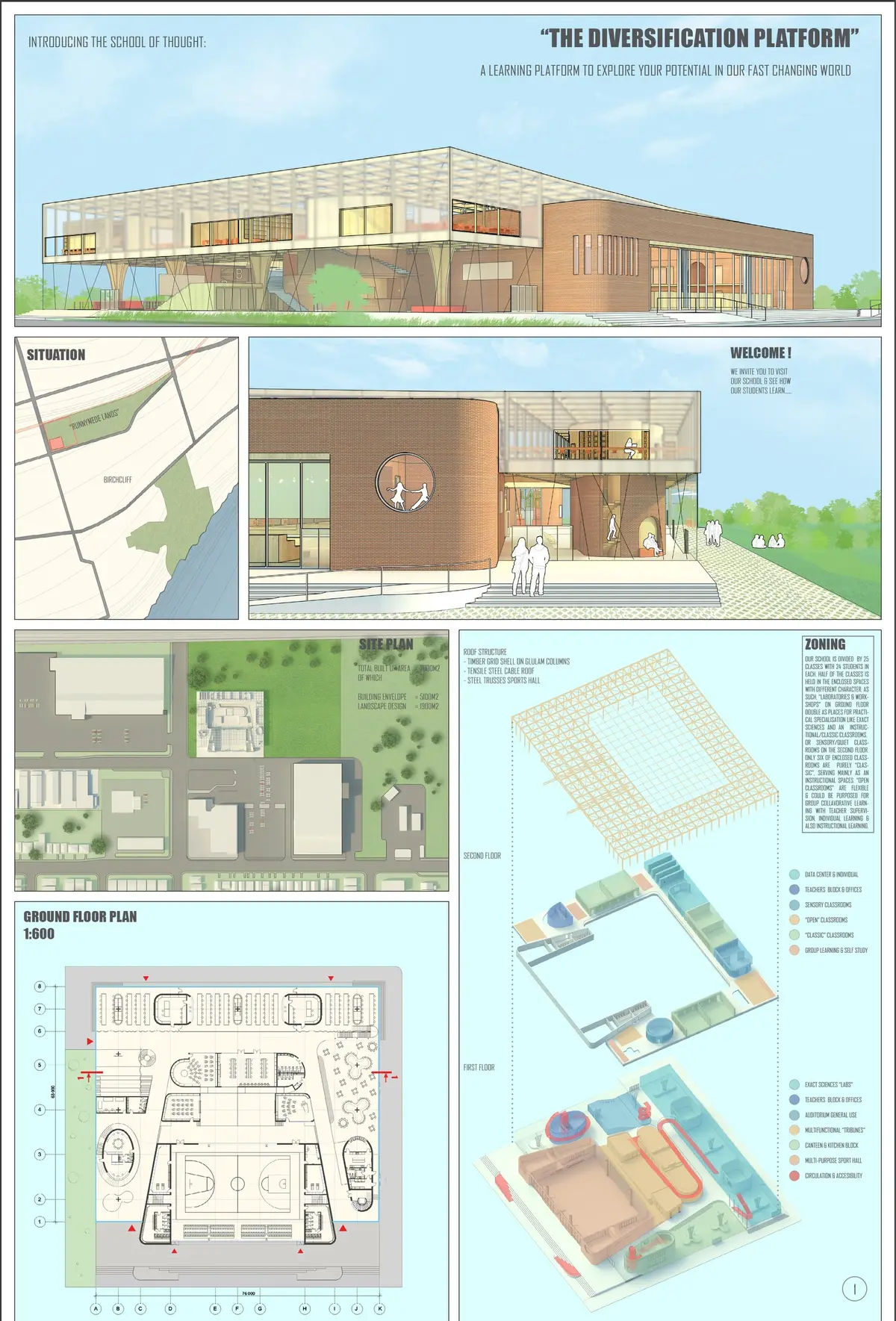
Education is rapidly evolving under the pressure of technological innovation, economic transformation, and changing social structures. Schools are no longer expected to function as isolated systems of instruction built around static classrooms and rigid routines. Instead, contemporary educational architecture is increasingly required to support adaptability, interdisciplinary collaboration, emotional well-being, inclusivity, and career-oriented learning. The Diversification Platform, an Honorable Mention entry from School Of Thought 2020 by Alexandra Shilova, proposes a bold architectural response to this shift.

Positioned as a future-ready school architecture concept, the project imagines education as an immersive ecosystem where learning extends beyond conventional classrooms into workshops, social spaces, libraries, laboratories, and collaborative tribunes. The school is designed not simply as a building, but as a dynamic educational platform capable of nurturing multiple forms of intelligence, creativity, and professional exploration.

At the heart of the proposal lies a critical question: how can architecture help young people navigate an increasingly complex and technologically driven world?

The answer offered by The Diversification Platform is spatial diversity.

Rather than prescribing one universal way of learning, the project creates an environment where students discover their own strengths through varied experiences and spatial identities. Every corner of the school is designed to encourage curiosity, experimentation, interaction, and personal development.

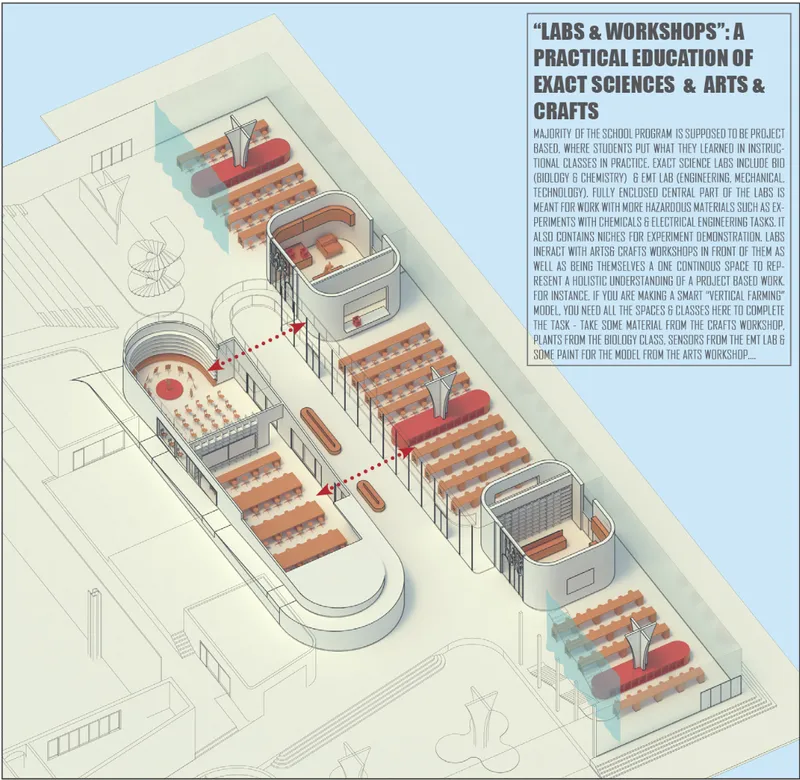
Labs and workshops transform the school into a hands-on learning environment where science, technology, and creative education intersect.
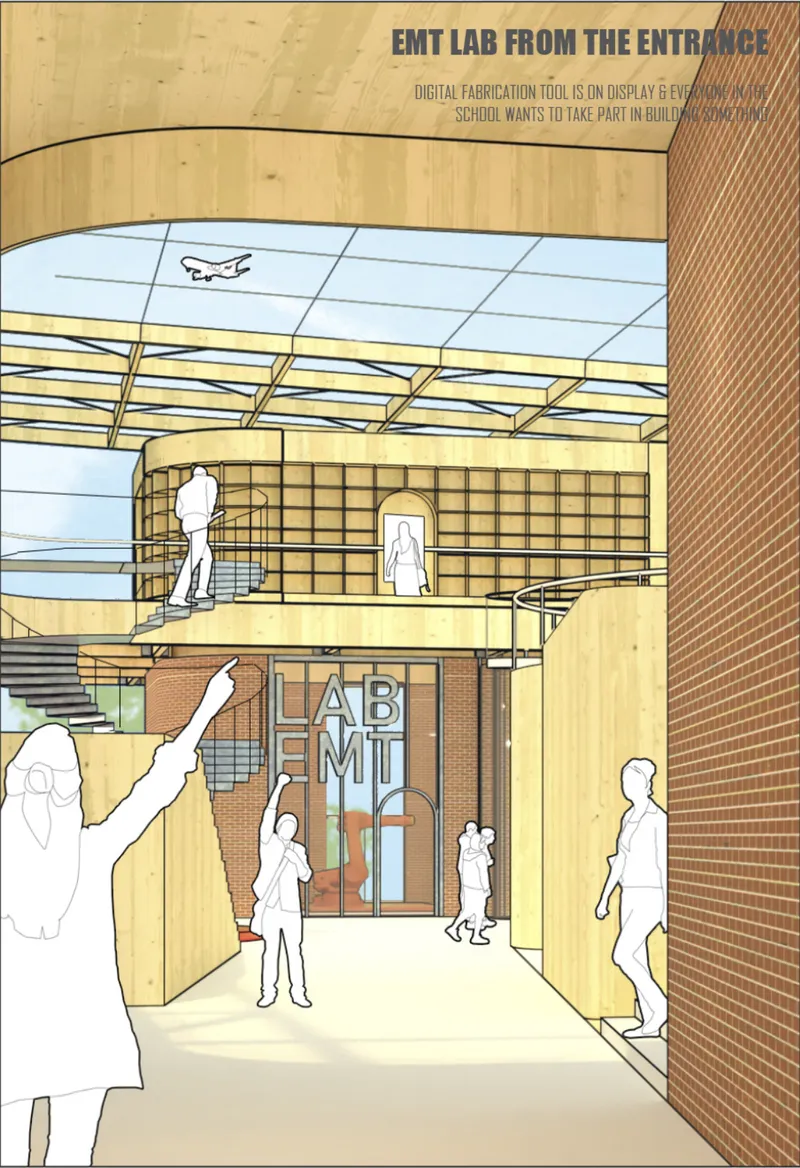
The EMT Lab entrance showcases digital fabrication and open experimentation as central elements of future-ready educational architecture.

Future-Ready School Architecture as a Learning Ecosystem

One of the strongest aspects of the project is its rejection of the traditional corridor-and-classroom typology that has dominated educational architecture for decades. Instead of repetitive enclosed rooms, The Diversification Platform organizes learning through interconnected environments that function as mini representations of real-life professions and experiences.

The architectural language reflects openness, movement, and flexibility. The building operates as a layered educational landscape where different learning typologies coexist and overlap. Students are encouraged to move between focused study, collaborative discussion, hands-on making, and public presentation.

This strategy aligns closely with contemporary discussions surrounding adaptive learning spaces and future-ready school architecture, where the physical environment becomes an active participant in education rather than a passive container.

The project recognizes that future professions will demand interdisciplinary thinking and practical adaptability. Consequently, spaces are designed to blur the boundaries between academic education, vocational training, creative exploration, and social engagement.

Large workshop areas, open tribunes, reading corners, laboratories, and communal gathering zones are integrated into a cohesive spatial system that supports multiple modes of learning simultaneously.

Architecture Inspired by Real-World Experience

Unlike conventional educational facilities that prioritize standardized classroom repetition, The Diversification Platform draws inspiration from industrial workshops, theaters, collaborative studios, and cultural institutions.

The architecture itself becomes educational.

Students encounter environments that resemble real-world professional spaces rather than abstract institutional interiors. Labs and workshops are intentionally visible and accessible, allowing practical learning to become part of the everyday spatial experience.

The project’s “Labs & Workshops” concept demonstrates this particularly well. The workshops are not isolated technical rooms hidden from the rest of the school. Instead, they are central architectural features integrated into circulation routes and communal spaces.

Mechanical engineering workshops, arts and crafts studios, biology labs, digital fabrication zones, and experimental classrooms create an atmosphere where making and learning happen openly.

This transparency encourages students to engage with disciplines outside their immediate interests while promoting cross-disciplinary curiosity.

By exposing students to practical activities and vocational experiences from an early age, the project addresses one of the central concerns of contemporary education: preparing students for professions that may not yet fully exist.

The Social Tribune as Educational Infrastructure

Among the project’s most innovative spatial interventions is the concept of the “social tribune.”

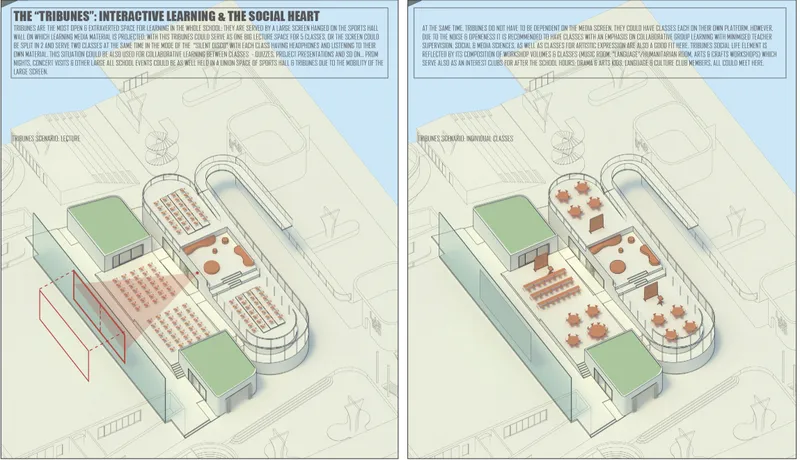
The tribunes function as interactive learning platforms that support lectures, performances, collaborative presentations, screenings, discussions, workshops, and informal gatherings. Rather than separating social interaction from education, the architecture merges them into one continuous spatial experience.

The sports hall wall doubles as a massive media projection surface, transforming the school into a hybrid environment where learning can scale from intimate conversations to collective events.

This approach reflects an important shift in educational architecture: the recognition that communication, social interaction, and collaborative performance are fundamental aspects of learning.

The tribunes are flexible enough to support both formal and informal educational activities. During school hours, they can host presentations, lectures, and collaborative sessions. After school, they transform into interest clubs and community gathering spaces.

Drama groups, culture clubs, arts collectives, and language communities can occupy the same spaces, reinforcing the school’s role as a social and cultural infrastructure rather than merely an academic institution.

Architecturally, the tribunes create spatial energy and openness within the school. Their stepped geometry introduces visual connectivity across multiple levels, allowing students to remain aware of ongoing activities throughout the building.

This continuous visibility strengthens the feeling of collective participation while reducing the sense of institutional isolation commonly associated with traditional schools.

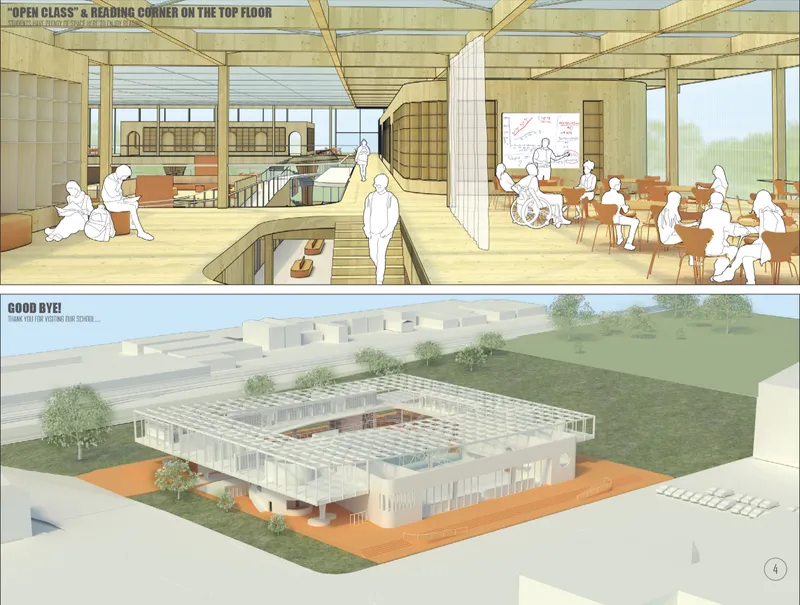
The “One Continuous Library” creates open learning zones that support focused study, collaboration, and inclusive educational experiences.
Warm timber interiors and flexible reading spaces redefine contemporary educational architecture through adaptive and student-centered design.

One Continuous Library: Redefining Quiet Learning

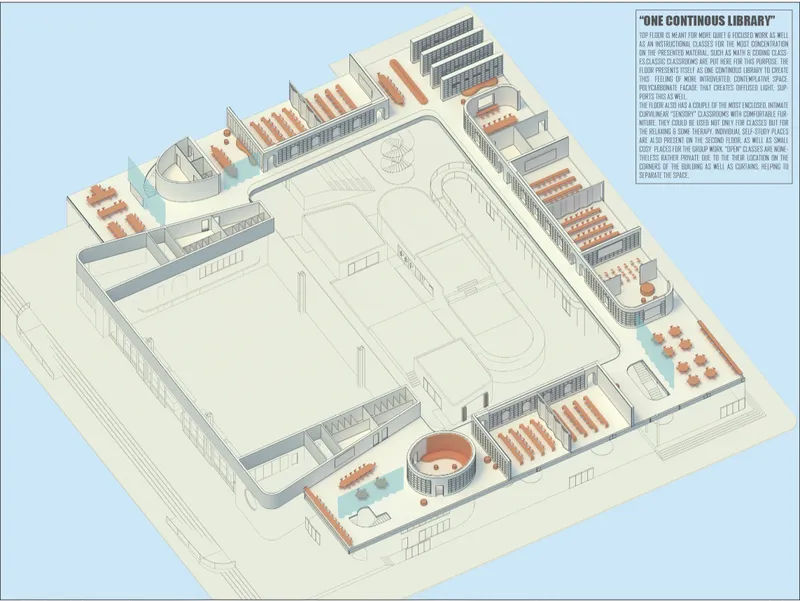
Another defining feature of the project is the “One Continuous Library” concept located on the upper floor.

Instead of treating the library as a separate enclosed room, the design transforms the entire upper level into a contemplative learning environment where reading, reflection, collaboration, and independent study coexist.

The top floor introduces a calmer architectural atmosphere compared to the active workshop zones below. Soft materials, intimate corners, sensory rooms, reading alcoves, and semi-private learning areas create a spatial identity focused on concentration and emotional comfort.

This layered transition from energetic communal zones to quieter introspective spaces demonstrates a sophisticated understanding of educational psychology.

Different students learn differently.

Some thrive in collaborative and extroverted environments, while others require solitude, sensory comfort, and focused concentration. The architecture acknowledges these differences without privileging one mode of learning over another.

This spatial inclusivity is central to the project’s educational philosophy.

By offering multiple environmental conditions within one cohesive system, the school becomes adaptable to diverse personalities, cognitive styles, and emotional needs.

Inclusive Design and Universal Accessibility

Inclusivity is deeply embedded into the architectural logic of The Diversification Platform.

The project integrates ramps into the primary circulation system so naturally that accessibility becomes part of the spatial identity rather than an additional technical requirement. Wheelchair users and able-bodied students share the same circulation paths and communal experiences.

This approach avoids segregated accessibility strategies and instead promotes genuine spatial equality.

Lift shafts are integrated where necessary, while sensory rooms provide supportive environments for students with learning disabilities or sensory sensitivities.

These sensory spaces are intentionally intimate and enclosed, offering moments of retreat within the otherwise open and collaborative school environment.

Such considerations reflect contemporary discussions around inclusive educational architecture, where schools are expected to support neurodiversity, emotional well-being, and universal accessibility simultaneously.

Importantly, the project treats accessibility not merely as compliance but as a fundamental architectural principle.

The result is a learning environment that feels open, democratic, and welcoming to all students.

Materiality and Spatial Warmth

Visually, The Diversification Platform balances industrial openness with warm educational atmospheres.

The extensive use of timber surfaces creates warmth and softness across the interior spaces, while exposed structural systems and workshop-inspired detailing reinforce the project’s practical and vocational character.

Brick volumes introduce texture and solidity, contrasting against the openness of glazed facades and flexible communal zones.

The structural rhythm of columns and ceiling grids gives the interiors a workshop-like identity while maintaining spatial clarity and navigability.

Natural light plays an important role throughout the project. Large glazed surfaces and open internal connections allow daylight to penetrate deep into the building, reducing the sense of institutional enclosure.

The combination of timber, transparency, and open circulation produces an environment that feels simultaneously educational, professional, and socially active.

The architectural atmosphere supports experimentation without becoming intimidating.

Educational Architecture Beyond the Classroom

The Diversification Platform represents a broader shift occurring within contemporary school design.

Educational spaces are increasingly expected to foster collaboration, adaptability, creativity, and practical engagement rather than simply accommodate lectures and examinations.

This project recognizes that the future of education lies in flexibility.

Rather than designing fixed-purpose rooms, the architecture creates adaptable environments capable of evolving with changing educational needs.

The integration of workshops, public forums, collaborative tribunes, vocational spaces, and contemplative libraries reflects an understanding that learning happens everywhere.

The school becomes a micro-city of experiences.

Students navigate different social and intellectual conditions throughout the day, developing communication skills, practical abilities, emotional intelligence, and independent thinking alongside traditional academic learning.

In this sense, the project positions architecture as a pedagogical tool.

Spatial organization, circulation, materiality, visibility, and flexibility all contribute directly to educational outcomes.

Reimagining the School for a Changing World

One of the project’s most compelling ideas is its emphasis on preparing students for uncertainty.

Technological acceleration continues to transform industries, economies, and professions at an unprecedented speed. Many future careers remain unknown, while traditional professional boundaries continue to dissolve.

The Diversification Platform addresses this condition not through technological spectacle, but through adaptability and exposure.

Students are introduced to diverse forms of making, communication, collaboration, and independent exploration. The architecture encourages experimentation rather than rigid specialization.

By merging educational spaces with workshop environments, social gathering zones, and cultural platforms, the project creates a school capable of evolving alongside society itself.

This vision aligns strongly with emerging discussions around future-ready school architecture, adaptive educational environments, and human-centered learning design.

The project demonstrates that architecture can actively support educational transformation by shaping how students interact, explore, and imagine their future.

A New Vision for Educational Space

The Diversification Platform by Alexandra Shilova ultimately proposes more than a school.

It proposes a framework for learning that embraces diversity, inclusivity, collaboration, vocational exploration, and emotional well-being within one unified architectural system.

The project rejects the outdated notion that education occurs only inside classrooms.

Instead, it imagines the entire building as an educational landscape where every corridor, tribune, workshop, library, and communal corner contributes to personal growth.

Its emphasis on adaptive learning spaces, social interaction, universal accessibility, and practical engagement positions the project as a compelling example of future-ready school architecture.

As educational institutions worldwide continue searching for new models capable of addressing the realities of the twenty-first century, The Diversification Platform offers an optimistic and deeply architectural response.

It demonstrates how thoughtful design can transform schools into environments that not only teach students, but also prepare them to navigate an evolving world with creativity, confidence, and curiosity.

Social tribunes transform school interiors into collaborative learning platforms for presentations, performances, and everyday interaction.
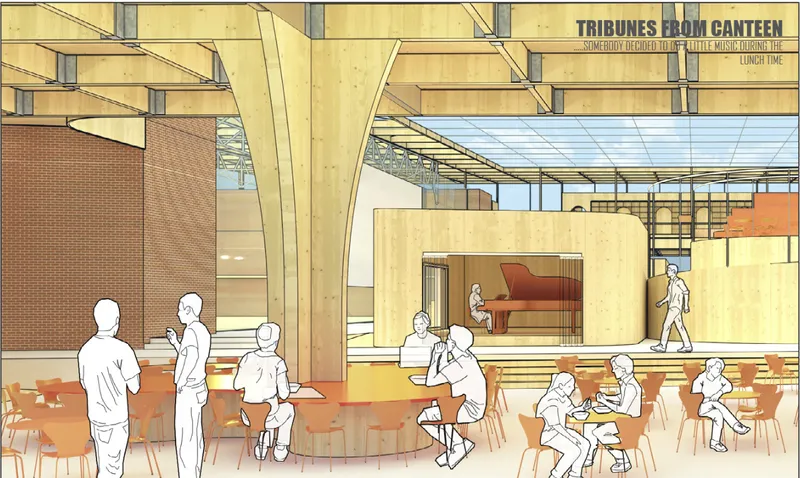
The communal canteen and performance spaces encourage informal learning, creativity, and social engagement throughout the school.
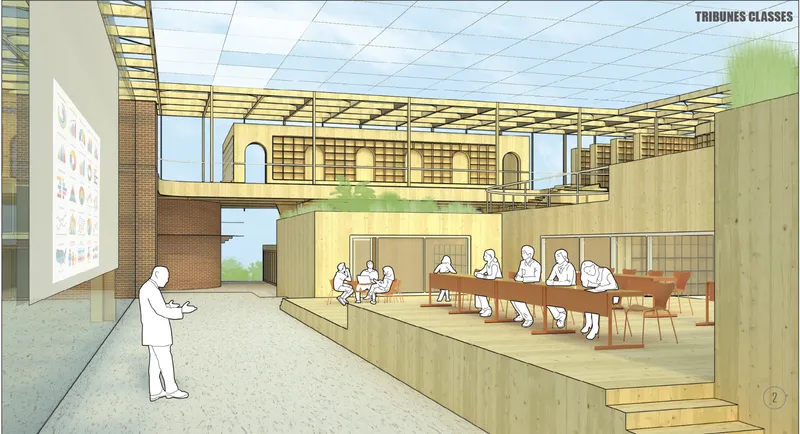
Flexible tribune classrooms integrate open discussion, digital presentation, and collaborative education within an adaptive school architecture concept.
UNI Editorial

UNI Editorial

Where architecture meets innovation, through curated news, insights, and reviews from around the globe.

Share your ideas with the world

Share your ideas with the world

Write about your design process, research, or opinions. Your voice matters in the architecture community.

Comments (0)

No comments yet. Be the first to comment!

Similar Reads

You might also enjoy these articles
publishedResults1 month ago
Urban Forest: A Vertical Ecosystem for 5,000 Workers in Singapore's Changi Business Park
publishedResults1 month ago
interACT: A Wearable Transit Object That Turns Commuting Into Social Infrastructure
publishedResults1 month ago
Lean On Barrier System: Where Traffic Safety Meets Chai Culture in Ahmedabad
publishedResults1 month ago
The Black Bagh: A Living Monument Built from Water, Light, and Memory

Explore Architecture Competitions

Discover active competitions in this discipline

UNI Editorial
Search in