

The Eco-Chapel: A Circular Pilgrimage Through Landscape, Light and Community in Ethiopia
A shortlisted chapel in Ethiopia wraps worship in concentric rings of garden, plaza and brick, turning the walk to the altar into a slow pilgrimage.


Most chapels announce themselves at the front door. The Eco-Chapel makes you earn the threshold. Its organising idea, Nature as a Guide to God, treats the approach as the real sanctuary: a deliberate, unhurried walk through gardens, plazas and gathering spaces that loosens the grip of the everyday before the worshipper ever reaches the sacred centre. The building is less a monument than the final ring of a landscape designed to be read slowly.
Designed by Cherine H, the proposal was shortlisted in the Eco-Chapel competition. Set in Ethiopia, within a humid subtropical climate zone, the project pairs a circular plan rooted in Christian and Ethiopian religious symbolism with passive environmental strategies and a programme that reaches well beyond Sunday worship. The result is a chapel that also behaves as a civic commons for its neighbourhood.
A Vertical Slot of Light in a Curved Brick Wall
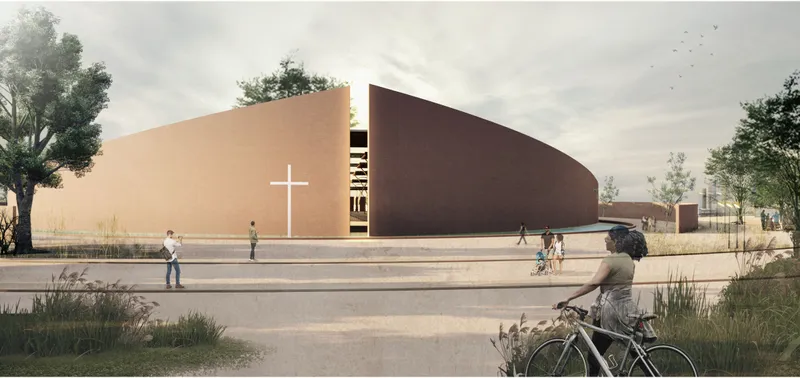
The dusk view sets the tone for the whole scheme. Curved brown brick walls fold around the visitor, and the only interruption is a narrow vertical slot carrying a white cross. There is no grand portal, no axial facade; the wall bends, and meaning is concentrated in a single cut. A woman pausing with her bicycle in the foreground is an apt detail, because the project is built for exactly this kind of everyday arrival rather than ceremonial procession.
That restraint is the point. By withholding a frontal view, the curved enclosure keeps the visitor moving along the edge, which is how the design turns architecture into an act of contemplation. The slot reads as an invitation inward, and the brick, warm and earthbound, ties the sacred gesture back to the material language of the place.
Concentric Rings and a Stepped Timber Crown
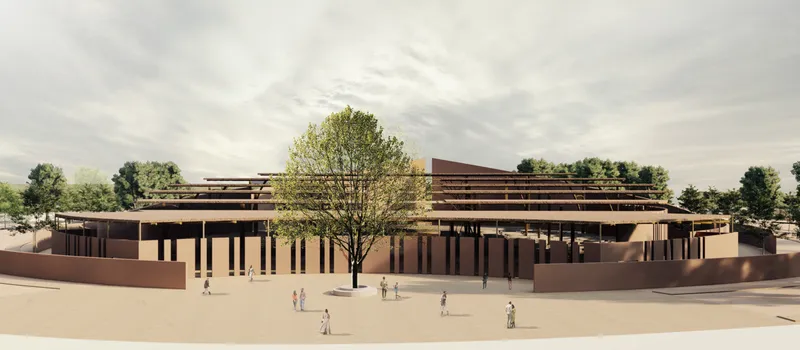
Seen from a distance, the chapel resolves into stacked timber roof tiers that step up toward the centre, fronted by a freestanding tree and a low curved wall. This is the circular geometry made legible in section as well as plan. The designer draws on the circle's long association with eternity, wholeness and the Alpha and Omega, and layers it outward as a series of concentric zones that organise both the building and its grounds. Each ring is a stage in the progression from the external world toward the spiritual core.
The geometry is also grounded locally. The proposal references Ethiopian religious traditions and their symbolism of creation, unity, the Holy Spirit and the Trinity, which keeps the round form from feeling like an imported abstraction. Environmentally, the scheme leans on passive design suited to a humid subtropical climate, drawing on local building traditions to reduce energy demand and improve comfort. The tiered roofs, with their layered overhangs, give that ambition a visible architectural form.
Inside the Circle: Timber Columns Bending Toward a Lit Cross
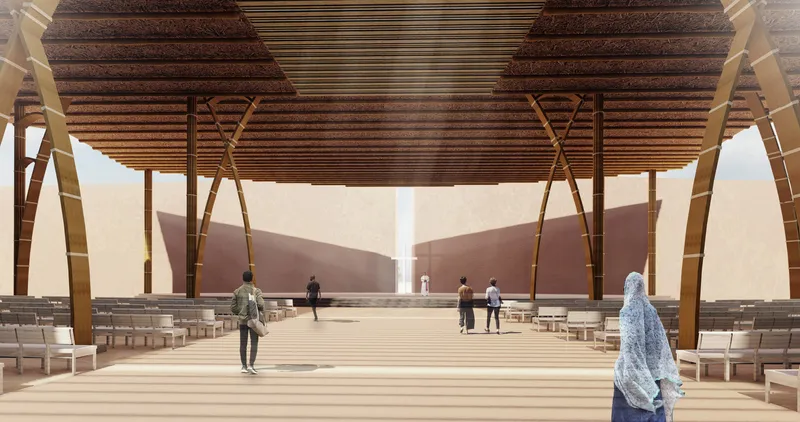
The interior pays off the journey. Curved timber columns rise toward a slatted ceiling, and rows of benches face a lit cross. The hall is open rather than sealed, so the boundary between worship space and landscape stays permeable, which matters for a project that frames nature as a guide to the divine. The curvature of the columns echoes the plan, so the circle is felt underfoot and overhead, not just on the drawings.
The slatted ceiling filters light instead of flooding the room, which keeps attention on the illuminated cross at the focal point. It is a modest set of moves, timber, rhythm and controlled light, but together they deliver the sense of arrival that the long approach has been preparing.
An Entry Plaza That Belongs to the Neighbourhood
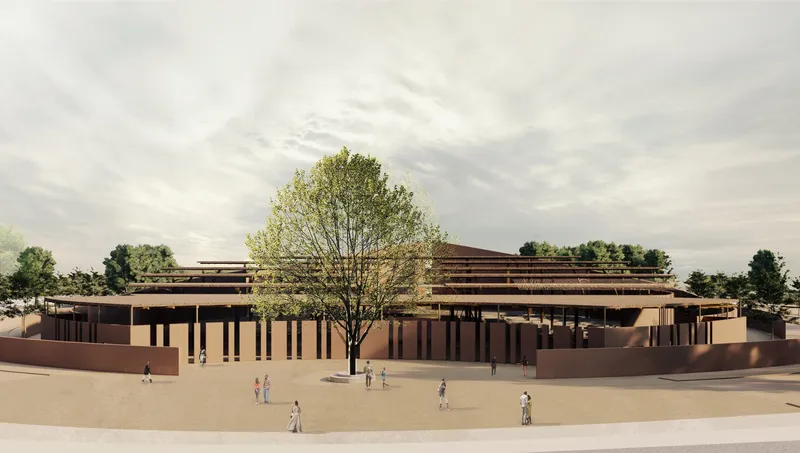
The final view shows the project's civic side. A single leafy tree anchors the entry plaza, people cross in soft cloud light, and behind them the layered timber roofs sit above brick-coloured screen walls. The master plan weaves curved pathways, gardens, workshops, plazas and community facilities into the site, so the grounds can host education, celebrations, cultural events and ordinary daily encounters. The chapel works as a social anchor, not only a destination for worship.
Resource thinking extends across the site as well. A rainwater harvesting system captures and stores water for use throughout the grounds, a practical gesture that supports the gardens and community programme the plaza implies. Sustainability here is framed as part of looking after a shared place, not as a bolt-on technical layer.
Why This Project Matters
The Eco-Chapel argues that sacred architecture is as much about sequence as it is about form. By organising the site as concentric rings and asking visitors to move through them slowly, Cherine H shifts the spiritual experience from a single room to an entire landscape. The circle is not decoration; it is the route, the plan and the symbolic content all at once, and its references to Ethiopian religious tradition keep it grounded.
Just as relevant is its refusal to separate the sacred from the social. Workshops, plazas and gathering spaces sit alongside the worship hall, passive climate strategies and rainwater collection respond to local conditions, and brick and timber keep the material palette close to the ground. For a competition centred on ecological chapels, this entry shows that a place of faith can also be a working piece of neighbourhood infrastructure, and that the walk to the altar can carry as much meaning as the altar itself.
View the Full Project
About the Designers
Designer: Cherine H
Enter a Design Competition on uni.xyz
uni.xyz runs architecture and design competitions year-round that reward proposals with spatial conviction and real site intelligence.
Project credits: The Eco-Chapel by Cherine H Eco-Chapel (uni.xyz).


Popular Articles
Popular articles from the community


Cloaked Colonization: A Mobile Underwater Habitat That Moves Like a Fish
Micah Abaya's shortlisted EHC Pacific entry reimagines ocean settlement as a dispersed network of self-sustaining architectural organisms.
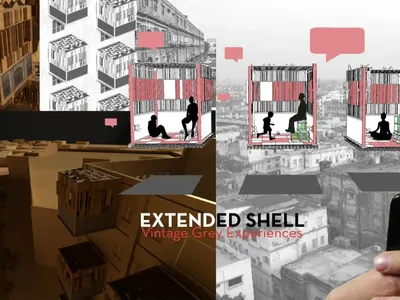
Extended Shell: Retrofitting Kolkata's Balconies as Living Urban Thresholds
A modular retrofit system recovers the social and environmental intelligence of Kolkata's historic verandas for contemporary Park Street residents.

The Amber Palace Opera: A Geological Fiction Surfaces on Tallinn's Baltic Waterfront
Pierre Brillard reimagines a Baltic legend as a public landscape, opera house, and waterfront promenade rooted in Tallinn's coastal identity.

Faces of the Soviet Avant-Garde: Turning Moscow's Street Names into an Open-Air Museum
A network of sculptural installations across a Moscow residential district transforms forgotten architect names into spatial encounters with cultural memor

Similar Reads
You might also enjoy these articles

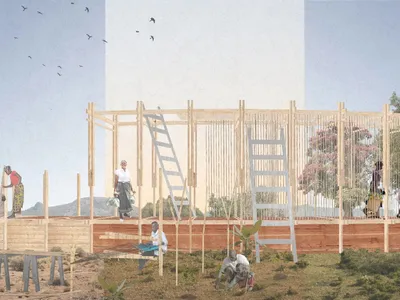
Healing Façade: A Modular Chapel System That Restores Ethiopia's Sacred Forests
Winner of the Eco-Chapel competition, this circular timber façade collects water from air to rebuild soil and reforest degraded Ethiopian landscapes.
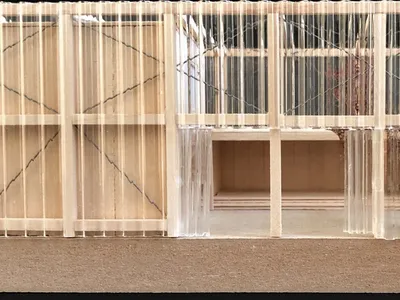
Kaffeebühnen: Where Coffee Shop Architecture Becomes a Civic Stage in Vienna
A linear sequence of timber boxes, transparent shells, and open yards turns the Viennese café tradition into a public performance space.
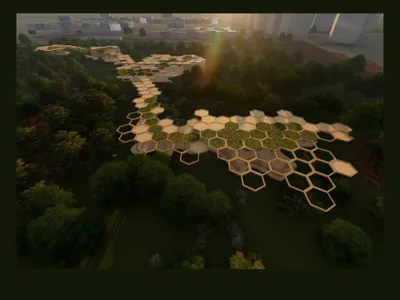
Eco Chapel: A Modular Forest Pavilion That Grows Like the Landscape It Protects
Hexagonal timber modules weave through existing trees, turning a chapel into a living system for prayer, education, and reforestation.


Urban Forest: A Vertical Ecosystem for 5,000 Workers in Singapore's Changi Business Park
Radially stacked pods and layered green decks turn a 7-acre plot into 47 acres of ecological workspace projected for 2040.

Comments (0)
Please login or sign up to add comments
No comments yet. Be the first to comment!