
The Evert House by VPA Architects: A Contemporary Indian Residence Rooted in Memory, Climate, and Craft
Climate-responsive Ahmedabad residence blending courtyards, upcycled wood, vernacular principles, and contemporary interiors to create an elegant, sustainable, memory-rich family home.


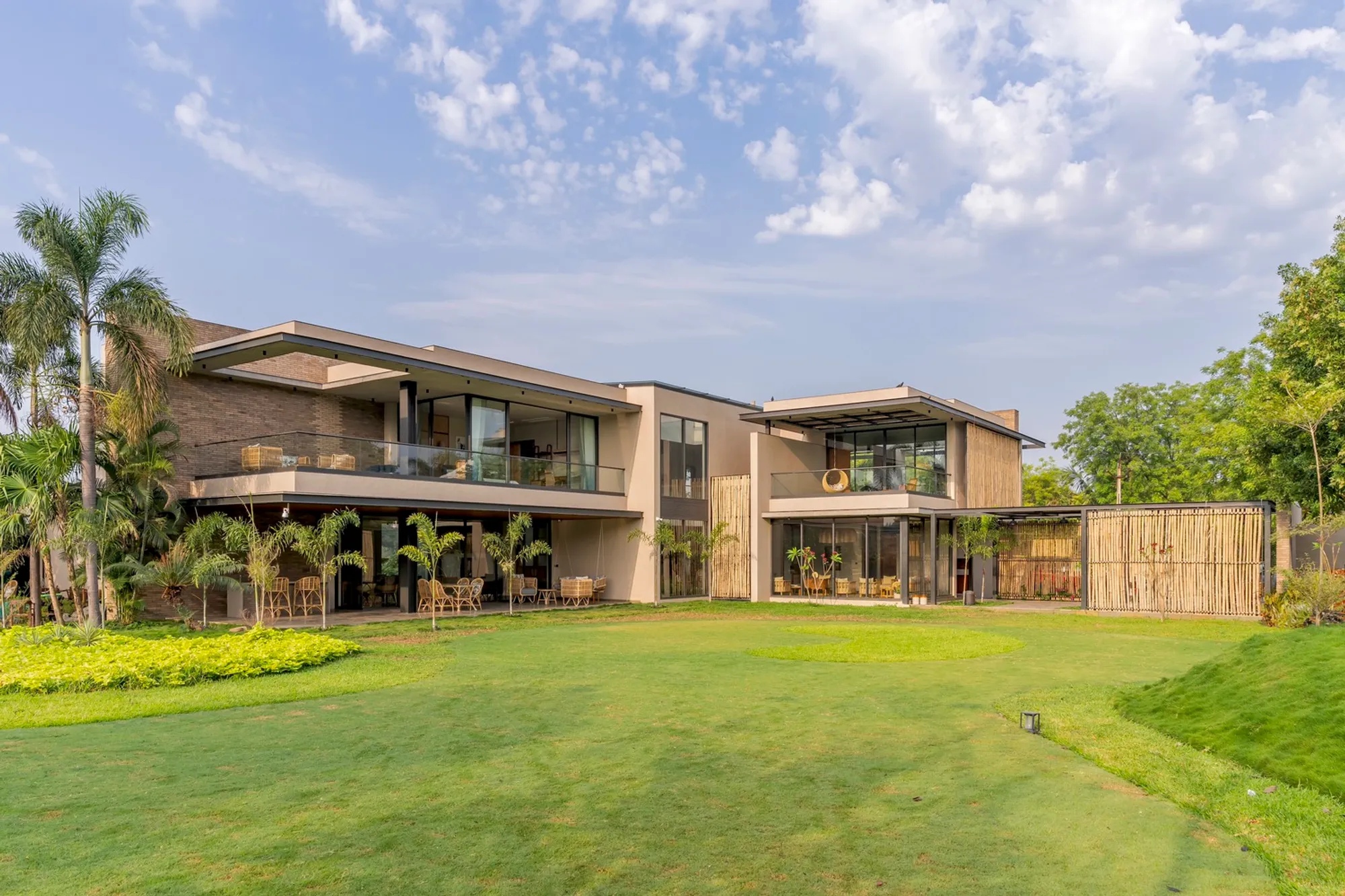
Located in Ahmedabad, India, The Evert House by VPA Architects is a 2,467-square-metre private residence completed in 2023 that blends vernacular sensibilities with contemporary living. Designed as a deeply personal home, the project explores architecture as an emotional and ecological response: where spatial planning, material choices, and light are guided by sentiment, sustainability, and climate consciousness.

Conceived as more than a luxury villa, the house is envisioned as a statement of honor, elegance, and lived memory. The architects embraced a subtle design language, allowing restrained forms, porous massing, and tactile materials to quietly shape a refined domestic environment.

Climate-Responsive Orientation and Porous Massing
The orientation of the Evert House is carefully calibrated to Ahmedabad’s hot, semi-arid climate while drawing inspiration from local vernacular architecture. The massing is deliberately porous, opening toward landscaped gardens on all sides to foster cross-ventilation and visual permeability. The north and east facades face expansive lawns, capturing soft daylight, while the west opens toward a more intimate backyard. The southern edge remains minimally punctured, shielding interior spaces from harsh solar exposure and accommodating service functions.
A northeast-facing configuration allows abundant natural light to filter deep into the interiors, mitigating heat gain and reinforcing the home’s ecological responsiveness. This strategic orientation establishes the house as a climate-sensitive residential architecture rooted in place.
Arrival Sequence and Transitional Spaces
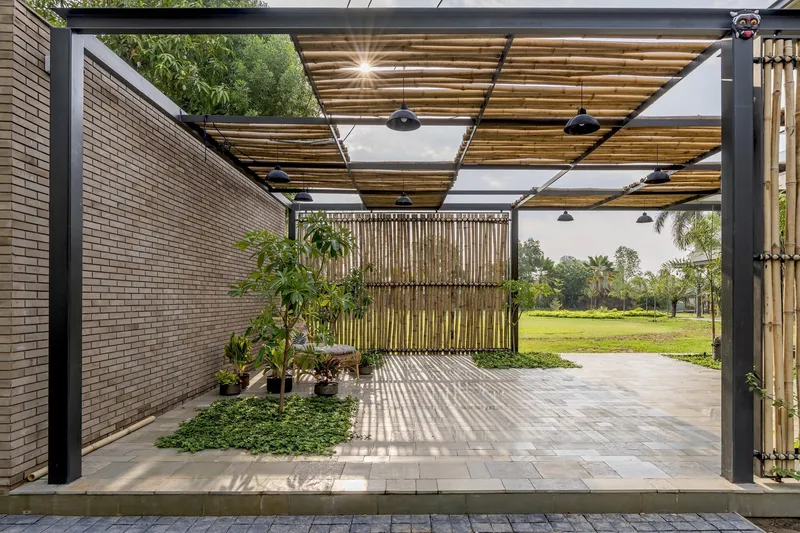
The arrival experience unfolds through a bamboo-canopied entry plaza, where Kota stone flooring, islanded trees, and layered bamboo screens create a gradual transition from exterior to interior. These screens act as contemporary ‘purdahs,’ filtering light and views while casting intricate shadow patterns that animate the spaces throughout the day.
Upon entry, a cozy formal living room and home office are revealed, offering privacy and controlled engagement with the outdoors. A secondary entry door leads residents through an artisanal passage into a central courtyard, from which the kitchen and dining spaces unfold organically.
Courtyard-Centered Living and Spatial Transparency
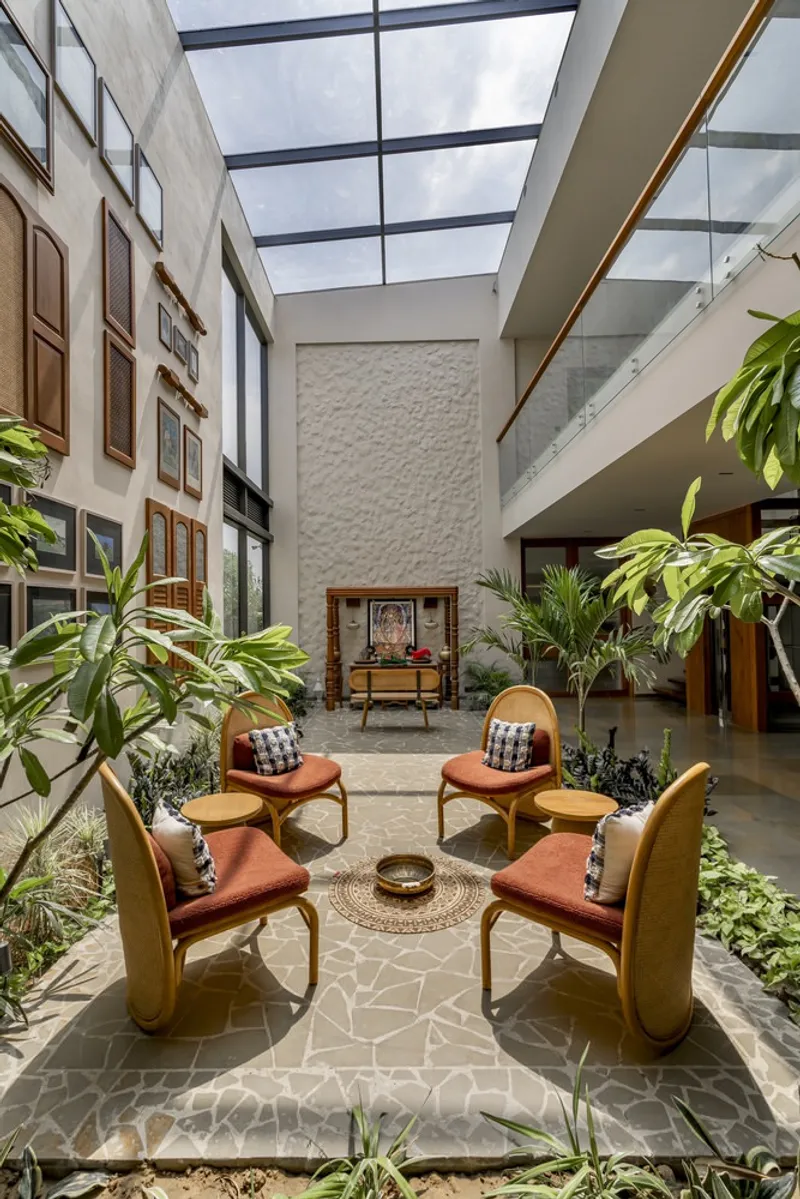
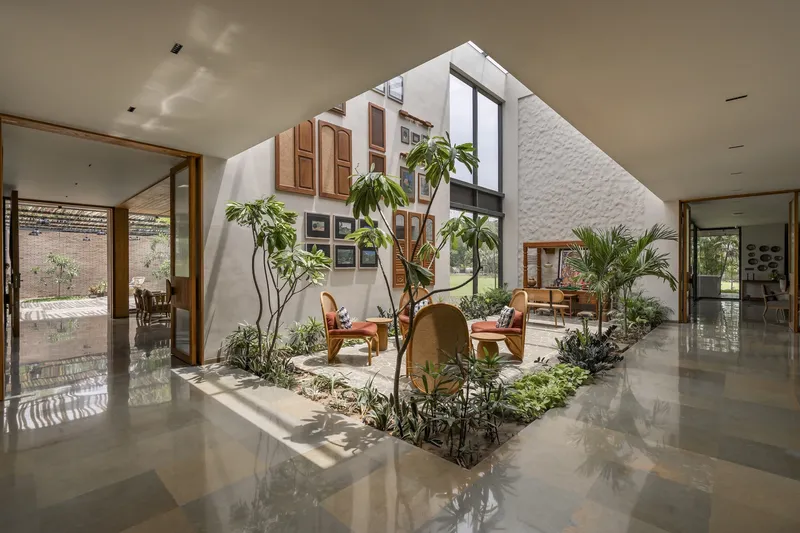
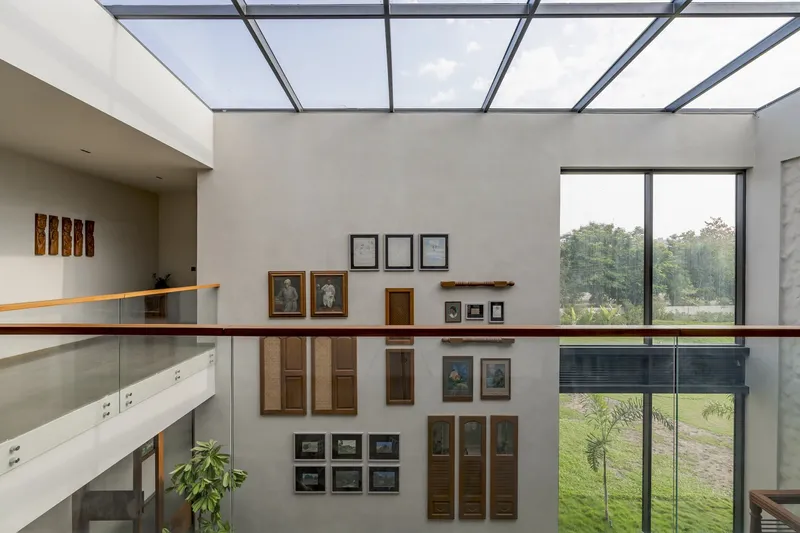
At the heart of the house lies a central skylit courtyard, conceived as both a spatial anchor and a symbolic core. Designed with museum-like restraint, the courtyard displays an ancestral collection of wooden furniture, transforming inherited objects into architectural artefacts. The placement of the temple against a textured wall sanctifies the space, reinforcing cultural continuity and spiritual grounding.
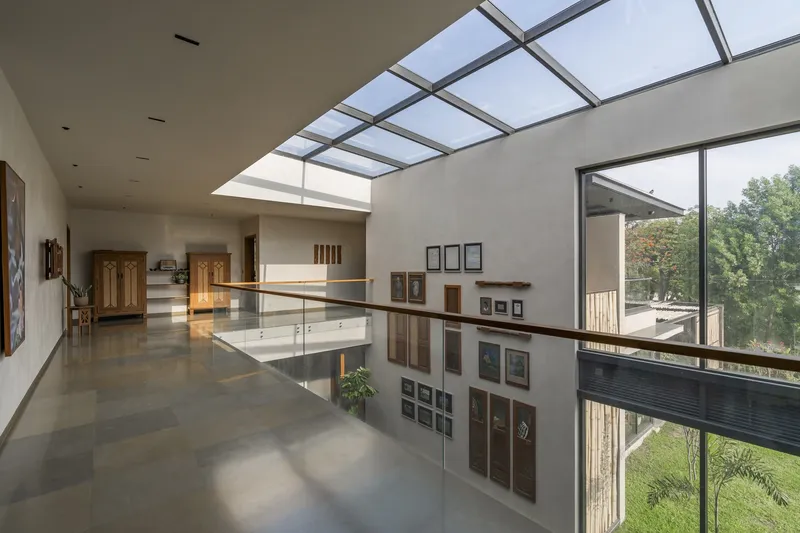
Circulation wraps around this double-height courtyard, ensuring constant visual connections across levels. The open-plan configuration seamlessly integrates the kitchen, living, and dining areas, fostering close familial interaction. The dining space extends outward into the garden, merging with an outdoor barbecue zone framed by a raw brick wall that visually and materially bridges inside and outside.

Private Spaces and Landscape Integration
Private zones are carefully layered beyond the main circulation spine. A guest bedroom with a spa-like washroom provides a retreat-like atmosphere, while the mother’s room is tucked into a quiet alcove. On the upper level, bedrooms are oriented toward open terraces and internal courtyards, reinforcing the home’s continuous dialogue with landscape.
The master bedroom opens onto a generous balcony, while the children’s room introduces playful green accents within an otherwise earthy palette. North-facing spaces house an indoor gym and yoga terrace, underscoring the project’s emphasis on wellness, calm, and mindful living.

Materiality, Upcycling, and Sustainable Design
Sustainability is integral to the Evert House, most notably through the extensive upcycling of old timber furniture. Approximately 90 percent of the wood used in chairs, doors, windows, wardrobes, and wall frames was reclaimed from existing furniture, significantly reducing the demand for new timber and minimizing environmental impact.
According to IGBC benchmarks, a typical 2,000 sq. ft. house consumes nearly 23 cubic meters of timber. By reusing inherited wood elements, the project actively contributes to reducing deforestation while preserving the tactile memory, scale, and familiarity of objects that carry generational value.
The interiors balance modern minimalism with classical warmth. Cane furniture, neutral plastered walls, warm lighting, and subtly patterned floors establish a cohesive and earthy aesthetic. Bathrooms are finished with stone tiles and brass fixtures, while indoor plants introduce verdant tones that soften the architecture and blur boundaries with the outdoors. A vibrant green accent wall in the children’s washroom adds a playful note to the restrained palette.

A House Defined by Memory and Modernity
The Evert House stands as an example of contemporary Indian residential architecture that prioritizes emotional resonance as much as environmental responsibility. By merging climate-responsive design, courtyard planning, reclaimed materials, and vernacular cues, VPA Architects have crafted a home that feels timeless yet deeply personal.
Ultimately, the project is not only about form or function, but about preserving memory: where the smell of old wood, the scale of familiar furniture, and the quiet presence of nature shape a lasting sense of place.

All photograps are works of Inclined Studio




Popular Articles
Popular articles from the community


Riyadh For All: Intergenerational Urban Design for Active Aging in Rabat
Riyadh For All reimagines urban design in Rabat with intergenerational co-living, adaptive courtyards, and Moroccan cultural exchange today.

The Ocean Hive: Sustainable Architecture for a Self-Sufficient Civilization at Sea
The Ocean Hive imagines sustainable architecture at sea, where modular habitats, algae, wave power and ocean waste sustain a growing colony.
AL-JANNAH: Sustainable Architecture and Permaculture for Afghan Widows
AL-JANNAH uses sustainable architecture and permaculture to create resilient oasis of housing, learning, work and renewal for Afghan widows.

Hill & Cross Opera: Sculptural Opera House Architecture Shaped by Tallinn’s Landscape and Identity
Hill & Cross Opera reimagines opera house architecture in Tallinn through its sculptural hill, civic plaza, glass wave and a luminous cross.


Similar Reads
You might also enjoy these articles


Hodi-Mandai Geram
Project Function: Preservation and revitalization of the Intangible heritage and socio-spatial identity of the Hodi by Housing, Cultural Memory Center, Sacred Grove, landscape, local tourism economy


Olio Towers: A Mid-Rise for Performers That Fuses Housing, Rehearsal, and Stage
Located blocks from Houston's Theater District, this modular tower stacks living units around a central performance atrium.

Oasis: Modular Green Housing Carved into Dhaka's Urban Fabric
A shortlisted Plugin Housing entry reclaims unauthorized settlements in Dhaka with stepped concrete volumes, green roofs, and ventilation-driven design.

Black Hole: A Floating Megastructure for the Post-Physical Era
Emiliano Mazzarotto envisions a spherical, self-scaling arena where e-sports, digital hotels, and holographic stadiums replace traditional public space.
Explore Architecture Competitions
Discover active competitions in this discipline



Challenge to reimagine the Iron Throne


Photograph architecture without architects


Illustrate the lost glory of Angkor Wat - Render Challenge


Design challenge to reuse E-waste
Comments (0)
Please login or sign up to add comments
No comments yet. Be the first to comment!