

The Green Bridge: Sustainable Urban Bridge Architecture in Copenhagen
A sustainable urban bridge in Copenhagen blending green terraces, cycling infrastructure, and public space into one dynamic architectural landmark.


In an era where cities are redefining mobility, public space, and environmental responsibility, The Green Bridge emerges as a powerful example of sustainable urban bridge architecture. Designed to connect Gammelholm and Christianshavn in Copenhagen, this innovative bridge is more than infrastructure, it is a vibrant public realm suspended above water.
Created by Kamil Ziółkowski, the project reimagines the traditional concept of a bridge. Instead of serving merely as a crossing point, it becomes a layered civic platform that integrates pedestrian movement, cycling routes, green terraces, and commercial spaces into one cohesive architectural system.
Redefining Urban Infrastructure Through Sustainable Design
Copenhagen is globally recognized for its bicycle culture and human-centered urban planning. The Green Bridge responds directly to this context by prioritizing pedestrians and cyclists while minimizing environmental impact.
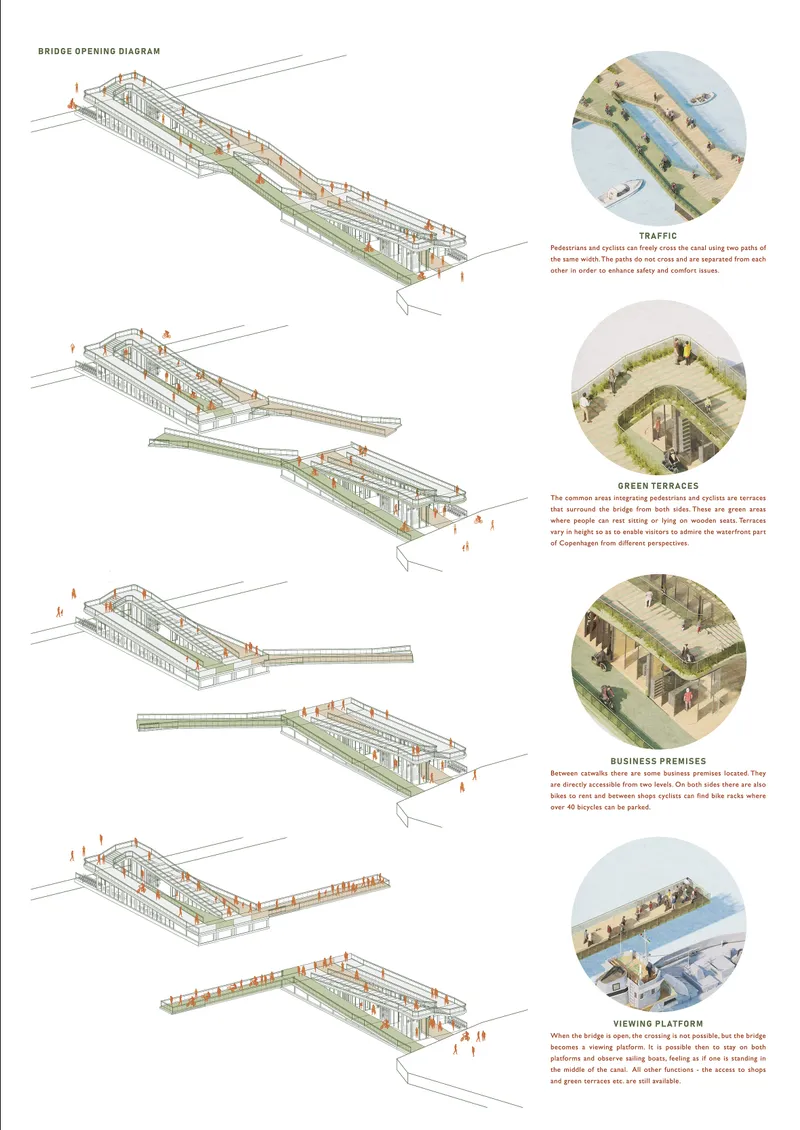
The design separates pedestrian and cycling flows into two equal-width paths. These routes do not intersect, ensuring safety, comfort, and clarity of movement. This simple yet effective strategy supports sustainable mobility and reflects principles of compact city design, where walking and cycling are encouraged over car dependency.
The bridge demonstrates how urban bridge design can actively shape behavior. By making sustainable transport intuitive and enjoyable, the architecture promotes healthier and more environmentally conscious lifestyles.
A Multi-Level Public Space Over Water
What distinguishes The Green Bridge from conventional bridges is its vertical layering. The structure allows users to shift paths and move between different height levels. These subtle changes in elevation create varied spatial experiences and encourage people to pause rather than simply pass through.
Green terraces line both sides of the bridge. These planted platforms serve as gathering areas where people can sit, rest, and observe the waterfront. The terraces vary in height, offering multiple perspectives of Copenhagen’s canal and surrounding architecture.
Rather than acting as a corridor, the bridge behaves like a public square stretched across water. The integration of landscape elements softens the structure and strengthens its identity as a piece of sustainable public architecture.
Integrated Business Premises and Social Activation
Between the pedestrian and cycling paths, the bridge incorporates business premises directly accessible from both levels. Retail units, bicycle rental spaces, and service areas are seamlessly integrated into the structural framework.
This mixed-use approach transforms the bridge into an active urban node. The terraces visually extend the commercial areas, while bicycle parking zones ensure practical usability. Over 40 bicycles can be accommodated within the designated racks, reinforcing Copenhagen’s cycling infrastructure.
Under the highest terrace, a landing space connects all functions efficiently. This thoughtful integration demonstrates how architecture can unify commerce, mobility, and leisure within a single form.
Structural Logic and Functional Clarity
The structural system of The Green Bridge reflects clarity and efficiency. The design is composed of:
- A concrete slab forming the base structure
- Pillars positioned beneath the waterline
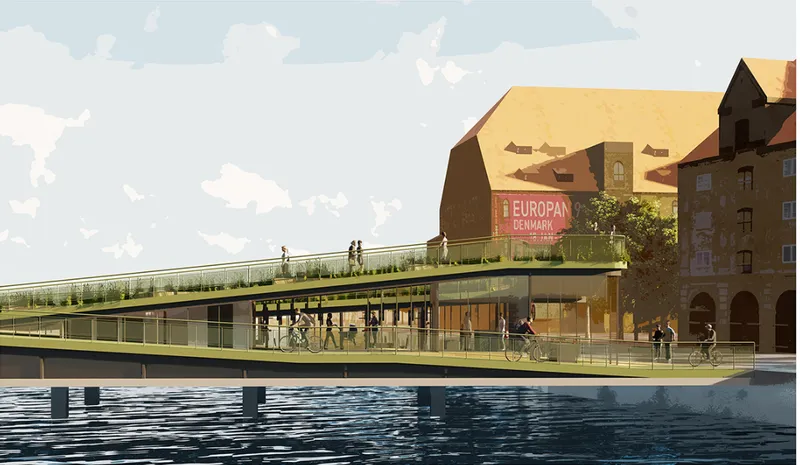
- Steel columns and beams supporting rooms and roof elements
- A wooden roof terrace construction with ornamental grass pots
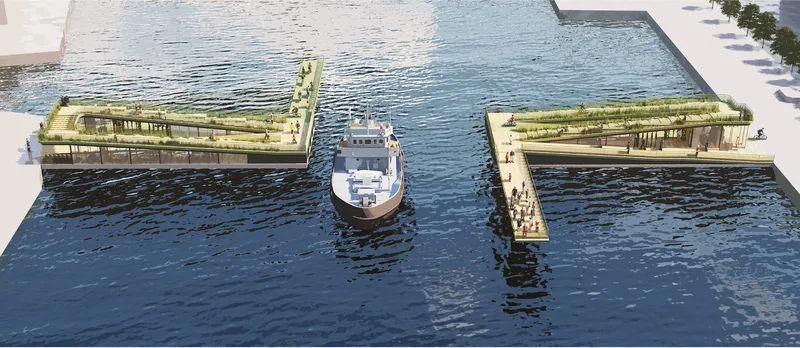
This layered assembly ensures durability while maintaining visual lightness. The bridge is also openable, allowing boat traffic to pass through. Even when opened, the structure functions as a viewing platform, an elevated stage from which visitors can observe sailing boats and the canal activity.
The form remains subtle and minimalist, yet highly recognizable. Its green tones and shifting elevations harmonize with Copenhagen’s waterfront architecture while establishing a distinct contemporary identity.

Encouraging Sustainable Transportation Through Urban Design
The project answers a critical urban question: how can architecture foster sustainable modes of transportation?
By creating compact, self-sufficient environments accessible within walking distance, cities reduce reliance on cars. The Green Bridge aligns with the 15-minute city principle, where essential services are reachable by foot or bicycle.
Bicycles are affordable, space-efficient, and environmentally friendly. In Copenhagen, they are not just transport, they are culture. The Green Bridge strengthens this identity by making cycling safe, visible, and central to the architectural concept.
A Landmark That Respects Its Context
Despite its innovative character, the bridge does not dominate its surroundings. Instead, it complements the historic waterfront fabric. Its color palette and modest proportions ensure that it integrates naturally into the urban landscape.
Its iconic presence emerges not through monumentality, but through experience. When open, it becomes a dramatic platform suspended over water. When closed, it functions as a seamless extension of the public realm.
The Green Bridge becomes a landmark because of how it is used, not just how it looks.
Architecture as Flow
At its core, The Green Bridge was created to enable free "flow": of people, functions, and perspectives. Movement is intuitive. Spaces invite gathering. Elevations encourage exploration.
This project exemplifies how sustainable urban bridge architecture can transcend technical necessity and become a living civic space. It demonstrates that infrastructure, when thoughtfully designed, can foster community, promote environmental responsibility, and enrich everyday urban life.
The Green Bridge is not just a connection between two districts. It is a connection between mobility and leisure, structure and landscape, infrastructure and architecture.




Popular Articles
Popular articles from the community

AL-JANNAH: Sustainable Architecture and Permaculture for Afghan Widows
AL-JANNAH uses sustainable architecture and permaculture to create resilient oasis of housing, learning, work and renewal for Afghan widows.

Conexión: Biophilic Design Reimagines High-Rise Living in Hong Kong
Conexión reimagines high-rise living in Hong Kong through biophilic design, green facades, shared spaces, daylight, water and nature within.

EW PARK: Sustainable Architecture Reimagines the Future of Urban Parking
EW PARK reimagines city parking as a modular wooden tower combining automation, solar energy, electric mobility, and adaptable urban design.

The Earth Pod: 3D Printed Homes for Resilient Refugee Communities
The Earth Pod reimagines refugee housing through 3D printed homes made from clay, combining resilience, self-sufficiency, and rapid shelter.


Similar Reads
You might also enjoy these articles

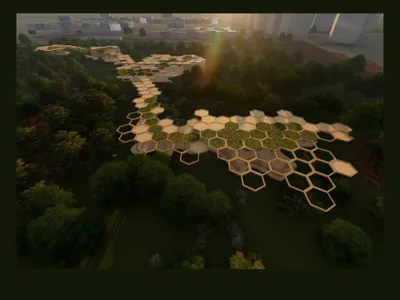
Eco Chapel: A Green Architecture Pavilion Designed in Symbiosis with the Forest
Eco Chapel uses green architecture to weave prayer, learning and reuse into a forest pavilion shaped by modular hexagonal canopies for life.
Kaffeebühnen: Coffee Shop Architecture Designed as a Civic Stage Between Vienna’s City and Park
Kaffeebühnen turns coffee shop architecture into a civic stage, linking Vienna’s park edge, urban life, warm timber yards, and coffee craft.
Healing Façade: Sustainable Architecture for Reforestation, Community, and Sacred Ecology in Ethiopia
Healing Façade reimagines sustainable architecture as a living wall that restores soil, catches water and renews Ethiopia's forest churches.


Urban Forest: A Vertical Ecosystem for 5,000 Workers in Singapore's Changi Business Park
Radially stacked pods and layered green decks turn a 7-acre plot into 47 acres of ecological workspace projected for 2040.

Comments (0)
Please login or sign up to add comments
No comments yet. Be the first to comment!