
The Ideal Ascent Home
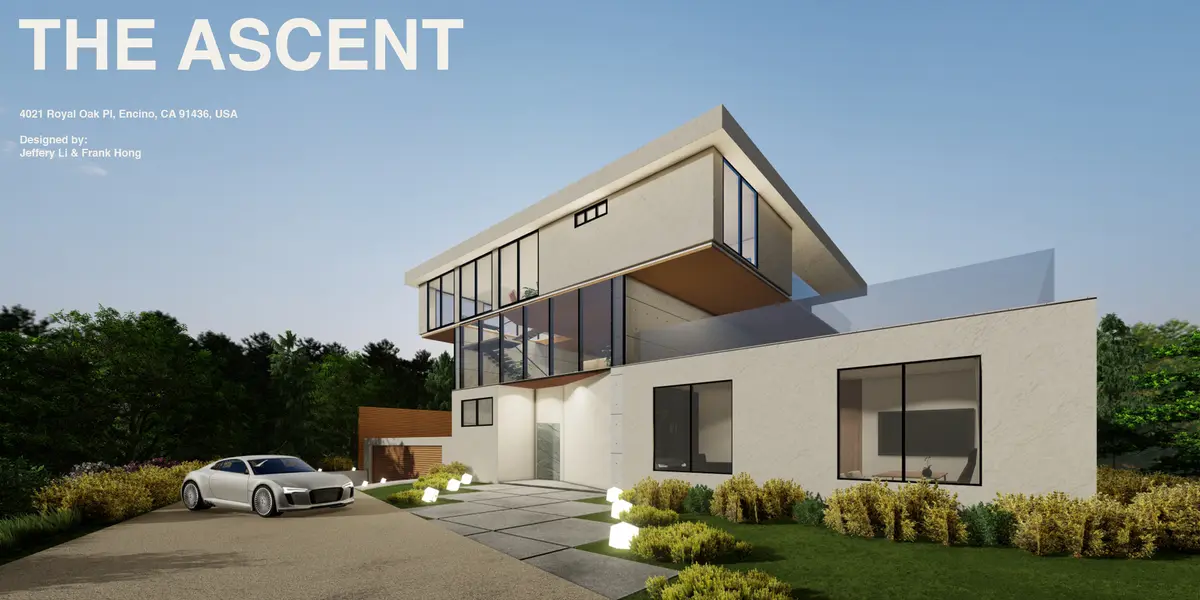
A modernistic cubicle style three-story house that takes your breath away

Johnny is a successful business in Los Angeles looking for a newly built home. After years of savings, he and his wife are finally ready to purchase their first mansion. Through numerous open houses and conversations with realtors, none were satisfactory. Thus, they decided to design a modernist-style mansion located in Encino, Los Angeles: The Ascent. The site is a residential neighbourhood on a slope looking down into the city. The surrounding lush trees provide a relaxing and cool atmosphere to the residents.
The Ascent is a three-story house with a semi-basement garage and a swimming pool. The first floor consists of a lounge area, living room, great hall, kitchen… The second floor acts as a connection between the first and third. However, there is a game/recreation room and it has easy access to an outdoor space at the roof of level 1. The third floor marks the home for the bedrooms and the master bedroom. At L3, residents can get a clear and beautiful view of the city at any moment. With this layout, the Ascent welcomes Johnny and his family to stay at the beautiful Los Angeles.
The concept behind the Ascent is its connectivity to its surroundings and nature. Given that the site overlooks the city, the building consists of curtain walls expanding from slab to glass to provide the user a clear full view of the scenery. When looking from the third floor, a mixture of greens and the faraway city can be spotted. During sunset and sunrises, one could not ask for more but to sit on a lounge chair sipping on Toffee Iced Coffee overlooking the city. Furthermore, the design of Ascent incorporates touches of modernistic cubicle style. The sharp and well-defined edges of the building create a dramatic contrast to neighbouring buildings. As a result, it creates an eye-catching effect on pedestrians. To the public, a cubicle provides a sense of restriction and tightness. However, the square-like designs in the Ascent accentuate the opposite effect: innovation. Even for a design with only squares, innovation cannot be bound.
The exterior cladding is decided to fibre cement boards for the following reasons. Fibre Cement siding has the durability of cement and is resistant to wood-boring insects, deterioration from salt and ultraviolet rays. In response to hot California summer days, the air gaps behind fibre cement panels becomes a perfect ventilation system to cool the interior. Furthermore, it also requires low maintenance after installation.
Structurally, the building is supported by concrete columns and precast concrete walls. There exists two concrete walls at the stairwell for structural support and several concrete columns at the edges of the building. Laterally, concrete beams and slabs expand between all levels and are hidden in the plenum space so it does not affect visual design. The plenum space is designed to be 12” deep, giving more than enough ceiling room for all mechanical/electrical services and structural beams/column capitals. Given that the site is in California with high average temperatures throughout the year, minimal snow loads were considered into the design. Thus, a flat roof does not create a structural issue as it will not hold an excessive amount of unaccounted dead load.
The outcome of this design is the result of many iterations. The design was initially decided as a slanted cube where the top of the cube can be designed as a balcony. However, due to difficulty to effectively utilize interior space given that slanted walls restrict lots of headroom space and therefore provide many unusable spaces. As a result, modifications were made to straighten the walls. In order to reflect its primary concept which is to connect the resident to the surroundings, we decided to make the building multi-story so the residents have a better view at higher grounds. Unlike the current design, one of the iterations developed before this involves an observation cube on top of the third floor. However, due to the difficulty to create structural support to the cube, the idea was quickly rejected. Having another sub floor on top of what is there already can cause excessive stress to the concrete walls and therefore can inflict structural failure.
The design of the Ascent does not only focus on modern aesthetics, it cares more about user experience and energy sustainability. Over the next 10 years, as climate change will most likely intensify and California will experience hotter and hotter summers. Thermal energy can be added into the design to create an energy source to power the building. For instance, solar panels with waterproof backsheets will be installed on the roof of the building. Since the roof is flat, the panels will maximize sunlight throughout the day and that energy can be converted into electricity to power the house independently.

Popular Articles
Popular articles from the community


ETEH Reworks the Shared Spaces of São Domingos School in Brazil Around Timber, Color and Hanging Plants
At São Domingos School in Brazil, 436 m² of hall, refectory and library are recast with timber joinery, a yellow and blue code and trailing greenery.


The Amber Palace Opera: A Geological Fiction Surfaces on Tallinn's Baltic Waterfront
Pierre Brillard reimagines a Baltic legend as a public landscape, opera house, and waterfront promenade rooted in Tallinn's coastal identity.

LT2A and OPEN Architectes Thread a Brick and Glass High School Through a Wooded Belgian Campus
In Braine-l'Alleud, a 3,000 m² wing for Collège Cardinal Mercier pairs pale brick with a glazed colonnade, deferring to a small chapel and a dense wood.

Aquadapt: An Underwater Habitat That Rewrites Its Rooms by the Hour
Curved modules ring the seabed while one shell shifts from breakfast room to cinema, farm and football pitch as residents' needs change.

Similar Reads
You might also enjoy these articles

Vereda Arquitetos Renovates a 40-Square-Meter Apartment Inside Niemeyer's Copan Building
A compact unit in São Paulo's most iconic residential tower gets a material overhaul that pairs exposed concrete with bold blue Formica.

Shakur's House: Exposed Brick as an Interior Organiser in a 168 m² Mashhad Residence
Brick moves indoors in this Mashhad residence, where masonry walls, glass partitions and teal planes sequence a compact home without closing it off.

Day and Night Park: A Time-Based Urban Newsstand in Beijing
A temporary urban newsstand in Beijing blending travel, light, and reading through poetic colors, compact form, and community-focused design.

Modernist Patio Renovation in El Masnou, Barcelona by Oliver Segura Arquitectura + Cebrià Arquitectura
Modernist patio renovation blending tradition and innovation with a movable pool, leveled floors, and Catalan materials in El Masnou.

Explore Low Cost Housing Competitions
Discover active competitions in this discipline


Comments (0)
Please login or sign up to add comments
No comments yet. Be the first to comment!