The Koala Pavilion: A Stilted Timber Sanctuary Where Recovering Koalas and Curious Visitors Share Ground
Aceson Han's Haven 2020 winner scatters timber pods on stilts across the terrain, letting wildlife pass beneath while visitors learn from above.


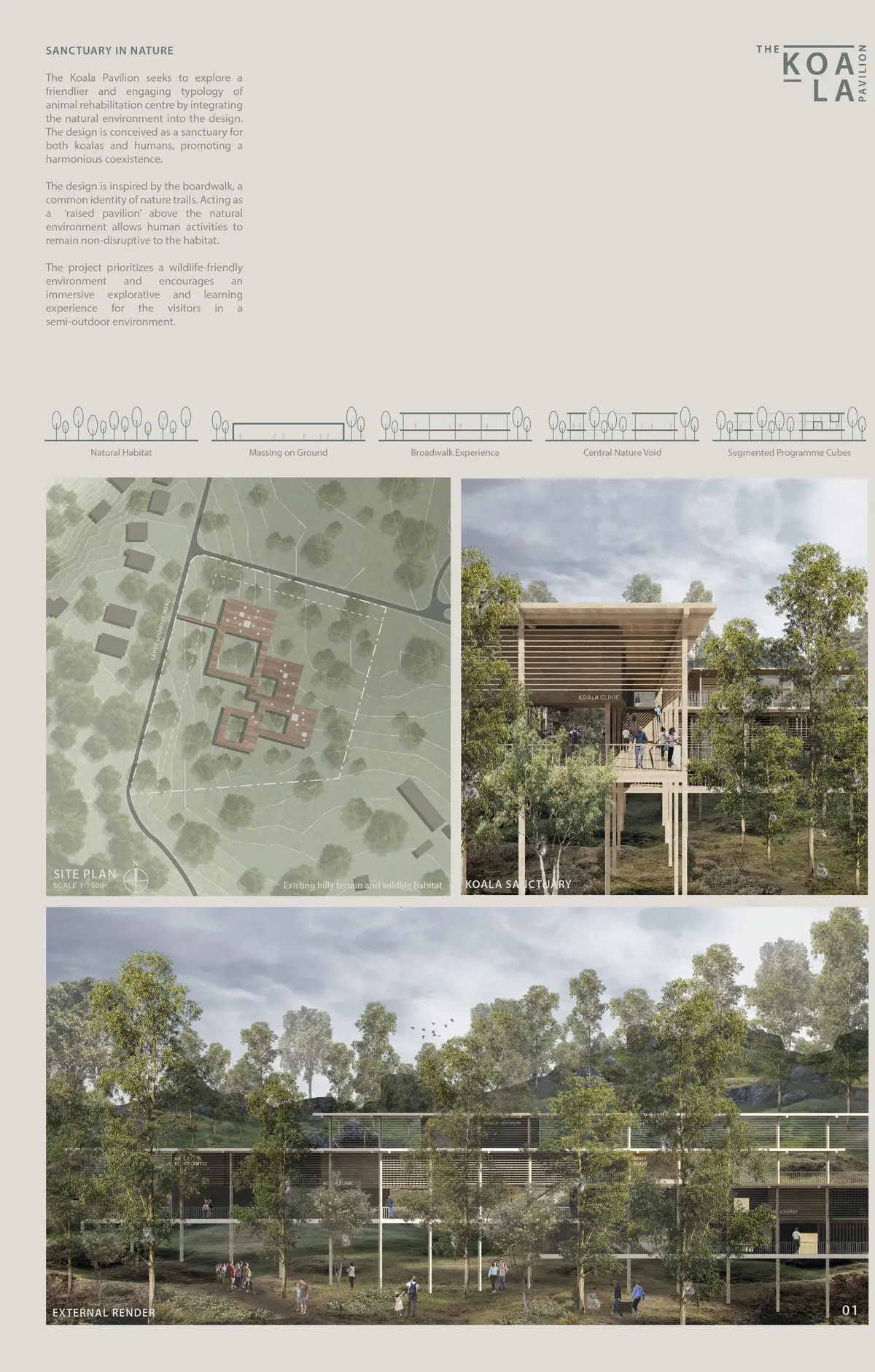
Most rehabilitation facilities treat the animal as a patient to be contained. The Koala Pavilion starts from a different premise: a koala is solitary and territorial, so the building should be too. Instead of one large enclosure, the project breaks its programme into a field of separate volumetric pods lifted on stilts and linked by sheltered boardwalks. That single move lowers stress for the animals, leaves the ground free for wildlife, and turns the visitor's walk into a lesson in how much space a recovering animal needs.
Designed by Aceson Han, the project was named a winner of Haven 2020. Han places the pavilion within a natural landscape and asks it to work as three institutions at once: a rehabilitation centre, a research facility and a public learning environment. The challenge is calibration. Each layer of programme has to stay accessible enough to teach but private enough to heal, so that people can observe without interfering.
The Boardwalk as a Buffer Between Two Worlds
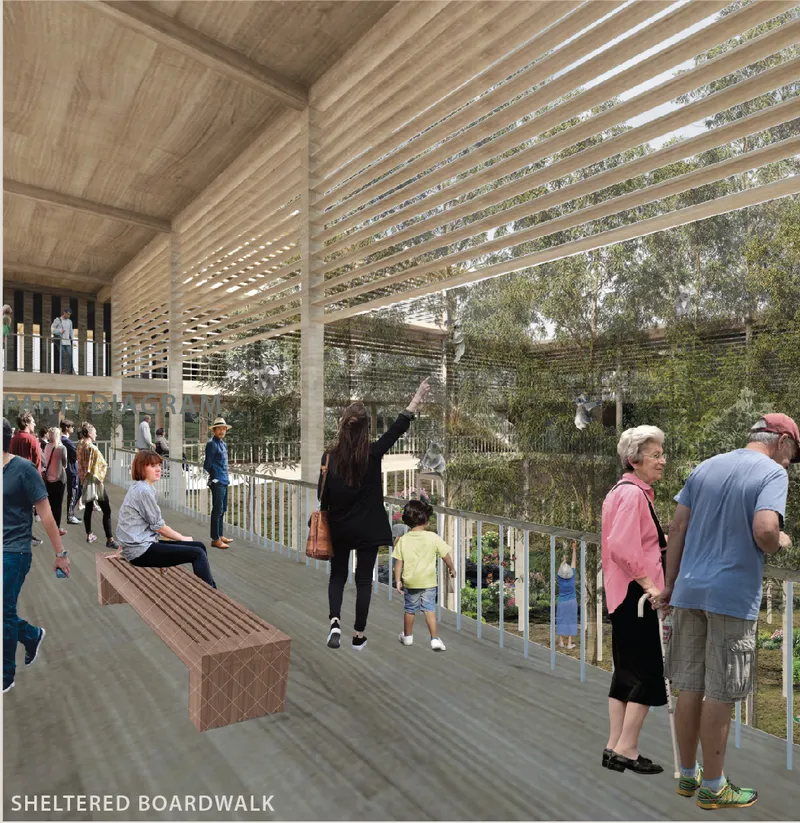
The boardwalk carries much of the project's thinking. In this rendering, a slatted timber canopy filters light over a simple bench, and visitors look out toward eucalyptus trees rather than into a cage. The walkway works as a transitional space, separating human activity from wildlife zones while keeping the two in sight of each other. Its sheltered, semi-outdoor character matters here: visitors stay in the landscape's air and light, so the experience reads as being inside a habitat rather than in front of an exhibit.
This is a quieter strategy than the glass viewing wall of a conventional zoo. Han curates views along the route so that different zones open up in turn, and that pacing gives the animals distance while giving visitors something to discover.
Pods on Stilts That Follow the Contours
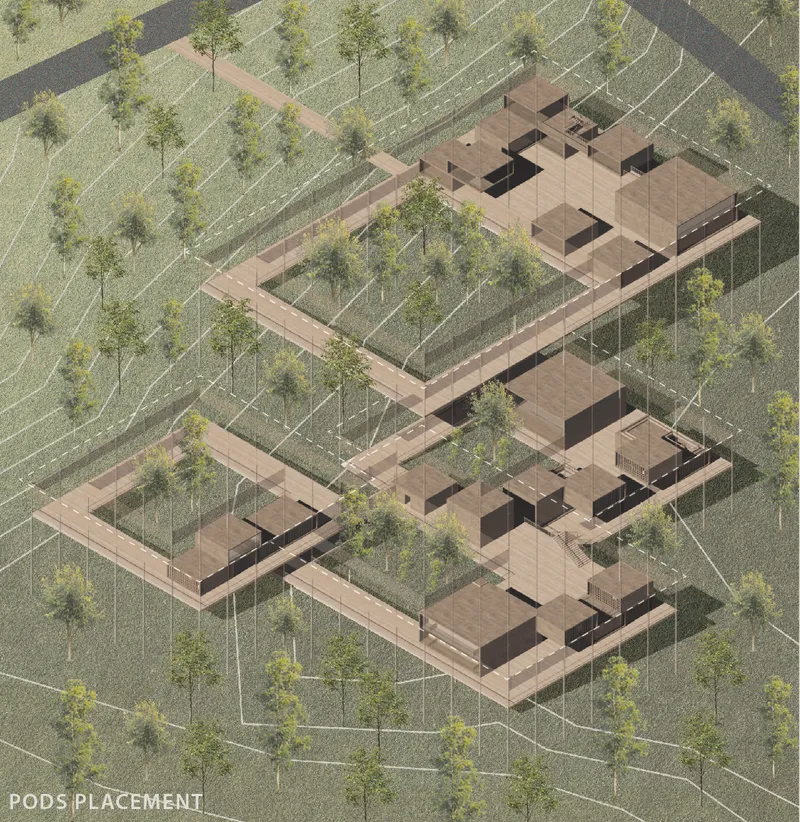
The isometric shows the logic plainly: boxy pods scattered over a contoured, tree-dotted site, threaded together by raised walkways that wrap planted courtyards. Han reads the topography first and leaves it in place, using elevated platforms and staggered volumes instead of a levelled pad. The result is a porous system in which nature runs through the built fabric rather than stopping at its edge.
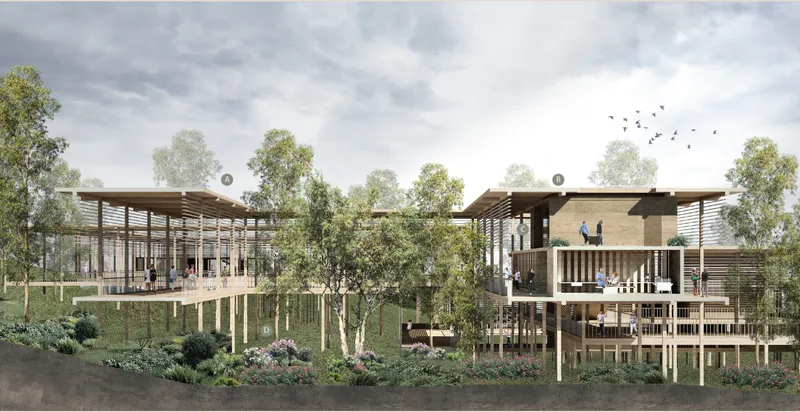
The section makes the case for the stilts. Two timber pavilions stand on slender supports above flowering shrubs, so contact with the ground drops to a minimum and wildlife can move underneath without interruption. Deep slatted roofs shade the outer perimeters, and the lack of rigid perimeter walls lets breezes cross the interiors, reducing reliance on mechanical cooling. Elevation, shading and airflow all come from the same structural decision.
A Museum Volume and a Courtyard That Lets Light Down
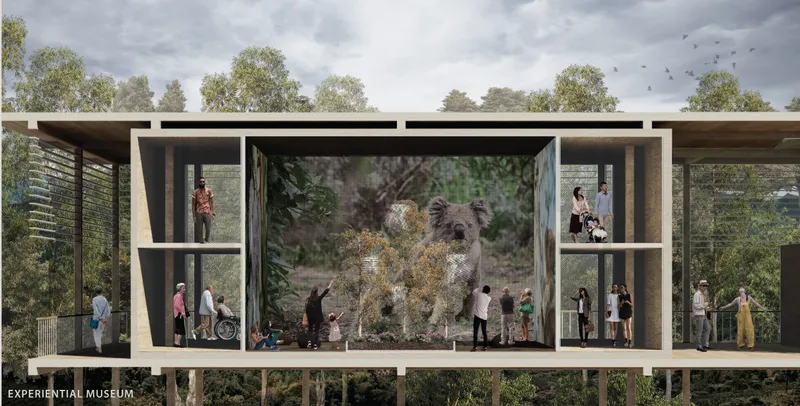
The museum cutaway shows the pavilion's educational side. A stilted volume holds visitors on two levels around a central wall carrying a large koala image, a direct and readable piece of interpretation set inside the same raised timber language as the rest of the complex. Stacking the programme vertically supports Han's gradient of privacy, which runs from public spaces to highly controlled medical areas, so that the most sensitive functions stay furthest from casual foot traffic.
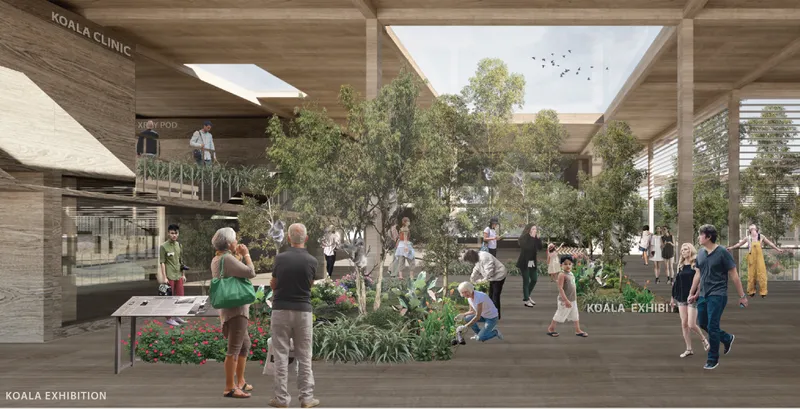
The courtyard rendering adds a second kind of daylight. Visitors gather on timber decking beside a planted bed and a skylight opening, right next to a clinic wall. Han orients the building form to the sun and uses skylights to bring daylight into deeper interior spaces. Placing a public gathering point against the clinic is a bold choice: it brings visitors close to the work of care while the wall holds the boundary.
Trees Indoors and Timber Made Off-Site
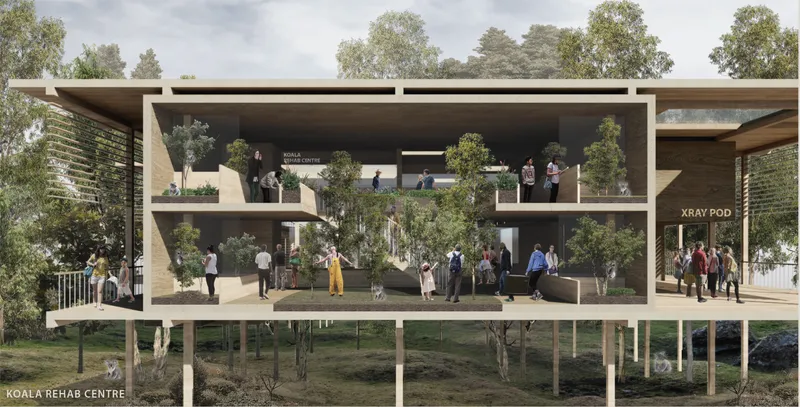
The rehab centre section is the clearest picture of the habitat moving indoors. A two-storey volume on stilts holds trees inside its envelope and a planted floor, with visitors moving between levels around it. Recovering koalas get vertical, climbable structure that is close to what they will return to, and the people circulating above and beside them see recovery as something that happens among branches rather than on sterile surfaces.
The construction strategy supports the ecological argument. Han specifies Mass Engineered Timber sourced from sustainable plantations, which lowers the carbon footprint and gives the interiors a warmth that sits easily in the landscape. The modules are prefabricated off-site under a Design for Manufacturing and Assembly approach and assembled on location, which cuts construction time, waste and disturbance. For a building whose purpose is to protect a fragile habitat, a short and light construction phase is an important part of the design.
Why This Project Matters
The Koala Pavilion is persuasive because its sustainability strategies are not added on after the fact. Fragmenting the programme answers the koala's solitary behaviour. Raising the pods answers the need for undisturbed ground. Leaving the perimeters open answers the climate. Prefabricated timber answers the problem of building lightly. Each decision serves the animal, the site and the visitor at once, and that overlap is what makes the scheme feel coherent rather than merely green.
It also suggests a useful direction for conservation architecture more broadly. Han treats the visitor as a guest moving through a working sanctuary on boardwalks, not as a spectator in front of an enclosure, and lets education come from proximity and restraint. As wildlife rehabilitation becomes more urgent, a model in which buildings step back from the ground and from the animals they serve deserves serious attention.
View the Full Project
About the Designers
Designer: Aceson Han
Enter a Design Competition on uni.xyz
uni.xyz runs architecture and design competitions year-round that reward proposals with spatial conviction and real site intelligence.
Project credits: The Koala Pavilion by Aceson Han Haven 2020 (uni.xyz).


Popular Articles
Popular articles from the community


U.GA Architects Wraps an Oval Rooftop Pool in Curved Board-Formed Concrete on Busan's Jeollidan-gil
In Busan's Jeonpo-dong, a 454 m² mixed-use block stacks a neighborhood facility, guest rooms and an oval rooftop pool inside spiraling concrete walls.

longwave studio Reorganizes a 112 m² Tainan Apartment Around the Daily Routines of a Family and Two Cats
In Tainan, Taiwan, birch plywood, rust-red furniture and a freestanding plaster wall link arrival, storage, work and family life in one apartment.

GROUP A Strips a 1969 Rotterdam Harbor Headquarters to Its Frame and Wraps It in Timber Louvers
In Rotterdam's M4H harbor district, Ferro Offices reuses a 1969 frame, adds one timber storey and reaches BREEAM-NL Outstanding.

Cube Design Draws an Ecological Corridor Between Two Shenzhen Hills with the Nankai Building
Beside Shenzhen's container docks, the Nankai Building pairs stacked balconies with a climbing green screen to connect two hillsides across its height.

Similar Reads
You might also enjoy these articles
Healing Façade: A Modular Chapel System That Restores Ethiopia's Sacred Forests
Winner of the Eco-Chapel competition, this circular timber façade collects water from air to rebuild soil and reforest degraded Ethiopian landscapes.
Kaffeebühnen: Where Coffee Shop Architecture Becomes a Civic Stage in Vienna
A linear sequence of timber boxes, transparent shells, and open yards turns the Viennese café tradition into a public performance space.
Eco Chapel: A Modular Forest Pavilion That Grows Like the Landscape It Protects
Hexagonal timber modules weave through existing trees, turning a chapel into a living system for prayer, education, and reforestation.


Urban Forest: A Vertical Ecosystem for 5,000 Workers in Singapore's Changi Business Park
Radially stacked pods and layered green decks turn a 7-acre plot into 47 acres of ecological workspace projected for 2040.

Explore Sustainable Design Competitions
Discover active competitions in this discipline

Challenge to design a portable theatre

Challenge to design a portable music platform

Challenge to design an open learning module for the elderly

Challenge to reimagine the Iron Throne
Comments (0)
Please login or sign up to add comments
No comments yet. Be the first to comment!