
THE LOOM ATRIUM
A SILK WEAVING CENTER THAT CLOSES THE BORDERS, OPERATES A COURTYARD INSIDE AND UNITIZES EVERYONE IN THAT COURTYARD.

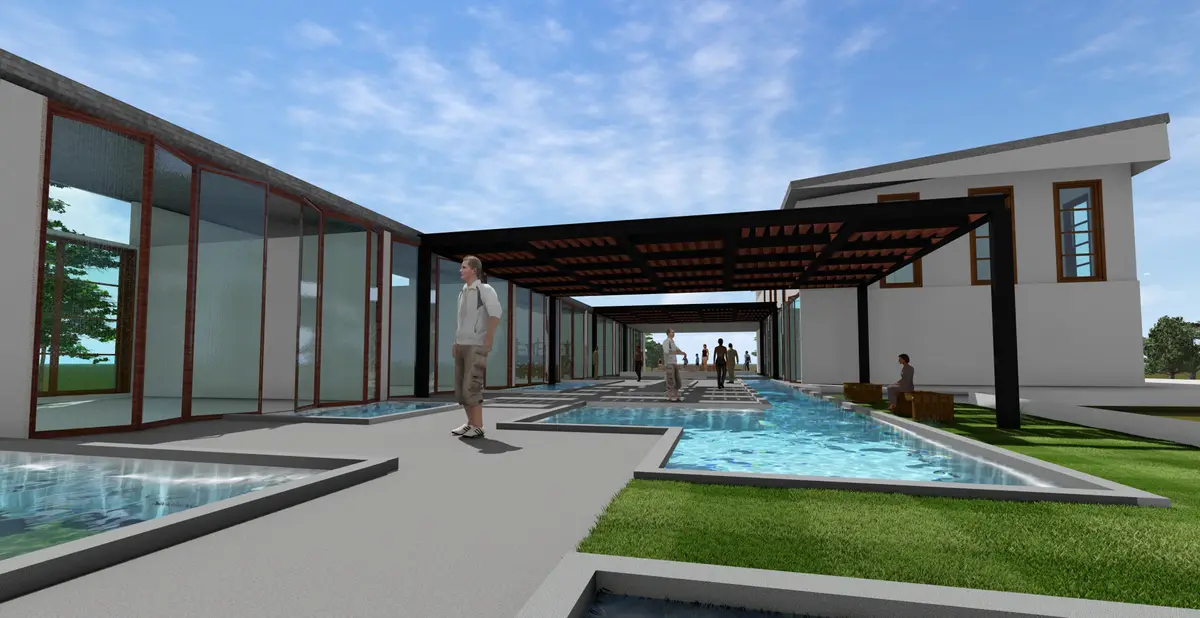
Our project is situated in the Kancheepuram region of India. Given that the surrounding environment does not naturally support the structure, we designed it as a self-sustaining, inward-focused space enclosed within defined boundaries. This space serves both craftsmen and producers, offering all necessary facilities internally. Sliding panel entrances allow natural light to enter the building while enabling those in the courtyard to observe the internal operations seamlessly.
The courtyard features pools with small islands designed primarily as resting and seating areas. These islands also support the adjacent enclosed spaces as needed. To address water requirements, we have implemented a rainwater harvesting system that collects, purifies, and supplies the pools. This system promotes sustainability and resource efficiency.
The courtyard connects all parts of the facility. Visitors primarily utilize the single-story block, while producers prefer the two-story block. The building is constructed of reinforced concrete, featuring a roof that slopes in one direction and is made of wood. Wooden pergolas provide shade over the courtyard, enhancing its ambiance. The entrance showcases a concrete structure that serves as an inviting threshold for visitors. The rear section of the production block includes an open-air dyeing area equipped with the necessary tools and materials.
During the design process, we conducted an in-depth study of various weaving center projects and analyzed the lifecycle of silk in India—from production and transportation to storage and weaving. We also examined the specifications and dimensions of looms. To visualize this process, we created diagrams that outline the stages of silk production. From the outset, our goal was to design a self-sufficient structure that operates efficiently within its boundaries. Local materials from India to honor the cultural and environmental context.
To further emphasize the connection between artisans and visitors, we incorporated fabrics produced in the facility into the front façade display. This design choice ensures that visitors immediately witness the results of the craftsmanship upon entering, setting the stage for their experience inside.

Popular Articles
Popular articles from the community


David Macias Steps a Doorless Stone and Plaster House Down a Tropical Colombian Hillside
In the humid hills of Colombia, Threshold House replaces the front door with an open void and terraces its 850 m² down the slope instead of fighting it.

Cube Design Draws an Ecological Corridor Between Two Shenzhen Hills with the Nankai Building
Beside Shenzhen's container docks, the Nankai Building pairs stacked balconies with a climbing green screen to connect two hillsides across its height.

Jaramillo Van Sluys Arquitectura and Urbanismo Turn a Demolished Registry Lot in Quito into an Orchard Plaza
In Quito's Centro Histórico, a 2,800 m² plaza exposes the San Agustín convent wall and redraws its lost Augustinian orchard in volcanic stone.

longwave studio Reorganizes a 112 m² Tainan Apartment Around the Daily Routines of a Family and Two Cats
In Tainan, Taiwan, birch plywood, rust-red furniture and a freestanding plaster wall link arrival, storage, work and family life in one apartment.

Similar Reads
You might also enjoy these articles


Vereda Arquitetos Renovates a 40-Square-Meter Apartment Inside Niemeyer's Copan Building
A compact unit in São Paulo's most iconic residential tower gets a material overhaul that pairs exposed concrete with bold blue Formica.

Shakur's House: Exposed Brick as an Interior Organiser in a 168 m² Mashhad Residence
Brick moves indoors in this Mashhad residence, where masonry walls, glass partitions and teal planes sequence a compact home without closing it off.

Day and Night Park: A Time-Based Urban Newsstand in Beijing
A temporary urban newsstand in Beijing blending travel, light, and reading through poetic colors, compact form, and community-focused design.

Modernist Patio Renovation in El Masnou, Barcelona by Oliver Segura Arquitectura + Cebrià Arquitectura
Modernist patio renovation blending tradition and innovation with a movable pool, leveled floors, and Catalan materials in El Masnou.

Explore Courtyard Competitions
Discover active competitions in this discipline


Challenge to reimagine the Iron Throne

Photograph architecture without architects

Illustrate the lost glory of Angkor Wat - Render Challenge

Design challenge to reuse E-waste
Comments (0)
Please login or sign up to add comments
No comments yet. Be the first to comment!