
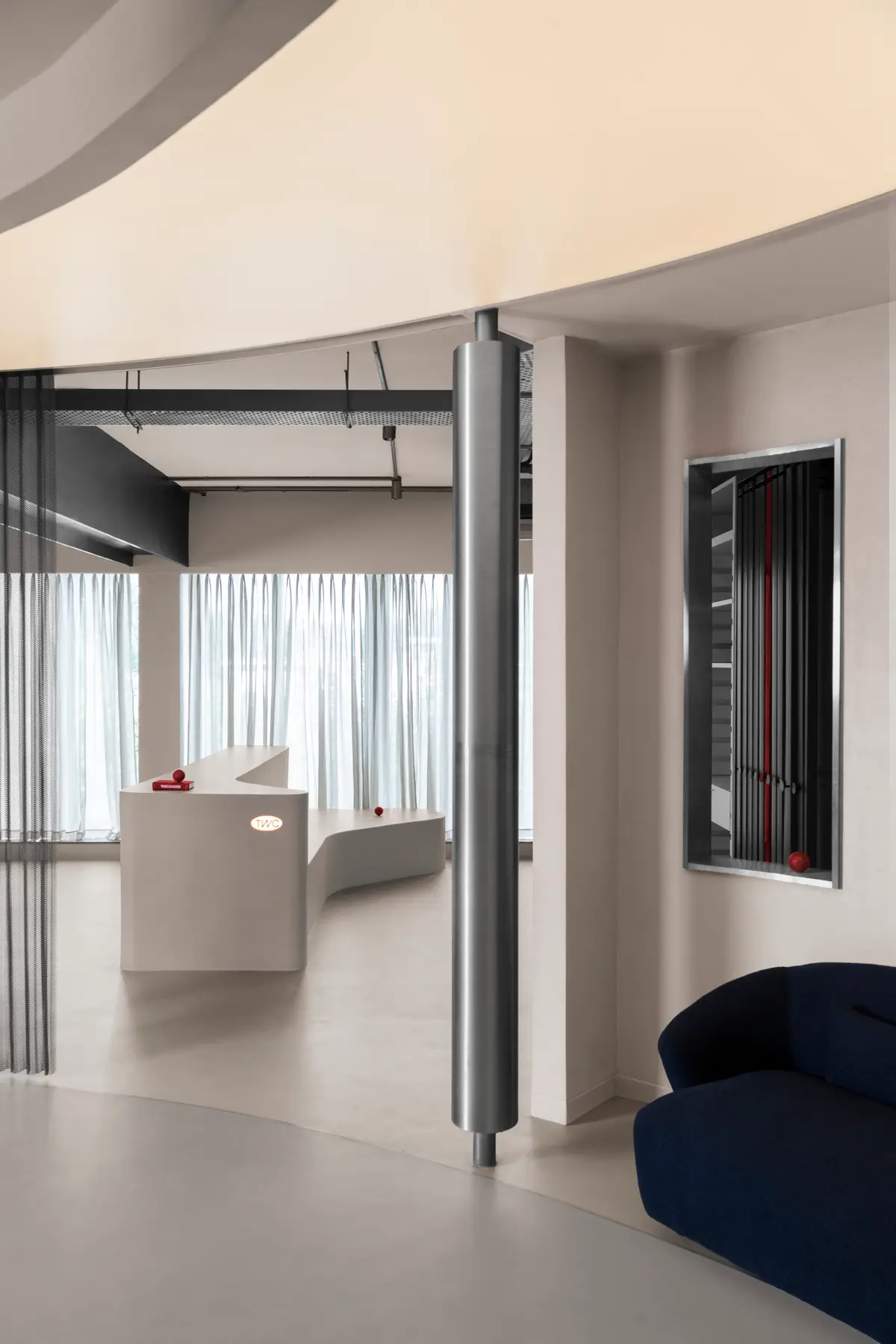
The Loop Rethinks Retail as a Living Room
STUDIO DOT designs a New Delhi showroom for The Wardrobe Company where circulation, customisation, and co-creation replace the traditional shopfront.


Retail interiors in India tend to fall into two camps: the glossy boutique that borrows luxury codes wholesale from Milan, or the pared-back concept store that leans on raw concrete and calls it a day. The Loop, designed by STUDIO DOT for The Wardrobe Company in New Delhi, refuses both templates. Instead, lead architects Anmol Arora and Shubhit Khurana have built an environment that operates more like a domestic gallery than a showroom, one where the customer's journey is literally shaped by a continuous curved path that loops back on itself.
What makes this project genuinely interesting is how it conflates selling with inhabiting. The Wardrobe Company is a brand that hinges on dialogue and co-creation: clients don't just pick a product off a rail, they configure it. That brief demanded a space you could occupy at length, sit in comfortably, and navigate intuitively. STUDIO DOT's response is a plan organized around two sweeping curved zones that flank a sequence of more rectangular rooms, creating a rhythm of openness and intimacy that feels closer to a residence than to any conventional store.
Circulation as Architecture
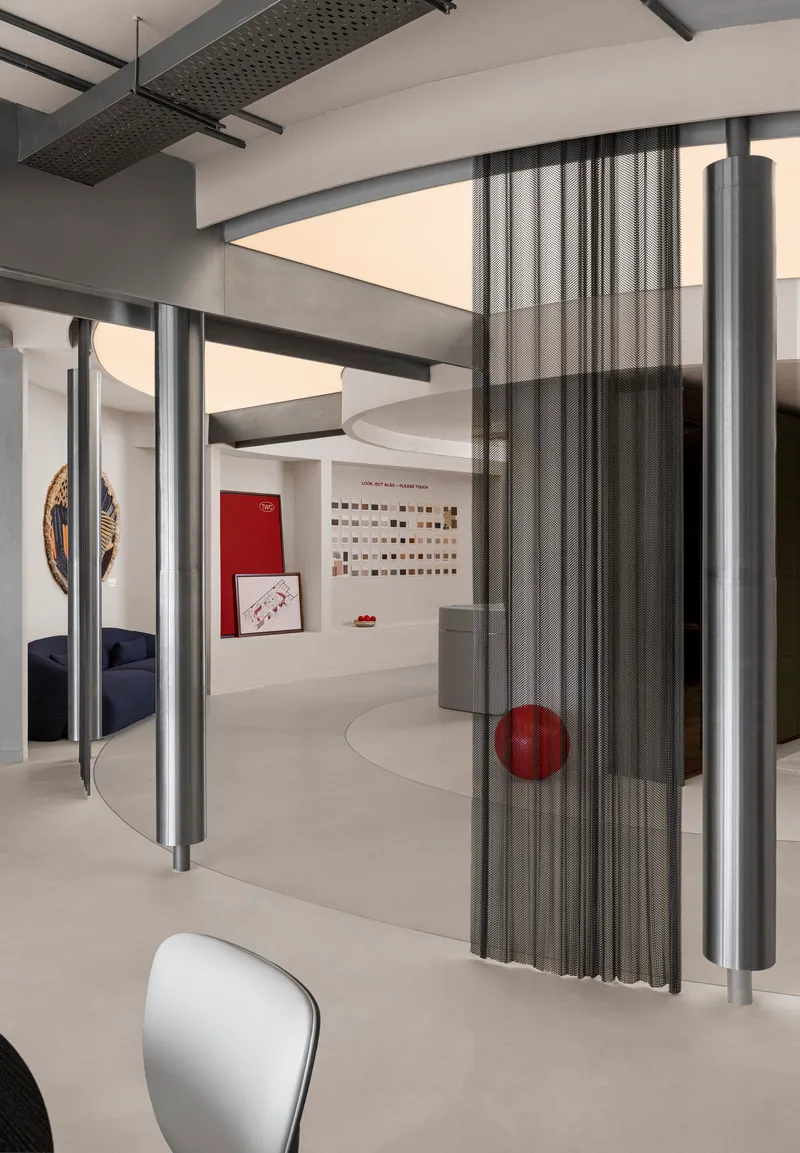
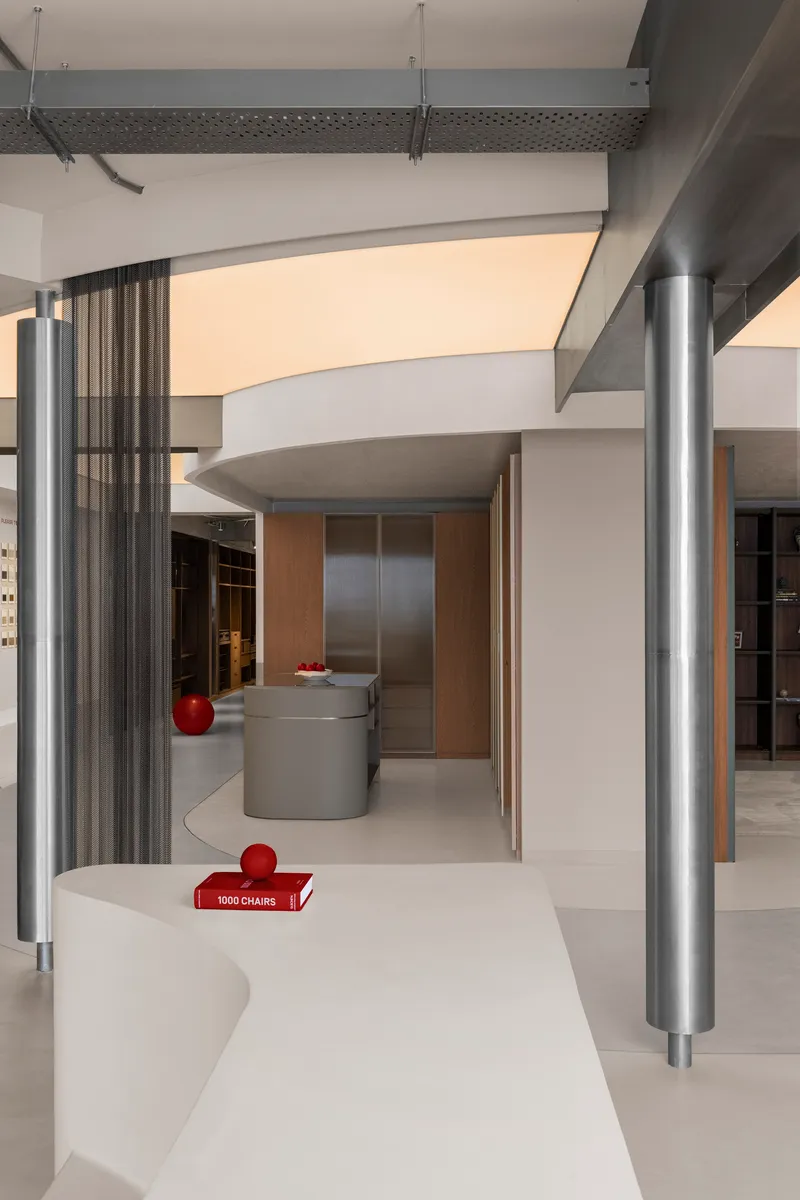
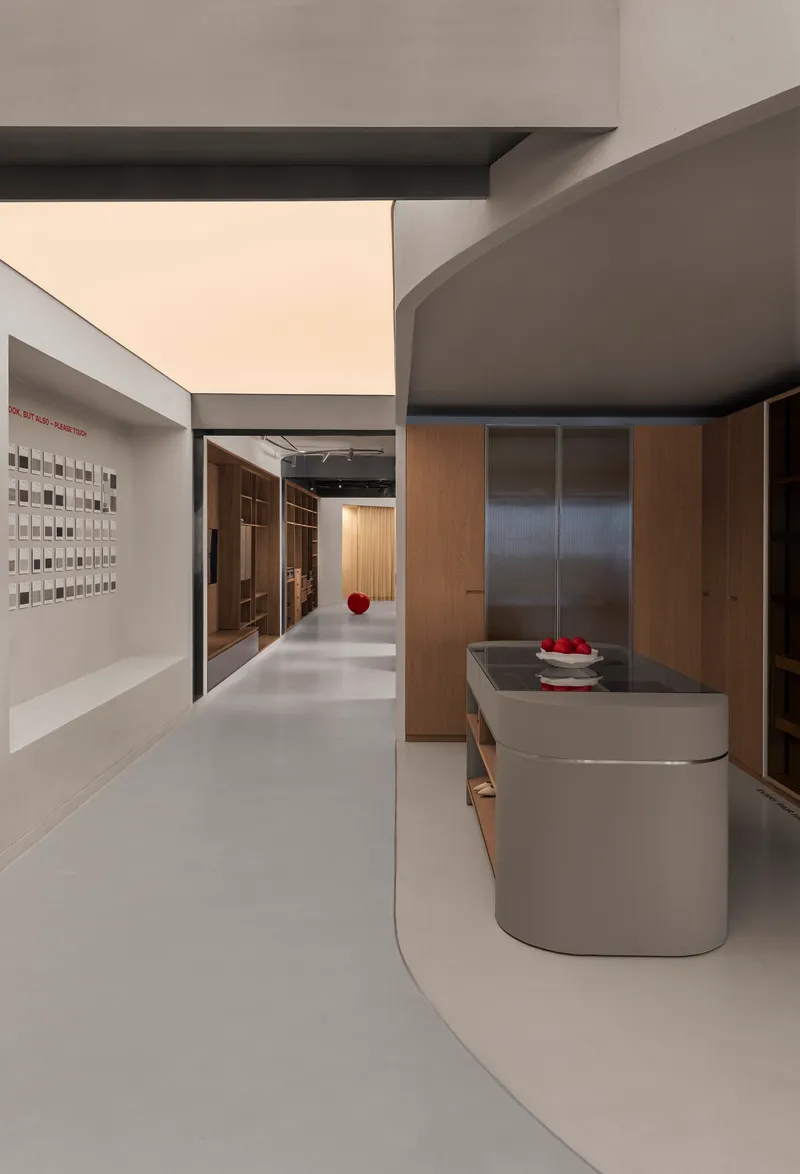
The name is not metaphorical. A continuous loop of circulation defines the plan, pulling visitors through the space without dead ends or the awkwardness of doubling back past a sales associate. Cylindrical metal screens and curving white counters reinforce this geometry at every turn, so you read the loop physically even before you look at a floor plan. The overhead beams and curved ceiling soffits act as tracks in three dimensions, guiding the eye forward while reinforcing the sense that the architecture itself is in motion.
At the material sample wall, the loop pauses. Grey resin flooring, a curved counter, and a grid of material tiles transform one segment of the route into an active workspace where designer and client can stand side by side. It is a subtle but critical shift: circulation becomes collaboration.
Screens, Curtains, and Controlled Transparency
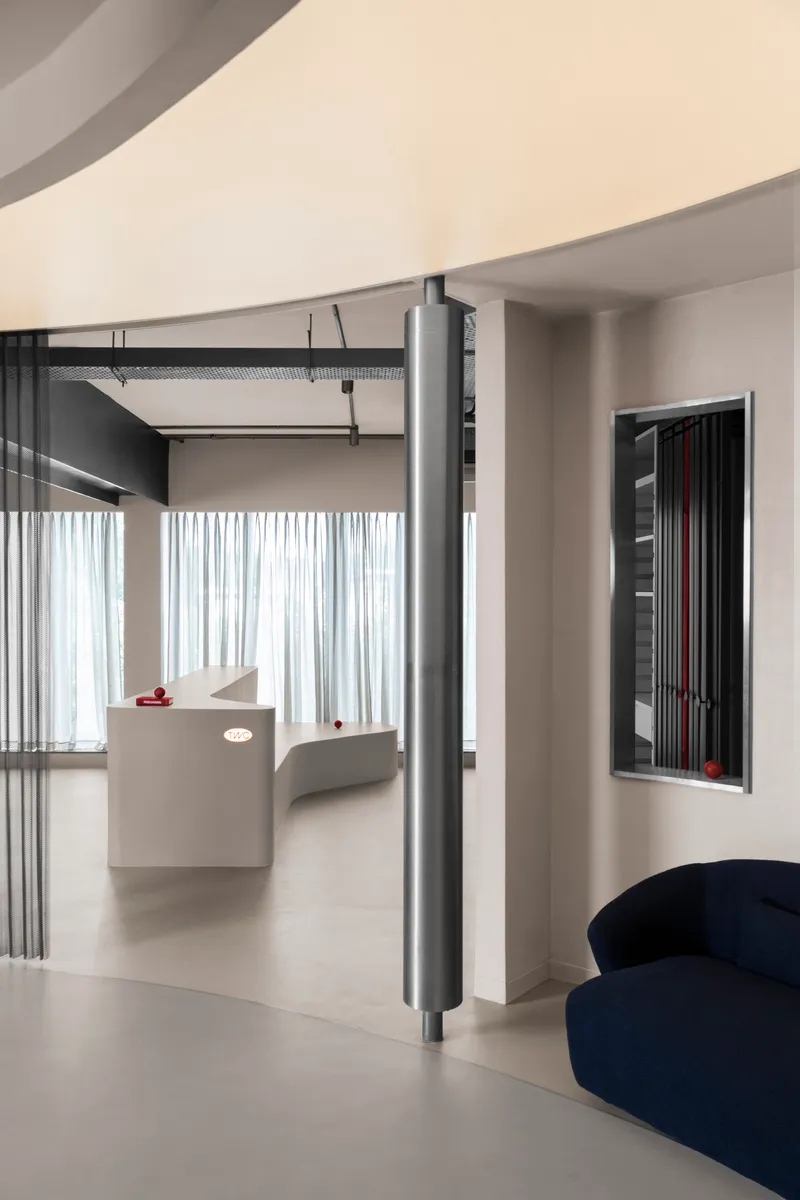

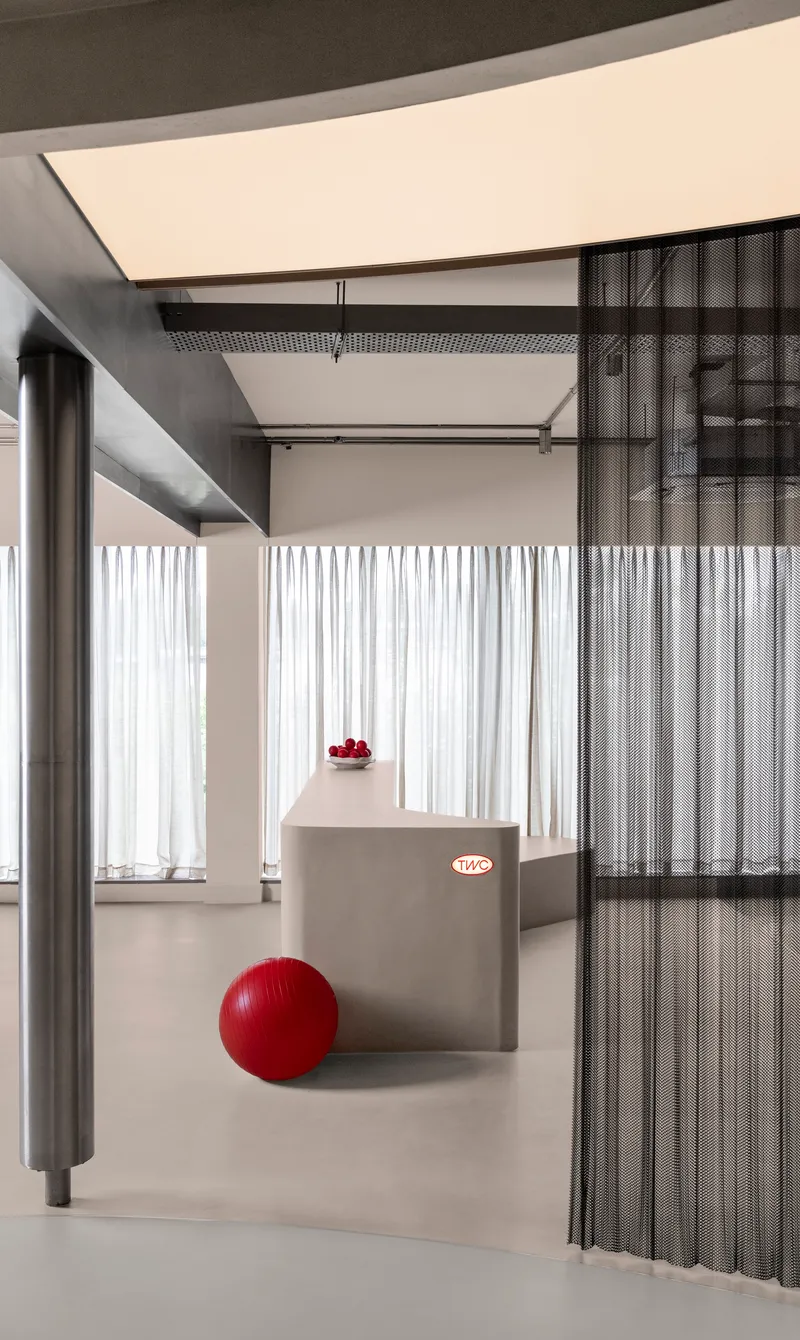
Privacy in a retail environment is a paradox. You want customers to feel secluded enough to deliberate, but you also want the space to feel generous and inviting. STUDIO DOT solves this with a layered system of ribbed screen panels, folding metal mesh partitions, and sheer white curtains. Each layer offers a different degree of visual permeability. The ribbed screens admit light and shadow in vertical bands; the mesh partitions give an industrial texture that reads as semi-opaque from certain angles; the curtains soften everything into a diffused glow.
The effect is spatial depth without walls. You are always aware of the rooms beyond, glimpsing a sofa here, a red sphere there, but you never feel exposed. It is a smart strategy for a brand that wants clients to linger, because lingering requires a certain degree of shelter.
Red Interventions


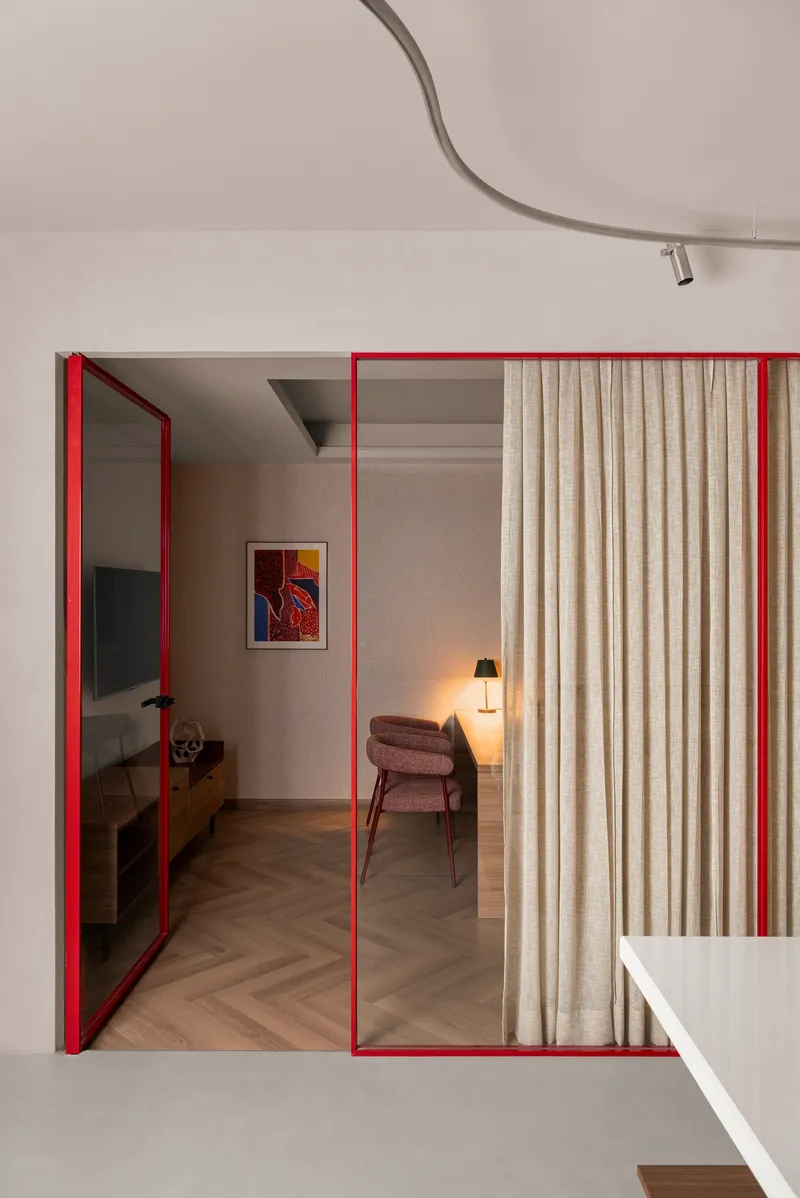
Scattered across the pale grey floors like dropped punctuation marks, red spheres appear throughout the space. They are not functional in any conventional sense. They are markers of play, signals that this is not a place governed by rigid retail protocol. Against the project's predominantly neutral palette of white, grey, and raw metal, the red pops hard: floor graphics, steel-framed sliding doors, accent shelves, even a refrigerator visible in the dining area.
This is a confident colour strategy because it refuses to be subtle. The red is The Wardrobe Company's identity made physical, and STUDIO DOT deploys it with the precision of a brand consultant and the playfulness of an artist. Whether it is a single exercise ball sitting on polished concrete or a pair of glazed doors framing a bedroom vignette, each red element asks you to stop and pay attention.
Domestic Vignettes Inside a Commercial Shell


A navy sofa with circular wall art. A blue sofa glimpsed through a corridor with a recessed lighting cove. A dining area with white curtains, exposed ceiling ducts, and a conspicuously residential red refrigerator at its edge. These are not staging accidents; they are deliberate domestic vignettes planted inside the commercial envelope. STUDIO DOT understands that The Wardrobe Company's products end up in people's homes, so the showroom must perform as a home, or at least a convincing facsimile of one.
The shift between retail display and living-room comfort happens without announcement. One moment you are browsing material samples, the next you are sitting on a sofa in what could pass for someone's apartment. That seamlessness is the real achievement here: it lowers the transactional temperature of the space and invites the kind of unhurried conversation the brand depends on.
Wardrobe as Architecture


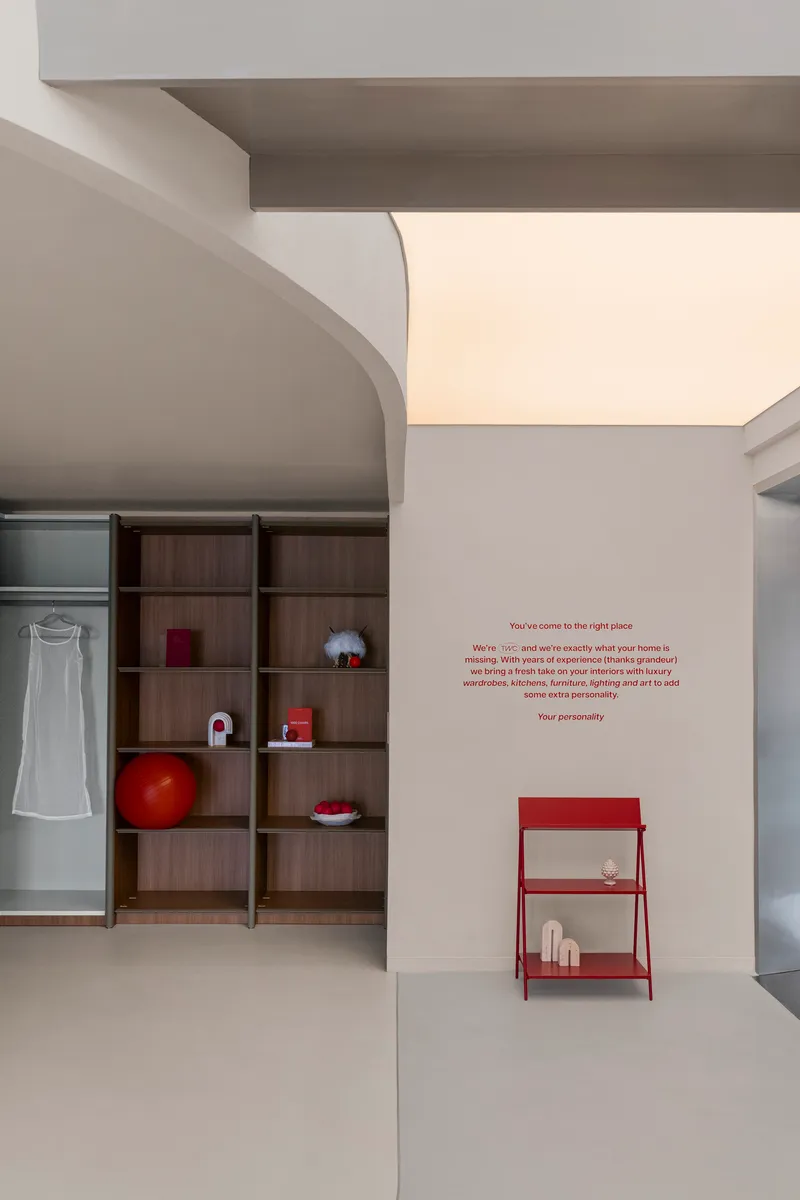
A tall, narrow aperture in a wall frames a single hanging garment like a painting. Elsewhere, a full wardrobe wall is fronted with pleated black curtains, white shelving, and red accent shelves beneath exposed ceiling ducts. These moments reveal the core proposition: wardrobes are not furniture, they are spatial conditions. STUDIO DOT treats storage as something worth looking at, something that can anchor a room's identity the way a fireplace or a window does.
The timber shelving and red metal side table arranged against a white wall with red text complete the picture. Everything here is curated to demonstrate configuration, not just capacity. You see how components fit together, how colour accents change the feel of a composition, how open and closed storage can coexist. It is a showroom that teaches you to design your own wardrobe by showing you the principles rather than just the products.
Overhead Systems and Material Honesty


Look up in The Loop and you will find exposed ceiling ducts, circular track lighting, and perforated steel beams coexisting with precise curved soffits and recessed cove lights. STUDIO DOT has opted for material honesty overhead while maintaining a clean, composed finish at eye level. The hallway lined with timber storage joinery gets its character as much from the circular pendant above as from the cabinetry itself.
A curved ceiling edge above a red floor graphic, with sculptural objects on grey pedestals, shows how the architects manage the threshold between raw infrastructure and curated display. The soffit defines the zone; the floor graphic energizes it; the objects give you something to contemplate. None of this would work if the ceiling simply disappeared behind plasterboard. The exposed systems give the space its industrial spine, the counterpoint that prevents all those curves and curtains from becoming precious.
Plans and Drawings


The floor plan confirms what the photographs suggest: two curved zones flank a series of rectangular rooms in a linear arrangement, forming the loop that gives the project its name. The axonometric drawing breaks the design into three legible layers, a plinth base, a rectangular maroon mass containing the programmatic rooms, and an oval-shaped roof volume that floats above. Reading these together, you grasp how STUDIO DOT conceived the project as a sequence of nested geometries rather than a single enclosure.
The axonometric of the full plan is particularly revealing. The continuous circulation path is not simply a corridor wrapped around rooms; it swells and contracts, creating pockets of gathering and moments of compression that control pace. This is retail planning at its most spatially literate, closer to museum design than to shop-fitting.
Why This Project Matters
The Loop matters because it takes the idea of experiential retail seriously without resorting to gimmicks. There are no LED tunnels, no Instagram backdrops, no ball pits pretending to be art installations. Instead, STUDIO DOT has invested in spatial intelligence: a plan that moves you, partitions that reveal and conceal, domestic vignettes that contextualize the product, and a colour strategy that doubles as brand identity. Every design decision serves the brief of turning a transaction into a conversation.
For a young Indian practice, this is a statement project. It demonstrates that commercial interiors can be architecturally ambitious without bloating the budget, and that a brand's values (flexibility, customisation, co-creation) can be encoded in form and material rather than pasted on a wall as a mission statement. If more retail spaces in Delhi followed this logic, the city's commercial landscape would be a far more interesting place to spend an afternoon.
The Loop Experiential Retail Space by STUDIO DOT (Anmol Arora, Shubhit Khurana). New Delhi, India, 2025. Photography by Saurabh Suryan.
About the Studio
Share Your Own Work on uni.xyz
If projects like this are the kind of work you want to make, uni.xyz is a place to publish your own, find collaborators, and enter design competitions.


Popular Articles
Popular articles from the community


Cube Design Draws an Ecological Corridor Between Two Shenzhen Hills with the Nankai Building
Beside Shenzhen's container docks, the Nankai Building pairs stacked balconies with a climbing green screen to connect two hillsides across its height.


Aquadapt: An Underwater Habitat That Rewrites Its Rooms by the Hour
Curved modules ring the seabed while one shell shifts from breakfast room to cinema, farm and football pitch as residents' needs change.

ETEH Reworks the Shared Spaces of São Domingos School in Brazil Around Timber, Color and Hanging Plants
At São Domingos School in Brazil, 436 m² of hall, refectory and library are recast with timber joinery, a yellow and blue code and trailing greenery.

Singing Woman: An Opera House That Performs Before the Curtain Rises
Ovidiu Cristian Pavel's conceptual opera house translates Estonia's choral identity into a sculpted waterfront landmark facing the Baltic Sea.

Similar Reads
You might also enjoy these articles

LAVA Architecten Gives Vocational Education a Sawtooth-Roofed Face on a Mechelen School Campus
In Mechelen, Belgium, a 2,053 m² STEM school on a 6×6 m grid turns workshops and classrooms into rooms that can be rearranged as teaching changes.

KEMA Studio Turns a Derelict Marvila Attic into a 60 m² Lighthouse Apartment Above Lisbon
In Lisbon's Marvila district, a rebuilt roof, four skylights and two plywood volumes turn an unlivable attic into a bright home facing the Tagus.

Pixel Gardens: One Repeated Module Stacked Into a Terraced Social Housing Tower for Famagusta
Salem Bader's shortlisted housing tower builds a vertical neighbourhood from one repeated module, offsetting units to carve terraces, light and air.

Bao Huynh Watercolor Atelier: A Serene Art Retreat in Hội An
Bao Huynh Watercolor Atelier in Hội An blends multifunctional art spaces, sustainable design, local materials, and family-friendly living in a serene environment.


Comments (0)
Please login or sign up to add comments
No comments yet. Be the first to comment!