

The Mexican Nano Nest: Prefab Housing That Grows with the Family
A modular stainless steel and concrete housing prototype in Guadalajara tackles density, cost, and multi-generational living at once.


Most affordable housing proposals treat density as a problem to be solved with smaller rooms. The Mexican Nano Nest flips that logic: it treats density as an opportunity to share more, not have less. Designed for multi-generational families in Guadalajara, Jalisco, the project uses a prefabricated modular system of stainless steel and concrete to deliver homes that are cheap to build, quick to assemble, and flexible enough to change as families do. Foldable beds, multi-purpose walls, and shared kitchens are not concessions to tight budgets here; they are deliberate architectural strategies for richer domestic life.
Designed by Cezary Loj, this shortlisted entry in the Nano Nest 2020 competition responds to the real pressures of Guadalajara's urban core: rising housing costs, shrinking access to green space, and the social isolation that comes with both. The proposal stakes out a clear position: that sustainability, affordability, and genuine community can coexist within a single compact structure, without sacrificing comfort or privacy.
A Courtyard Section Pulled Open
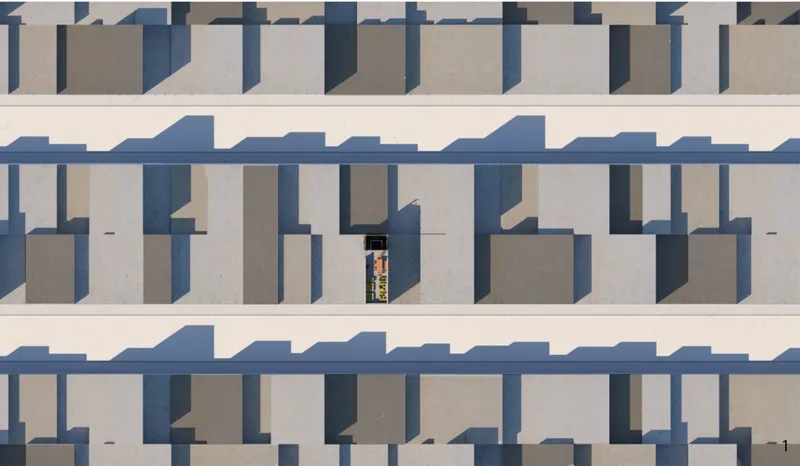
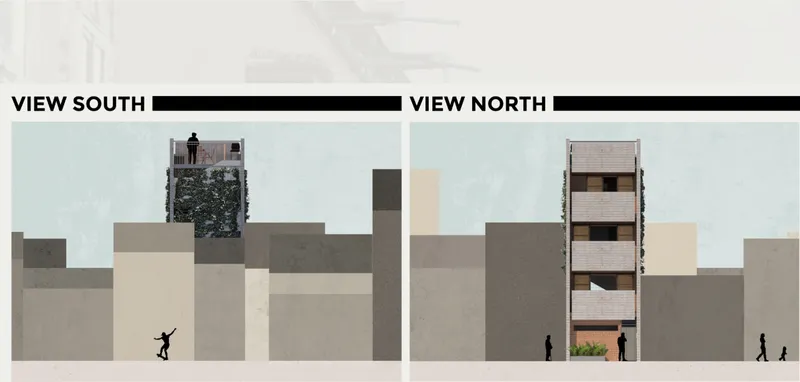
From above, the building reads as a series of recessed openings punched into a horizontal facade, with a courtyard at its center where a single figure gives immediate scale. The south and north elevations confirm the sectional strategy: rooftop terraces planted with greenery sit above compact floor plates, while the ground level opens directly to the street. Creeper plants climb the exterior surfaces, providing natural thermal regulation that reduces interior heat gain. This is not decorative landscaping; in Guadalajara's warm climate, the planted skin is a working environmental system.
Stacked Layers of Shared and Private Life

The exploded axonometric drawing makes the spatial logic legible. Each level is stacked with a specific programme: shared dining and kitchen areas foster daily interaction, while private bedrooms with adaptable layouts are set apart for individual households within the family unit. The rooftop terrace and garden appear at the top, offering residents space for gardening, relaxation, and social gathering. Light wells are threaded through the section, pulling daylight deep into the interior, and strategic window placement ensures cross-ventilation through the plan. The drawing also reveals how modular construction enables future modification; walls and storage units can be reconfigured without structural disruption.
Brick, Timber, and Concrete at Room Scale
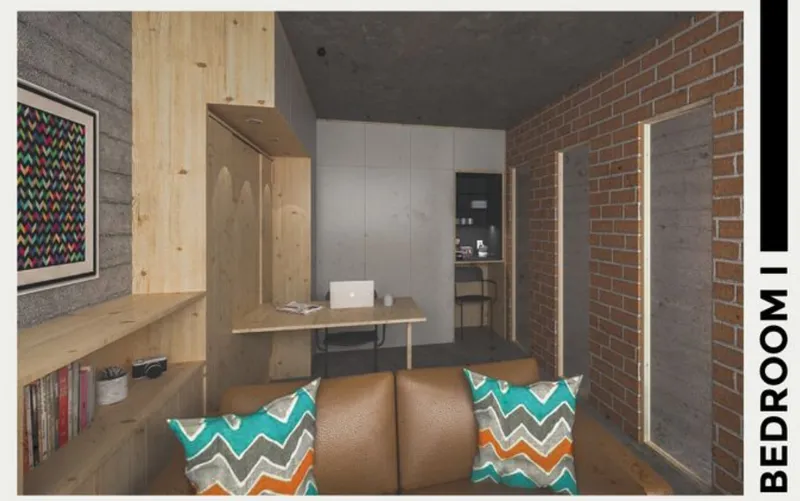
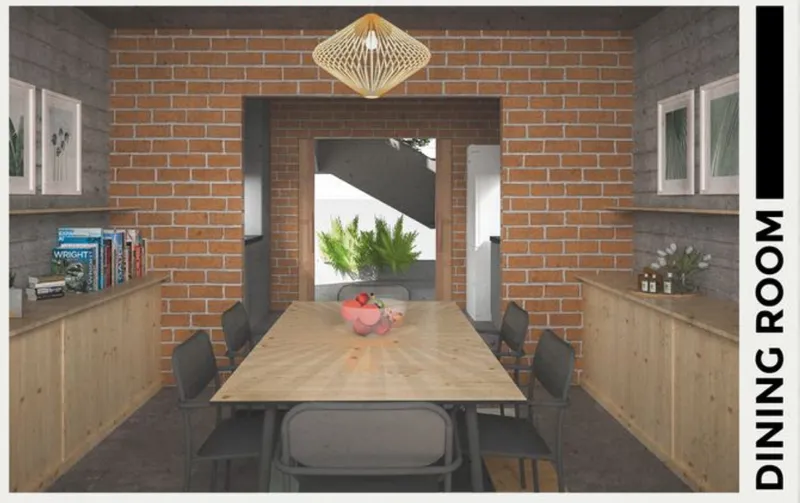
The interior renderings ground the project in material specificity. A bedroom features an exposed brick wall paired with timber shelving and a raw concrete ceiling, producing a palette that is warm without being decorative. The dining room rendering shows a long timber table set against the same brick, lit by a geometric pendant light. These are not luxury finishes; they are locally sourced materials chosen to minimize transportation emissions while achieving a domestic atmosphere that feels considered rather than austere. The combination of textures gives each room a tactile quality that prefabricated systems often lack.
Fold-Down Furniture and Framed Courtyard Views

The bedroom interiors demonstrate how space optimization works at the scale of furniture. Fold-down beds tuck flush against timber cabinetry, freeing floor area during the day. Desks fold in the same way, transforming sleeping quarters into workspaces or children's play areas. What elevates these rooms beyond utilitarian efficiency is the framing: each bedroom opens to a courtyard view, bringing natural light and a visual connection to the planted exterior into the most private rooms of the house. The window openings are generous enough to feel expansive without compromising the structural simplicity of the prefabricated wall panels.
Why This Project Matters
The Mexican Nano Nest works because it refuses to separate the economic argument from the architectural one. Prefabricated stainless steel and concrete components lower construction costs and reduce site disruption, but the same modular logic also produces adaptable rooms that respond to the changing shape of a multi-generational household. The environmental strategies, from natural ventilation to creeper-clad facades, are not bolt-on features but integral to the building's section and materiality.
What Cezary Loj proposes here is a scalable prototype rather than a singular object. The shared dining rooms, rooftop gardens, and courtyard connections address the emotional dimension of housing that density often erodes: the chance to eat together, grow something, and know your neighbors. In a global housing discourse that frequently treats affordability and quality as opposing forces, the Nano Nest offers evidence that they can be designed as the same thing.
View the Full Project
About the Designers
Designer: Cezary Loj
Enter a Design Competition on uni.xyz
uni.xyz runs architecture and design competitions year-round that reward proposals with spatial conviction and real site intelligence.
Project credits: The Mexican Nano Nest by Cezary Loj Nano Nest 2020 (uni.xyz).


Popular Articles
Popular articles from the community


graciastudio Turns a Viewless Tijuana Lot Inward Around a Courtyard of Concrete, Timber and Trees
In Tijuana, Jorge Gracia's GA2 House stacks a timber-clad private floor over exposed concrete and replaces a missing view with a planted interior patio.


Singing Woman: An Opera House That Performs Before the Curtain Rises
Ovidiu Cristian Pavel's conceptual opera house translates Estonia's choral identity into a sculpted waterfront landmark facing the Baltic Sea.

ETEH Reworks the Shared Spaces of São Domingos School in Brazil Around Timber, Color and Hanging Plants
At São Domingos School in Brazil, 436 m² of hall, refectory and library are recast with timber joinery, a yellow and blue code and trailing greenery.

Manzana Morphosis: Stretching Barcelona's Grid into a Living Landscape for 2050
A radical reworking of the Eixample manzana turns density into a tool for generous public space, vertical ecology, and environmental performance.

Similar Reads
You might also enjoy these articles

Vereda Arquitetos Renovates a 40-Square-Meter Apartment Inside Niemeyer's Copan Building
A compact unit in São Paulo's most iconic residential tower gets a material overhaul that pairs exposed concrete with bold blue Formica.

Shakur's House: Exposed Brick as an Interior Organiser in a 168 m² Mashhad Residence
Brick moves indoors in this Mashhad residence, where masonry walls, glass partitions and teal planes sequence a compact home without closing it off.

Day and Night Park: A Time-Based Urban Newsstand in Beijing
A temporary urban newsstand in Beijing blending travel, light, and reading through poetic colors, compact form, and community-focused design.

Modernist Patio Renovation in El Masnou, Barcelona by Oliver Segura Arquitectura + Cebrià Arquitectura
Modernist patio renovation blending tradition and innovation with a movable pool, leveled floors, and Catalan materials in El Masnou.

Explore Nano Nest Competitions
Discover active competitions in this discipline

Challenge to design luxury tourism on rails

VR headsets Storefront design competition

Designing a staircase for a client
Comments (0)
Please login or sign up to add comments
No comments yet. Be the first to comment!