
The Mountain: A Climbable Library That Merges Topography with Civic Life
A sloping public promenade, modular courtyards, and landscape integration redefine the library as living social infrastructure.


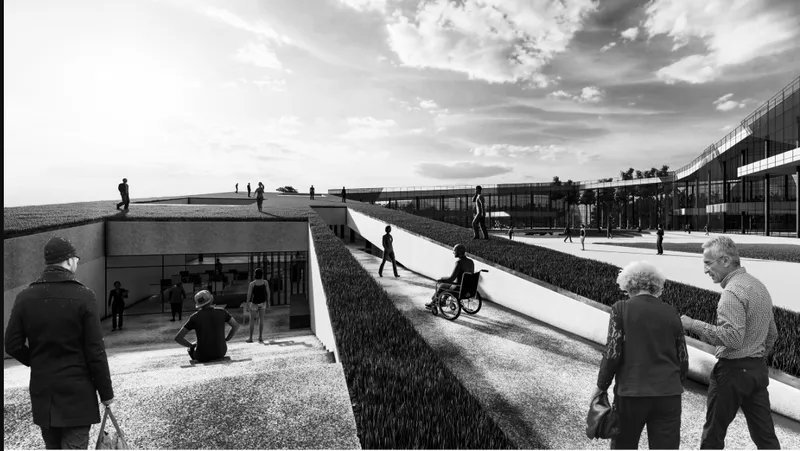
What if the roof of a library were not a boundary but a public path? The Mountain proposes exactly that: a continuous sloping surface that users can ascend, cross, and descend, turning the building itself into a piece of navigable topography. It is a library you walk over as much as you walk through, and in that simple inversion of convention, it opens up a provocative argument about what civic architecture owes to the street, the park, and the communities that surround it.
Designed by Juan Pablo Henao Gallego, Santiago R, and Juan Jose Vargas Castillo, The Mountain was shortlisted in the Libgen 2019 competition. The brief asked entrants to rethink the public library for a new generation. This team responded not with a building that sits on its site but one that envelopes it, creating a central courtyard for civic gatherings while its sloped form rises to connect pedestrians to adjacent structures via integrated bridges. The name is literal: the morphology reads as a constructed mountain, its slopes planted, walkable, and open to the city.
A Roof You Can Walk: The Promenade as Public Space
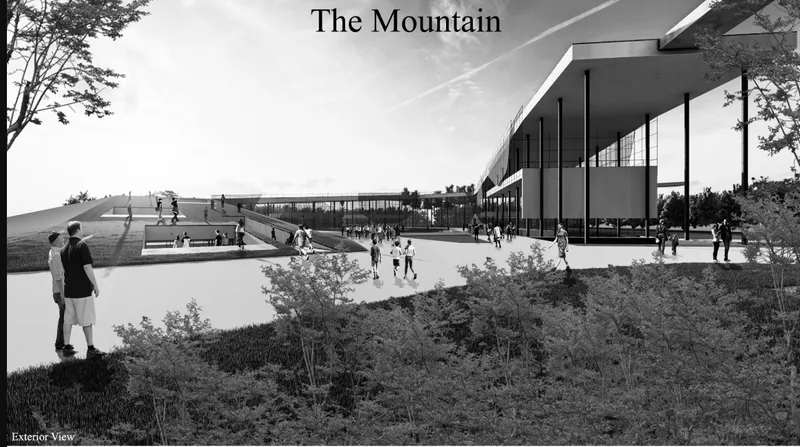
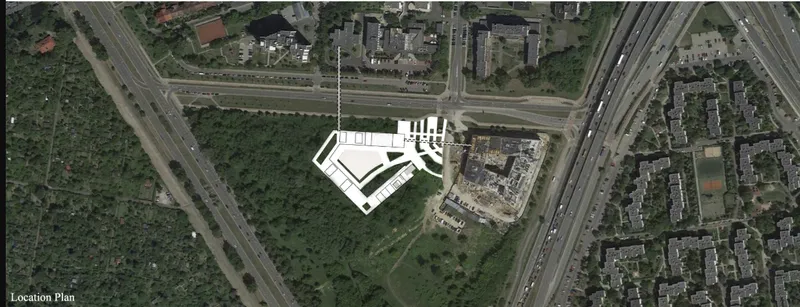
The elevated glass and metal pavilion shown here gives a sense of the project's ambition: a cantilevered roof structure overlooking a terraced plaza where visitors gather in bright daylight. The aerial site plan reveals how the angular footprint sits adjacent to highways and residential neighborhoods, negotiating between scales of infrastructure and domestic fabric. The continuous sloping roof is the project's signature move. It is not decorative. It functions as a public promenade that allows people to ascend the structure, cross over it, and reach adjacent buildings through pedestrian bridges. The result is a new layer of urban mobility, one that is inclusive and deeply integrated with the surrounding cityscape.
Pentagonal Courtyards and Modular Flexibility
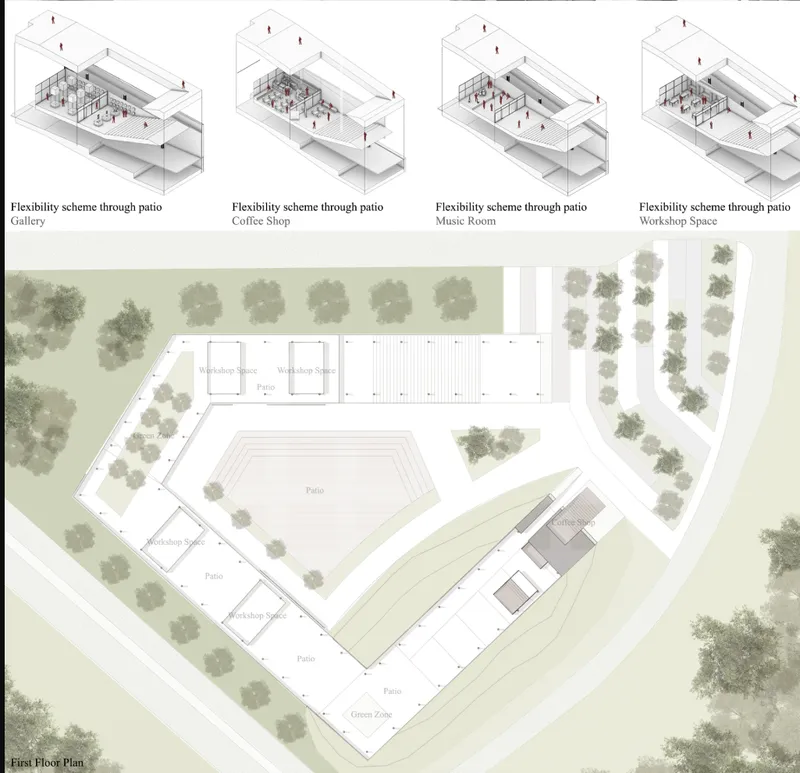
The floor plan and axonometric drawings reveal the organizational logic: a pentagonal courtyard at the center, surrounded by linear spaces and rows of tree plantings. Galleries, music rooms, coffee shops, and workshop zones orbit these open courtyards, organized not as fixed rooms but as modular zones capable of fluid reprogramming. The patios extend the spatial rhythm of the building and dissolve the hard line between indoor and outdoor, allowing for seasonal adaptability and diverse use. A ramped plaza with planted berms leads to a sunken entrance, reinforcing the landscape-as-architecture approach. Rather than a grand front door, users descend into the building gradually, the experience shaped by topography rather than threshold.
This flexibility is not arbitrary. It stems from a deliberate reading of how public needs evolve. Families, students, artists, and researchers all require different things from a civic building, often at different times of day. By refusing mono-functional spaces, the designers allow the library to function as living social infrastructure, a term that feels earned here rather than aspirational.
Landscape as Architectural Material
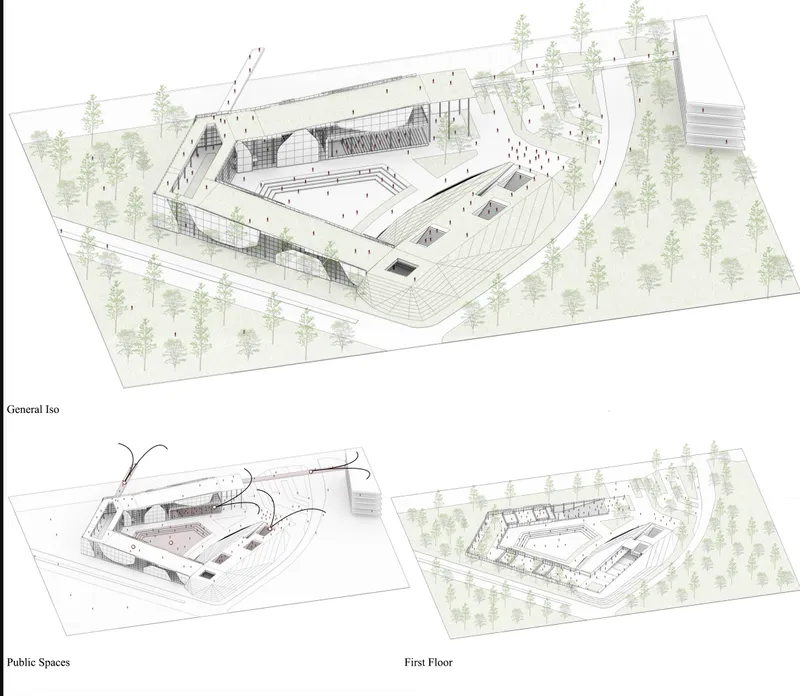
The isometric drawing makes the landscape strategy legible: terraced levels step down across the pentagonal site, perimeter tree rows define edges, and central courtyard spaces breathe air into the plan. Green zones are distributed throughout the site and across multiple building levels, contributing to local biodiversity and improving microclimatic conditions. These planted areas, combined with open-air walkways and shaded terraces, reduce the heat island effect and provide quieter zones for rest, reflection, and study.
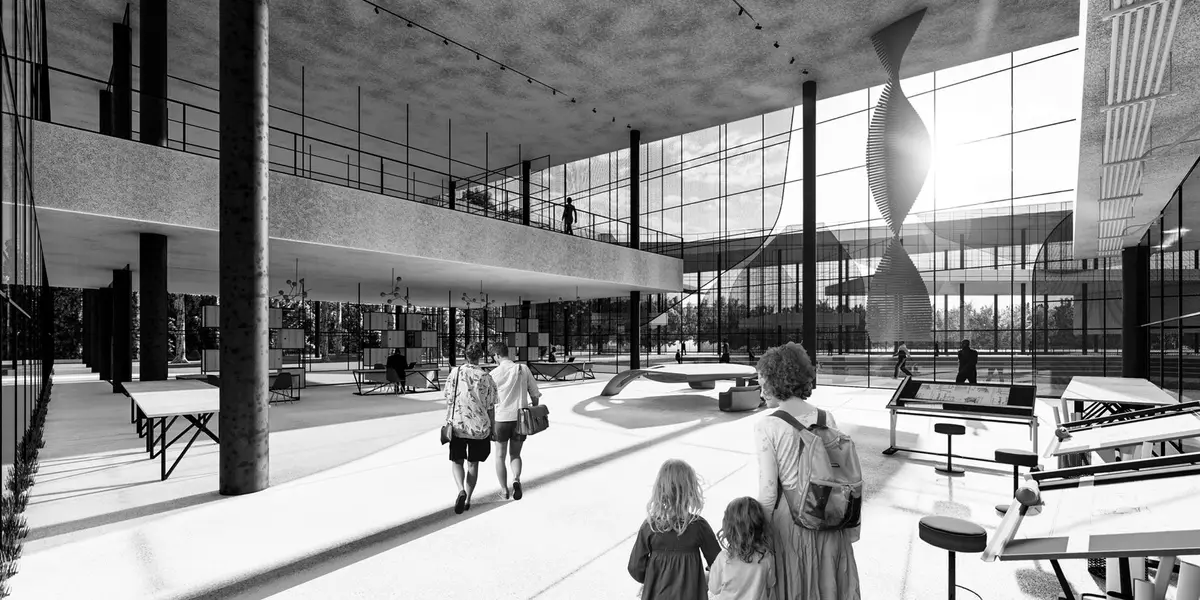
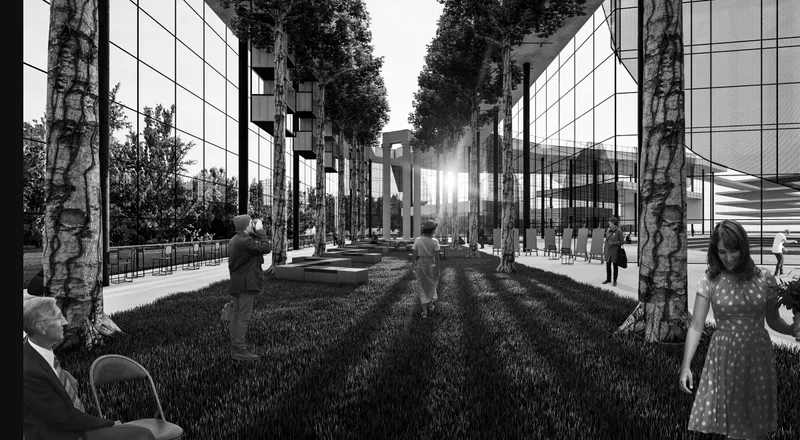
The glass corridor image captures something harder to draw in plan: atmosphere. Birch trees cast long shadows from a low sun as pedestrians move through the space. Natural light, vegetation, and human movement coexist without hierarchy. The landscape is not applied decoration; it is embedded in the architectural language. When green infrastructure becomes structural to the experience of a building rather than supplementary, sustainability shifts from metric to sensation.
Why This Project Matters
The Mountain matters because it refuses the false choice between ecological responsibility and spatial generosity. Too many sustainability-forward projects feel ascetic, as though caring about the environment requires architectural restraint. Here, the environmental strategies, from planted terraces to microclimatic modulation, produce richer public spaces, not thinner ones. The sloped roof is simultaneously a green surface, a pedestrian route, and a civic gesture. That convergence of purposes in a single architectural element is where the design thinking becomes genuinely inventive.
For a library competition, the entry also makes a sharp argument about what these institutions should become. Not repositories, not reading rooms with coffee shops bolted on, but true pieces of urban landscape: climbable, crossable, adaptable. By merging topography with public program, Henao Gallego, Santiago R, and Vargas Castillo propose a model where the building and the city are not adjacent conditions but continuous ones. That continuity, physical and social, is the project's most persuasive idea.
View the Full Project
About the Designers
Designers: Juan Pablo Henao Gallego, Santiago R, Juan Jose Vargas Castillo
Enter a Design Competition on uni.xyz
uni.xyz runs architecture and design competitions year-round that reward proposals with spatial conviction and real site intelligence.
Project credits: The Mountain Libgen Library by Juan Pablo Henao Gallego, Santiago R, Juan Jose Vargas Castillo Libgen 2019 (uni.xyz).


Popular Articles
Popular articles from the community


Little Red Riding Hood: Architectural Design as a Journey Through Fear, Light, and Storytelling
Little Red Riding Hood reimagines the fairy tale through architectural design shaped by fear, light, scale, memory, uncertainty, and choice.

Conexión: Biophilic Design Reimagines High-Rise Living in Hong Kong
Conexión reimagines high-rise living in Hong Kong through biophilic design, green facades, shared spaces, daylight, water and nature within.

The Ocean Hive: Sustainable Architecture for a Self-Sufficient Civilization at Sea
The Ocean Hive imagines sustainable architecture at sea, where modular habitats, algae, wave power and ocean waste sustain a growing colony.

Co-Life: Senior Housing Design That Reconnects Older Adults With the City
Co-Life reimagines senior housing design through healing gardens, shared streets, workshops, and a sustainable community across generations.

Similar Reads
You might also enjoy these articles

Day and Night Park: A Time-Based Urban Newsstand in Beijing
A temporary urban newsstand in Beijing blending travel, light, and reading through poetic colors, compact form, and community-focused design.

Modernist Patio Renovation in El Masnou, Barcelona by Oliver Segura Arquitectura + Cebrià Arquitectura
Modernist patio renovation blending tradition and innovation with a movable pool, leveled floors, and Catalan materials in El Masnou.

Alto Residencial Coop: Cooperative Housing Development in Santiago de Compostela by Carbajo Barrios Arquitectos
A linear cooperative housing complex blending white volumes and perforated metal façades, enhancing community living, natural light, privacy, and urban integration.
Vil Genis School by BPA ARCHITECTURE – Massy, France
Vil Genis School in Massy, France, features sustainable design, south-facing classrooms, community integration, accessible spaces, and modern educational architecture.

Explore Public Building Competitions
Discover active competitions in this discipline

Challenge to design locus for the upliftment of human rights

Challenge to design public laboratory

Design challenge to reuse E-waste
Comments (0)
Please login or sign up to add comments
No comments yet. Be the first to comment!