

THE ROTATING GREENS
A sustainable high-rise architecture redefining vertical living through green voids, mixed-use integration, and climate-responsive design.


Located in GIFT City, Gandhinagar, a rapidly emerging global financial and IT hub, The Rotating Greens proposes a forward-thinking approach to sustainable high-rise architecture. Designed by Smit Ramani, this shortlisted entry in the Commercial ‘20 category reimagines the conventional commercial tower by integrating ecological sensitivity, spatial efficiency, and programmatic diversity into a single vertical ecosystem.
At its core, the project responds to the increasing demand for mixed-use developments in dense urban environments. The building accommodates a wide range of functions including administration areas, co-working spaces, service offices, recreational zones, and residential accommodation. Instead of treating these programs as isolated layers, the design interweaves them through a carefully articulated spatial strategy that promotes interaction, flexibility, and environmental performance.

The conceptual development begins with a maximum volumetric envelope derived from site constraints and urban context. This initial mass is then strategically carved to introduce voids across different levels. These voids are not arbitrary but are placed based on functional requirements, daylight access, and cross-ventilation needs. The resulting form breaks the monotony of a typical high-rise and establishes a dynamic relationship between built and unbuilt space.
These carved volumes evolve into the defining feature of the project: rotating green terraces distributed vertically throughout the tower. Acting as semi-open spaces, these terraces function as social condensers where users can engage, relax, and reconnect with nature. The integration of landscape within the building enhances thermal comfort, reduces heat gain, and improves indoor air quality, aligning with key principles of sustainable high-rise architecture.
The spatial organization of the building is structured through a central service core that ensures efficient circulation and service distribution. Passenger lifts, service lifts, fire staircases, and utility ducts are consolidated to optimize usable floor area while maintaining safety and operational clarity. The structural grid further reinforces this efficiency, allowing flexibility in interior layouts and accommodating the diverse programmatic needs of the building.
Zoning within the tower is clearly defined yet visually interconnected. Lower levels house public and semi-public functions such as recreation and co-working, fostering accessibility and engagement. Mid-levels are dedicated to service offices and administrative functions, while upper levels accommodate residential units, offering privacy and panoramic views. Refuge areas and service floors are integrated seamlessly to comply with safety regulations without disrupting spatial continuity.
The ground plane extends the architectural language of the tower into the site. The site plan reveals a thoughtfully designed landscape with pedestrian pathways, green buffers, and organized vehicular circulation. The building sits as a central node within this layout, establishing a strong visual and functional anchor in the urban fabric of GIFT City.
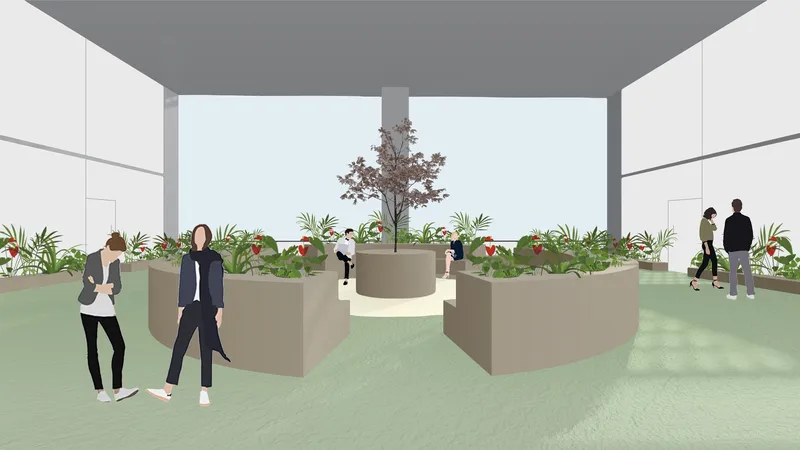
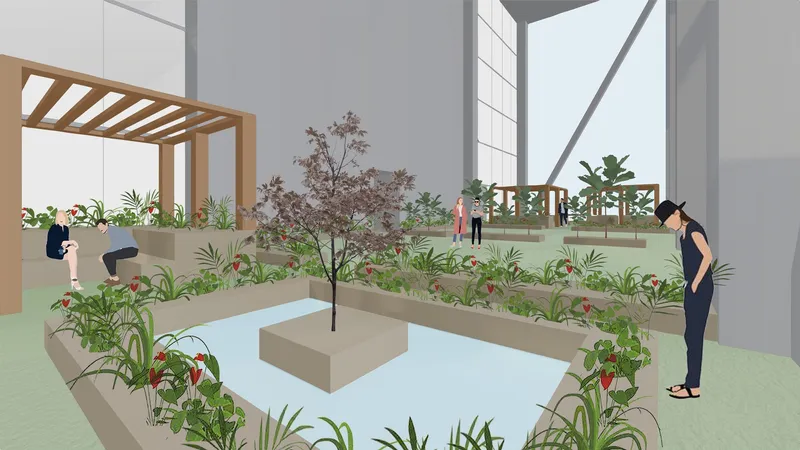
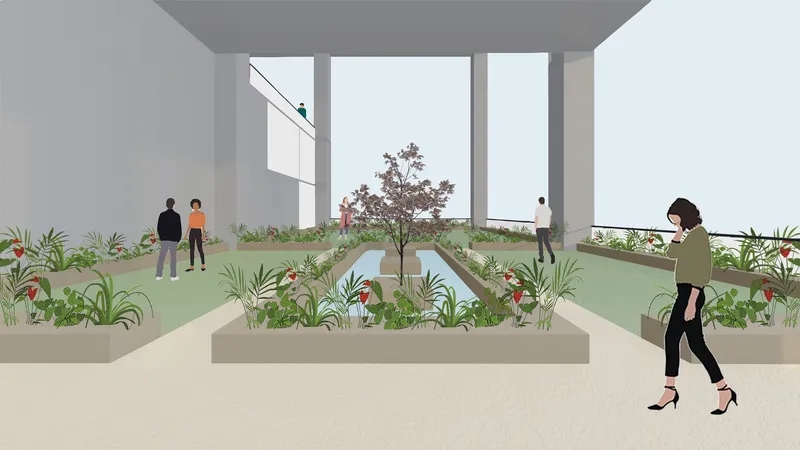
Interior visualizations highlight the experiential quality of the green voids. These spaces are designed as multi-level gardens with seating, water features, and shaded areas, encouraging informal interaction and providing relief from the intensity of a commercial environment. The interplay of light, vegetation, and open volumes creates a spatial rhythm that enhances user well-being and productivity.
Materiality and form remain intentionally restrained, allowing the spatial strategy and green interventions to take precedence. The clean façade articulation emphasizes horizontal layering while the voids introduce depth and variation, resulting in a visually balanced yet distinctive high-rise.
The Rotating Greens ultimately positions itself as more than a commercial building. It is a prototype for future urban development where sustainability is not an add-on but an integral design driver. By merging architecture, landscape, and program into a cohesive system, the project demonstrates how high-rise buildings can evolve into resilient, human-centric environments.
In the context of rapidly urbanizing cities, this approach offers a compelling model for sustainable high-rise architecture that prioritizes ecological balance, social interaction, and long-term adaptability.



Popular Articles
Popular articles from the community


Riyadh For All: Intergenerational Urban Design for Active Aging in Rabat
Riyadh For All reimagines urban design in Rabat with intergenerational co-living, adaptive courtyards, and Moroccan cultural exchange today.

AL-JANNAH: Sustainable Architecture and Permaculture for Afghan Widows
AL-JANNAH uses sustainable architecture and permaculture to create resilient oasis of housing, learning, work and renewal for Afghan widows.

Co-life: Sustainable Architecture for Age-Friendly Community Living
Co-life reimagines sustainable architecture for seniors through courtyards, rammed earth, shared gardens, and spaces designed for belonging.

Conexión: Biophilic Design Reimagines High-Rise Living in Hong Kong
Conexión reimagines high-rise living in Hong Kong through biophilic design, green facades, shared spaces, daylight, water and nature within.

Similar Reads
You might also enjoy these articles

Eco Chapel: A Green Architecture Pavilion Designed in Symbiosis with the Forest
Eco Chapel uses green architecture to weave prayer, learning and reuse into a forest pavilion shaped by modular hexagonal canopies for life.
Kaffeebühnen: Coffee Shop Architecture Designed as a Civic Stage Between Vienna’s City and Park
Kaffeebühnen turns coffee shop architecture into a civic stage, linking Vienna’s park edge, urban life, warm timber yards, and coffee craft.
Healing Façade: Sustainable Architecture for Reforestation, Community, and Sacred Ecology in Ethiopia
Healing Façade reimagines sustainable architecture as a living wall that restores soil, catches water and renews Ethiopia's forest churches.


Urban Forest: A Vertical Ecosystem for 5,000 Workers in Singapore's Changi Business Park
Radially stacked pods and layered green decks turn a 7-acre plot into 47 acres of ecological workspace projected for 2040.


Explore Architecture Competitions
Discover active competitions in this discipline



Challenge to reimagine the Iron Throne


Photograph architecture without architects


Illustrate the lost glory of Angkor Wat - Render Challenge


Design challenge to reuse E-waste
Comments (0)
Please login or sign up to add comments
No comments yet. Be the first to comment!