

The “ Spine ”
From transportation to inhabitation - reimagining movement as a way of living.

Across Europe’s largest cities, housing affordability, density, and mobility have hit a crucial level. Young professionals, independent contractors, and mobile workers especially those between the ages of 25 and 35 are being priced out of metropolitan areas and compelled to live in temporary housing, travel great distances, or move frequently. At the same time, cities are getting denser both vertically and horizontally, making it difficult to accommodate new types of residence. In response to these circumstances, our idea suggests a new architectural layer: a continuous, livable infrastructure spine that reorganizes social, professional, and residential activities outside of the static boundaries of the modern metropolis.
The proposal integrates housing and transportation into a single continuous structure instead of considering them as distinct systems. The idea reimagines mobility as a spatial condition rather than a solely mechanical one, drawing inspiration from historical antecedents where infrastructure has affected urban design, from Roman arches to railway viaducts and contemporary transport networks. Movement is now a lived experience that may accommodate social, economic, and household life rather than only being about efficiency or speed.
In densely populated historic sites like Manchester, the spine functions as a lightweight, raised structure that travels through and between existing urban fabrics. It does not impose a single architectural piece or take the place of the city. Rather, it threads through already-existing structures, adjusting its openness, density, and spatial rhythm to fit the situation. The structure becomes tighter, more regulated, and aesthetically restrained in crowded metropolitan settings. It loosens when it approaches open spaces, letting views, light, and air into the system. The spine responds locally to its environment while maintaining coherence thanks to this segmented yet continuous logic.
The concept of nodes versus lines is central to the approach. Meaningful urban life mostly happens at certain nodal locations, whereas the spine is always in motion. These nodes serve as transient, livable micro-communities when pods separate, halt, and re-connect. Here, the system facilitates marketplaces, social interaction, shared facilities, and downtime. The segments between nodes, on the other hand, emphasize mobility, continuity, and speed, supporting the notion that not all infrastructure has to be in use at all times.
Skeletal systems, particularly the logic of ribs and cavities, served as inspiration for the spine's main structure. By eliminating expressive formal gestures that may compete with the city itself, this skeleton structure serves as a constant structural language in many circumstances. Its rib density varies with location, resulting in varying levels of light filtering, sound diffusion, and visual permeability. In order to minimize its visual and physical footprint while preserving continuity, the construction is purposefully lightweight and breathable. In this way, the spine functions more like a flexible urban organ than a structure.
Modular pods that can accommodate one or two people make it feasible to live inside the system. These pods are designed to be simple yet cozy living spaces that are ideal for extended travel and residence. Their shape adapts to aerodynamic needs, lowering friction and enabling the spine to move smoothly. The pods promote comfort, privacy, and psychological well-being despite their small size, acknowledging that users may stay in the system for lengthy periods of time, sometimes traveling thousands of kilometers between cities. Both solitary and shared living are supported by pods, which can function independently or join at nodes to form larger communal arrangements.
An adaptive interface layer appears between the spine and the current city. Local participation is possible in this intermediate zone without interfering with the main infrastructure flow. Here, inhabitants may monitor activity, engage in informal businesses, or just occupy a transitional area between rapid and slow urban life by temporarily attaching tiny balconies, platforms, and microbusiness spaces to the system. The intentionally small size of these areas emphasizes flexibility and reversibility over permanency.
Programmatically, the system facilitates a narrow but targeted range of activities: leisure, local markets, green areas with specialized uses, fitness and wellness, and cultural interaction. Activities are clustered at nodes rather than distributed uniformly down the spine, which reinforces halt and interaction times. Instead of being seen as ornamental features, green spaces are viewed as functional settings that serve as anchors for the otherwise mobile experience places for relaxation, gardening, or social gathering.
The proposal makes technological assumptions about future developments in autonomous capsule systems, high-speed transportation, and energy - efficient infrastructure. However, technology is never foregrounded as spectacle. Rather, it functions silently in the background, maintaining continuity, safety, and comfort while preserving the legibility and human scale of urban life and architecture.
Ultimately, the proposal envisions a future where inhabitation is no longer bound exclusively to land ownership or static urban form. By offering an alternative mode of living that exists between cities rather than within them, the spine reduces housing pressure in dense urban centers, redistributes population flows, and introduces a new relationship between movement and dwelling. It proposes not a replacement for the city, but an additional layer one that is adaptable, reversible, and responsive to the evolving realities of contemporary life.


Popular Articles
Popular articles from the community


Opera by the Sea Estonia: Three Shells Dissolving Architecture into Tallinn's Coastline
A winning opera house proposal replaces monumental form with interconnected shells that blur the boundary between building, park and Baltic Sea.
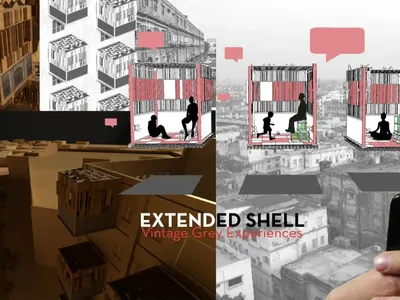
Extended Shell: Retrofitting Kolkata's Balconies as Living Urban Thresholds
A modular retrofit system recovers the social and environmental intelligence of Kolkata's historic verandas for contemporary Park Street residents.
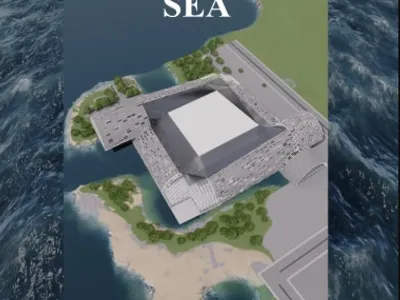
Opera on the Sea: Driftwood Logic Shapes a Timber Opera House on Estonia's Coast
Trevor Orgill's opera house translates the entangled drift of floating timber into a civic building where wood, water, and music converge.

The Amber Palace Opera: A Geological Fiction Surfaces on Tallinn's Baltic Waterfront
Pierre Brillard reimagines a Baltic legend as a public landscape, opera house, and waterfront promenade rooted in Tallinn's coastal identity.

Similar Reads
You might also enjoy these articles
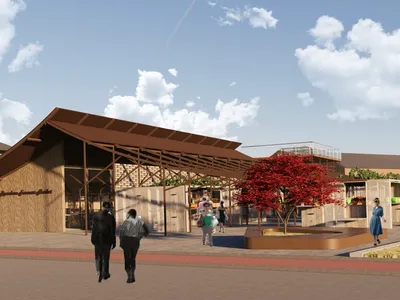
The Rhythm of Seasons
A Farmers' Market Connecting Nature and the City

More Than a Building-Designing a Living System
More Than a Building-Designing a Living System
Base Beyond
DESERT COMPOUND ARID: TOURISM OF ABSENCE AND ABUNDANCE

Explore Urban Mobility Competitions
Discover active competitions in this discipline


Challenge to reimagine the Iron Throne

Photograph architecture without architects

Illustrate the lost glory of Angkor Wat - Render Challenge

Design challenge to reuse E-waste
Comments (0)
Please login or sign up to add comments
No comments yet. Be the first to comment!