

THE SPRUCE Eco-lodge
This project explores alternatives to traditional tourism development with an off-grid immersive experiential escape. The proposed year-round ecolodge offers a diverse set of accommodations catering to a variety of guests and experiences while introducing the visitors to the net-zero lifestyle. Inspired by Nature’s ecosystems functions and evolutionary structure, this ecolodge rests harmoniously in its natural setting, preserving its ecological landscape processes. The conceptual ideas presented for this ecolodge acts as a prototype for sustainable living which can be applied at a variety of scales and geographic locations.
MISSION
This project explores alternatives to traditional tourism development with an off-grid immersive experiential escape. The proposed year-round ecolodge offers a diverse set of accommodations catering to a variety of guests and experiences while introducing the visitors to the net-zero lifestyle. Inspired by Nature’s ecosystems functions and evolutionary structure, this ecolodge rests harmoniously in its natural setting, preserving its ecological landscape processes. The conceptual ideas presented for this ecolodge acts as a prototype for sustainable living which can be applied at a variety of scales and geographic locations.
THE CONCEPT
Biomimicry is the core conceptual framework for developing this sustainable living community and solution to net-zero living in the subarctic landscape. Inspired from the form and function of the onsite natural wetlands and the native spruce trees, the major site structure and architectural design features function in Nature to create an iconic and memorable solution for an escape in Nature.
As a core design feature, an artificial wetland mimics the functions of natural wetlands to treat wastewater on-site for reuse. An atrium that houses the wetland is connected to the residential units to help passively control the indoor temperatures and provide a comfortable community space to socialize.
Modular housing (PODS) proposed for the more sensitive locations onsite mimics the spruce tree cone. Like the cones, the PODS walls raise and lower to allow sun and wind to control the climate naturally.
DESIGN PROCESS
Site exploration, data collection, and focused research establish a knowledge base to best approach the design challenge.
Contextual Inquiries
The following questions are explored and considered at the onset and throughout the design process:
1. What are the PHYSICAL FEATURES or layers (cultural + natural) on and around the site?
2. What is the PALETTE of materials at hand?
3. What are the sites and surrounding areas larger CONTEXTUAL ISSUES? (history, economic forces, socio-cultural, environmental)
4. What is the SPATIAL STRUCTURE of the site?
5. What areas should be PRESERVED, conserved, restored? What areas should be DEVELOPED, changed, highlighted, modified?
6. What is the CAPACITY of the site? What is APPROPRIATE? What is NOT APPROPRIATE?
7. What is the HISTORY of the site? How has it changed over time? How long has been here?
8. What SPECIES (flora + fauna) are present? What indicators of the natural world are visible? Is there evidence of WATER (drainage, creeks, topography)? What are the qualities of the SOIL?
9. What PROCESSES, flow, cycles are visible? How might the ECOLOGICAL HEALTH of the site be monitored?
10. What are CLIMATIC and MICROCLIMATIC conditions on site?
Site Inventory
To understand context, project opportunities, and limitations, site conditions are investigated and interpreted. Data collected from Geographic Information Systems (GIS) databases examines environmental and natural processes, which has informed the design program and concept development.
- Natural ecosystems functions are interpreted from topography/hydrology analysis.
- Sensitive habitats and previous land use are identified from landcover data.
- Land use suitability is determined by topography and soil characteristic

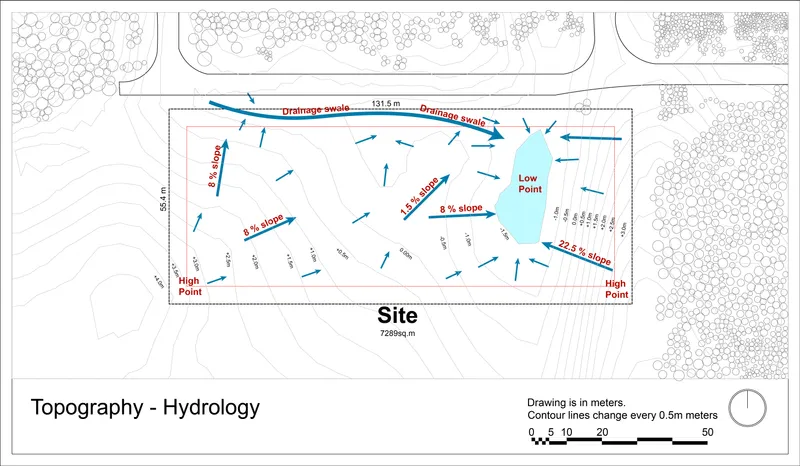
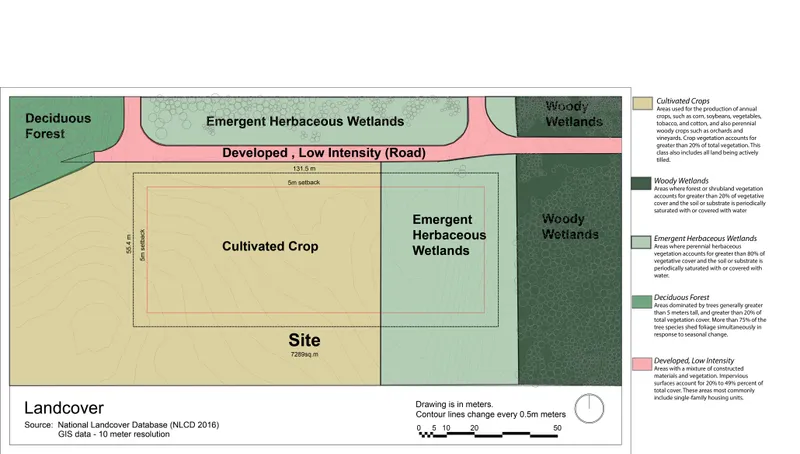
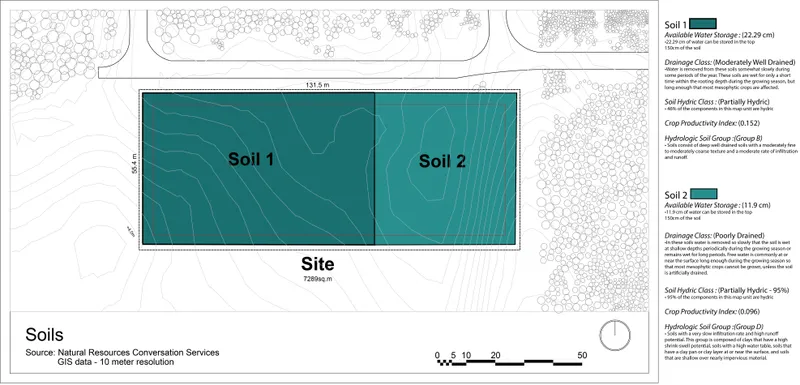
Outcomes from the inventory:
- The site has been previously cultivated (disturbed).
- There is a significant change in topography with clear drainage patterns that leads to onsite Emerging Herbaceous Wetlands.
- There are two distinct types of soils that indicate the most suitable locations to build and appropriate development intensities.
- Pulling from the contextual environment, rammed earth and sustainably harvested wood are suitable material pallets.
Research
Several research topics contributed to the development of this design; Ecotourism, Earthships, passive design, ecological design, regional design, The Living Machine (wastewater treatment), alternative building materials.
Below is a set of principles derived from the research that are the driving concepts that lead the program development.
1. Biological and physical features should influence design form
2. Don’t disturb natural processes that exist and restore those that are missing
3. Enrichment through complexity
4. Landscape as a process
5. Minimal energy consumption
6. Use the vernacular
7. Utilize borrowed views
8. Comprehend and reflect on climate change
9. Water systems as a design feature
10. Net-zero waste
11. Community-oriented
12. Educate visitors
13. Implement stormwater Best Management Practices (BMP)
14. Interactive/immersive experience
15. Resilient landscape infrastructure
16. Energy use and conservation
17. Water conservation and management
18. Waste management
19. Building technology, materials, and construction
CONCEPT DEVELOPMENT
Looking to Nature for solutions, the ecological process in which wetlands purify water drives the design concept. After exploring alternative approaches to replicate the ecological process so that it can survive the Alaskan winter's climatic conditions, the artificial wetland should be housed in an atrium to help moderate the temperature. Additionally, the atrium can moderate the interior temperature of the housing units. The diagrams below explore alternatives to how to organize the units to function with the atriums for wastewater treatment/reuse and passive climate control.
- Individual detached systems (30 wetlands)
- Pods of 6 units (5 wetlands)
- Central System with all units functioning together


After exploring the configurations, the site catered most to a centralized clustered system, which minimized the footprint on the site and allowed for a larger, healthier wetland that could have a consistent water source to function year-round. The artificial wetland is dependent on the wastewater from humans to function and the centralized system will allow the wetland to function without full occupancy. This solution also allows for more land to be preserved, untouched from development.
However, based on the site limitations and the design program only 26 units fit with this “central-system” design concept. An additional concept was developed for the remaining six units.
Once again, Nature inspired the design concept. Placing the remaining units on the East end of the property, these units needed to be independent of the artificial wetland on the opposite side of the preserved onsite wetland. The cone of the native Spruce tree was examined to discover how they reproduce; protect their seeds from the cold climatic conditions. The outcome was the creation of the Seed Pod, a modular home with walls and windows that retract on-demand to take advantage the natural energy sources (wind and sun) to heat, cool, and collect water and energy for the home passively and actively.
CONCLUSION
This ecolodge design mimics natural processes and structure to facilitate an ecotourism retreat that can house visitors year-round and preserve the most sensitive ecosystem onsite.
It educates, immerses the visitor in off-the-grid living, and provides an escape from the urban environment.

Popular Articles
Popular articles from the community


Architekt Andreas Gruber Scatters 23 Dark Timber Chalets Across a South Tyrolean Forest Edge
In Molini di Tures, Amonti Chalets breaks a resort into a hamlet of gabled timber houses, with parking, storage and services pushed into the slope.

Juan García Correa, John González and Claudia Rueda Sink a Circular Amphitheater into a Manizales Engineering Building
On the La Nubia campus in Manizales, Colombia, the S1 Building folds labs and offices into a hillside of ramped lawns that double as a campus route.

David Macias Steps a Doorless Stone and Plaster House Down a Tropical Colombian Hillside
In the humid hills of Colombia, Threshold House replaces the front door with an open void and terraces its 850 m² down the slope instead of fighting it.

David Ortega Stacks a Two-Story Mexico City Penthouse Around a Steel Stair and a Pergola-Shaded Roof Terrace
In Colonia Roma, a 300 m² penthouse uses oak joinery, a planted steel stair and a slatted roof pergola to make a new-build apartment feel like a house.

Similar Reads
You might also enjoy these articles


Vereda Arquitetos Renovates a 40-Square-Meter Apartment Inside Niemeyer's Copan Building
A compact unit in São Paulo's most iconic residential tower gets a material overhaul that pairs exposed concrete with bold blue Formica.

Shakur's House: Exposed Brick as an Interior Organiser in a 168 m² Mashhad Residence
Brick moves indoors in this Mashhad residence, where masonry walls, glass partitions and teal planes sequence a compact home without closing it off.

Day and Night Park: A Time-Based Urban Newsstand in Beijing
A temporary urban newsstand in Beijing blending travel, light, and reading through poetic colors, compact form, and community-focused design.

Modernist Patio Renovation in El Masnou, Barcelona by Oliver Segura Arquitectura + Cebrià Arquitectura
Modernist patio renovation blending tradition and innovation with a movable pool, leveled floors, and Catalan materials in El Masnou.


Comments (0)
Please login or sign up to add comments
No comments yet. Be the first to comment!