
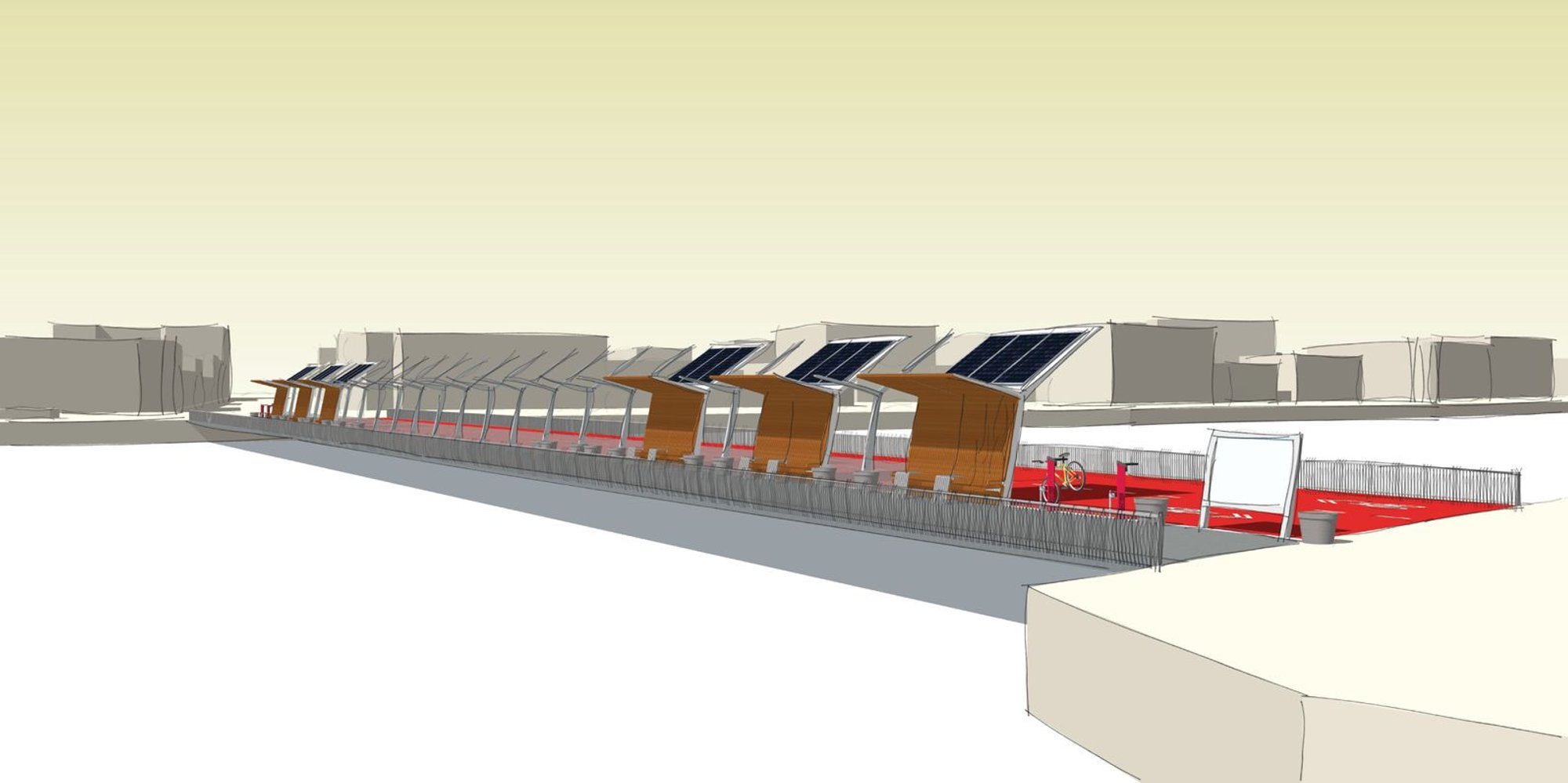
The Sunbeam Overpass: A Self-Powering Pedestrian Bridge for Copenhagen
Solar canopies, timber pavilions, and separated bike lanes transform a water crossing into active public infrastructure.

What if a bridge could generate the energy it consumes, separate cyclists from pedestrians without walls, and still feel like a park floating on water? The Sunbeam Overpass proposes exactly that: a self-managing pedestrian and cycling bridge for Copenhagen that doubles as public space, solar power station, and urban landmark. Rather than treating a water crossing as a problem of minimum distance, the project treats it as an opportunity to extend the city's civic life out over the harbor.
Designed by Janis Urbins, the Sunbeam Overpass is rooted in Copenhagen's well-documented cycling culture and its policy ambitions around carbon neutrality. The city already ranks as one of the world's most bicycle-friendly capitals, yet its bridge infrastructure largely follows conventional transit-corridor logic. Urbins challenges that norm with a holistic approach where mobility, renewable energy, and social interaction coexist within a single linear structure.
A Floating Datum of Orange and Timber
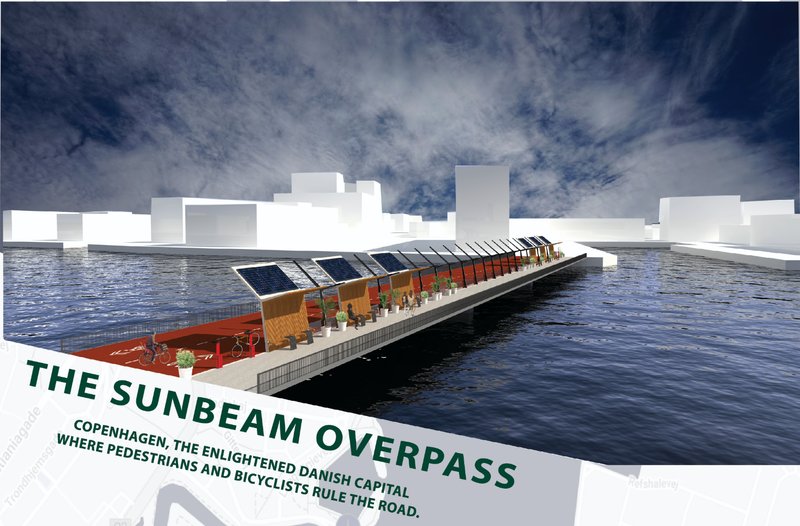
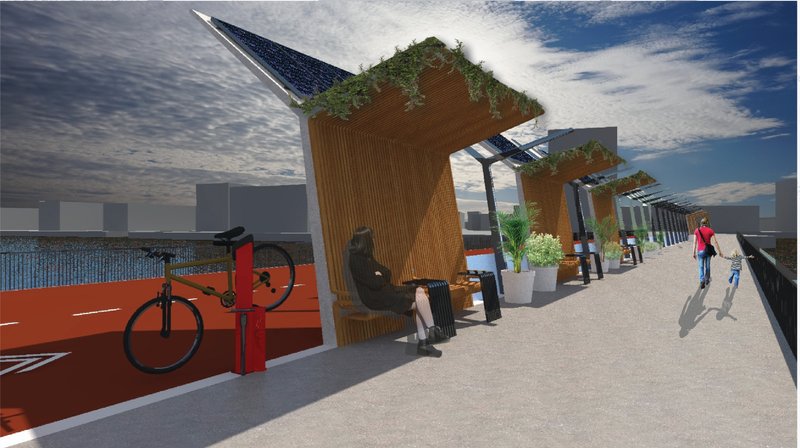
The bridge reads immediately as two parallel systems: a dedicated orange bike lane and a broader pedestrian promenade, each given distinct material identity but held together by a continuous structural deck over the water. The separation is legible at a glance, which matters on a crossing shared by commuters, tourists, children, and elderly users. Timber surfaces line the pedestrian side, softening the structure's presence and creating a warm, human-scaled environment that contrasts with the surrounding harbor and urban skyline.
Interspersed along the promenade are timber-clad pavilions topped with planted roofs. These are not decorative; they serve as rest zones, seating niches, and weather shelters, transforming what would otherwise be a transit corridor into a sequence of small public rooms. Greenery at roof level helps manage stormwater and softens the bridge's visual profile from adjacent buildings. The result is a pedestrian experience closer to walking through a garden than crossing a piece of infrastructure.
Angled Canopies That Harvest Light
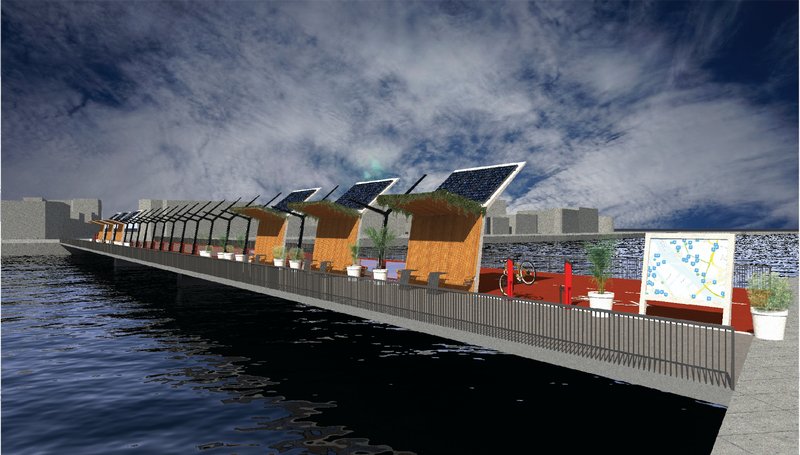
The architectural signature of the Sunbeam Overpass is a rhythmic sequence of inclined canopy structures that march along the bridge's length. Each module serves a dual purpose: it shelters users from rain and wind while its angled roof surface supports integrated solar panels oriented to maximize energy capture in Copenhagen's northern latitude. The repetitive geometry creates a visual cadence that reinforces intuitive navigation, pulling the eye forward along the crossing.
The harvested solar energy powers the bridge's own systems, including LED streetlights, digital information displays, and safety features. Public bike repair stations are also integrated, reinforcing the structure's role as supportive urban infrastructure rather than passive architecture. By reducing reliance on external energy sources, the design demonstrates a credible model for how pedestrian bridges can actively contribute to a city's environmental targets rather than simply consuming municipal power.
After Dark, the Structure Becomes a Lantern
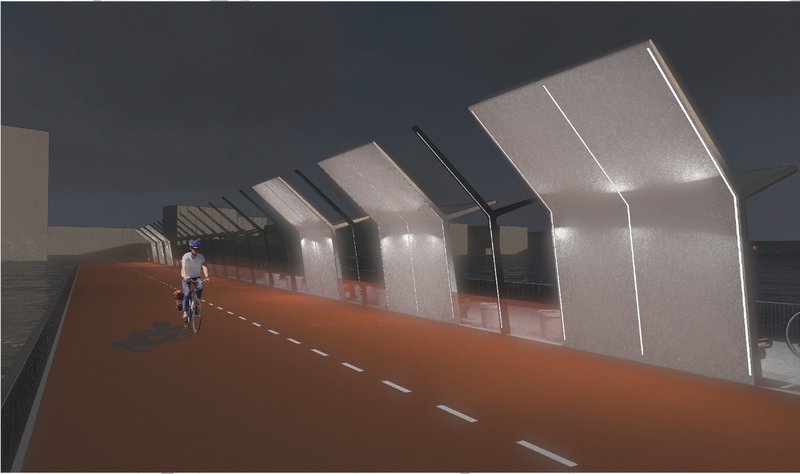
At night, the bridge's character shifts entirely. Solar-powered LED lights mounted within the canopy structures cast a warm glow downward onto the orange bike lane and timber walkways, turning the entire crossing into a luminous line across the harbor. The night rendering shows a lone cyclist moving through this corridor of light, and the image makes a convincing case: the bridge feels safe, legible, and inviting after dark, not merely functional. Visibility is high without the harshness of conventional street lighting.
The metallic canopy frames catch and reflect the artificial light, giving the structure a lantern-like quality when seen from the waterfront. For a city that loses daylight early in winter months, this nocturnal identity is not a secondary concern. It is arguably the condition under which most commuters will experience the bridge, and the design treats it with appropriate seriousness.
Accessibility as a Design Driver, Not an Afterthought
Universal access is embedded in the bridge's fundamental geometry. Generous clear widths, barrier-free surfaces, and gentle gradients ensure comfortable use for people with reduced mobility, families with strollers, and elderly pedestrians. Clear visual cues and continuous pathways enhance wayfinding without relying on signage alone. The approach aligns with Copenhagen's broader ambition for equitable public space, where infrastructure serves all citizens rather than optimizing for one user group at the expense of others.
Why This Project Matters
Most pedestrian bridges are designed to solve a single problem: getting people from one side to the other. The Sunbeam Overpass rejects that reductionism. By layering energy generation, social space, inclusive access, and separated mobility onto a single linear structure, Janis Urbins demonstrates that even the most utilitarian piece of urban infrastructure can be reimagined as a generator of public value. The project does not rely on spectacular form to make its argument; it relies on systematic thinking about how multiple systems can reinforce each other within a coherent architectural envelope.
Copenhagen already leads the world in cycling infrastructure, but its next frontier is integrating renewable energy into the fabric of everyday movement. The Sunbeam Overpass offers a compelling prototype for that integration. It is a bridge that pays for its own lighting, shelters its users from Nordic weather, and still manages to feel like a place worth lingering in. That combination of pragmatism and generosity is rare in infrastructure design, and it deserves attention.
View the Full Project
About the Designers
Designer: Janis Urbins
Enter a Design Competition on uni.xyz
uni.xyz runs architecture and design competitions year-round that reward proposals with spatial conviction and real site intelligence.
Project credits: The Sunbeam Overpass by Janis Urbins.




Popular Articles
Popular articles from the community

Rojkind Arquitectos and Think Parametric Build a Glueless Pavilion from 67 Interlocking Panels
A serpentine fiber-cement installation in Chapultepec Park celebrates a decade of architectural media in Mexico City.
3dor Concepts Wraps a Kerala Home in Mirrored Concrete Arcs Around a Courtyard Tree
In the Western Ghats foothills of Thamarassery, a 270 m² single-story house uses two curved volumes to frame nature as its center.

YOAP Architects Round a Corner in Yeongcheon with a Cylindrical Community Hub
A 197-square-meter brick and ribbed-clad tower turns a forgotten alley corner in South Korea into a public garden with a low threshold.

RDTH architekti Rips Out Nearly Every Wall in a Prague Apartment and Replaces Them with Furniture
A 101-square-meter post-war flat in Prague trades rigid partitions for a single rotated furniture block, curtains, and glass concrete.


Similar Reads
You might also enjoy these articles

Mechanism of Memories: Adaptive Architecture Reimagines Offshore Structures as Living Cultural Machines
Floating adaptive architecture transforms abandoned offshore structures into cultural spaces that preserve memory, habitation, and human connection.

Wildlife Rehabilitation Architecture in Australia: A Regenerative Sanctuary for Koalas by Philip Skein and Keegan Mayber
A regenerative wildlife sanctuary in Queensland redefines sustainable architecture through habitat restoration, healing, and ecological awareness.
The Interfusion: Mobile Performance Architecture Reconnecting Art and Public Space
A mobile performance architecture project transforming Madrid’s streets into inclusive cultural spaces through adaptive urban design.
Biophilic Architecture and Regenerative Stadium Design: Biophilia Lagos by Rachel George
A regenerative stadium in Lagos transforms landfill into a living ecosystem through biophilic architecture, waste reuse, and environmental healing.





Comments (0)
Please login or sign up to add comments
No comments yet. Be the first to comment!