
The White lands
Rethinking the largest tent city of Mina.

Hajj is one of the five important elements of the Islamic religious fraternity. In the recent years, Because of the rise in number of pilgrims coming for Hajj every year, Mina’s social and spatial configurations are unfolding beyond its prescribed physical boundaries.
Concept
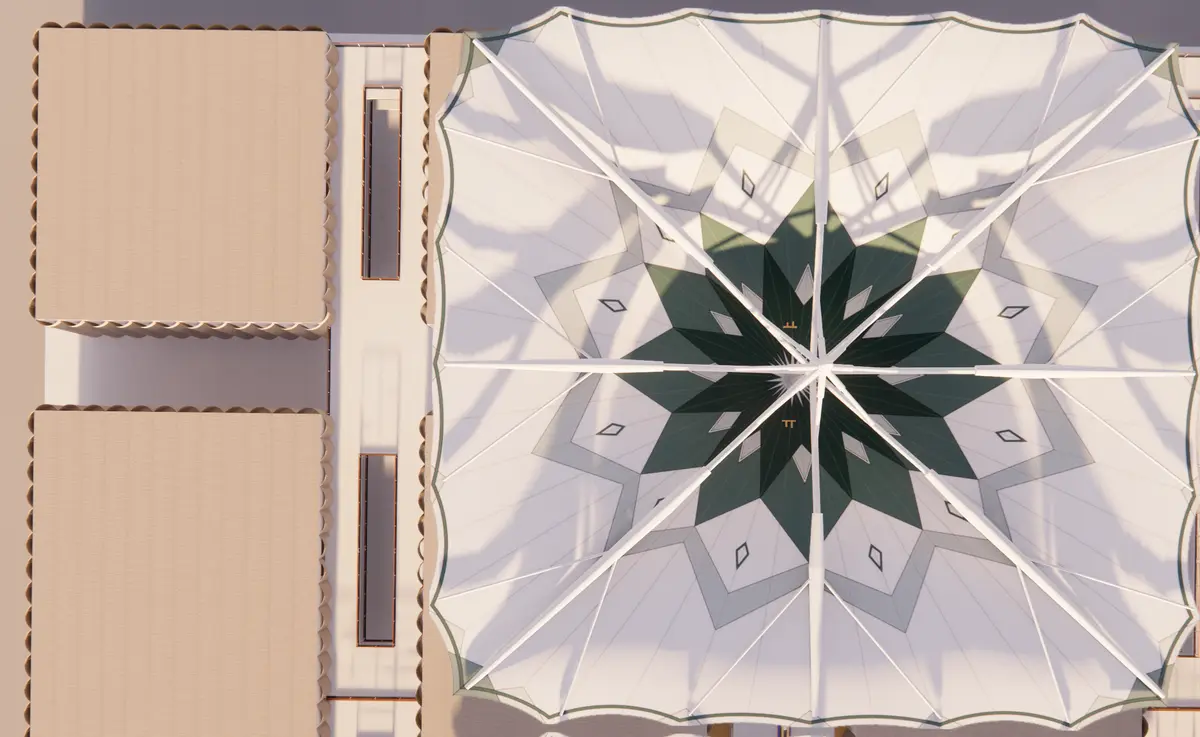
Our concept is to suggest a more sophisticated space for the pilgrims, while maintaining the capacity and ability of execution of the project. Cubical form gives the liberty to utilize maximum space, and the retractable umbrella provides resistance to heat. The umbrella can also be implanted with solar power cells for onsite energy. We introduced the new concept of super modules other than the given brief. The Super module consist of 4 living modules, 2 toilet modules (consisting of 36 lavatories), ramps for connectivity in the higher floors and a umbrella to prevent the modules from the excessive heat gain. The super module can be repeated on the site various time according to the need. Structurally, the tents have simple joineries and connections, which can make the execution easy and expeditious. Moreover, we tried to alter the tent structure the least, because according to us, it’s a part of rituals to live in tents for a certain period while being on Hajj pilgrimage. So, we tried to keep persisting the tent feeling in our design.

A super module.
Capacity
The Saudi government has an ambitious plan for the Vision 2030 agenda. The 2030 vision of the Saudi government looks forward at expanding the Hajj pilgrim bandwidth to more than 10 million pilgrims. With rising pilgrims, a lot of Hajj facilities are being expanded to accommodate this new growth of visitors. To maximize capacity in the given ground coverage, we used the vertical permissible area. Hence, resulting in a G+2 structure with individual inside cabins, along with 1.5x more capacity. The structure and material used inside the tent, is also tensile and heat resistant. This makes it potent to accommodate more pilgrims.
Hygiene
Hygiene is the most important area of concern, in the 5 days tenure of Hajj. To provide comfortable stay and a sense of privacy, the module is internally divided into separate cabins. There is a staircase between every two cabins. Toilet modules have separate, wet and dry areas. Also, the wudu area is separately placed from the toilets. All the modules are connected by wide corridors and ramps, which gives barrier free and hygienic environment to the pilgrims. Also, as we have built vertically, the waste management and movement was also a crucial part, to tackle with this problem we propose to install garbage chutes in all living modules. All the occupants in higher floor are supposed to dump there waste in Garbage chute, in this way all the waste of a particular module will collect in a large bin, which could be collected easily without any dirt.

Garbage chute.
Crowd Management
With a capacity of up to 3 million people, Mina has been called the largest tent city in the world. The 2030 vision of the Saudi government looks forward at expanding the Hajj pilgrim bandwidth to more than 10 million pilgrims. To manage a large crowd, the system needs more pathways and circulation spaces for the obstruction free movement for the pilgrims. Every module has multiple exits for easy mobility across the modules. In addition, the spaces are semi open and open spaces for the pilgrims to find their way. This makes it efficient and cost effective, because it will need fewer human resources. The living modules directly connects to the toilet modules to avoid the conjunction of pilgrims from different modules. The multipurpose modules are placed at the periphery of the site, to attract maximum people.
Executable
The main aim in the whole design was to keep it expansive and executable. The design of the tents is kept simple and efficient. The cubical form has strong structure from inside, to keep it stiff and load bearing. The outer shell is covered by heat resisting fabric membrane that act as shield from the harsh sun rays. For the vertical circulation, ramps are placed which joins with the external corridors. The whole structure can be easily dismantled to install at other position if required. Every super module is covered by a retractable umbrella on top. The umbrella no only protects the residing pilgrims from heat, but also can be used as solar power generator in future. The whole design is in such a way that it can easily be expanded and moulded in whatever direction required as per the situation.

Popular Articles
Popular articles from the community


Manzana Morphosis: Stretching Barcelona's Grid into a Living Landscape for 2050
A radical reworking of the Eixample manzana turns density into a tool for generous public space, vertical ecology, and environmental performance.

Cloaked Colonization: A Mobile Underwater Habitat That Moves Like a Fish
Micah Abaya's shortlisted EHC Pacific entry reimagines ocean settlement as a dispersed network of self-sustaining architectural organisms.

Tsunami Convergenics: Turning Catastrophic Ocean Forces into Underwater Housing Infrastructure
A speculative underwater settlement off the coast of Onagawa, Japan, treats tsunamis and typhoons as energy sources rather than threats.

Opera by the Sea Estonia: Three Shells Dissolving Architecture into Tallinn's Coastline
A winning opera house proposal replaces monumental form with interconnected shells that blur the boundary between building, park and Baltic Sea.

Similar Reads
You might also enjoy these articles

The Rhythm of Seasons
A Farmers' Market Connecting Nature and the City

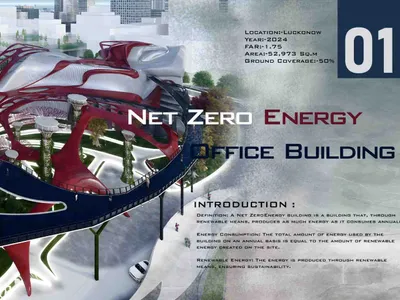
More Than a Building-Designing a Living System
More Than a Building-Designing a Living System
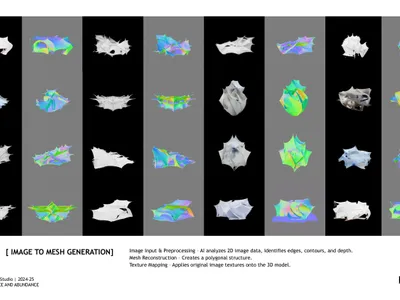
Base Beyond
DESERT COMPOUND ARID: TOURISM OF ABSENCE AND ABUNDANCE

Explore Cultural Architecture Competitions
Discover active competitions in this discipline


Comments (0)
Please login or sign up to add comments
No comments yet. Be the first to comment!