
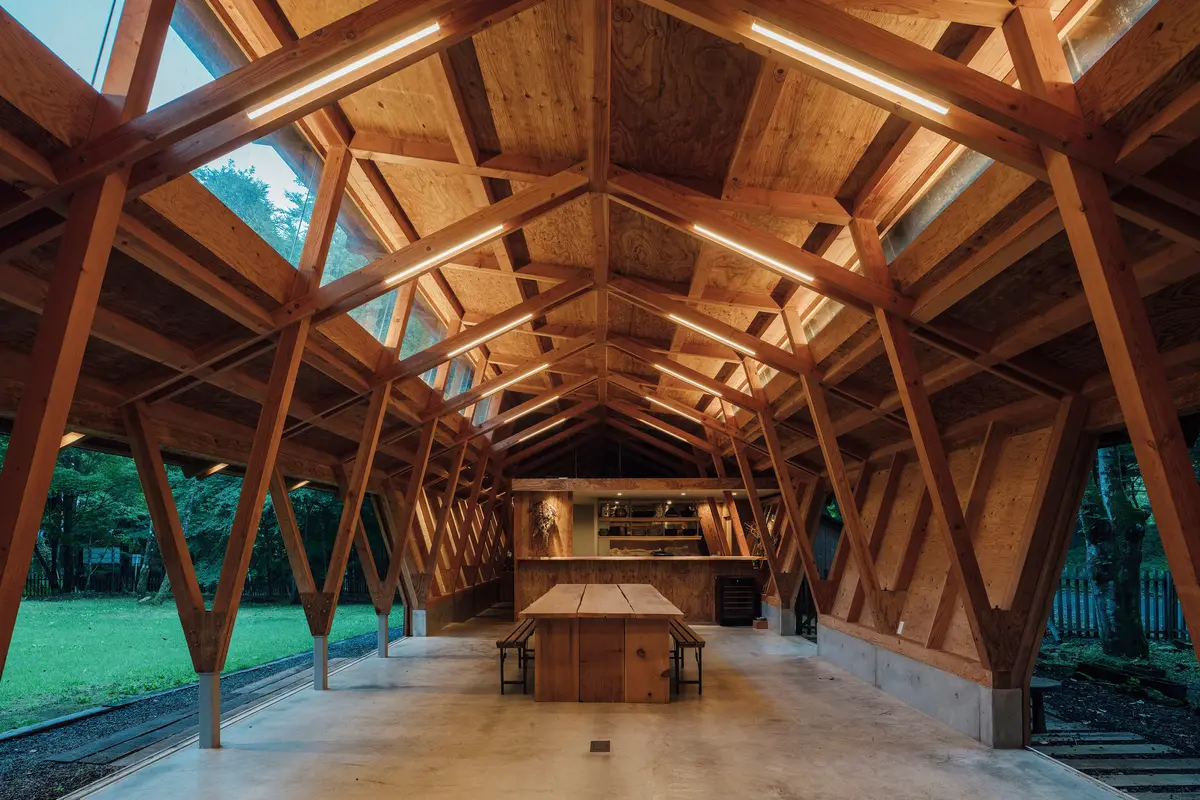
Three Roofs Timber Hall by OOTT in Karuizawa
A forest pavilion in Japan's most storied summer retreat uses diagonal timber framing to dissolve the boundary between structure and landscape.


Karuizawa has been a retreat destination for well over a century, drawing visitors from Tokyo to its cool highland forests. Building anything here carries implicit obligations: defer to the trees, keep the scale intimate, and resist the temptation to announce yourself. Three Roofs Timber Hall by OOTT fulfills all three with an almost stubborn quietness, a 129 square meter hall that reads less as architecture and more as a clearing that happened to acquire a roof.
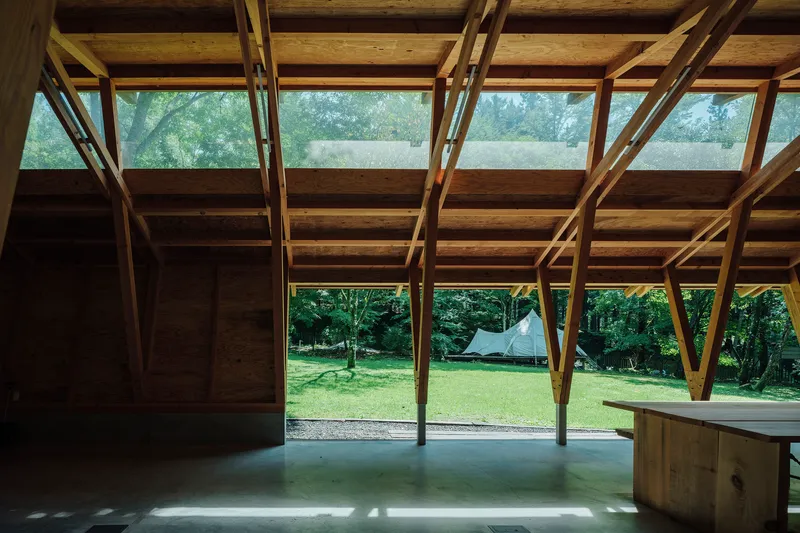
What makes this project genuinely interesting is its structural proposition. The diagonal timber bracing is not hidden behind finishes or treated as an engineering afterthought. It is the architecture. Every column tilts, every brace doubles as spatial divider and visual frame, and the result is a building whose interior feels like walking through a forest of leaning trunks. The three pitched roofs, each punctuated by clerestory slots, ensure that light enters from above in narrow bands, mimicking the dappled conditions under the canopy outside.
Sitting Lightly in the Forest


Approached from the surrounding lawn, the hall registers as a low horizontal line. Its metal standing seam roofs barely rise above the birch canopy, and the timber cladding ages into a tone that matches the bark of the surrounding trees. There is no grand entrance, no formal axis. You simply walk toward it through the clearing, the building revealing itself incrementally through gaps between trunks.
The site strategy distributes several small volumes across the landscape rather than consolidating everything into a single mass. Canvas tent pavilions on timber platforms occupy the far edges of the lawn, reinforcing the sense that this is a campus of lightweight shelters rather than a permanent compound. The hall anchors the composition without dominating it.
The Diagonal Frame as Spatial Language
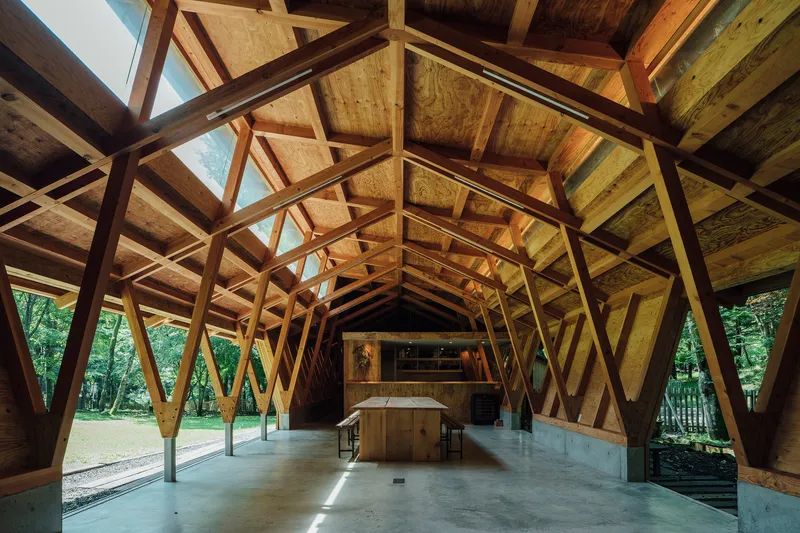
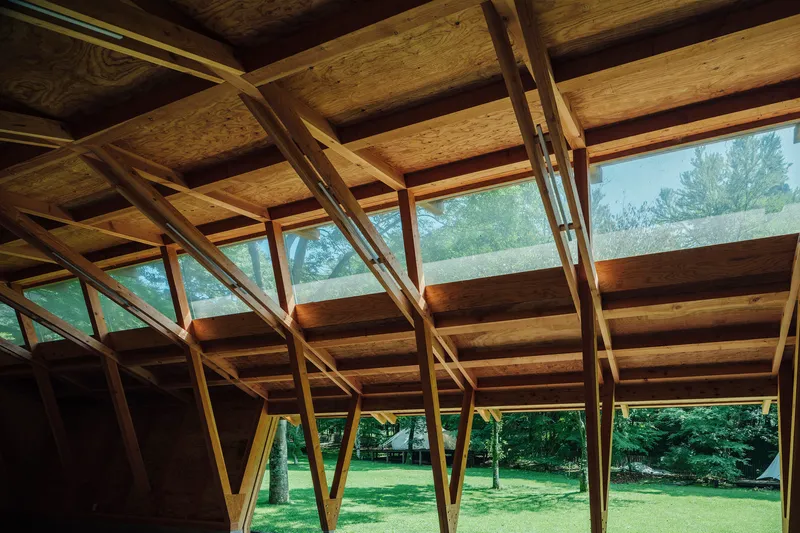

Look up inside this building and you understand immediately that OOTT is interested in how structure shapes perception. The angled rafters and diagonal braces create a rhythmic lattice overhead, each joint expressed cleanly in exposed timber. Plywood ceiling panels fill the voids between members, their warm surface catching the narrow bands of daylight that pour through clerestory slots at the ridge.
The detailing is deliberately straightforward. Connections are bolted, not concealed. Plywood is left unfinished. This honesty works because the geometry does the heavy lifting. When every column leans and every brace crosses at a slightly different angle, you do not need ornamental finishes to hold attention. The structure is the ornament, and OOTT trusts the viewer to see it.
Interior: A Room That Breathes
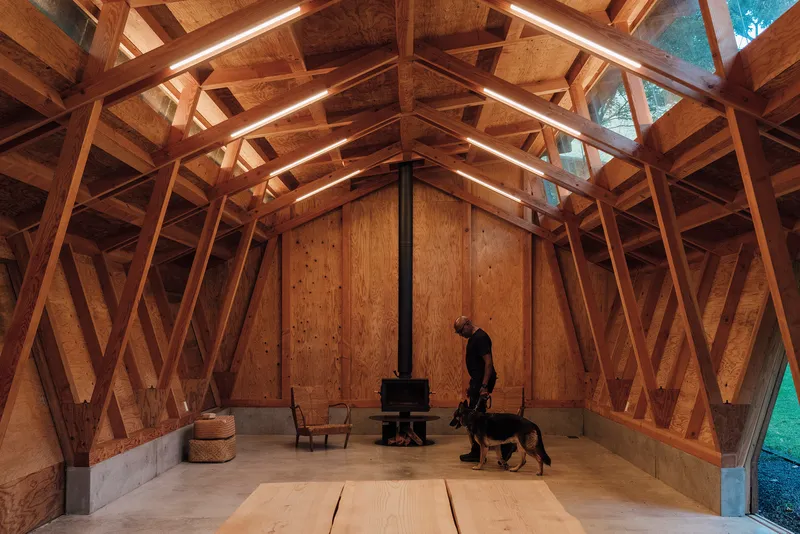

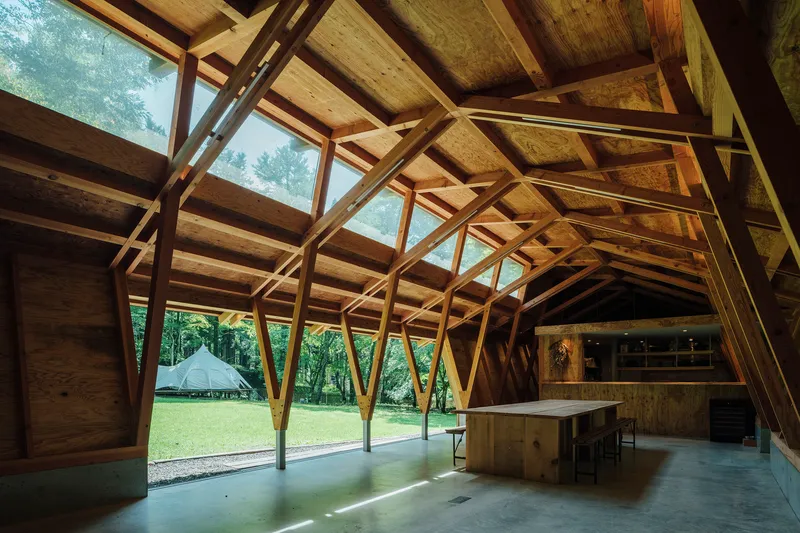
The main hall operates as a single generous room organized around a central wood stove. At dusk, with the stove lit and the clerestory glazing glowing, the space takes on the quality of a lantern set among the trees. The polished concrete floor acts as a thermal anchor, absorbing warmth during the day and releasing it slowly in the cool mountain evenings.
What prevents the room from feeling barn-like despite its openness is the disciplined repetition of the diagonal frames. They subdivide the volume visually without closing it off, creating zones of intimacy within a continuous space. A pair of chairs beside the stove, a bench against the wall, a counter for serving: each occupies a bay defined by structure rather than partitions.
Thresholds and Corridors

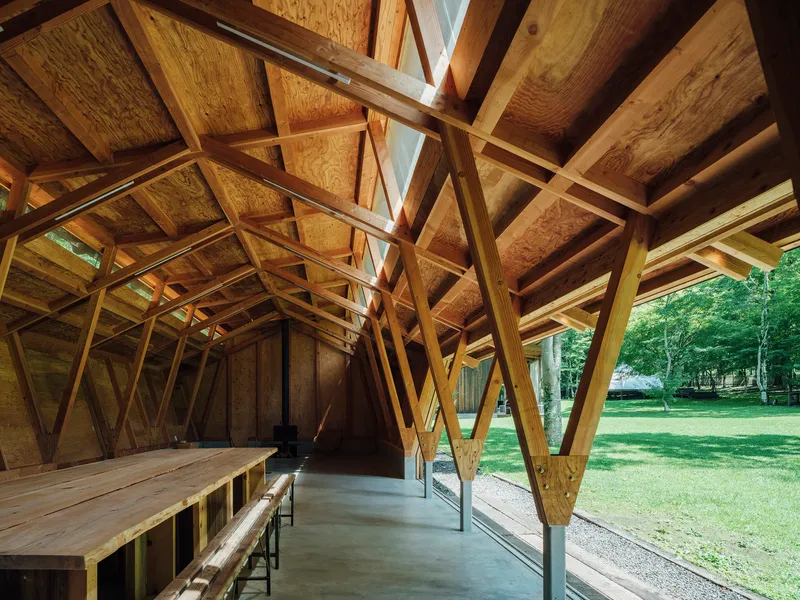
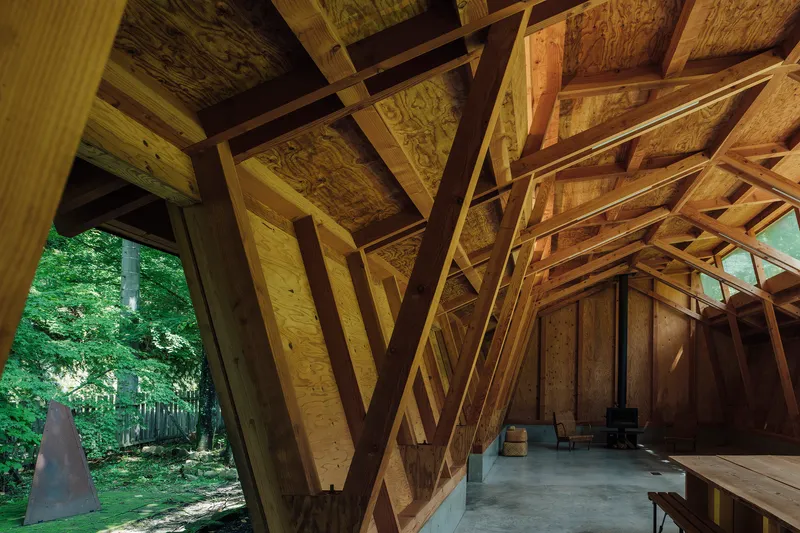
The narrow corridors between plywood clad walls are among the most compelling moments in the building. Warm light filters through the diagonal timber structure, casting shifting shadow patterns across the floor. These are not mere circulation routes; they are carefully orchestrated transitions between the compact service spaces and the open hall.
Walking through one of these passages and emerging into the main volume produces a spatial compression and release that recalls traditional Japanese engawa thresholds. The dappled light within the corridor mirrors the dappled light outside, collapsing the distinction between interior atmosphere and forest canopy.
The Facade at Twilight
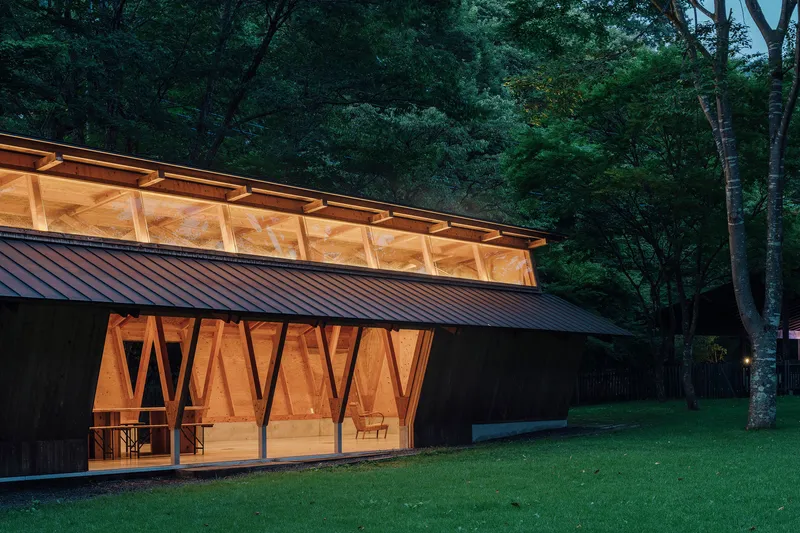
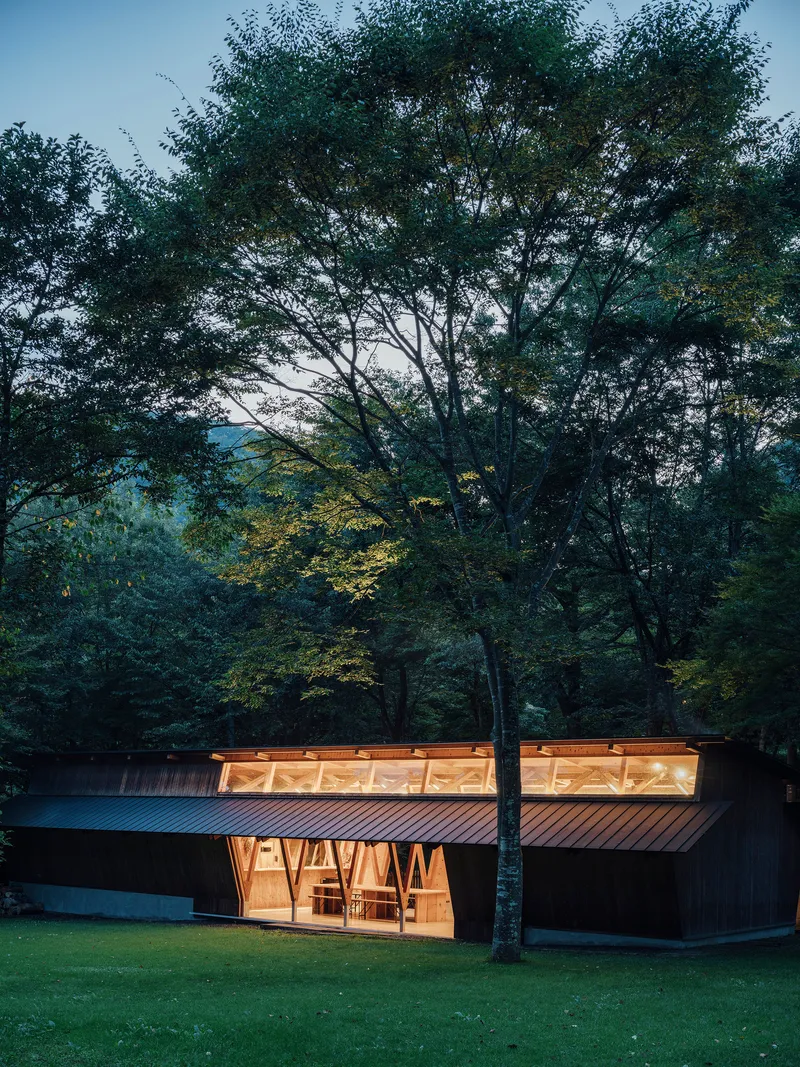

Photographed at dusk, the building reveals its double identity. By day it recedes into the forest, its muted materials blending with bark and moss. At twilight the clerestory bands become luminous ribbons, and the diagonal braces cast sharp shadows against the cladding. The metal roof, barely visible during the day, catches the last ambient light and registers as a thin silver line.
This transformation is not accidental. The proportions of the clerestory openings and the depth of the roof overhangs are calibrated to maximize the lantern effect at exactly the hour when visitors gather inside. Architecture that performs differently at different times of day is always more interesting than architecture that presents a single face, and OOTT clearly understands this.
Hearth and Domesticity at 129 Square Meters
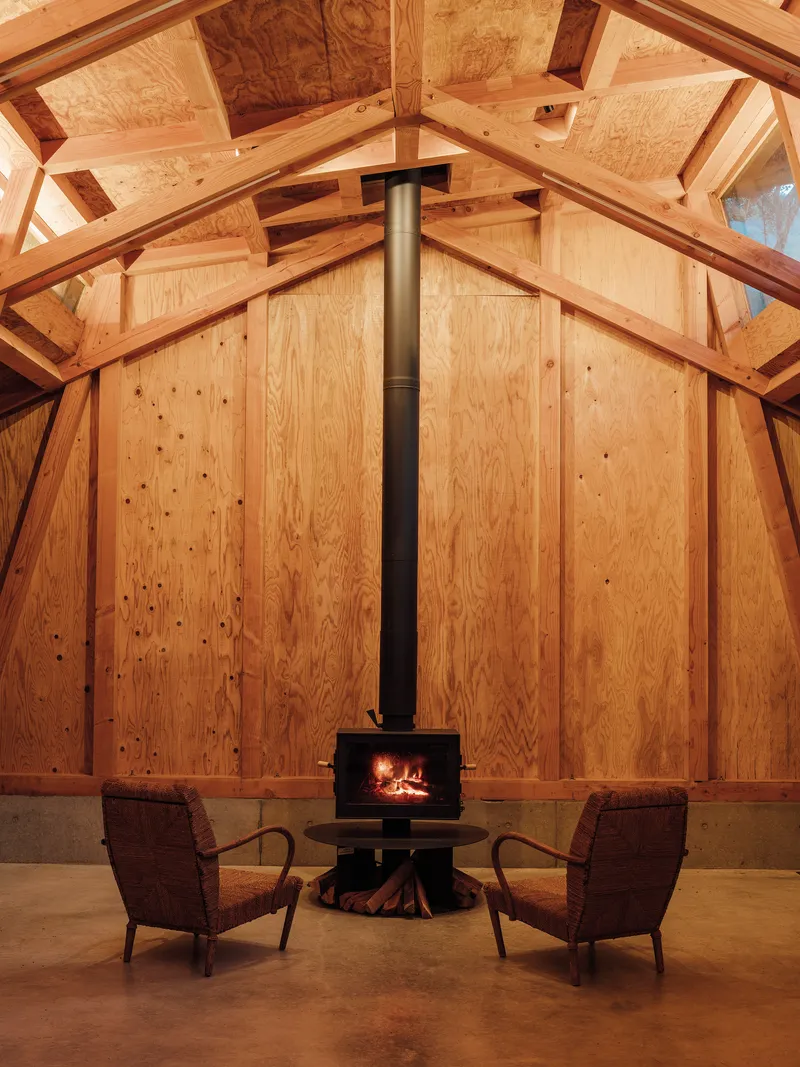
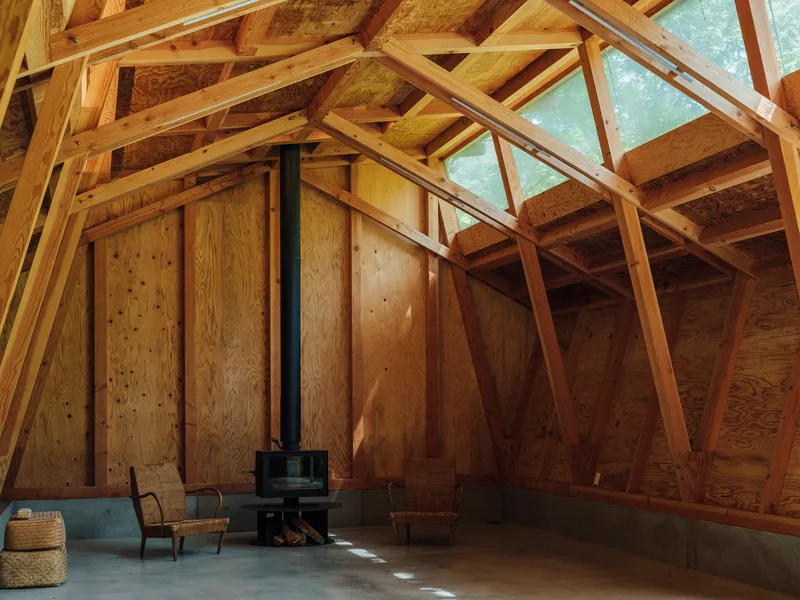

The wood stove is not merely a heating device. It is the social center of the hall, positioned precisely at the midpoint of the plan where the pitched roof reaches its highest point. The vertical flue pipe reads as a central column, a structural gesture that is actually mechanical. Two chairs flank it like sentinels, completing a fireplace tableau that feels timeless.
Around the periphery, service functions are handled with restraint. A plywood counter doubles as kitchen and bar. Dried flowers hang from a wall, the kind of casual decoration that only works when the architecture is confident enough to tolerate imperfection. The concrete floor absorbs everything, stove soot, foot traffic, spilled coffee, without complaint.
Context: Tent Pavilions and the Wider Landscape

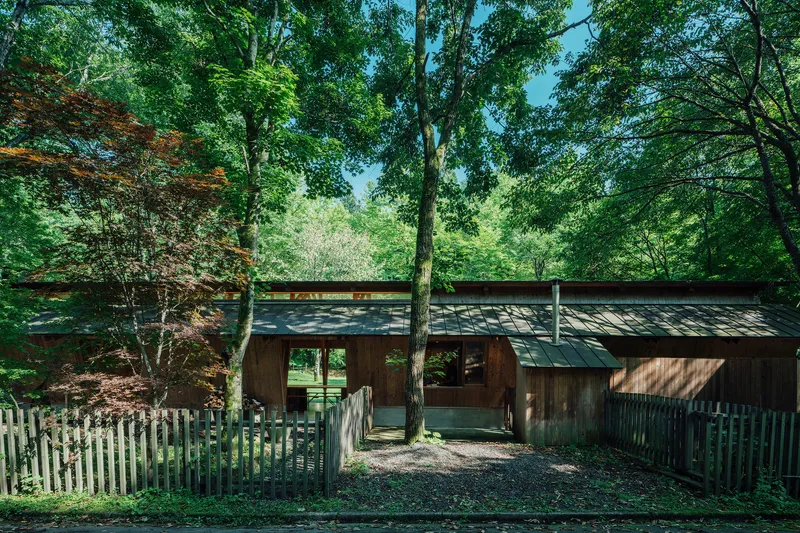

The timber hall does not exist in isolation. Scattered across the lawn are canvas tent structures on raised timber platforms, an ensemble that reinforces the idea of a summer camp rather than a resort. The entry courtyard, defined by metal roof volumes and diagonal supports between birch trees, establishes a loose threshold that is more gesture than barrier.
This relationship between permanent and temporary, solid and fabric, grounded and elevated, is what gives the project its character. The hall is the most resolved piece of architecture on the site, but it gains meaning from its proximity to the tents. Together they argue for a way of occupying the forest that is communal, seasonal, and deliberately unfinished.
Exterior Details


Close up, the building's material palette reveals its logic. The metal roof overhang extends generously beyond the timber columns, protecting the exposed wood from rain while framing the forest like a deep picture frame. The vertical timber cladding on the gable ends rises into the tree canopy, its proportions deliberately tall and narrow to echo the surrounding trunks.
From the interior, the open framing dissolves the wall plane entirely. Diagonal braces become visual guides that lead the eye outward to the grassed clearing, and the ribbon of high windows pulls your gaze up toward the treetops. The building is simultaneously shelter and aperture, closed enough to provide comfort and open enough to never let you forget where you are.
Plans and Drawings


The floor plan confirms what the experience suggests: this is a linear volume organized with covered decks and service spaces at the ends and a single open interior at the center. The plan is remarkably simple, almost diagrammatic, which makes the spatial richness of the built result all the more impressive. Complexity here comes from the section, not the plan. The three pitched roofs generate different ceiling heights, different light conditions, and different degrees of enclosure within a footprint that could be described in a single sentence.
Why This Project Matters
Three Roofs Timber Hall matters because it demonstrates that a small building, just 129 square meters, can produce architectural ideas worth paying attention to. The diagonal structural language is not a gimmick; it generates spatial variety, frames views, modulates light, and gives the interior its distinctive atmosphere. Every decision, from the clerestory proportions to the exposed bolted connections, serves the larger argument that structure and space are the same thing.
More broadly, the project is a quiet counterpoint to the trophy architecture that often appears in resort contexts. OOTT has built a hall that belongs to its forest clearing in Karuizawa without mimicking nature or retreating into false rusticity. It is precisely made, structurally expressive, and comfortable with its own modesty. In an era when architects are routinely asked to do more with less, this is a compelling example of doing exactly enough.
Three Roofs Timber Hall by OOTT. Karuizawa, Japan. 129 m². Completed 2023. Photography by Tatsuya Tabii.
About the Studio
Share Your Own Work on uni.xyz
If projects like this are the kind of work you want to make, uni.xyz is a place to publish your own, find collaborators, and enter design competitions.


Popular Articles
Popular articles from the community


Cube Design Draws an Ecological Corridor Between Two Shenzhen Hills with the Nankai Building
Beside Shenzhen's container docks, the Nankai Building pairs stacked balconies with a climbing green screen to connect two hillsides across its height.

David Ortega Stacks a Two-Story Mexico City Penthouse Around a Steel Stair and a Pergola-Shaded Roof Terrace
In Colonia Roma, a 300 m² penthouse uses oak joinery, a planted steel stair and a slatted roof pergola to make a new-build apartment feel like a house.

U.GA Architects Wraps an Oval Rooftop Pool in Curved Board-Formed Concrete on Busan's Jeollidan-gil
In Busan's Jeonpo-dong, a 454 m² mixed-use block stacks a neighborhood facility, guest rooms and an oval rooftop pool inside spiraling concrete walls.

Architekt Andreas Gruber Scatters 23 Dark Timber Chalets Across a South Tyrolean Forest Edge
In Molini di Tures, Amonti Chalets breaks a resort into a hamlet of gabled timber houses, with parking, storage and services pushed into the slope.

Similar Reads
You might also enjoy these articles


LAVA Architecten Gives Vocational Education a Sawtooth-Roofed Face on a Mechelen School Campus
In Mechelen, Belgium, a 2,053 m² STEM school on a 6×6 m grid turns workshops and classrooms into rooms that can be rearranged as teaching changes.

KEMA Studio Turns a Derelict Marvila Attic into a 60 m² Lighthouse Apartment Above Lisbon
In Lisbon's Marvila district, a rebuilt roof, four skylights and two plywood volumes turn an unlivable attic into a bright home facing the Tagus.

Pixel Gardens: One Repeated Module Stacked Into a Terraced Social Housing Tower for Famagusta
Salem Bader's shortlisted housing tower builds a vertical neighbourhood from one repeated module, offsetting units to carve terraces, light and air.

Bao Huynh Watercolor Atelier: A Serene Art Retreat in Hội An
Bao Huynh Watercolor Atelier in Hội An blends multifunctional art spaces, sustainable design, local materials, and family-friendly living in a serene environment.

Explore Wood Construction Competitions
Discover active competitions in this discipline

Challenge to design public laboratory

Challenge to design mud housing for contemporary communities
Comments (0)
Please login or sign up to add comments
No comments yet. Be the first to comment!