

Three Studios from Tokyo and Hyderabad Build a Convention Center of Curved Concrete and Courtyards
A Japan-India collaboration at IIT Hyderabad uses 36 different cantilevers and seven linked blocks to frame campus life along an artificial lake.


The Convention Center at the Indian Institute of Technology Hyderabad is the product of an unlikely alliance: the IITH Campus Design Team of the University of Tokyo, NIHON SEKKEI, and APL design workshop, working together through a Japan International Cooperation Agency framework that began in 2011. Sitting on a roughly two-square-kilometer campus about 60 kilometers outside Hyderabad, the 17,124-square-meter complex is one of six landmark buildings conceived as the public face of a new university. Its neighbors include a guest house and an artificial lake, and its job is to gather the campus's civic life, from auditoriums and seminar halls to cafeterias and offices, under one legible roof.
What makes this building worth studying is not the cross-cultural backstory but the spatial argument at its core. The three firms took a Japanese preoccupation with intermediate space, the ambiguous zone between inside and out, and tested it against the punishing climate of southern India. The result is seven interconnected blocks separated by expansion joints, stitched together by courtyards, covered streets, and 36 different curved cantilevers whose radii and spans vary up to nine meters. Stone and reinforced concrete replace the timber a Tokyo office might instinctively reach for. The palette is austere, but the sectional inventiveness is not.
Seven Blocks, One Building


From the air, the convention center reads as a cluster of flat-roofed volumes stepping down toward the waterfront. The massing is deliberately anti-monumental: instead of one grand hall, the program splits into seven blocks that breathe through gaps and setbacks. Expansion joints between the blocks are structural necessities on a site this large, but here they double as organizational seams, creating the thresholds and passages that define daily experience.
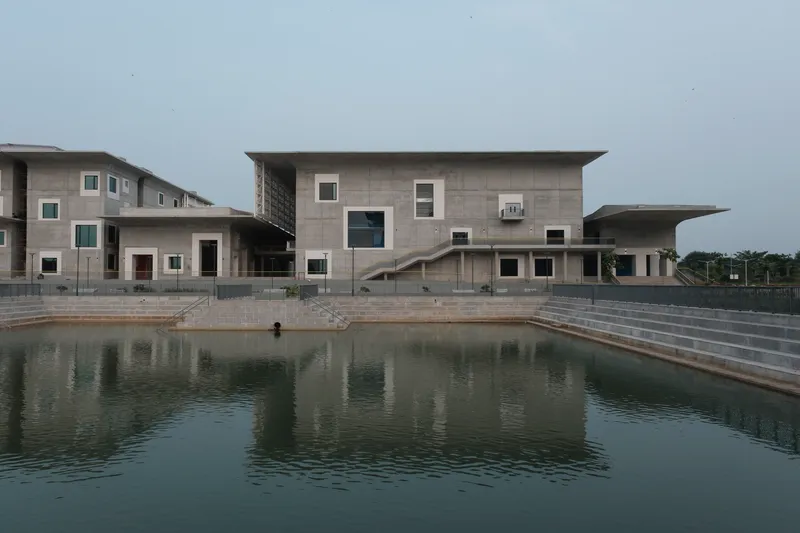
The lakeside elevation is the building's quietest face. Board-formed concrete walls, punctured by scattered square windows framed in white tile, meet a still pond that acts as both a cooling device and a mirror. There is no entrance canopy competing for attention, just mass, water, and reflection. The cantilevered concrete canopy on the opposite side, by contrast, projects outward to shade arrival zones, its soffit marked by the same tile-framed openings that appear throughout.
The Interior Street
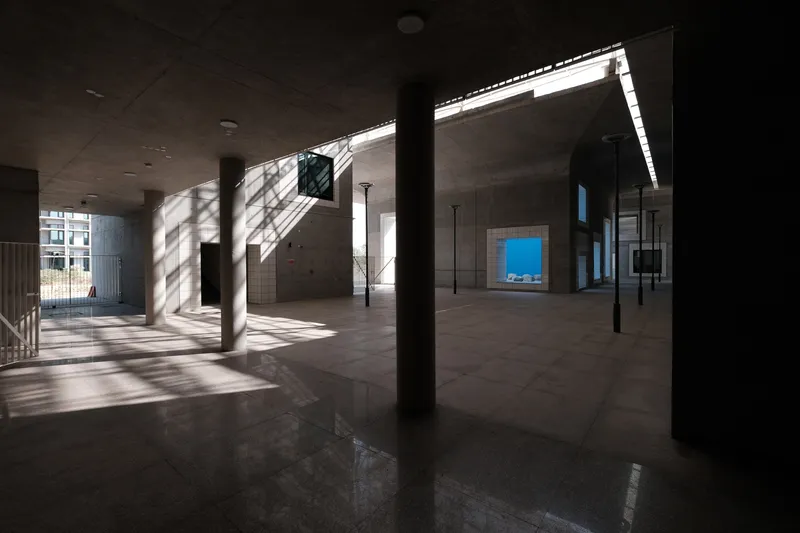

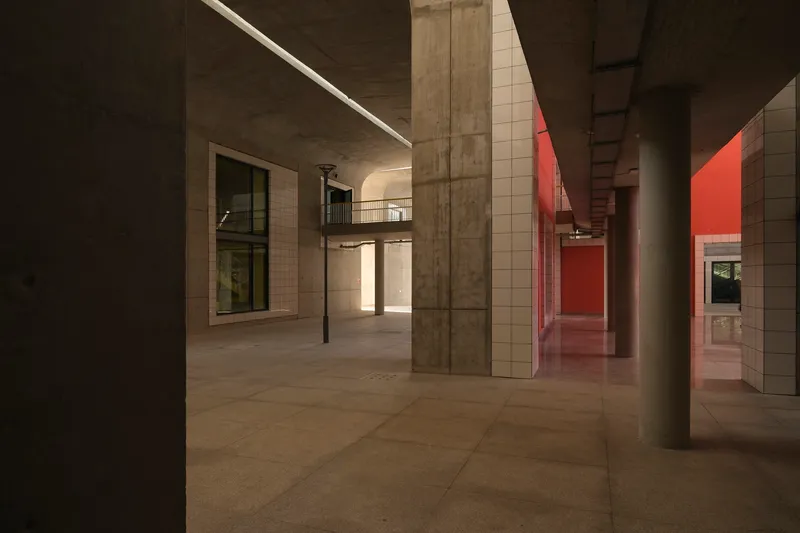
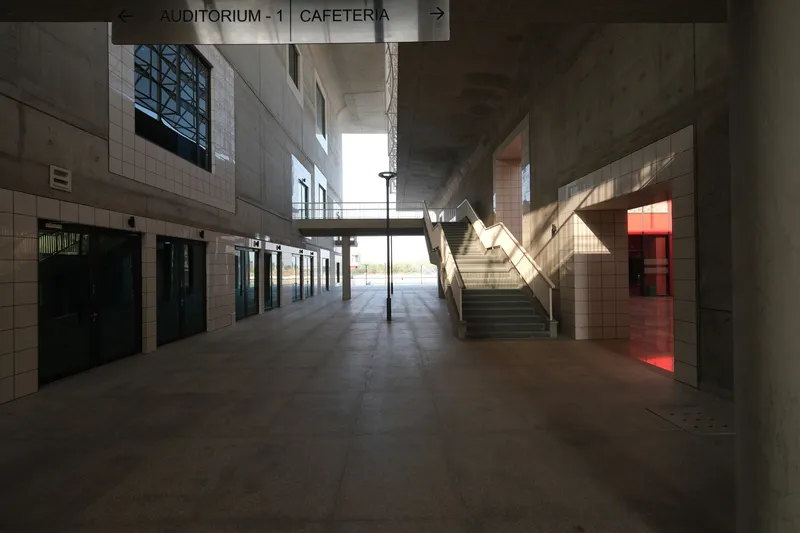
A central interior street runs through the complex, binding auditoriums, seminar rooms, and offices into a legible sequence. This is where the Japanese concept of in-between space does its heaviest work. Polished concrete columns cast diagonal shadows from clerestory slots, and translucent screen walls filter light into soft gradients that shift through the day. At dusk, passages glow red and amber, turning utilitarian corridors into something closer to a bazaar.
The street is not simply a distribution spine; it is the social condenser of the building. Groups gather at column bases, duck into side courts, or climb stairs to upper-level balconies that overlook the route below. Circulation here is never neutral. It is always offering a view, a change in ceiling height, or a blast of color on a distant wall.
Courtyards and Color


Color arrives sparingly but with real conviction. A blue-painted courtyard, scattered with loose rocks on tile paving, opens views through to planted greenery beyond. A red-orange wall in one of the meeting halls transforms an otherwise sober concrete volume into a space with warmth and identity. These are not decorative afterthoughts; they mark thresholds, signal program changes, and orient users in a building that could otherwise feel labyrinthine.
The courtyards themselves act as light wells and ventilation chimneys, pulling hot air upward and drawing cooler air through ground-floor passages. Stacked balconies clad in white tile frame the courts, giving every upper-level corridor a prospect onto daylight and planting. The effect is of a building that constantly reminds you where the sky is, even when you are deep inside.
Vaults and Cantilevers


The structural ambition shows most clearly in the curved concrete ceilings that crown the major atria. Vaulted forms gather light from central skylight slots, casting a diffuse glow across board-formed surfaces below. The 36 different curved cantilevers, each with its own radius and span, give every overhang a slightly different profile. The building never settles into repetition; each turn reveals a new proportion.
The vaults do more than shape space. They channel air movement, creating pressure differentials that pull breezes through the interior street. In a climate where temperatures regularly exceed 40 degrees Celsius, these passive strategies are not poetic luxuries. They are survival mechanisms, and the building wears them on its face.
Shading, Screens, and Walkways


Covered walkways ring the complex, mediating between the harsh sun and the cool interior. Diagonal lattice screens project shadow patterns across concrete walls that change by the hour, turning a simple circulation device into an evolving graphic surface. A curved orange metal canopy frames a view to the lake, its warm hue a deliberate counterpoint to the concrete gray.
These transitional zones are where the collaboration between the three studios is most legible. The Japanese instinct for shaded thresholds, for the engawa reinterpreted in concrete, meets an Indian comfort with layered perimeters and jali-like filtering. Neither tradition dominates. The result is a hybrid language that feels site-specific rather than imported.
Atria, Auditoriums, and Assembly


The multi-level atrium at the building's heart is the most generous space. Board-formed concrete walls rise through several stories, punctuated by tile-framed apertures that frame views upward and across. Visitors gather on the polished floor below, dwarfed by the volume but oriented by the light pouring in from above. It is a space designed for ceremony, for the moment when a thousand students enter at once and the building has to absorb them.
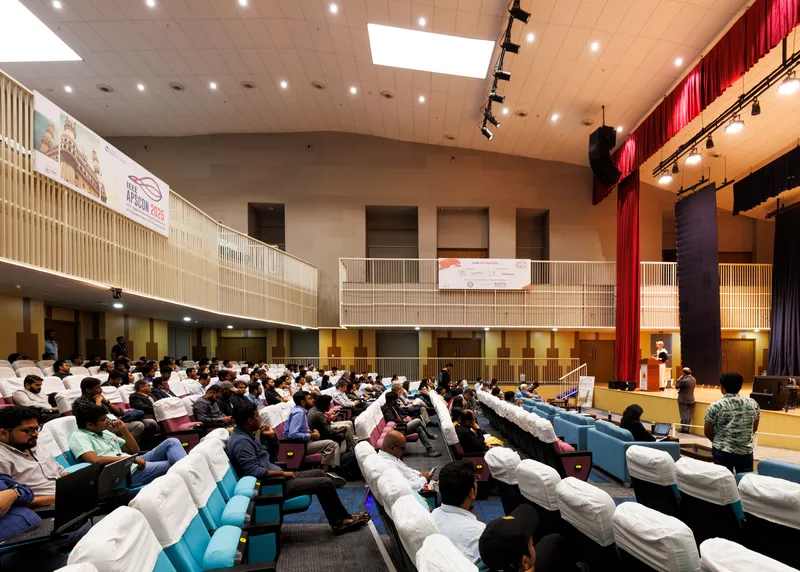
The auditoriums are more contained. Wood-paneled balconies and recessed spotlights create the focused atmosphere a lecture or performance demands. A steel truss skylight tops one of the secondary courtyards, flooding the upper corridors with daylight and connecting the auditorium lobbies back to the outdoor network. Yellow metal railings on the upper levels add a graphic sharpness that reads well from below.
Surface and Detail


At close range, the building reveals a careful hierarchy of surface. Board-formed concrete carries the grain of its formwork. White tile frames every window, creating a datum that reads across all seven blocks and unifies facades that might otherwise fragment. Blue-painted service corridors, exposed ductwork, and a solitary figure walking toward the lit end: these are the unglamorous moments where the building's honestly shows. Nothing is hidden, nothing is clad in a lie.
The four white tile-framed openings in a concrete wall, a bicycle parked below: this is the scale at which the convention center becomes a campus building. It is not trying to be a monument. It is trying to be a place where people park their bikes and walk inside, and the architecture makes that walk worth paying attention to.
Plans and Drawings


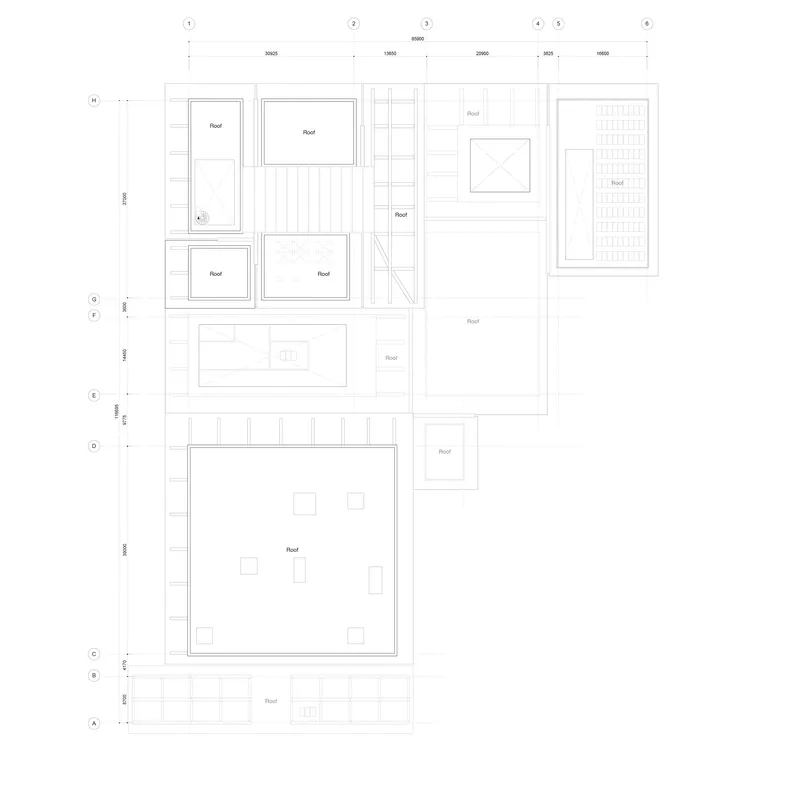
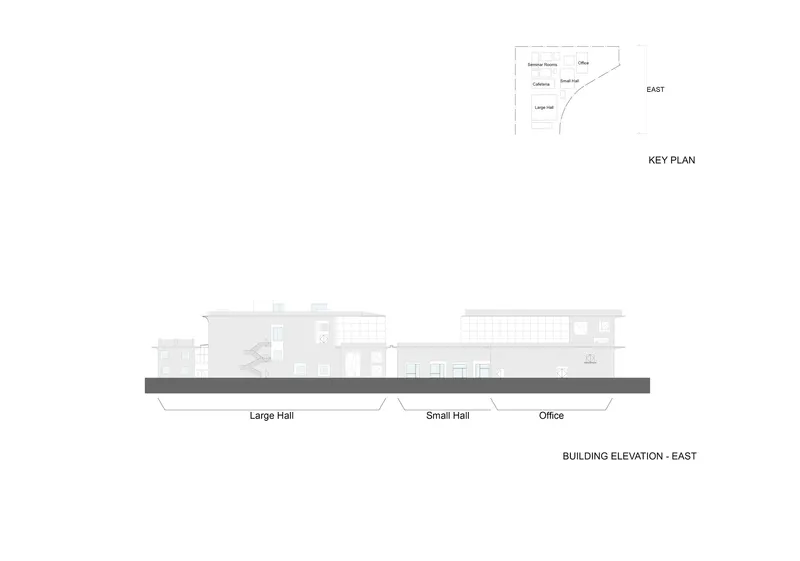
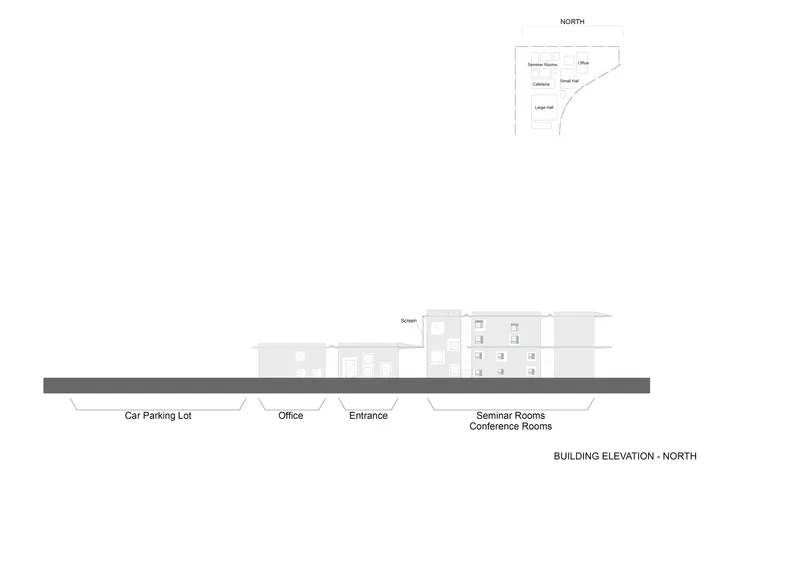
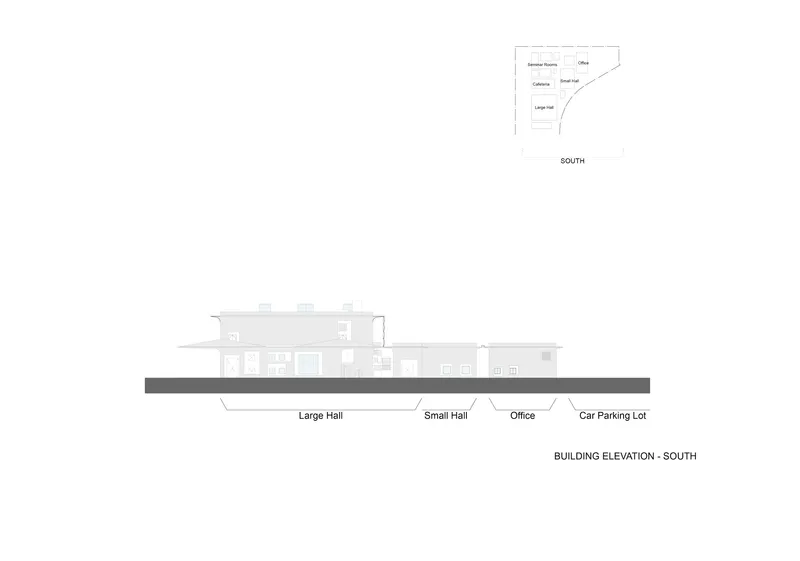
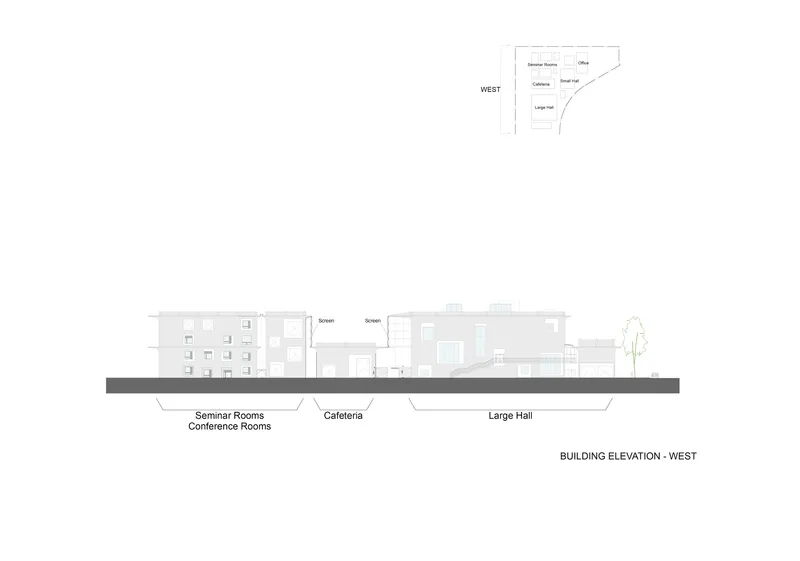

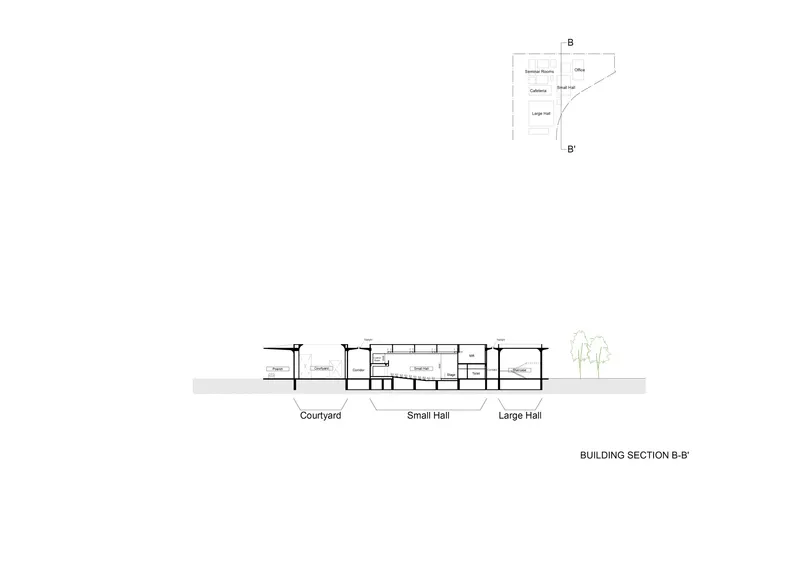
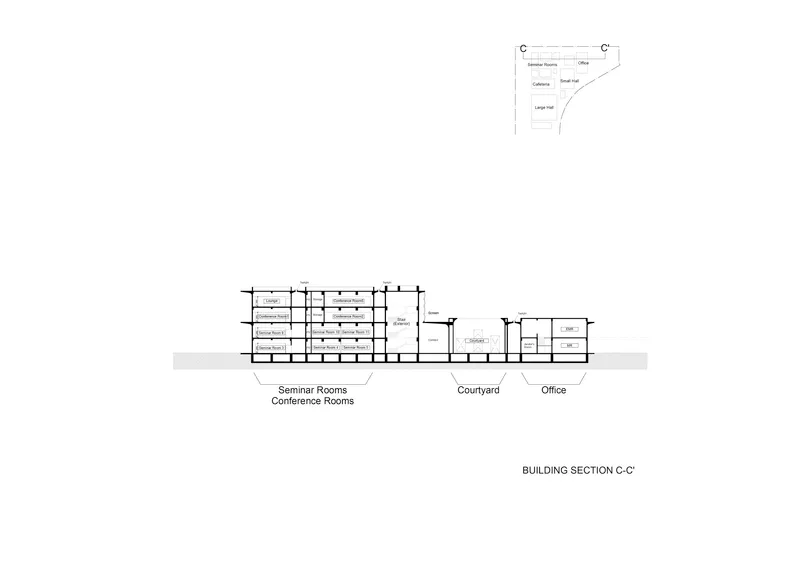


The site plan confirms the convention center's role within a campus constellation: reservoir to the north, international guest house adjacent, parking and landscape buffers on every side. Floor plans show the clustered rectangular volumes arranged around the central open courtyard, with auditoriums, seminar rooms, offices, and a cafeteria distributed across the seven blocks. The sections are where the building's sectional ambition becomes clearest, revealing how courtyards punch through multiple levels and how the vaulted ceilings create layered spatial sequences from ground floor to rooftop terrace.
The colored pencil sketches are a rare and revealing inclusion. They show the interior street imagined as a covered bazaar, with shops and pedestrians moving beneath vaulted ceilings and angular planes. The sketches suggest that the architects were thinking about the building as a piece of urbanism from the very beginning: not a convention center that happens to have corridors, but a fragment of city implanted on a campus.
Why This Project Matters

The Convention Center at IIT Hyderabad matters because it demonstrates what a genuine cross-cultural collaboration can produce when both sides resist the temptation to default to their own conventions. The Japanese studios brought a sensitivity to intermediate space, a sectional sophistication, and a material discipline that is visible in every vault and threshold. The Indian context demanded scale, climate resilience, and a willingness to use stone and concrete instead of timber. The resulting building belongs to neither tradition exclusively. It is specific to this site, this latitude, this institution.
More practically, the project offers a model for how large institutional buildings in hot climates can be organized around passive strategies without sacrificing spatial ambition. The courtyards, covered streets, cantilevers, and screen walls are not ornamental gestures. They are the building's environmental engine, and they produce the architecture's best moments. In an era when campus buildings in India too often default to glass-curtain-wall anonymity, the IITH convention center proposes a concrete alternative: heavy, rooted, and full of light.
Convention Center IIT Hyderabad, designed by IITH Campus Design Team of the University of Tokyo, NIHON SEKKEI, and APL design workshop. Hyderabad, India. 17,124 m². Completed 2021. Photography by Masaki Hamada (kkpo) and Hidetoshi Ohno.
About the Studio
Share Your Own Work on uni.xyz
If projects like this are the kind of work you want to make, uni.xyz is a place to publish your own, find collaborators, and enter design competitions.


Popular Articles
Popular articles from the community


The Amber Palace Opera: A Geological Fiction Surfaces on Tallinn's Baltic Waterfront
Pierre Brillard reimagines a Baltic legend as a public landscape, opera house, and waterfront promenade rooted in Tallinn's coastal identity.

Opera on the Sea: Driftwood Logic Shapes a Timber Opera House on Estonia's Coast
Trevor Orgill's opera house translates the entangled drift of floating timber into a civic building where wood, water, and music converge.
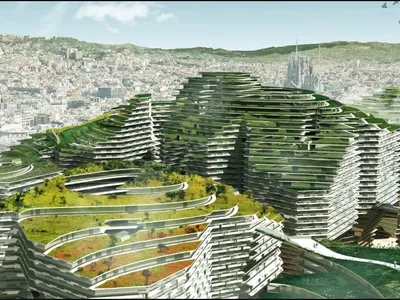
Manzana Morphosis: Stretching Barcelona's Grid into a Living Landscape for 2050
A radical reworking of the Eixample manzana turns density into a tool for generous public space, vertical ecology, and environmental performance.
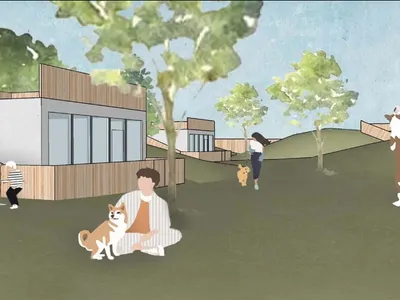
Temporary Home for Dogs: A Reversed Zoo Rethinks Animal Shelter Architecture
In Bucharest, a sinuous corridor and freed landscape flip the logic of containment, designing a shelter that works to make itself unnecessary.

Similar Reads
You might also enjoy these articles

Bao Huynh Watercolor Atelier: A Serene Art Retreat in Hội An
Bao Huynh Watercolor Atelier in Hội An blends multifunctional art spaces, sustainable design, local materials, and family-friendly living in a serene environment.

Atelier Macri Concept Store Interior Design by CASE-REAL
Atelier Macri store features a "ko" counter, walnut wood details, cork displays, blending retail, gallery, and seamless customer experiences.

Manuel Vargas Izquierdo Stadium and High-Performance Sports Center: Architectural Excellence in Jalpa de Méndez
The Manuel Vargas Izquierdo Stadium blends sustainable design, inclusive sports facilities, and cultural-inspired architecture, revitalizing Jalpa de Méndez’s public spaces.

KAKR Buluh Awar Hall: Revitalizing Community and Ecology Through Bamboo Architecture
Community built bamboo hall revitalizes Buluh Awar village, empowering youth, restoring ecology, celebrating vernacular craftsmanship through sustainable architecture and culture.

Explore CSIIT School Of Architecture Competitions
Discover active competitions in this discipline

Challenge to design public laboratory

Challenge to design mud housing for contemporary communities
Comments (0)
Please login or sign up to add comments
No comments yet. Be the first to comment!