
Timeout: A Parametric Pavilion Between the Playful and the Grotesque
A 7-foot-high spiked pavilion swirls animal-like forms into a surreal shelter that blurs childhood memory and architectural experiment.


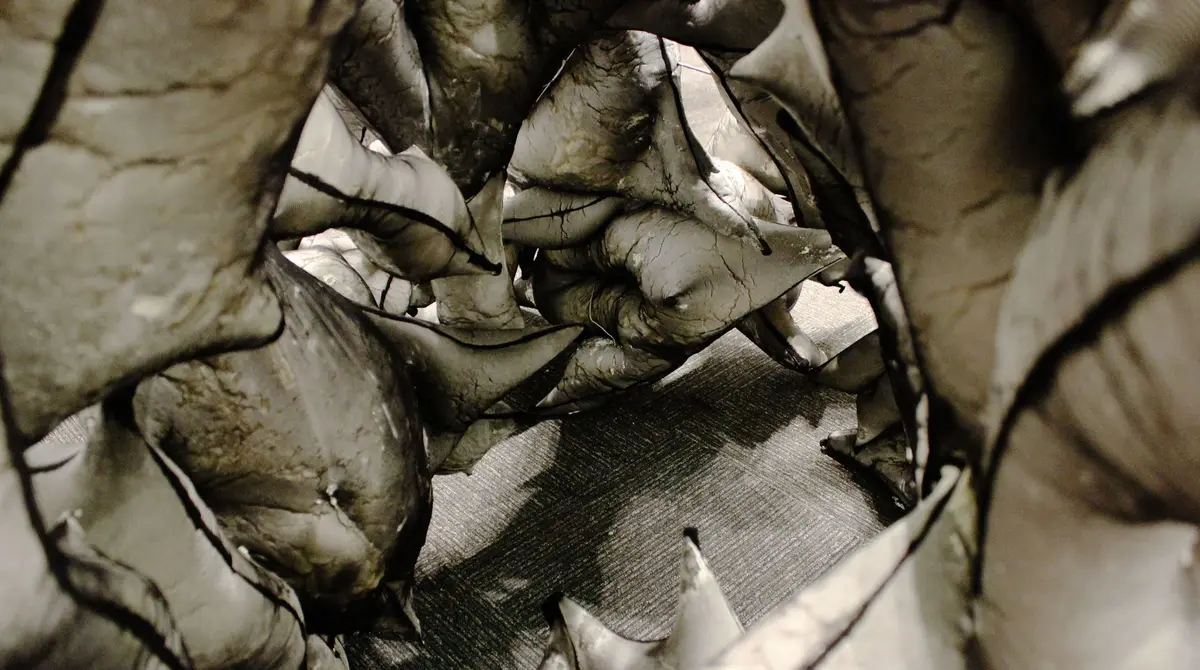
What if a building could feel like a half-remembered dream? Timeout is a 7-foot-high pavilion that looks less like architecture and more like a creature caught mid-transformation. Composed of abstract, spiked components that recall animals in motion, it swirls into a continuous, restless form, one that refuses to sit still even when frozen in material. The design operates on a deliberate tension between the playful and the grotesque, pulling at childhood memories and surreal imagery in equal measure.
Conceived by Yuheng Ouyang and Yu Zhou, Timeout was shortlisted in Architecture on the Clock, a competition that challenges designers to rethink how architecture engages with temporal experience. The pavilion uses parametric techniques to generate its organic, spiraling geometry, producing a structure where static form and dynamic energy merge into something genuinely uncanny.
Surface as Memory: Cracked Skins and Hidden Layers
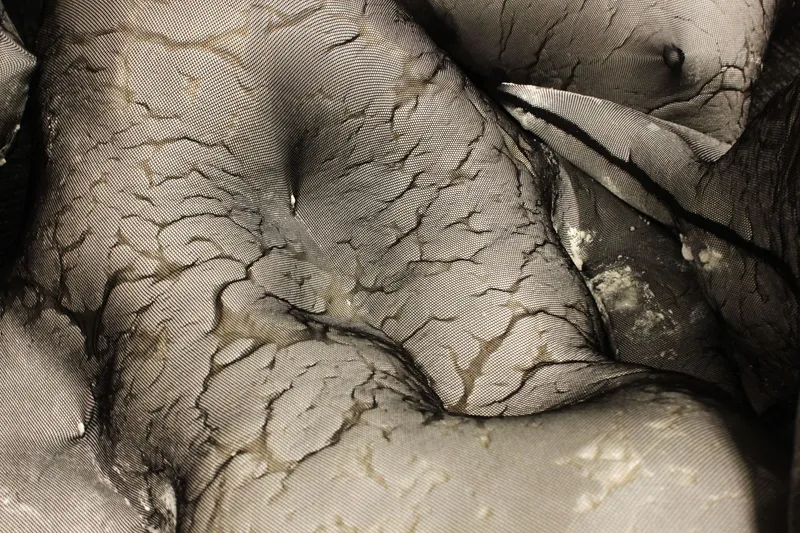

The material language of Timeout begins at the surface. Close inspection reveals a cracked plaster skin with peeling edges that expose underlying layers, suggesting decay, age, and the passage of time embedded directly into the pavilion's body. This is not damage; it is design intent. The weathered surface forces viewers to confront the structure as something organic and mortal rather than pristine and permanent.
Placed within a wheat field beneath gathering storm clouds, the pavilion's spiked forms rise from the landscape like an eruption. The contrast between the soft, golden grain and the aggressive verticality of the spikes is startling. It reads as an intrusion, something alien that has surfaced from beneath the earth. The setting amplifies the surreal quality Ouyang and Zhou clearly pursued: nature as backdrop, architecture as disruption.
Occupying the Interior: Spikes Overhead and Shelter Below
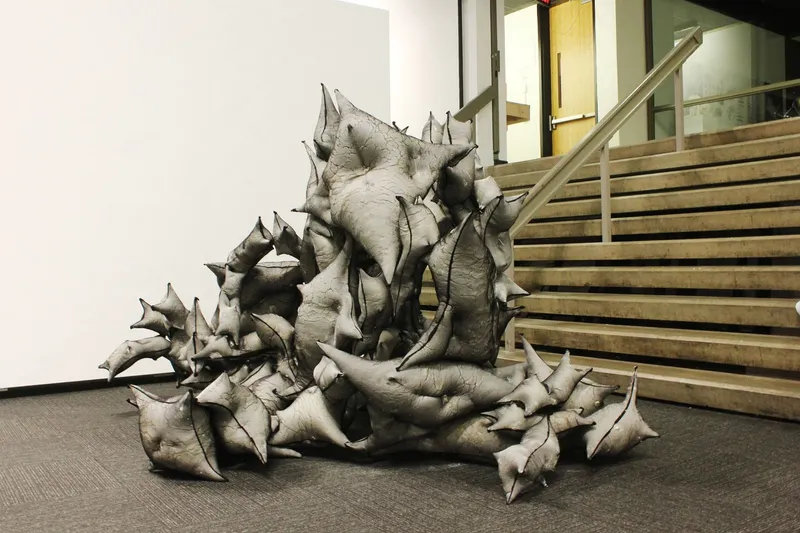
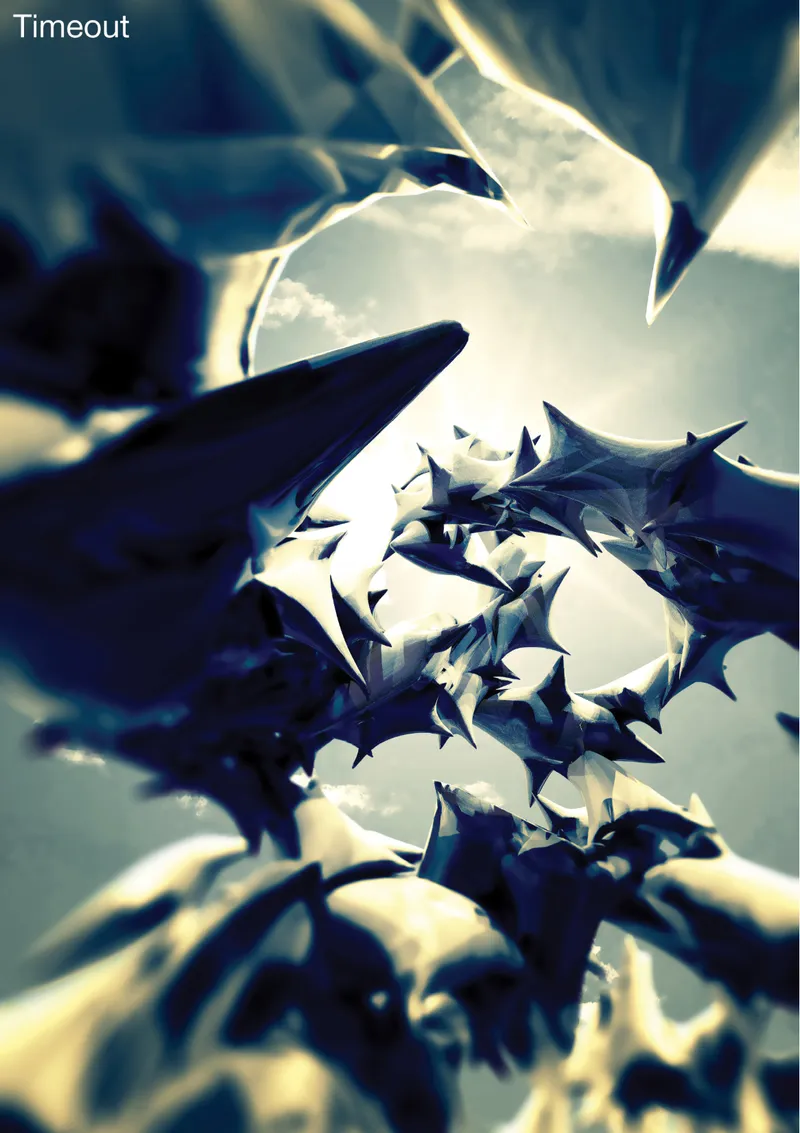
At its base, the sculptural form crouches beside a timber staircase, its pale, protruding spikes reaching outward like the quills of a startled animal. The domestic scale is key here. At only 7 feet high, the pavilion forces an intimate encounter. You do not observe it from a distance; you move around it, duck beneath it, look up through it. The view from below through an opening in the spiked assembly reveals how the components overlap and interlock, creating a canopy that is simultaneously sheltering and threatening.
The Pavilion as Refuge: Children Under a Strange Canopy

One of the most compelling images shows two children sheltering beneath a canopy of overlapping metallic panels, dark clouds pressing in above them. It is a scene that crystallizes the forced dichotomy at the heart of the project: the pavilion is both protector and predator. The children appear safe, but the forms above them are jagged, aggressive, alive with tension. The playful and the grotesque coexist in a single frame.
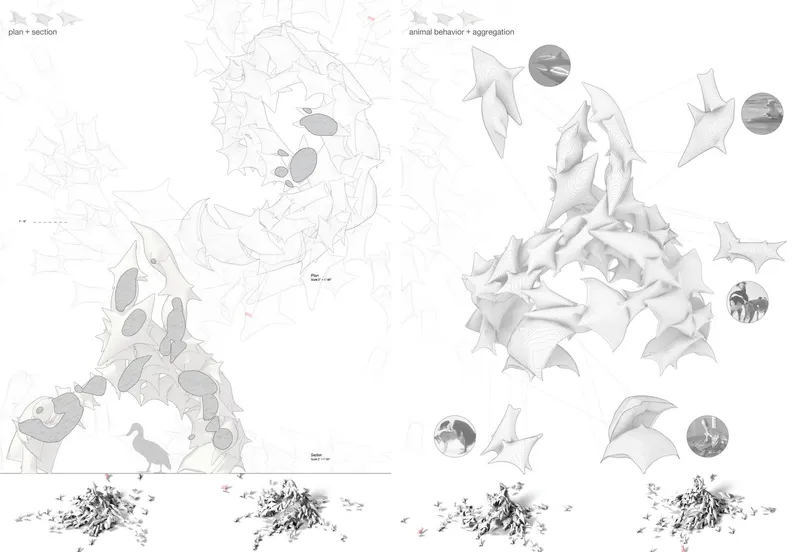
The composite drawing sheet offers critical insight into how the pavilion is organized. Plan, section, and rendered views are accompanied by wildlife notations, suggesting that the parametric geometry was not generated arbitrarily but drawn from the study of animal morphology. The spiked forms now read less as abstract computation and more as biomimetic translation, animal bodies rendered in architectural terms.
Material Entropy: Concrete, Mesh, and Deliberate Ruin
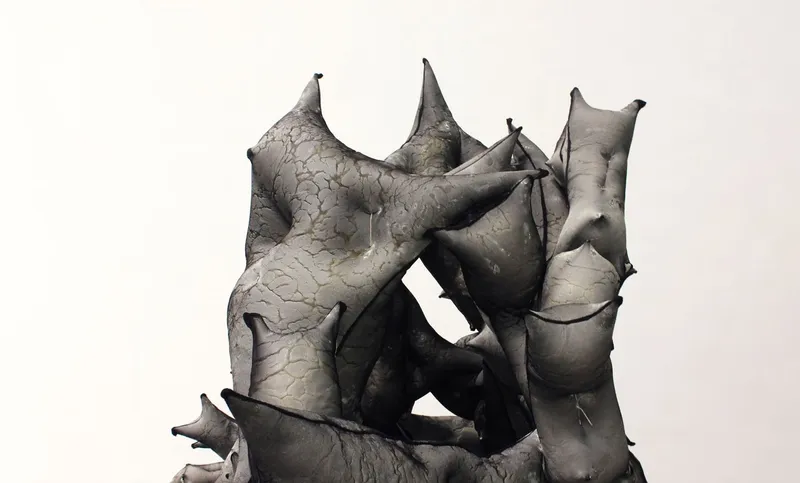
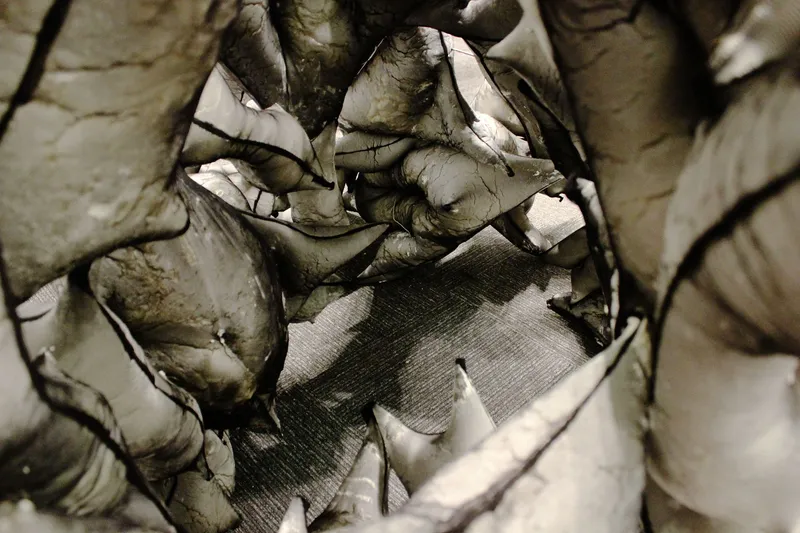
The final material studies push the project into territory rarely explored at this scale. A crumbling concrete shell with jagged edges sits against a pale sky, its surface cracked and eroded to the point of near-dissolution. A closer view reveals exposed mesh reinforcement and fractured layers within a deteriorated cavity. These are not images of failure; they document a deliberate engagement with entropy. Ouyang and Zhou seem to argue that time should not be resisted by architecture but absorbed into it, made visible as texture and form.
Why This Project Matters
Timeout succeeds because it refuses to treat parametric design as a purely formal exercise. The computational geometry is present, but it serves a narrative about memory, time, and the uncanny space between comfort and unease. The animal-like forms, the decayed surfaces, the small scale that demands bodily engagement: all of these choices point to designers thinking beyond the screen and into the experience of standing beneath something strange.
For a shortlisted competition entry, the ambition here is significant. Ouyang and Zhou have produced a pavilion that operates simultaneously as shelter, sculpture, and provocation. It asks how architecture can embody the passage of time not through monumental permanence but through deliberate fragility, through surfaces that crack and forms that seem to breathe. That is a question worth taking seriously.
View the Full Project
About the Designers
Designers: Yuheng Ouyang, Yu Zhou
Enter a Design Competition on uni.xyz
uni.xyz runs architecture and design competitions year-round that reward proposals with spatial conviction and real site intelligence.
Project credits: Timeout by Yuheng Ouyang, Yu Zhou Architecture on the Clock (uni.xyz).


Popular Articles
Popular articles from the community


The Amber Palace Opera: A Geological Fiction Surfaces on Tallinn's Baltic Waterfront
Pierre Brillard reimagines a Baltic legend as a public landscape, opera house, and waterfront promenade rooted in Tallinn's coastal identity.


Cube Design Draws an Ecological Corridor Between Two Shenzhen Hills with the Nankai Building
Beside Shenzhen's container docks, the Nankai Building pairs stacked balconies with a climbing green screen to connect two hillsides across its height.

FCC Arquitectura Expands a Portuguese Granite House with a Board-Marked Concrete Wing
In Portugal, JV House pairs a cleaned-up whitewashed and granite dwelling with a timber-shuttered concrete extension, courtyards and a garden pool.

ETEH Reworks the Shared Spaces of São Domingos School in Brazil Around Timber, Color and Hanging Plants
At São Domingos School in Brazil, 436 m² of hall, refectory and library are recast with timber joinery, a yellow and blue code and trailing greenery.

Similar Reads
You might also enjoy these articles

Vereda Arquitetos Renovates a 40-Square-Meter Apartment Inside Niemeyer's Copan Building
A compact unit in São Paulo's most iconic residential tower gets a material overhaul that pairs exposed concrete with bold blue Formica.

Shakur's House: Exposed Brick as an Interior Organiser in a 168 m² Mashhad Residence
Brick moves indoors in this Mashhad residence, where masonry walls, glass partitions and teal planes sequence a compact home without closing it off.

Day and Night Park: A Time-Based Urban Newsstand in Beijing
A temporary urban newsstand in Beijing blending travel, light, and reading through poetic colors, compact form, and community-focused design.

Modernist Patio Renovation in El Masnou, Barcelona by Oliver Segura Arquitectura + Cebrià Arquitectura
Modernist patio renovation blending tradition and innovation with a movable pool, leveled floors, and Catalan materials in El Masnou.

Explore Architecture Of Time Competitions
Discover active competitions in this discipline


From Logic to Configurators

Challenge to reimagine the Iron Throne

Photograph architecture without architects

Illustrate the lost glory of Angkor Wat - Render Challenge
Comments (0)
Please login or sign up to add comments
No comments yet. Be the first to comment!