
To Life Through the Intricacy: A Labyrinth That Heals in the Heart of Edinburgh
A circular psychotherapy center in Edinburgh uses labyrinthine geometry and therapeutic spatial programming to guide visitors toward emotional recovery.


What if the building itself were the therapy? Not a backdrop to treatment but an active participant in recovery, its corridors and courtyards calibrated to coax someone from confusion toward clarity. In Edinburgh, a circular psychotherapy center proposes exactly that: architecture modeled on the labyrinth, where disorientation is not a flaw but the first step in healing. The building's plan is a pure circle, and every spatial decision, from the placement of a scream therapy room to the filtered light through timber brise-soleils, serves a dual role as functional accommodation and psychological metaphor.
To Live Laugh Love Through the Intricacy is a shortlisted entry in the Live Laugh Love 2020 competition, designed by Irina Ozheredova. Sited in Edinburgh, Scotland, the proposal works within a 9-meter height limit and 25% ground coverage to deliver a two-story center for mental wellness. Juror Eleena Jamil praised its "renderings that show the potentials of the proposal," while Juanjo Otero of MOL Arquitectura called the use of wooden brise-soleils and landscaped patio "very successful." The project sits at the intersection of symbolic geometry and evidence-informed spatial design, grounding its poetic ambitions in a clear programmatic logic.
A Circle as Compass: Plan Geometry and Sun Path Logic
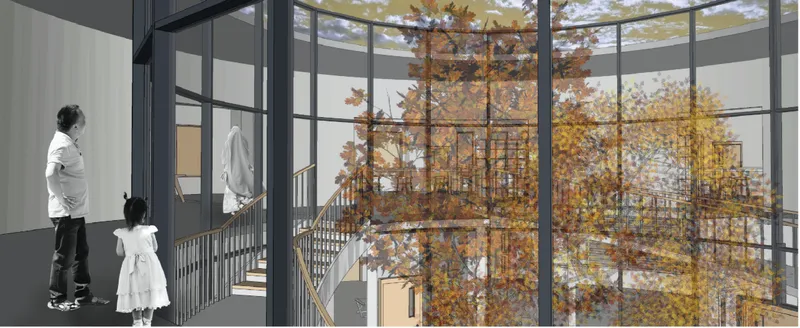
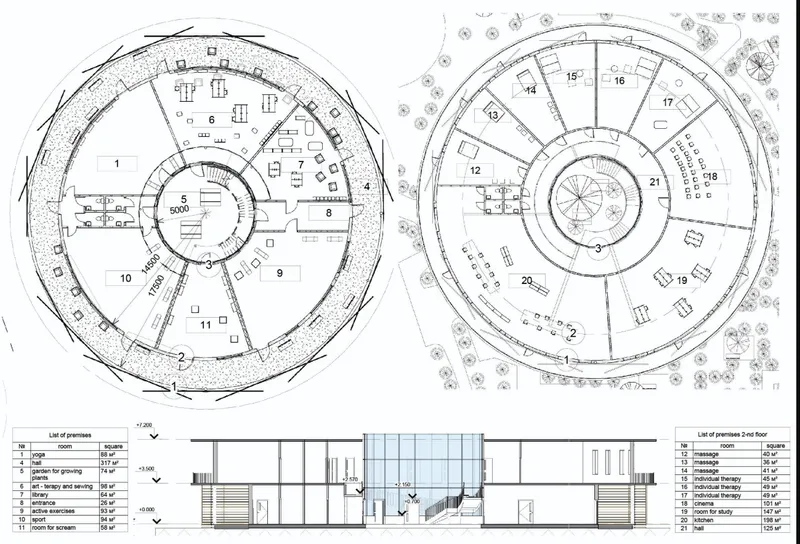
The circular plan is not decorative; it is operational. Ozheredova arranges passive and active zones along the cardinal sun path so that meditation spaces, libraries, and quiet reading areas occupy calmer, shaded orientations, while group therapy rooms, physical exercise areas, and communal kitchens face directions activated by solar warmth. The floor plans and section drawing reveal a radial layout spiraling out from a central double-height atrium, where a single tree stands as a symbol of growth, rootedness, and connection. The geometry, as Otero noted, is "very blunt," and that bluntness is its strength: the circle reads immediately as wholeness, continuity, and return.
The interior balcony view through steel-framed glazing captures how the building frames the outside world as part of the therapeutic experience. Autumn trees fill the frame, and two figures stand at the threshold between interior shelter and natural landscape. The architecture does not seal patients away; it mediates their re-engagement with the world at a pace they can control.
Vertical Journeys: The Curved Staircase as Spatial Narrative
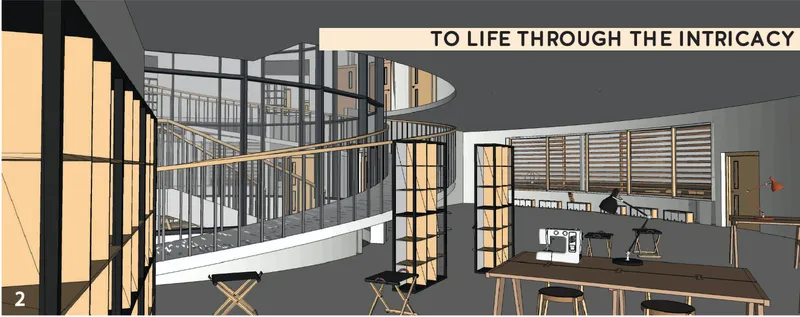
The section view reveals a curved staircase connecting the ground and upper levels, and it reads less as circulation infrastructure than as a narrative device. On the ground floor, the program is deliberately social and expressive: a room for scream therapy, a kitchen, communal areas, active exercise spaces, and a sewing area. The upper level shifts to introspection, housing individual therapy rooms, massage spaces, study rooms, and quiet living lounges. Moving upward is moving inward. The staircase wraps around the central atrium, keeping the symbolic tree in peripheral vision as users ascend, a persistent reminder of rootedness even as the spatial character changes.
Workspaces visible in the section drawing are tucked into the building's curved perimeter, benefiting from the timber brise-soleils that filter daylight without exposing occupants to the full intensity of an unshielded view. Privacy and openness coexist here, neither dominating the other.
Timber Screens and the Threshold Between Inside and Out
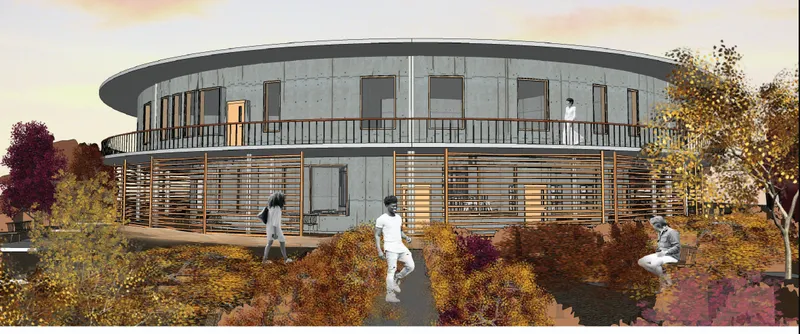
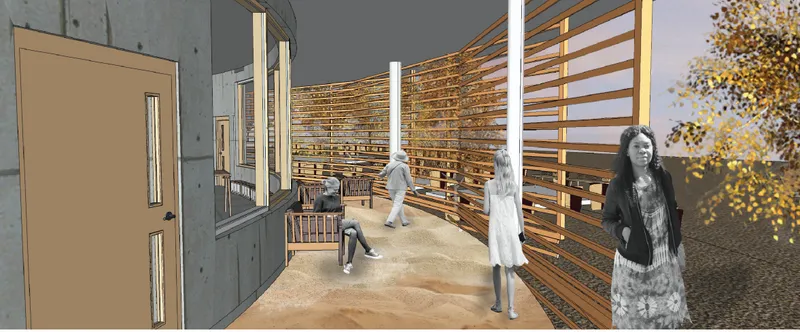
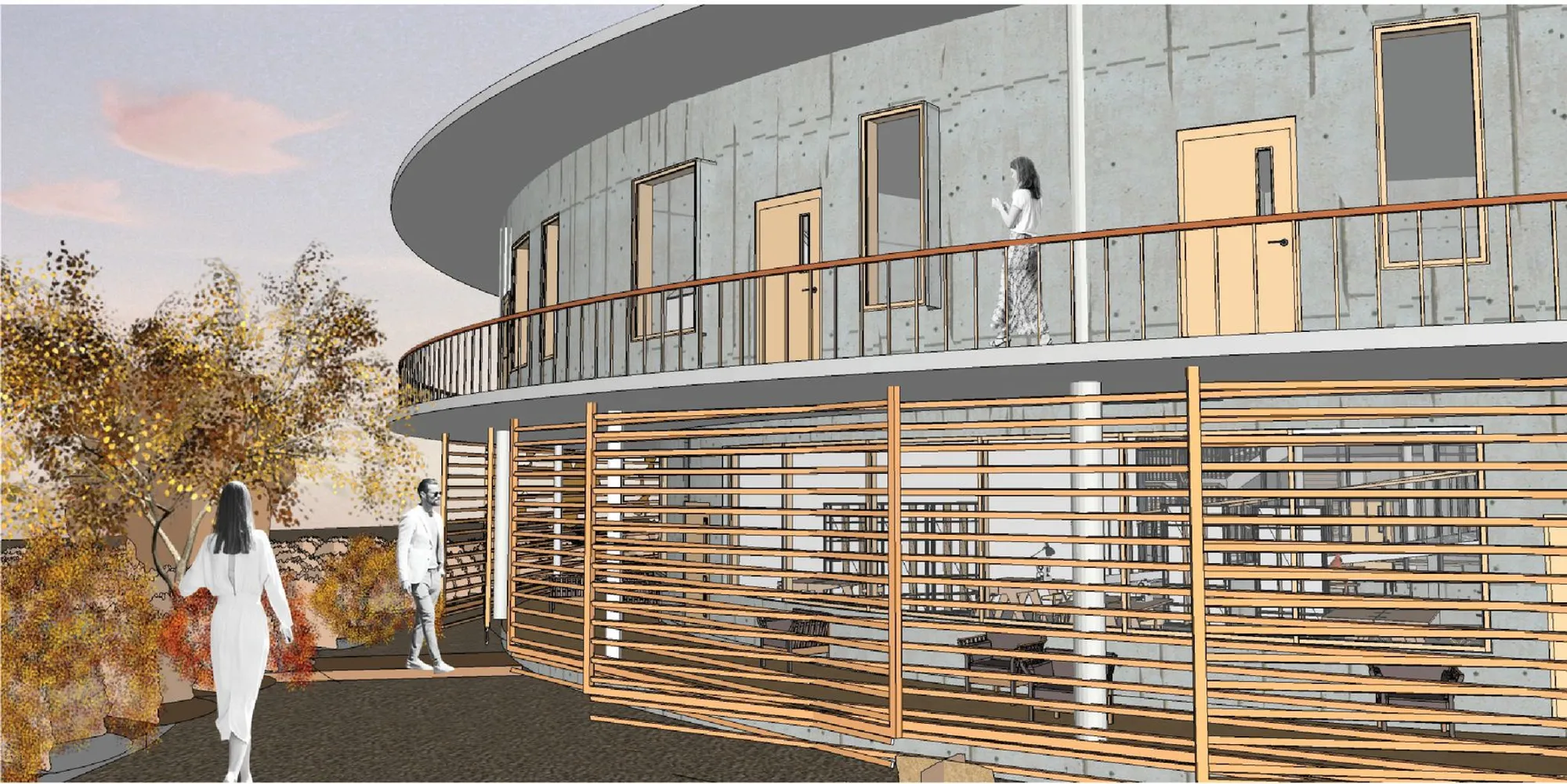
The exterior view of the cylindrical building shows horizontal timber screens wrapping the facade, their rhythm softening the geometry while performing real environmental work: shading, ventilation, and visual privacy. Autumn planting at the base dissolves the hard line between building and ground, reinforcing the project's commitment to therapeutic landscapes. The covered walkway image makes the experience tangible. Figures pass through bands of warm light sliced by the timber slats, and the effect is neither fully enclosed nor fully open. It is a transitional space, the kind of in-between zone that healing architecture depends on, where a person can pause without pressure, adjusting to the shift between interior refuge and the wider world.
Landscape as Emotional Terrain
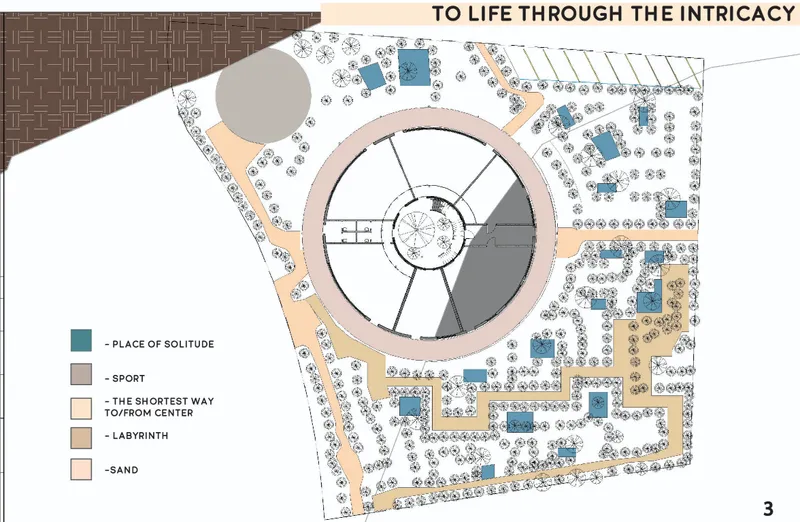
The site plan drawing maps the surrounding landscape into named zones: "Place of Solitude," "Sport," "Sand," and "The Shortest Way to/from Center." These labels turn a garden into an emotional cartography. Cyclical pathways and layered plantings are not ornamental but programmatic, designed to ground individuals through movement, reflection, and contact with nature. The labyrinthine walking paths echo the building's circular plan, extending the metaphor of self-discovery beyond the building envelope and into the Edinburgh landscape.
Ozheredova draws on the historical resonance of the labyrinth not as a puzzle to be solved but as a contemplative path, a tool for meditation and self-awareness that predates modern psychotherapy by centuries. The landscape plan literalizes this idea, offering patients a physical journey whose twists and returns mirror the non-linear process of emotional recovery.
Why This Project Matters
Mental health facilities are too often designed as clinical containers: efficient, neutral, and forgettable. Ozheredova's proposal rejects that premise entirely. By rooting the building in a legible symbolic system, the labyrinth, and then populating it with specific, carefully zoned programs, the project argues that architecture can be an active agent in psychological care. The scream therapy room, the quiet upper-level lounges, the central tree, the timber-filtered light: each element carries both practical function and emotional weight.
The jury's feedback pointed to an appetite for deeper development of the labyrinthine concept, and that critique is fair. But the core proposition is strong. In a field where "healing architecture" often remains a vague aspiration, this project demonstrates what it looks like when a designer commits to a single spatial metaphor and follows it from site plan to section to landscape. The result is a building that asks you to get a little lost on your way to getting better.
View the Full Project
About the Designers
Designer: Irina Ozheredova
Enter a Design Competition on uni.xyz
uni.xyz runs architecture and design competitions year-round that reward proposals with spatial conviction and real site intelligence.
Project credits: Live Laugh Love by Irina Ozheredova Live Laugh Love 2020 (uni.xyz).




Popular Articles
Popular articles from the community


Riyadh For All: Intergenerational Urban Design for Active Aging in Rabat
Riyadh For All reimagines urban design in Rabat with intergenerational co-living, adaptive courtyards, and Moroccan cultural exchange today.

The Earth Pod: 3D Printed Homes for Resilient Refugee Communities
The Earth Pod reimagines refugee housing through 3D printed homes made from clay, combining resilience, self-sufficiency, and rapid shelter.

Hill & Cross Opera: Sculptural Opera House Architecture Shaped by Tallinn’s Landscape and Identity
Hill & Cross Opera reimagines opera house architecture in Tallinn through its sculptural hill, civic plaza, glass wave and a luminous cross.

The Musturak Paradise: Senior Living Architecture for a Connected Future in Temara, Morocco
The Musturak Paradise reimagines senior living architecture in Temara via private homes, social spaces, culture, community, and shared care.

Similar Reads
You might also enjoy these articles

Day and Night Park: A Time-Based Urban Newsstand in Beijing
A temporary urban newsstand in Beijing blending travel, light, and reading through poetic colors, compact form, and community-focused design.

Modernist Patio Renovation in El Masnou, Barcelona by Oliver Segura Arquitectura + Cebrià Arquitectura
Modernist patio renovation blending tradition and innovation with a movable pool, leveled floors, and Catalan materials in El Masnou.

Alto Residencial Coop: Cooperative Housing Development in Santiago de Compostela by Carbajo Barrios Arquitectos
A linear cooperative housing complex blending white volumes and perforated metal façades, enhancing community living, natural light, privacy, and urban integration.
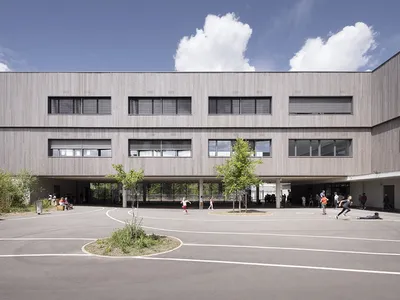
Vil Genis School by BPA ARCHITECTURE – Massy, France
Vil Genis School in Massy, France, features sustainable design, south-facing classrooms, community integration, accessible spaces, and modern educational architecture.


Explore Sustainable Design Competitions
Discover active competitions in this discipline



Challenge to design public laboratory


Design challenge to reuse E-waste
Comments (0)
Please login or sign up to add comments
No comments yet. Be the first to comment!