
Takeru Shoji Architects Sinks a Family Home into Niigata's Ancient Sand Dunes
Toga House half-buries itself in 1,700-year-old coastal dunes, turning excavated sand into a soft threshold between domestic life and open grassland.


Most houses sit on the ground. Toga House sits in it. Designed by Takeru Shoji Architects for a family in Niigata City's Nishi Ward, this 158-square-meter residence is partially excavated into a sand dune range that formed along the Japanese coast roughly 1,700 years ago. The terrain undulates by about 30 meters across the region, and the site itself is ringed by expansive grasslands with no planned future development. Rather than perching a conventional volume on this landscape, project architect Yuki Hirano and structural engineer Tetsuya Tanaka devised a strategy borrowed from primitive construction: dig, pile, embed pillars in sand, and let an umbrella-like roof spread overhead.
What makes this project genuinely compelling is how the half-sunken posture resolves two opposing desires at once. The first floor, pushed below grade, delivers the privacy and enclosure of a cave. The second floor, which barely crests ground level, opens onto the grasslands through sliding doors and a wraparound terrace. The excavated sand is not carted away but redistributed around the building's perimeter, producing a gradual slope that erases the hard line between architecture and dune. It is a house that treats its own construction spoil as landscape material, and the result is a dwelling that feels simultaneously sheltered and wide open.
A Dune-Level Silhouette
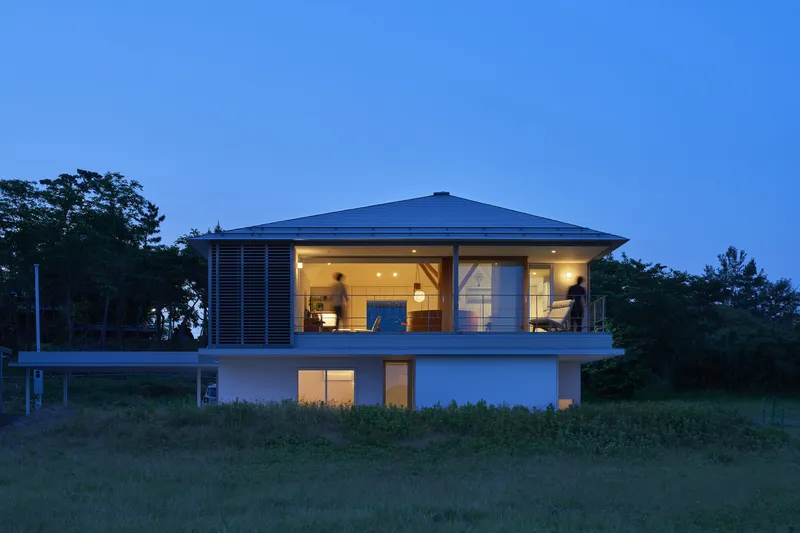
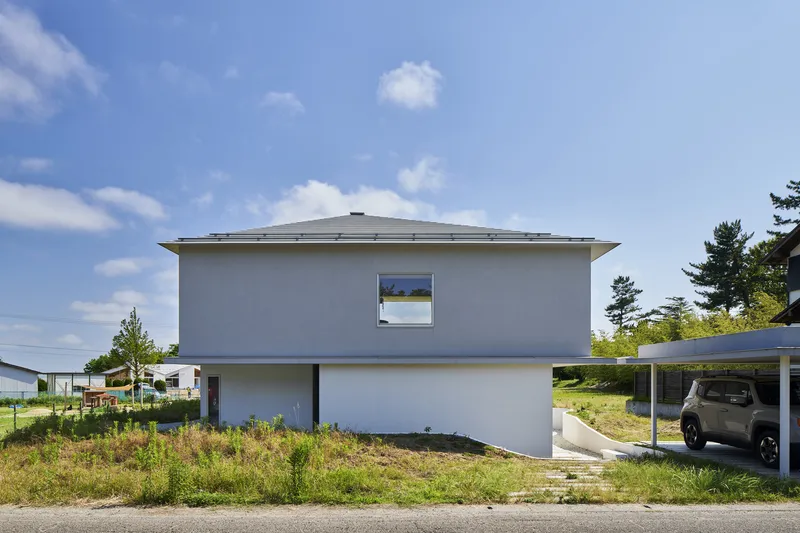
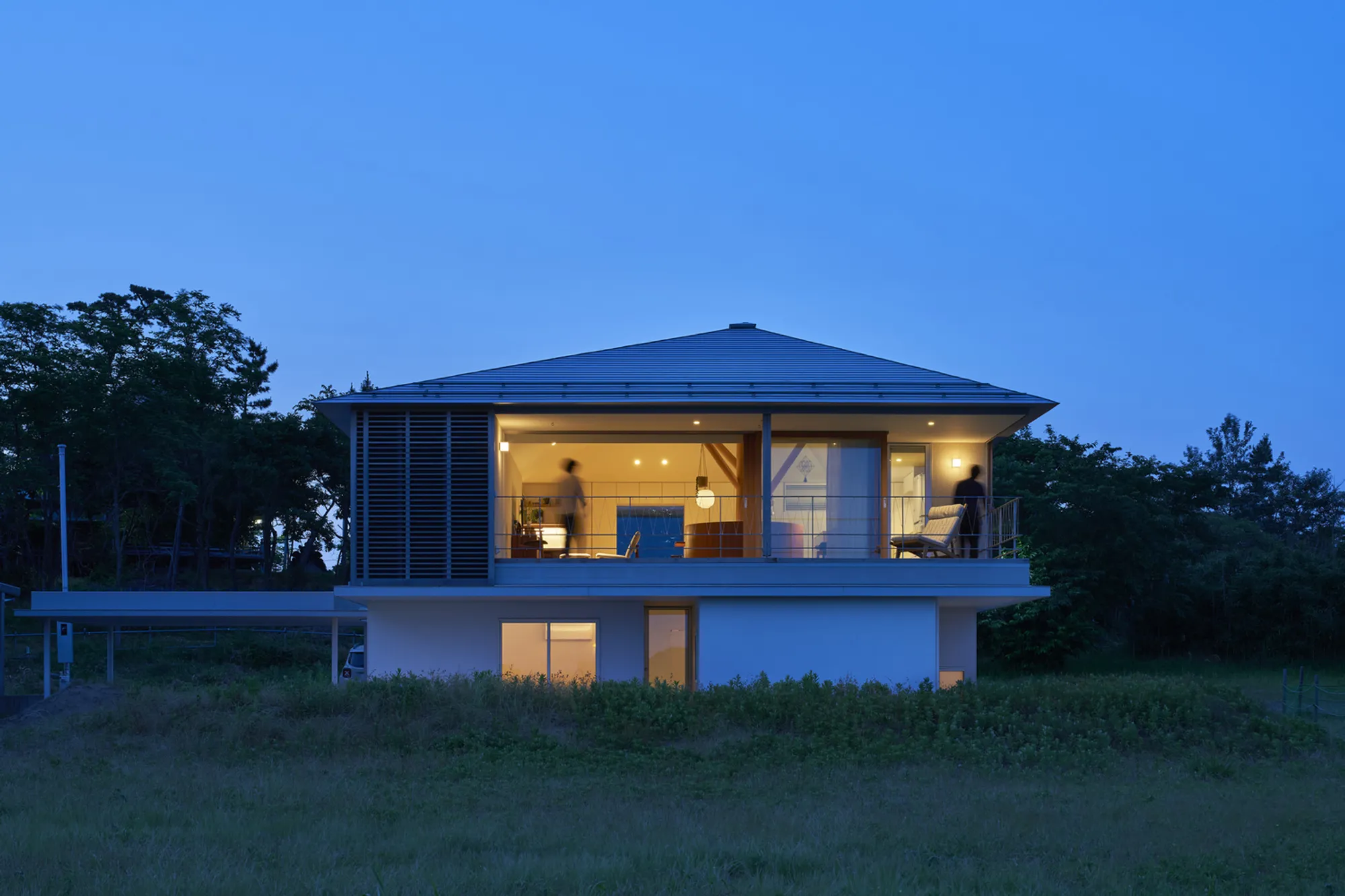
From the street, Toga House reads as a low, white-rendered volume capped by a shallow hipped roof. At dusk, when the meadow grasses catch the last light, the house nearly vanishes into the terrain. Horizontal louvers modulate views and ventilation along the upper band, while the roof pitch stays deliberately restrained to avoid breaking the dune's horizon line. The message is clear: this building does not want to announce itself. It wants to belong.
The white render is a deliberate foil to the warm timber interior. It keeps the exterior abstract and quiet, letting the landscape do the talking. There is no heroic cantilever, no dramatic overhang. The architecture earns its presence through proportion and position rather than gesture.
Arriving Through Sand and Gravel
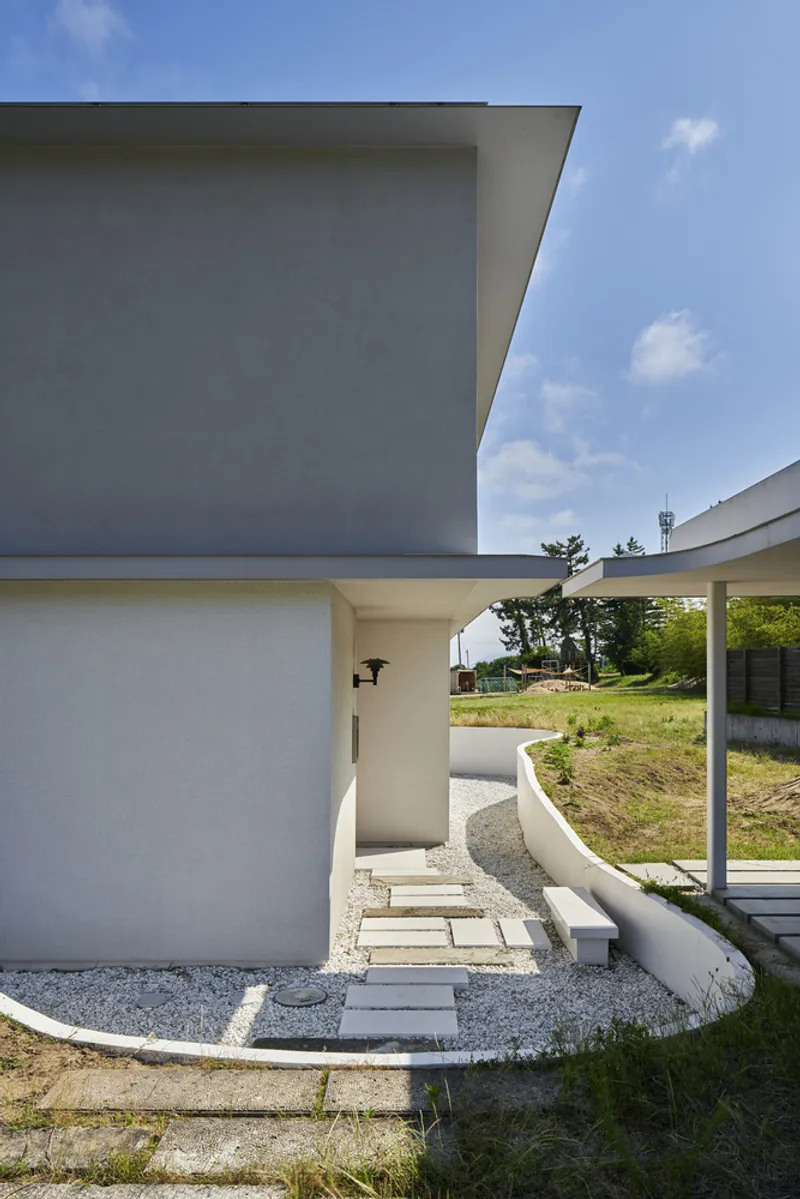
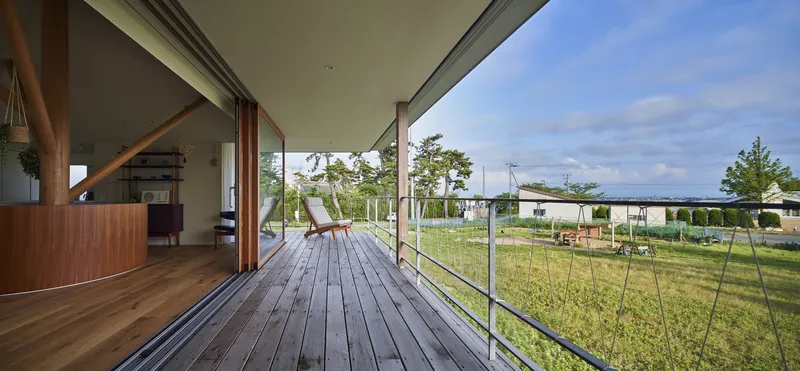
The entry sequence reinforces the geological narrative. Stepping stones set into gravel lead to a recessed doorway beneath a carport, compressing the visitor's field of vision before releasing it inside. The gravel itself echoes the sandy substrate below, a subtle reminder that the house is literally nested in dune material. On the opposite side, a covered timber deck extends into a grassed yard, framing the sky and grassland as a single panoramic field. These two thresholds, one compressed and one expansive, bracket the domestic experience.
The Central Pillar as Structural Tree
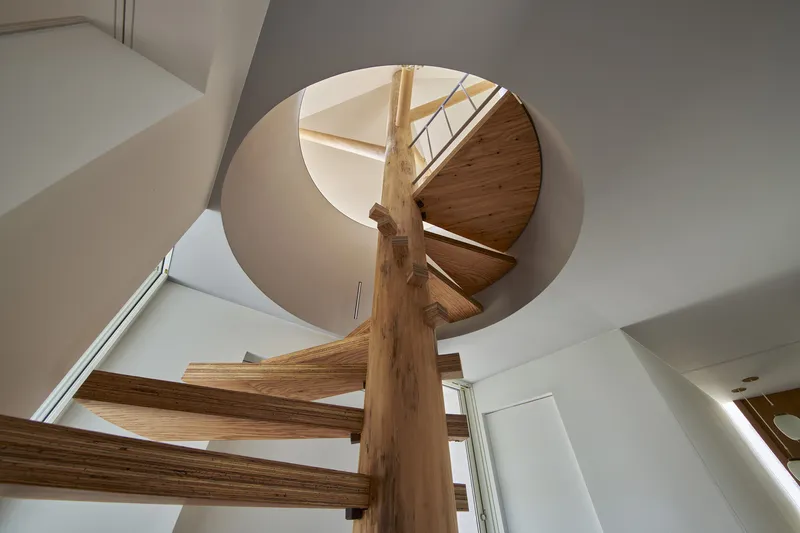
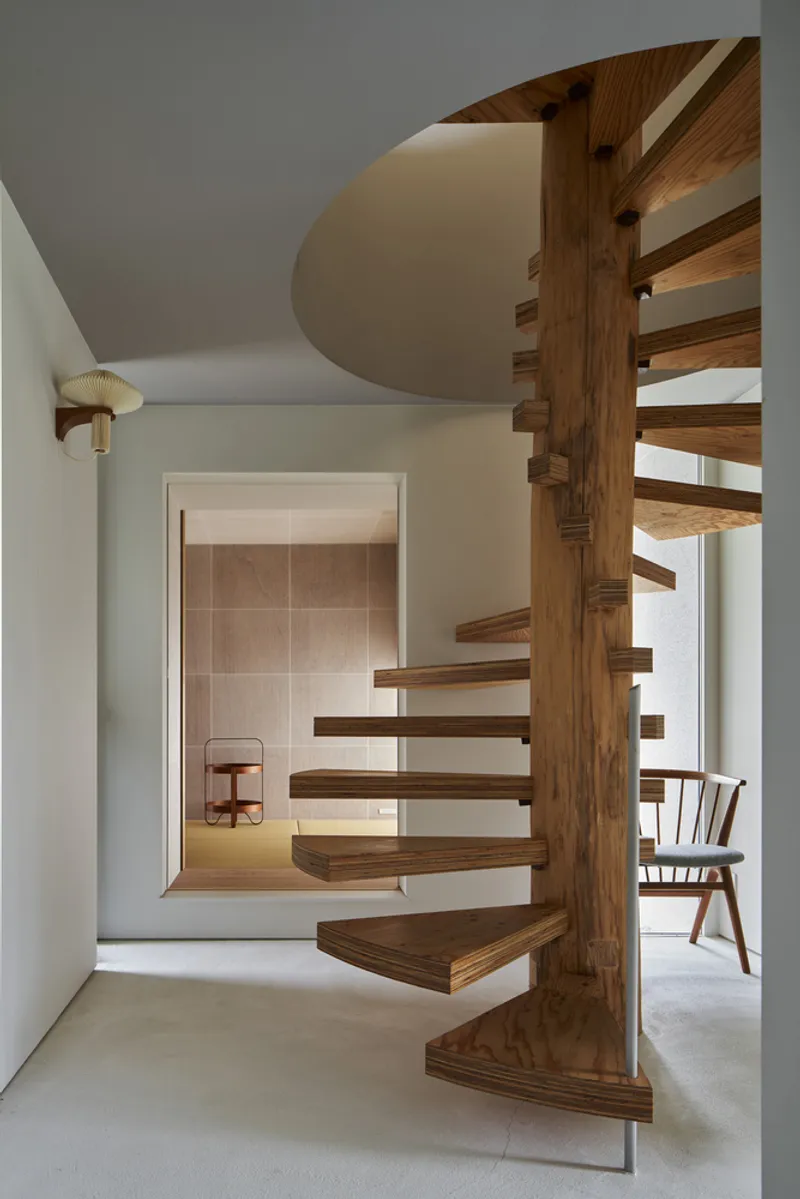
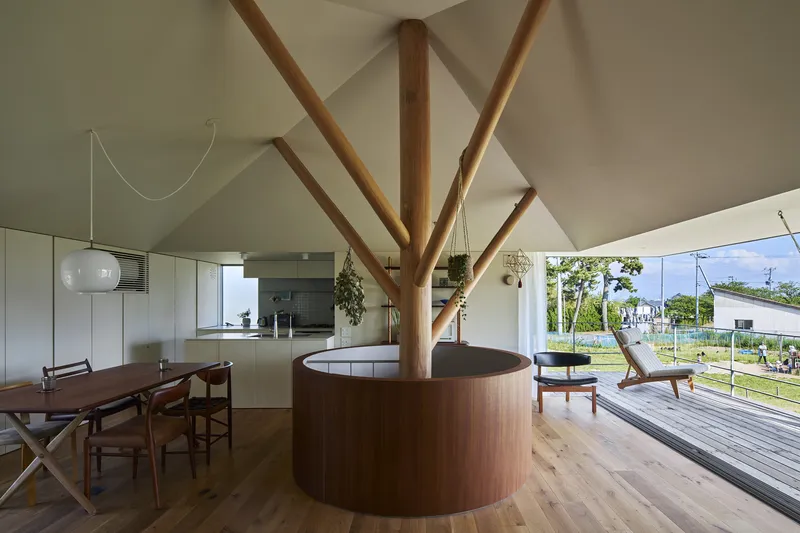
At the core of Toga House stands a single wooden pillar, 360 millimeters in diameter, that rises from the first floor to support both the roof and a spiral staircase. Cantilevered timber treads wrap around this column, and from below the assembly reads like a trunk branching into a canopy. Diagonal braces fan out from the pillar to the roof corners, transferring loads in a tree-shaped pattern that eliminates the need for intermediate columns on the second floor. Every element of the stair, including its hardware, is wood, reinforcing the monolithic quality of the structure.
Structurally, this is the move that makes the open second-floor plan possible. Without the column-free span it enables, the LDK could not slide open to the terrace and grassland beyond. The pillar is not decorative symbolism dressed up as structure; it is genuinely doing the work, and the spatial payoff is immediate.
Light, Timber, and the Vaulted Ceiling
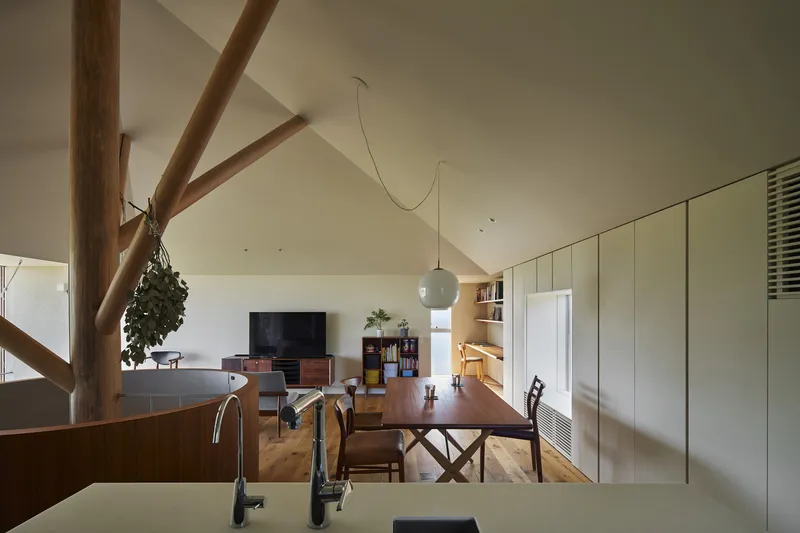
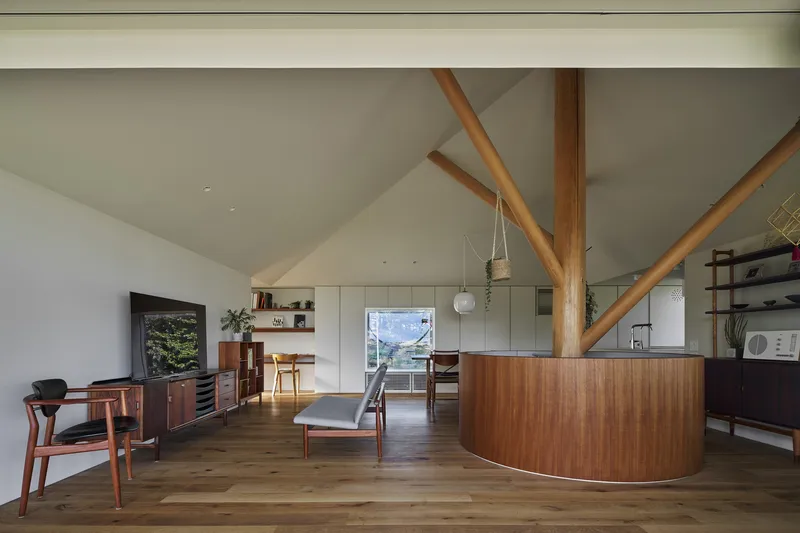
The second-floor living, dining, and kitchen space occupies the generous volume beneath the hipped roof. Exposed timber rafters radiate from the central pillar like the ribs of an umbrella, and natural light washes down from high openings to illuminate the vaulted ceiling. A curved walnut partition wall below the diagonal bracing defines secondary zones without closing them off. The palette stays disciplined: white ceiling planes, warm timber members, and a neutral floor that recedes underfoot.
Because the second floor barely rises above ground level, the relationship between interior and landscape is unusually intimate for an upper story. You are not looking down at the grasslands; you are looking across them, almost at eye level with the tops of the dune grasses. The sliding doors amplify this, collapsing the boundary between room and terrace until the living space effectively doubles.
Cave-Like Privacy Below Grade
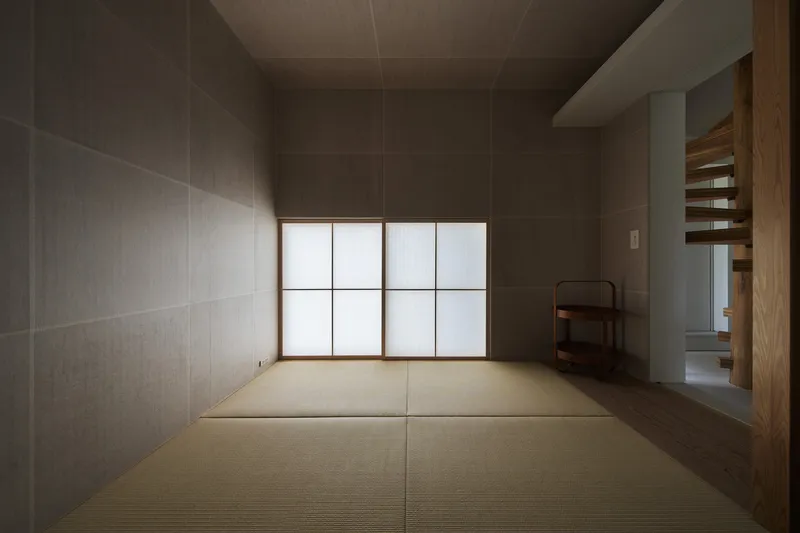
Downstairs, the mood shifts entirely. Bedrooms and private rooms sit within the excavated zone, screened from the outside world by the banked sand and by grey textile-clad walls that absorb sound and soften light. A tatami room with translucent shoji screens diffuses daylight into a gentle glow, evoking the sheltered interiority that the architects describe as cave-like. The contrast with the expansive second floor is the project's central spatial tension, and it is calibrated precisely. You retreat downward, you gather upward.
Plans and Drawings
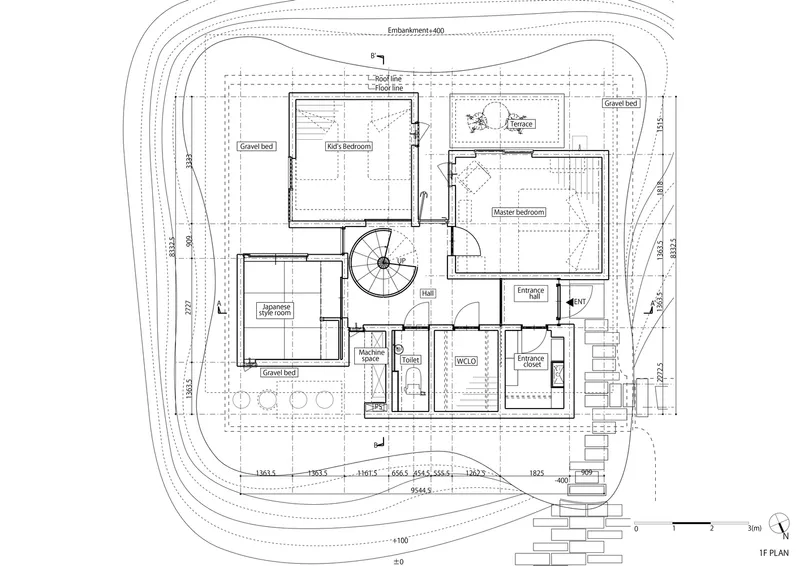
The first-floor plan reveals how the bedroom clusters orbit the central spiral stair, with contour lines drawn into the document to register the excavated topography. The radial logic of the pillar and its bracing arms is visible even in plan, confirming that structure and spatial organization share a single generative idea. The contour lines also make legible the strategy of redistributing excavated sand: the building does not sit in a pit but in a sculpted bowl whose edges taper gently into the surrounding grassland.
Why This Project Matters
Toga House offers a counter-narrative to the prevailing instinct to elevate residential architecture above its context, whether on stilts, podiums, or manicured platforms. By sinking the private program into the dune and letting the communal space barely surface, Takeru Shoji Architects produce a house whose section is its most radical drawing. The excavated sand becomes landscape, the central pillar becomes a tree, and the roof becomes an umbrella. None of these analogies feel forced because they emerge directly from construction logic rather than from mood boards.
The project also demonstrates that site-specific ambition does not require a large budget or exotic materials. Wood, sand, and a disciplined structural idea are enough. In a profession that often conflates innovation with complexity, Toga House is a reminder that the most resonant moves can be almost geological in their simplicity: dig, pile, shelter, open.
Toga House by Takeru Shoji Architects, Nishi Ward, Niigata City, Japan. 157.89 m². Completed July 2019. Photographs by Koji Fujii.
About the Studio
Share Your Own Work on uni.xyz
If projects like this are the kind of work you want to make, uni.xyz is a place to publish your own, find collaborators, and enter design competitions.




Popular Articles
Popular articles from the community


Hill & Cross Opera: Sculptural Opera House Architecture Shaped by Tallinn’s Landscape and Identity
Hill & Cross Opera reimagines opera house architecture in Tallinn through its sculptural hill, civic plaza, glass wave and a luminous cross.

Lunar Spiral: Space Architecture Shaped by the Mathematics of the Universe
Lunar Spiral reimagines space architecture through Fibonacci geometry, lunar regolith, levitating habitats, and self-sustaining Moon living.

Co-Life: Senior Housing Design That Reconnects Older Adults With the City
Co-Life reimagines senior housing design through healing gardens, shared streets, workshops, and a sustainable community across generations.

Riyadh For All: Intergenerational Urban Design for Active Aging in Rabat
Riyadh For All reimagines urban design in Rabat with intergenerational co-living, adaptive courtyards, and Moroccan cultural exchange today.


Similar Reads
You might also enjoy these articles


Hodi-Mandai Geram
Project Function: Preservation and revitalization of the Intangible heritage and socio-spatial identity of the Hodi by Housing, Cultural Memory Center, Sacred Grove, landscape, local tourism economy


Olio Towers: A Mid-Rise for Performers That Fuses Housing, Rehearsal, and Stage
Located blocks from Houston's Theater District, this modular tower stacks living units around a central performance atrium.

Oasis: Modular Green Housing Carved into Dhaka's Urban Fabric
A shortlisted Plugin Housing entry reclaims unauthorized settlements in Dhaka with stepped concrete volumes, green roofs, and ventilation-driven design.

Black Hole: A Floating Megastructure for the Post-Physical Era
Emiliano Mazzarotto envisions a spherical, self-scaling arena where e-sports, digital hotels, and holographic stadiums replace traditional public space.


Explore Architecture Competitions
Discover active competitions in this discipline



Challenge to reimagine the Iron Throne


Photograph architecture without architects


Illustrate the lost glory of Angkor Wat - Render Challenge


Design challenge to reuse E-waste
Comments (0)
Please login or sign up to add comments
No comments yet. Be the first to comment!