

Transformation of the Mies van der Rohe Pavilion through the "Mass is More" Installation
Exploring the Interplay of Mass and Space through Innovative Art Installations


The Mass is More project, a collaboration between the Institute for Advanced Architecture of Catalonia (IAAC) and Bauhaus Earth (BE), will be on exhibit at the Mies van der Rohe Pavilion in Barcelona until October 9th. The installation explores the implementation of eco-friendly and carbon-reducing building materials in contemporary architecture. By reimagining the materials used in the original pavilion, the project reflects on how low-emission practices can revitalize our cities and help achieve the European Union's 2050 environmental goals.
This project was made possible through the support of Built by Nature, a philanthropic fund dedicated to reducing embodied carbon in European timber buildings, storing carbon for future generations, and promoting forest preservation. The Laudes Foundation is the founding partner of Built by Nature.
The "Mass is More" pavilion will feature the launch of MASS MADERA, a network of Spanish innovators in industrialized solid wood construction, including cities, governments, companies, organizations, and architects from across the country. This network is being coordinated by IAAC, whose goal is to advance the use of mass timber construction and reduce the CO2 emissions related to it.

This pavilion showcases recent advancements in wood building technology and coincides with the Barcelona European Forest City 2022, a weeklong event organized by the European Forest Institute (EFI) in collaboration with the Metropolitan Area of Barcelona, the Barcelona City Council, the Barcelona Provincial Council, the Generalitat de Catalunya, and various scientific centres such as IAAC, CTFC, CREAF, and Parc de Belloch.
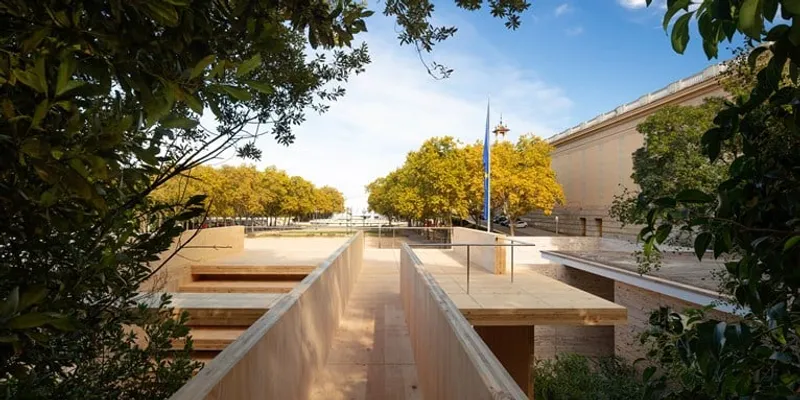
As part of the various events and activities taking place in Barcelona this year, the "Mass is More" installation aims to spark a deeper discussion on Biocities and new ways of designing and managing urban environments, based on circular economy principles. The pavilion reflects on our relationship with forests and promotes innovative construction methods.

IAAC and Bauhaus Earth have revitalized the Mies van der Rohe Pavilion with their "Mass is More" installation, which bridges the gap between the past and future of wooden architecture. Nearly a hundred years after the German Pavilion was designed by Mies van der Rohe and Reich, this exhibition showcases the use of biogenic materials in architecture.
The Mies van der Rohe Pavilion is also a proud host of the biennial European Union Prize for Contemporary Architecture / Mies van der Rohe Awards, highlighting the significance and impact of the Fundació Mies van der Rohe in today's architectural discourse.

IAAC and Bauhaus Earth have revitalized the Mies van der Rohe Pavilion with their "Mass is More" installation, which bridges the gap between the past and future of wooden architecture. Nearly a hundred years after the German Pavilion was designed by Mies van der Rohe and Reich, this exhibition showcases the use of biogenic materials in architecture.
The Mies van der Rohe Pavilion is also a proud host of the biennial European Union Prize for Contemporary Architecture / Mies van der Rohe Awards, highlighting the significance and impact of the Fundació Mies van der Rohe in today's architectural discourse.


Staying true to the design style of the pavilion, this latest installation blends cutting-edge materials from both the 20th and 21st centuries. Utilizing locally sourced cross-laminated timber (CLT) panels, the installation showcases the impressive strength of this eco-friendly material and its potential for constructing more sustainable structures with reduced environmental impact. The components of this installation were manufactured by Xilonor, a leading CLT company from Galicia, Spain, and a member of the FINSA group.

The exhibit features a 4.8-meter-long diorama showcasing the journey of wood from the forest to the city as a carbon-storing material. The interactive digital application, developed by Bestiario, a renowned data visualization company, presents a comparison of the environmental impact between the 1929 Barcelona Pavilion and the mass timber installation.
To ensure a fair comparison, only architectural elements such as the roof, walls, columns, and floor were taken into account. The analysis includes the embodied carbon emissions, energy usage, distance travelled, and steps taken during the extraction, manufacturing, transportation, and assembly of the structures.
Alongside the digital piece, there are also analogue tags placed on various components of both pavilions, displaying the materials used in their construction. This offers transparency to architectural practice, much like how food items are required to disclose their ingredients. Additionally, visitors can also enjoy a video installation by filmmaker Jaume Cebolla inside the pavilion, showcasing the transformation of the wood used in the construction of the mass timber structure from a first-person viewpoint.

The design of the installation reflects the formal grid of the original pavilion, creating an alternative narrative and a different way of experiencing the site with new pathways and view corridors. Throughout the tour, visitors will be able to see different uses and representations of wood and modern building technology.
The entrance to the space inverts the traditional circulation, offering the opportunity to first pass through the trees in the garden behind the pavilion. An elevated walkway leads to a cantilevered platform that offers unprecedented views of the Barcelona pavilion. This platform gives access to an auditorium where small meetings and talks will be held.
A 12 x 2.5-meter industrialized wood panel has been installed in the pavilion’s pond, illustrating the process used in the 19th century to transport the material directly from the forest to the factory via the river. On this panel the flamenco dancer José Manuel Álvarez will give a performance on the evening of October 4.
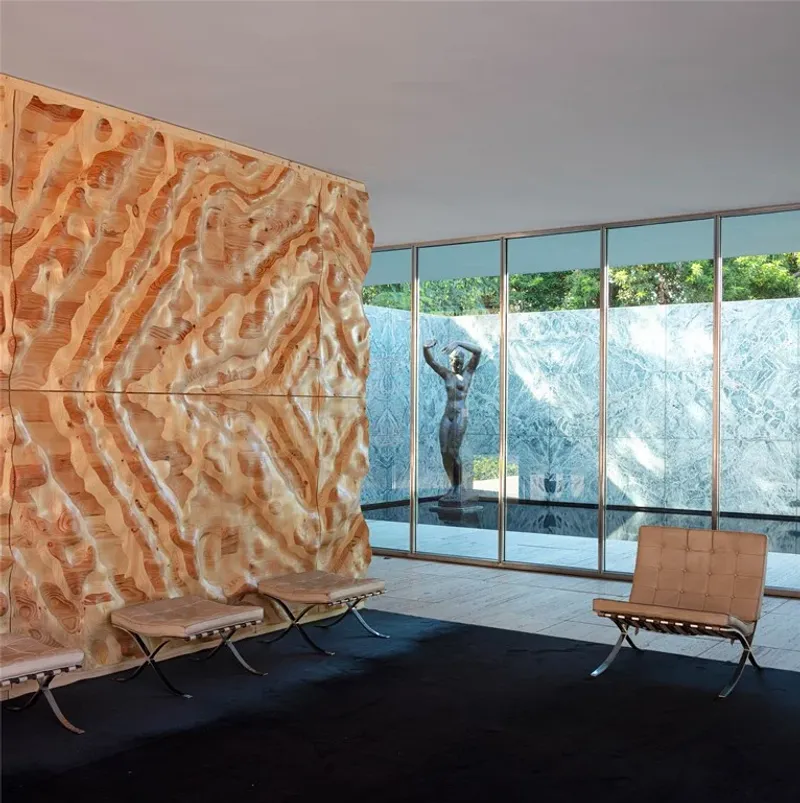
Inside, the pavilion’s luxurious onyx central wall is reinterpreted with new textures created from a CLT panel composed of multiple wood species. Illustrating the original geometry of the marble, the panel is subjected to a new digital milling process to create a warm and lush three-dimensional topography capable of revealing the various layers that compose it.
Finally, the exhibition accompanying the space will also review and analyze the different stages of the wood construction cycle through a model diorama, from the place where the trees used to produce the pavilion are harvested, to the extraction, processing and assembly, through the replanting process that represents the regeneration and sustainable use of the material, approaching the issue from a radically transparent perspective.
The need for a new urban model with more wood(s)
The Pavilion installation serves as a platform for the unveiling of MASS MADERA, a nationwide network established through funding by Built by Nature. The main goal of the network is to bring together key players in the industry to promote the construction of mass timber structures and reduce the CO2 emissions generated by the building sector.
So, why mass timber? It is one of the most effective solutions for decarbonizing the construction process. On one hand, wood can replace fossil-based materials such as concrete or steel, enabling the CO2 absorbed by trees to be stored in the form of buildings. This, in turn, allows for even more CO2 to be sequestered in new trees in the forest.
Over the past 25 years, the production of industrialized solid wood has been growing rapidly, making it the focus of the transformation of the current building model. In Europe, CLT is a major competitor to other more polluting materials, such as steel, concrete, or brick, particularly in the residential market.
If the 19th century was the era of steel and the 20th century was dominated by concrete, the 21st century will be the era of wood. This is not only due to its constructive qualities but also because it is the only material with positive externalities. Industrialized solid wood has the potential to create a circular economic flow, being a material of renewable origin that promotes sustainable forest management. It has the ability to store CO2 safely, is lightweight, easy to transport, is good for insulation while still being a structural material, and allows for quick construction with greater control, lower risks, and less pollution.
As cities are major sources of carbon dioxide (CO2) emissions, they play a crucial role in combating global warming by absorbing these emissions. The majority of emissions from buildings come from the construction process, including the sourcing of materials, rather than their daily operations. To effectively absorb these emissions, a sustainably managed productive forest is the best natural solution.
Unfortunately, many current wood products, such as paper and firewood, only store CO2 temporarily and release it back into the atmosphere shortly after. Additionally, many productive forests are not properly managed for carbon sequestration, leading to excessive logging and short harvesting rotations.
To address these challenges, the promotion of wood as a building material is crucial. This will increase the demand for certified wood and, in turn, lead to better management of productive forests for carbon sequestration. However, there are several barriers to the widespread adoption of wood as a building material, including a lack of specialized companies and experts, inadequate incentives and regulations, and a general lack of public knowledge about the benefits of wood.
Networks such as MASS-MADERA aim to overcome these challenges by connecting and coordinating various agents in the use of wood construction systems, ultimately accelerating their growth and promoting their wider use.
The BARCELONA PROTOCOL: European Action Plan for Cities and the Earth was introduced during a recent event. This plan highlights the importance of using locally sourced biological resources to construct and manage cities in order to transform urban settlements, which contribute to climate change, into catalysts for ecosystem healing. The 2022 Charter for Cities and Earth, which outlines the idea of a regenerative built environment, was launched in Rome.
The BARCELONA PROTOCOL calls on European cities to implement an action plan and lead the way. The plan, developed by an international team including Bauahus Earth, IAAC, EFI Biocities Facility, and Barcelona City Council, outlines specific actions to be taken in the near future. These include conducting a CO2 census of all buildings to assess the need for energy rehabilitation and mandating that all new projects must be built with zero emissions and using regional biomaterials.
Mass is More, Mies van der Rohe, Barcelona. Photos ©Adrià Goula

Popular Articles
Popular articles from the community


LT2A and OPEN Architectes Thread a Brick and Glass High School Through a Wooded Belgian Campus
In Braine-l'Alleud, a 3,000 m² wing for Collège Cardinal Mercier pairs pale brick with a glazed colonnade, deferring to a small chapel and a dense wood.

graciastudio Turns a Viewless Tijuana Lot Inward Around a Courtyard of Concrete, Timber and Trees
In Tijuana, Jorge Gracia's GA2 House stacks a timber-clad private floor over exposed concrete and replaces a missing view with a planted interior patio.


Aquadapt: An Underwater Habitat That Rewrites Its Rooms by the Hour
Curved modules ring the seabed while one shell shifts from breakfast room to cinema, farm and football pitch as residents' needs change.

The Amber Palace Opera: A Geological Fiction Surfaces on Tallinn's Baltic Waterfront
Pierre Brillard reimagines a Baltic legend as a public landscape, opera house, and waterfront promenade rooted in Tallinn's coastal identity.

Similar Reads
You might also enjoy these articles

Rede Arquitetos Turns Circulation into Civic Space at the Educar II SESC School in Fortaleza
In Fortaleza, Brazil, Educar II SESC-CE trades a signature form for mesh screens, yellow thresholds and courtyard walkways built for equatorial heat.
116 Rokeby Building, Collingwood
Sustainable Collingwood office building featuring double-skin façade, natural ventilation, rooftop amenities, and carbon-neutral design focused on wellbeing and longevity.
Contemporary Apartment Renovation in Spain: RV House by BIAN Opens Up to the Sea
A minimalist 1930s apartment in Santander is transformed into a flexible, sea-facing home through contemporary Spanish renovation.
3 Marías House: A Contemporary Mediterranean Courtyard Retreat by Bajet Giramé + Burckhardt
Mediterranean courtyard home blending traditional architecture with modern design, terracotta flooring, flexible interiors, sustainable climate strategies, and garden integration.

Explore Massing Design Competitions
Discover active competitions in this discipline


Challenge to design a portable theatre

Challenge to design a portable music platform

Challenge to design an open learning module for the elderly

Challenge to reimagine the Iron Throne
Comments (0)
Please login or sign up to add comments
No comments yet. Be the first to comment!