

Situations School: Modular Architecture That Refuses to Tell Children What to Do
A competition-winning school design built on stackable modules, bay windows, and gardens that put exploration before instruction.


Most school buildings are designed by adults who assume they know exactly what children need. Situations School starts from the opposite premise: that a learning environment should not dictate behavior but instead offer a field of possibilities. Stackable, replicable modules form classrooms that open onto shared gardens, bay windows create intimate nooks for self-directed study, and perforated concrete walls dissolve the boundary between indoors and out. The result is a school that treats children not as passive recipients of instruction but as active agents navigating a rich spatial landscape.
Designed by Mariana Rios and Lety Lozano, Situations School won the Learn Better competition. The brief asked entrants to conceive a new model of school, and Rios and Lozano responded with a system rather than a single building: a modular framework that can be adapted to different cultural contexts, expanded over time, and customized to the socio-cultural needs of its community. A public library embedded within the school doubles as a neighborhood resource, signaling that learning here is not confined to enrolled students.
A Courtyard That Belongs to the Children
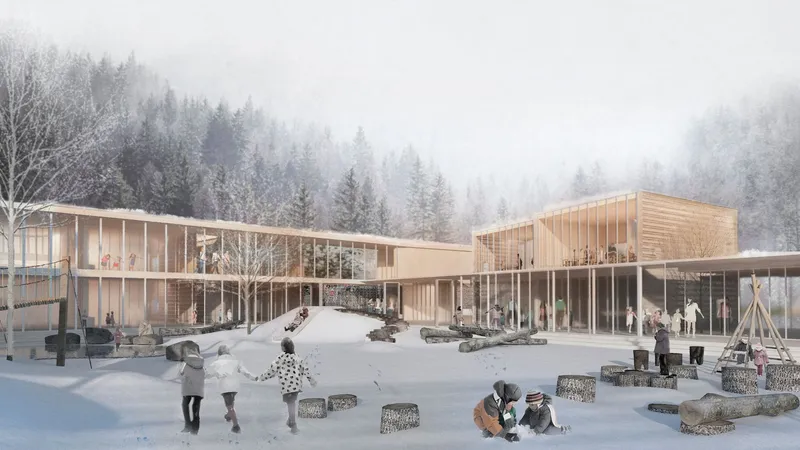
The courtyard view reveals timber-framed school wings enclosing a generous outdoor space where children play on scattered blocks in the snow. Climbing nets, logs, and sculpted topography populate these playful outdoor zones, turning the gaps between buildings into cognitive and physical playgrounds rather than leftover circulation. The design treats landscape as a teaching tool: interaction with nature, changes in terrain, and loose elements encourage exploration without prescribing how that exploration should unfold.
Stepped Volumes and Textured Walls Shape the Section
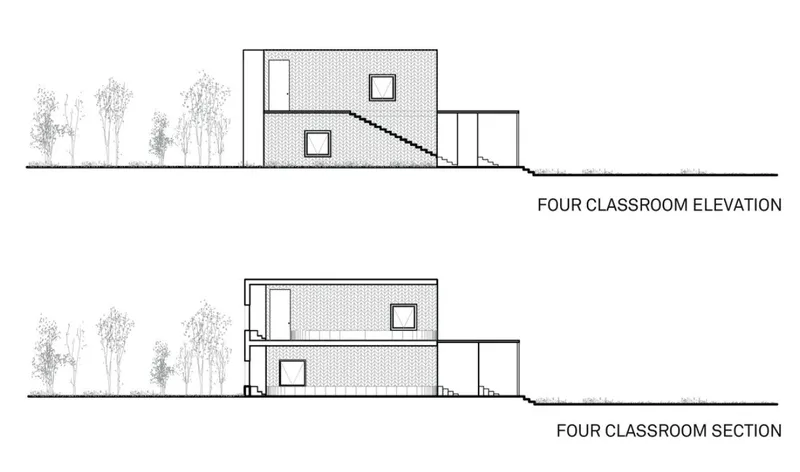
The elevation and section drawings show how the classroom block steps down with the terrain, each level offset to allow generous natural light and ventilation into the interior. Textured wall panels, likely the perforated concrete the designers describe, filter daylight while maintaining visual connections to the surrounding trees. These are not decorative surfaces; they perform the critical work of keeping classrooms bright without glare and connected to the outdoors without exposure.
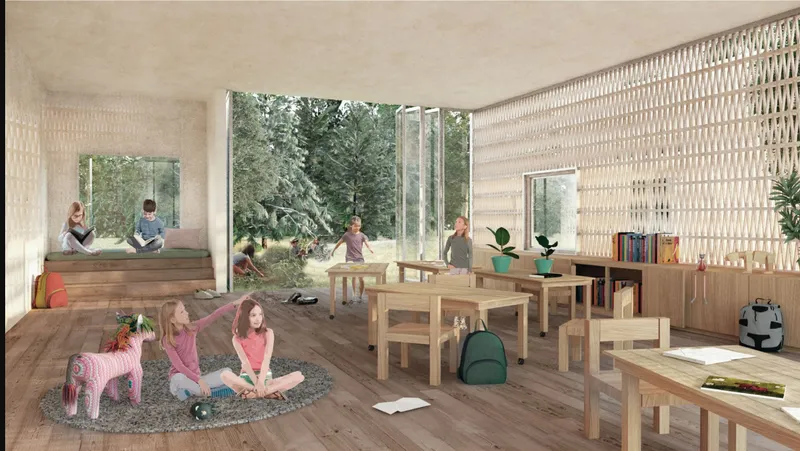
Inside, the classroom photograph confirms the spatial ambition. Tiered timber seating cascades toward floor-to-ceiling glazing that frames an immediate view of trees, collapsing any sense of separation between learning space and landscape. Lightweight partition screens suggest that the room can be subdivided or opened up depending on the activity, reinforcing the modular adaptability that drives the entire project. The bay windows visible at the edges offer those cozy nooks intended for self-directed and peer learning, scaled to a child's body rather than an adult's expectations.
Covered Walkways as In-Between Learning Spaces
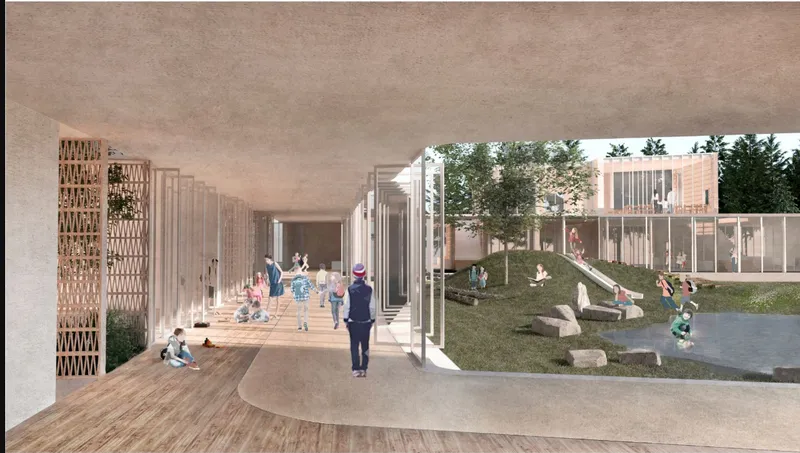
A covered walkway with a concrete ceiling and timber screens opens onto a planted courtyard where children gather. In many conventional schools, corridors are dead space: conduits for getting from one room to another. Here, the walkway is a room in itself. The timber screens modulate light and air, the planted courtyard is immediately accessible, and the generous ceiling height gives the passage a sense of dwelling rather than transit. Shared gardens positioned between classrooms are visible from these thresholds, making nature a constant companion rather than a scheduled field trip.
A Kit of Parts That Can Travel
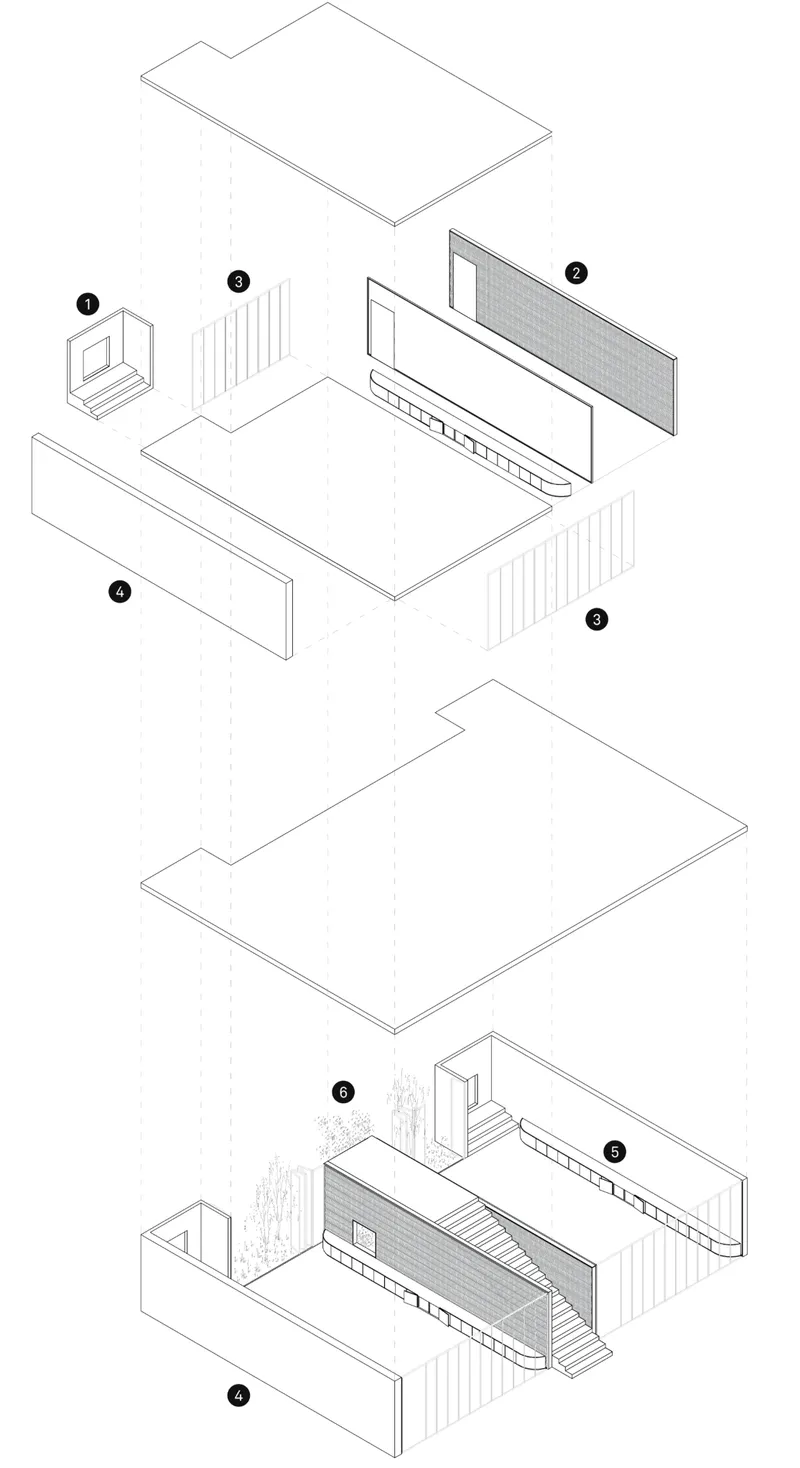

The exploded axonometric drawing is the clearest articulation of the project's core proposition. Floor slabs, wall panels, and roof components are shown as discrete layers that stack and combine, illustrating how the modular system can be assembled, expanded, or reconfigured. This is not a building frozen in time; it is a kit of parts designed for evolution. The accompanying elevation drawing reinforces the horizontal calm of the assembled volumes, with timber screening and adjacent landscape integrating the school into its site without monumental gestures.
Facade Language: Slats, Screens, and Selective Openings

The final elevation drawing focuses on the facade strategy: vertical slatted sections alternate with square window openings to create a rhythm that is visually coherent yet functionally varied. Some bays are screened for diffused light, others punch through cleanly to frame specific views. The facade is a calibrated instrument for managing the relationship between interior comfort and exterior context, and its repetitive logic means it can be adapted to different orientations and climates as the module travels to new sites.
Why This Project Matters
Situations School matters because it refuses the twin traps of educational architecture: the generic open plan that mistakes emptiness for flexibility, and the prescriptive layout that choreographs every minute of a child's day. Instead, Rios and Lozano propose a middle path where spatial variety, from intimate bay windows to expansive courtyards, gives children genuine choices about how and where they learn. The modular system ensures that these choices are not fixed at the moment of construction but can evolve as pedagogy, demographics, and community needs change.
Equally important is the project's insistence that a school is not an island. The integrated public library, the shared gardens visible from the street, and the permeable walkways all position the school as civic infrastructure. In a field where competition entries often prioritize striking form over operational intelligence, Situations School earns its recognition by demonstrating that adaptability, community engagement, and spatial generosity can coexist within a disciplined structural logic.
View the Full Project
About the Designers
Designers: Mariana Rios, Lety Lozano
Enter a Design Competition on uni.xyz
uni.xyz runs architecture and design competitions year-round that reward proposals with spatial conviction and real site intelligence.
Project credits: Situations School by Mariana Rios, Lety Lozano Learn Better (uni.xyz).


Popular Articles
Popular articles from the community


Tsunami Convergenics: Turning Catastrophic Ocean Forces into Underwater Housing Infrastructure
A speculative underwater settlement off the coast of Onagawa, Japan, treats tsunamis and typhoons as energy sources rather than threats.

Opera on the Sea: Driftwood Logic Shapes a Timber Opera House on Estonia's Coast
Trevor Orgill's opera house translates the entangled drift of floating timber into a civic building where wood, water, and music converge.

The Amber Palace Opera: A Geological Fiction Surfaces on Tallinn's Baltic Waterfront
Pierre Brillard reimagines a Baltic legend as a public landscape, opera house, and waterfront promenade rooted in Tallinn's coastal identity.

Cloaked Colonization: A Mobile Underwater Habitat That Moves Like a Fish
Micah Abaya's shortlisted EHC Pacific entry reimagines ocean settlement as a dispersed network of self-sustaining architectural organisms.

Similar Reads
You might also enjoy these articles

Day and Night Park: A Time-Based Urban Newsstand in Beijing
A temporary urban newsstand in Beijing blending travel, light, and reading through poetic colors, compact form, and community-focused design.

Modernist Patio Renovation in El Masnou, Barcelona by Oliver Segura Arquitectura + Cebrià Arquitectura
Modernist patio renovation blending tradition and innovation with a movable pool, leveled floors, and Catalan materials in El Masnou.

Alto Residencial Coop: Cooperative Housing Development in Santiago de Compostela by Carbajo Barrios Arquitectos
A linear cooperative housing complex blending white volumes and perforated metal façades, enhancing community living, natural light, privacy, and urban integration.
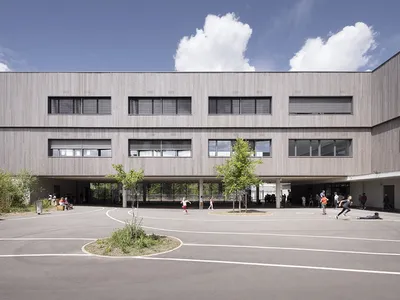
Vil Genis School by BPA ARCHITECTURE – Massy, France
Vil Genis School in Massy, France, features sustainable design, south-facing classrooms, community integration, accessible spaces, and modern educational architecture.


Comments (0)
Please login or sign up to add comments
No comments yet. Be the first to comment!