

Stadium Cultural Center Park: A Building That Plans Its Own Afterlife
An adaptive stadium for the FIFA Women's World Cup 2023 that dismantles into a cultural center and urban park over time.


What happens when a stadium is designed not to last, but to transform? Most mega-event venues become expensive relics within a decade, but this project flips that script entirely. "Stadium - Cultural Center - Park" proposes a spatial infrastructure that evolves through three distinct phases: first as a FIFA Women's World Cup 2023 venue, then as a cultural center, and finally as an urban park where concrete slabs remain as historical markers within a green landscape. The building carries its future inside its present form.
Designed by Dinah Brütsch and Simone Durrer, the project was selected as an Editor's Choice Entry in Staydium 2020, a competition that challenged designers to rethink the relationship between stadiums and the cities that host them. Rather than proposing a monument to a single event, Brütsch and Durrer deliver a temporal architecture: a structure whose primary design ambition is its own graceful dissolution into civic life.
A Courtyard That Remembers the Stadium
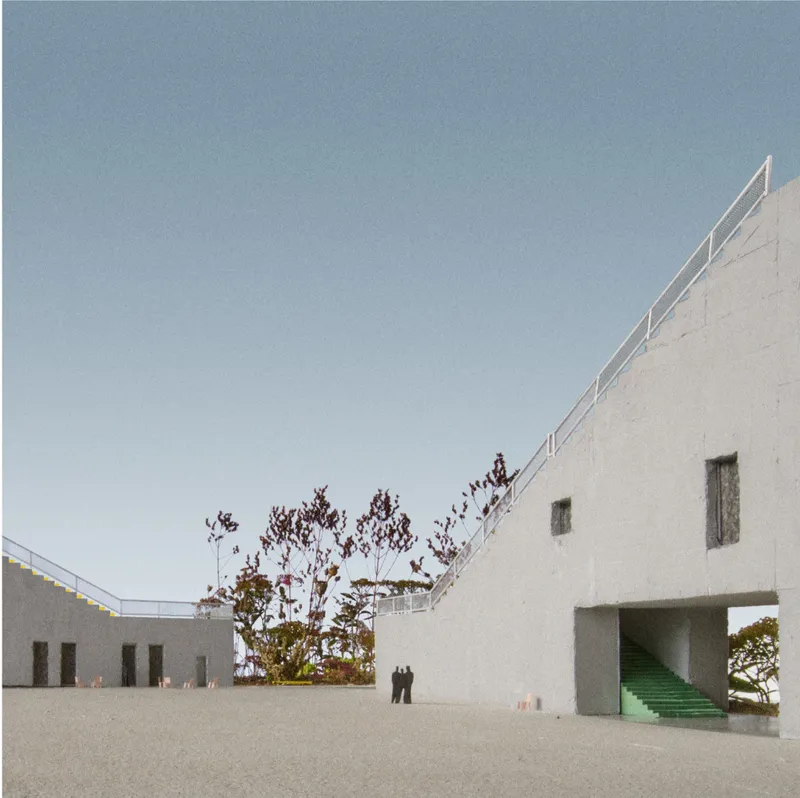
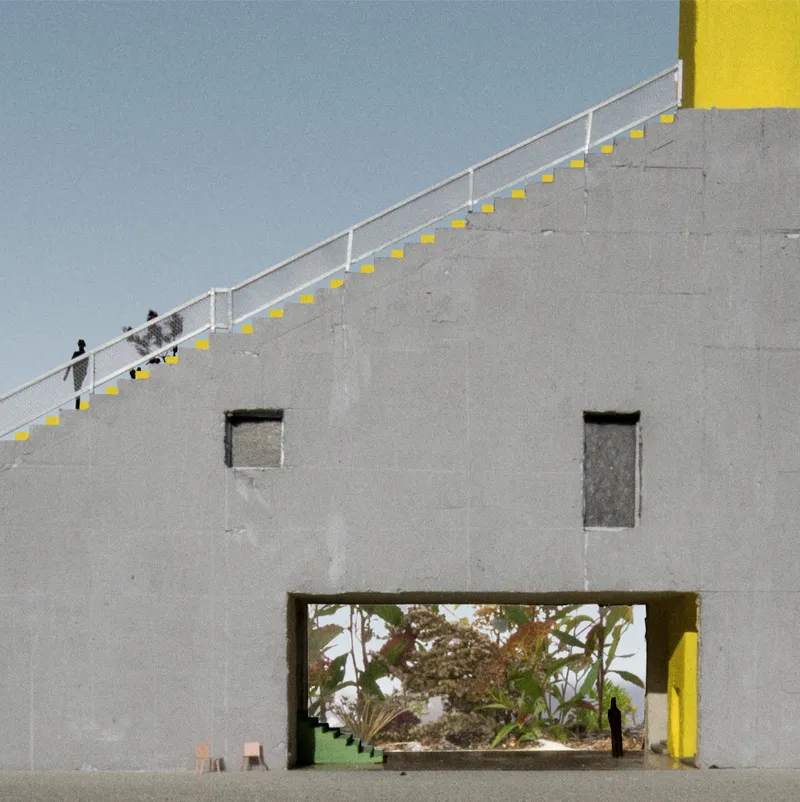
The rendered views reveal an architecture that already feels post-event: white volumes frame an open courtyard where exterior staircases and green planted steps create a terrain of accessible public space. Trees punctuate the interior, softening the concrete structure and hinting at the park phase yet to come. Yellow accents on the facade add identity without heaviness, marking circulation routes and entry points. The staircase, visible through a framed opening in the second image, doubles as both spectator access during the stadium phase and a connective spine for the cultural center that follows.
What stands out here is the porosity of the design. There are no fortress walls, no turnstile-only thresholds. The courtyard is legible as public space from the start, which makes the eventual transition away from stadium use feel less like demolition and more like subtraction of temporary layers to reveal the permanent civic space beneath.
Mirrored Plan, Embedded Flexibility
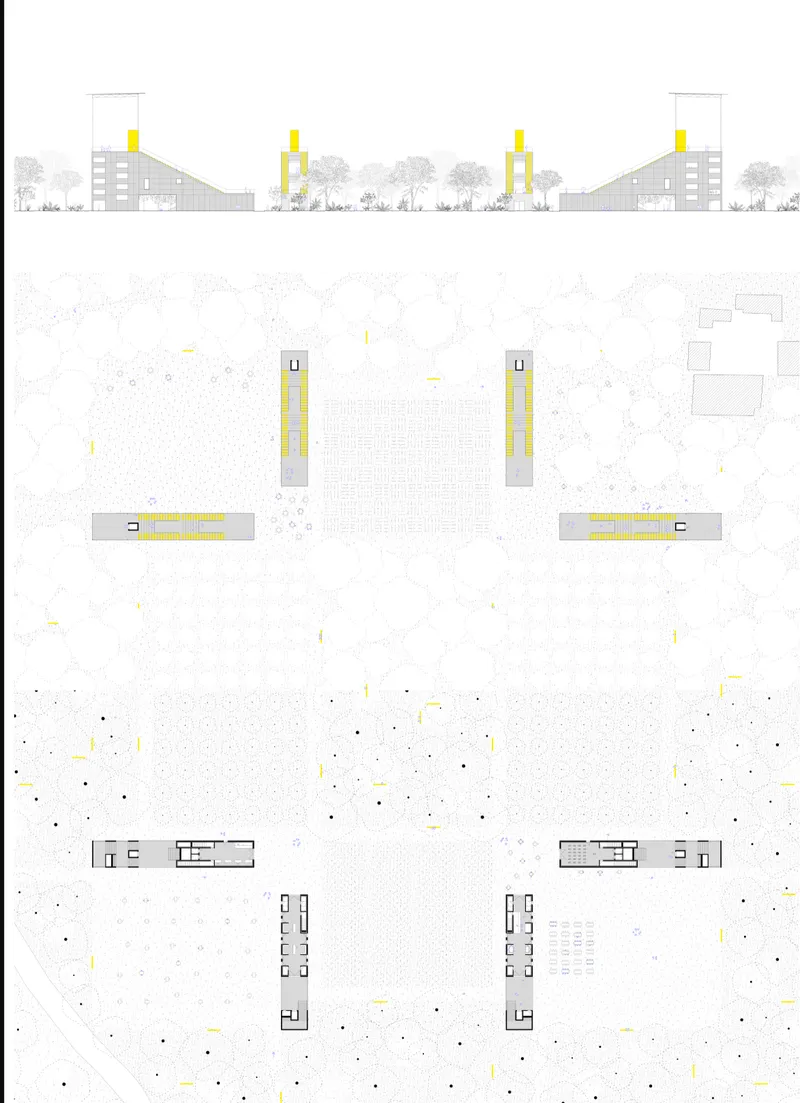
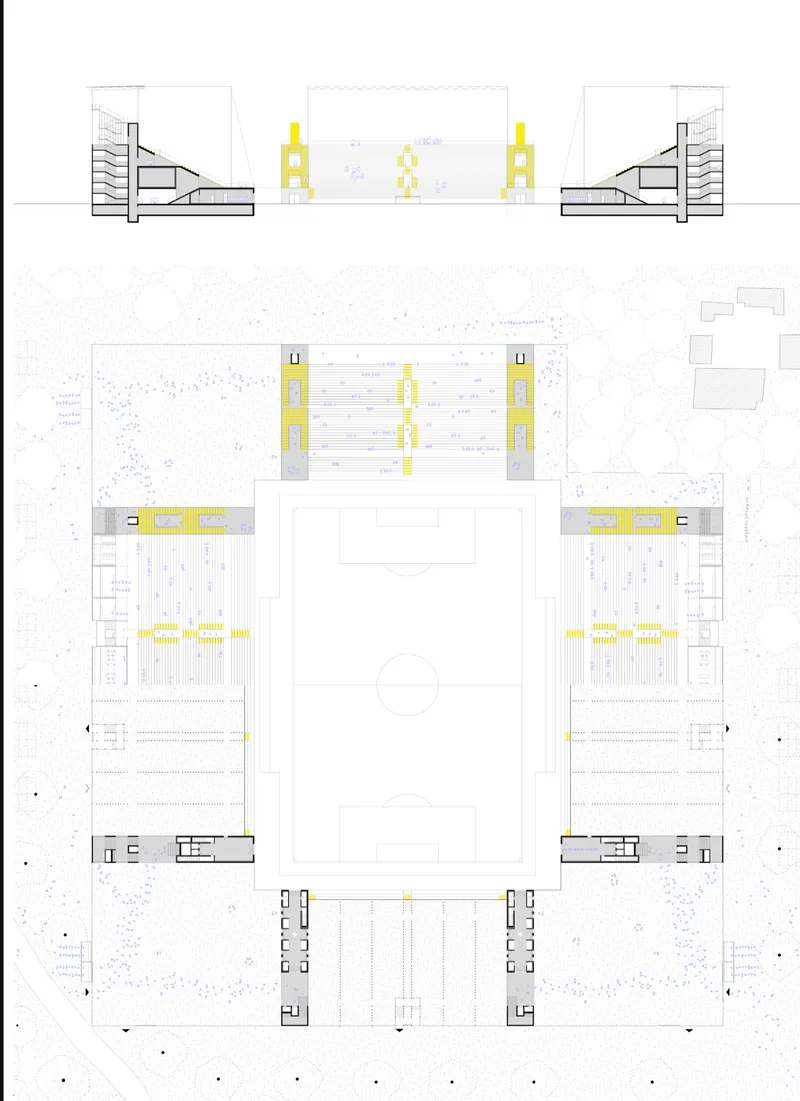
The site plan drawings expose the organizational logic: mirrored building volumes flanking a central plaza, with yellow tower elements anchoring the composition. A section cut through the site shows stadium seating nested within this symmetrical layout, confirming that the spectator infrastructure is an insertion rather than the primary structure. The towers and the flanking volumes are the bones; the seating bowl is the temporary organ.
This distinction matters enormously. By treating the stadium function as an overlay on a more durable urban framework, the designers avoid the trap of retrofitting a single-purpose building. The symmetry of the plan also generates clear orientations and sightlines, qualities that serve equally well for wayfinding during a packed match and for daily navigation through a neighborhood cultural precinct.
Three Lives in Axonometric
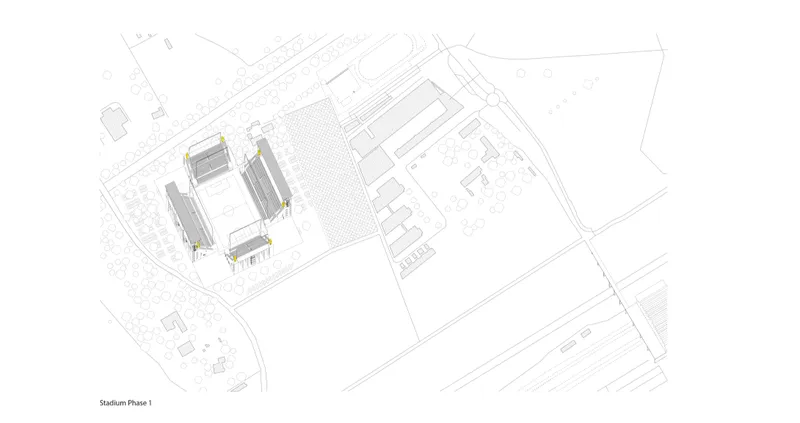
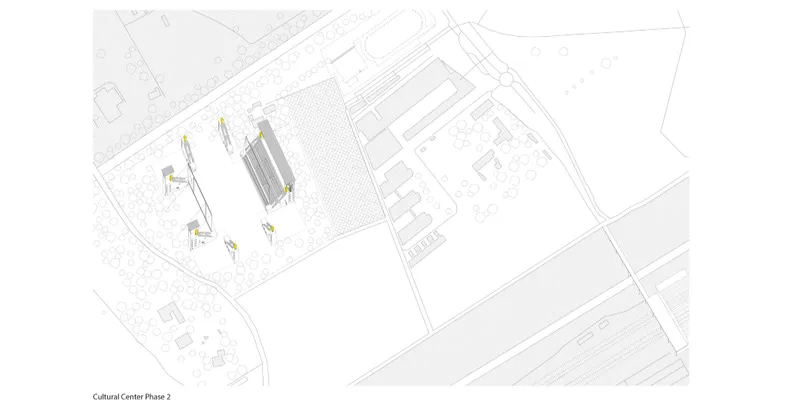
The axonometric drawings place the project within its surrounding street grid, making the scale and integration legible. The first axon shows the complex in its stadium configuration: a dense, event-ready mass that fills its urban block. The second strips back to the cultural center phase, where yellow crane elements suggest an architecture comfortable with its own ongoing construction and deconstruction. The open plaza at the center reappears, larger now, breathing.
Reading these two drawings together is the clearest articulation of the project's thesis. The same plot of land holds radically different programs across time, not through demolition and reconstruction, but through a planned sequence of removal and reinterpretation. The concrete slabs that remain as the final park phase are not ruins. They are designed artifacts, intentional traces of a building that always knew it was going to become something else.
Why This Project Matters
The global track record of mega-event infrastructure is grim: billions spent on venues that decay into underused shells within years. Brütsch and Durrer confront this reality head-on by proposing a building whose value increases as its original program fades. The stadium phase draws international attention and revenue; the cultural center phase serves daily community life; the park phase contributes ecological and social value for generations. Each transition is not a loss but a gain.
At a moment when sustainability in architecture is too often reduced to material certifications and energy calculations, this project reminds us that the most sustainable building might be the one that plans for its own transformation. By embedding adaptability into the structural DNA of the design rather than treating it as an afterthought, the project offers a compelling and replicable model for how cities can host the world without mortgaging their future.
View the Full Project
About the Designers
Designers: Dinah Brütsch, Simone Durrer
Enter a Design Competition on uni.xyz
uni.xyz runs architecture and design competitions year-round that reward proposals with spatial conviction and real site intelligence.
Project credits: Stadium - Cultural Center - Park by Dinah Brütsch, Simone Durrer Staydium 2020 (uni.xyz).


Popular Articles
Popular articles from the community


Tsunami Convergenics: Turning Catastrophic Ocean Forces into Underwater Housing Infrastructure
A speculative underwater settlement off the coast of Onagawa, Japan, treats tsunamis and typhoons as energy sources rather than threats.

Opera on the Sea: Driftwood Logic Shapes a Timber Opera House on Estonia's Coast
Trevor Orgill's opera house translates the entangled drift of floating timber into a civic building where wood, water, and music converge.

The Amber Palace Opera: A Geological Fiction Surfaces on Tallinn's Baltic Waterfront
Pierre Brillard reimagines a Baltic legend as a public landscape, opera house, and waterfront promenade rooted in Tallinn's coastal identity.

Cloaked Colonization: A Mobile Underwater Habitat That Moves Like a Fish
Micah Abaya's shortlisted EHC Pacific entry reimagines ocean settlement as a dispersed network of self-sustaining architectural organisms.

Similar Reads
You might also enjoy these articles

Shakur's House: Exposed Brick as an Interior Organiser in a 168 m² Mashhad Residence
Brick moves indoors in this Mashhad residence, where masonry walls, glass partitions and teal planes sequence a compact home without closing it off.

Day and Night Park: A Time-Based Urban Newsstand in Beijing
A temporary urban newsstand in Beijing blending travel, light, and reading through poetic colors, compact form, and community-focused design.

Modernist Patio Renovation in El Masnou, Barcelona by Oliver Segura Arquitectura + Cebrià Arquitectura
Modernist patio renovation blending tradition and innovation with a movable pool, leveled floors, and Catalan materials in El Masnou.

Alto Residencial Coop: Cooperative Housing Development in Santiago de Compostela by Carbajo Barrios Arquitectos
A linear cooperative housing complex blending white volumes and perforated metal façades, enhancing community living, natural light, privacy, and urban integration.

Explore Sports Architecture Competitions
Discover active competitions in this discipline

Challenge to design a barrier free sports center

Challenge to design an outdoor ice-rink and park

Challenge to reimagine the Iron Throne

Photograph architecture without architects
Comments (0)
Please login or sign up to add comments
No comments yet. Be the first to comment!