
Turf-Koi
Student housing design along the riverside

Turf project came into my design world when I just completed a house design for my colleague in the Philippines. At that time, I had been already immersed in the Filipino culture. My decision to participate in the design competition was because of my following research around the neighborhood, that I was deeply touched by the ongoing rehabilitation of one of the world’s most polluted rivers that resides in Metro Manila – the Pasig River. The effort of these river warriors should be remembered, the ideas of clean environment should be passed on to the next generations through best educated students.
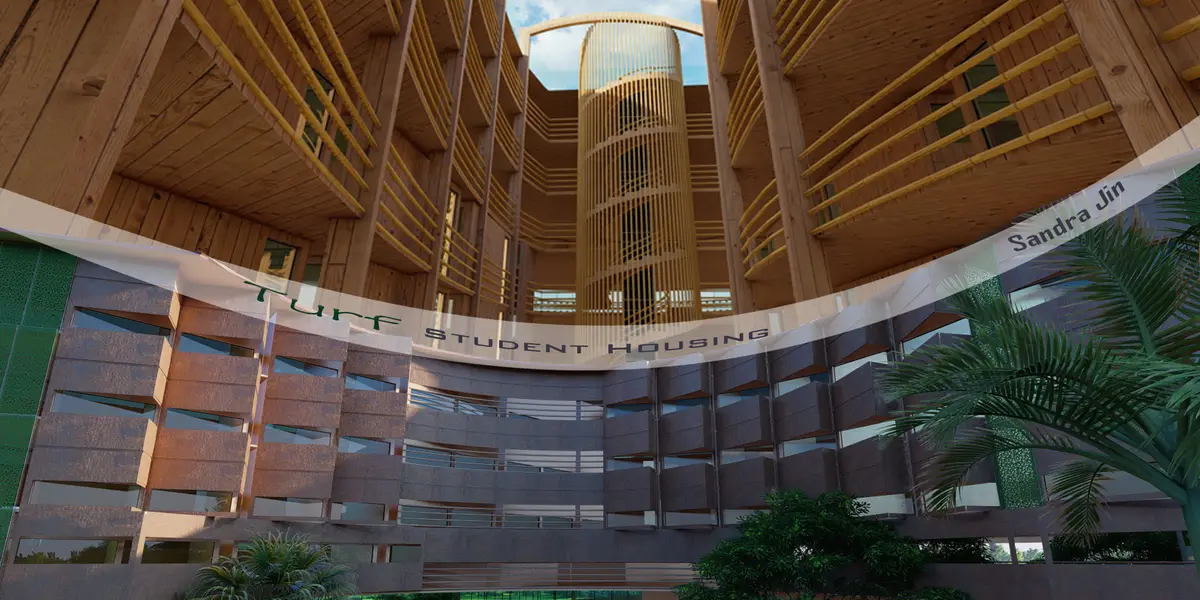
In birds’ view, the building for Turf student housing is in an abstract shape of a koi fish with arched columns framing it up at the center. It symbolizes a living fish spirit hovering along the clean river, it highlights the strength of each college student trying like a koi flying pass the Dragon Gate after thousands of jumps. To enhance the concept of environmental protection, various aspects are looked at in design to be sustainable in every possible way.
The site is in a tropical environment where winter heating is not required, which makes the idea of natural ventilation possible. The system consists of different orientation rooms arrayed along the curve of the ‘fish’ body allowing gaps between every two modular units, slim linear windows at different heights at different sides of walls that achieve the air draft, and the roof chimney that completes the air circulation. Modular window screens that cover the gaps bring a touch of green in the appearance as well as keep heat in and insects out.
Apart from the deployment of wind throughout the entire building to maintain it free from artificial air conditioning, the seasonal wind is also captured by wind turbine on the fence at all angles for minimal lighting requirement to shine up the campus at night. Solar energy generated from the photovoltaic panels on the sloped roof and kinetic energy from the smart gym equipment can proportionally power up the building.
Renewable or recyclable energy is designed to be harvested to a large extent. Rainwater collection system is generously utilized to harvest rain in both direct and indirect forms: rooftop harvesting pipes, perimeter moat and bamboo structured pavilions. Water is collected and filtered underground to be pumped back up and recycled for toilet flushing.
Rain on one side is an excellent energy source, and on the other can definitely become a threat exceeding certain amount – flooding is a long existing concern in the Filipino architectural history. In this case, the design of columns is inherited, and only functional areas are on the ground floor as swimming pool, basketball court and parking areas. Swimming pool and basketball court can also be open on weekends and holidays through the side gate on the northwest corner, for public use or even sheltering with good security management to optimize space using.
During the design investigation, the process of doing research, documenting information, sketching ideas, checking facts and communicating with people is iterated. Research in architecture in the Philippines motivates the component of something old, the rich colonial look in its columns, arches, cobblestone pavement brings in the historical taste. Then the compelling idea of something new follows, to awaken the area from the passed times, to blend in the fast-paced modern world, the simple raw material has to be introduced as its Corten façade and Glulam structure. Hereby extends to further iteration of contrasts being absorbed in the project: local versus international, lines versus curves, warm earth color versus gray surrounding streets. The building curves are either arcs between the perimeter fence wall and concentric circles from corner points on the property line.
Although different numbers of twin-sharing unit and solo studio are scattered on each floor, the concept of lower exterior window in each unit is consistent throughout the project. Bamboo is repeatedly seen in curve shaped elements such as the spiral staircase, the handrail, and the hydroponic pipes for gardening. All is to achieve both aesthetic and functional harmony.
Building breathes, it lives with a soul. My intent is letting my Turf-Koi be a heartfelt living reminder of the energy we consume and the effort we contribute will be in good balance with nature.

Popular Articles
Popular articles from the community


Juan García Correa, John González and Claudia Rueda Sink a Circular Amphitheater into a Manizales Engineering Building
On the La Nubia campus in Manizales, Colombia, the S1 Building folds labs and offices into a hillside of ramped lawns that double as a campus route.

LT2A and OPEN Architectes Thread a Brick and Glass High School Through a Wooded Belgian Campus
In Braine-l'Alleud, a 3,000 m² wing for Collège Cardinal Mercier pairs pale brick with a glazed colonnade, deferring to a small chapel and a dense wood.

David Macias Steps a Doorless Stone and Plaster House Down a Tropical Colombian Hillside
In the humid hills of Colombia, Threshold House replaces the front door with an open void and terraces its 850 m² down the slope instead of fighting it.

Jaramillo Van Sluys Arquitectura and Urbanismo Turn a Demolished Registry Lot in Quito into an Orchard Plaza
In Quito's Centro Histórico, a 2,800 m² plaza exposes the San Agustín convent wall and redraws its lost Augustinian orchard in volcanic stone.

Similar Reads
You might also enjoy these articles


Vereda Arquitetos Renovates a 40-Square-Meter Apartment Inside Niemeyer's Copan Building
A compact unit in São Paulo's most iconic residential tower gets a material overhaul that pairs exposed concrete with bold blue Formica.

Shakur's House: Exposed Brick as an Interior Organiser in a 168 m² Mashhad Residence
Brick moves indoors in this Mashhad residence, where masonry walls, glass partitions and teal planes sequence a compact home without closing it off.

Day and Night Park: A Time-Based Urban Newsstand in Beijing
A temporary urban newsstand in Beijing blending travel, light, and reading through poetic colors, compact form, and community-focused design.

Modernist Patio Renovation in El Masnou, Barcelona by Oliver Segura Arquitectura + Cebrià Arquitectura
Modernist patio renovation blending tradition and innovation with a movable pool, leveled floors, and Catalan materials in El Masnou.

Explore Student Housing Competitions
Discover active competitions in this discipline


Design challenge to equip cities with modern furniture

Challenge to reimagine the Iron Throne

Photograph architecture without architects

Illustrate the lost glory of Angkor Wat - Render Challenge
Comments (0)
Please login or sign up to add comments
No comments yet. Be the first to comment!