
Ulviklende Kobling
Evolving Linkage

Copenhagen is a place, a city and a harbour where is a home to a never-ending alteration. As it referred in the Gesta Danorum, the city is founded as Portus Mercatorum which is followingly turned into Hafn, a city where castles have been raised. As it follows throughout the eras, The Merchants’ Haven has evolved into the capital of Danes and evolving inwards future in order to be the capital of architecture. Inasmuch as their architecture is evolving and architecture of Denmark is leaking around the world, citizens around the world has leaked into the Danish capital and changed it something anew through the time.
Since the alteration of longhouse, castles and palaces which are the new landmarks of modern era meets the demographics and lead the architecture to transform into creating public spaces. In that case, Ulviklende Kobling (Evolving Linkage) appears as a new public realm for the city by enhancing the connection between the sea, land, Copenhagen’s old and the new cityscape. Located in a region where surroundings are a blend of contemporary and diachronic architecture, the site enables the opportunity of linking the past, present with the future. Whilst the north side of the area are predicted to be home to the future development of Refshaleøen, Kastellet and Amalienborg on the West constitute the continuous linkage with the past.
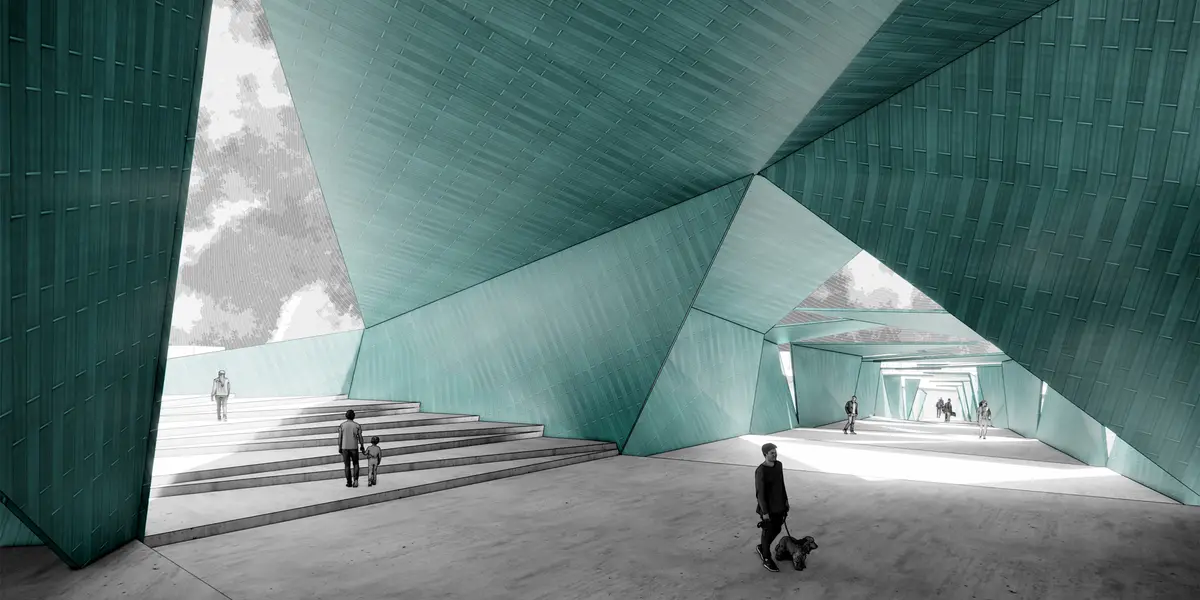
Evolving from a realm like this, Ulviklende Kobling (Evolving Linkage) has aspired to create a linkage in the current contrary. By creating a gathering space in the middle of the site yet detached from the land which faces Kastellet in order to constitute connection between the assemblage inside Ulviklende Kobling (Evolving Linkage) and surroundings. Nonetheless, its contemporary aspects that created as the result of detachment from the land, Ulviklende Kobling (Evolving Linkage) is still connected to its roots, surroundings and carry the traces of architecture of in the history of Denmark. The platforms that are allocated circumambiently around the main gathering space in the middle are inspired from the bastions of Kastellet and plan organization of Danish Citadels in terms of its triangular shapes and its feature of giving view to surroundings. While routes that connect the space with the city and the land are representing the bivious linkage between the contemporary and diachronic miens of the site within impacts of modern architecture in terms of the identical elements of the shell that envelop the routes. Inasmuch as the routes identify the connection between different features of time, but also creates the linkage between the platforms that are representing the bastions of Kastellet are enhancing the tie and continuity between several eras such as Amalienborg’s Rococo features, literary inheritance of Den lille Havfrue which also symbolises the evolution of mermaid into a human being. Correlatively to enveloping planes of the routes that constitute the connection with the city, partially encompassing overhead of the main gathering space which is derived from the connective routes between the view platforms that depict the incessantness between the past and the future architecture of Denmark and pursue the enhancement of the features of surroundings within its triangular shaped envelope which come into existence as the display of characteristics of Danish rooftops.
Whilst it takes its final shape, Ulviklende Kobling (Evolving Linkage) provides comprehensive gathering space that meets with the sea in order to refer the history of Portus Mercatorum can be a home for exhibitions, concerts, and various several gathering needs of the region in an enhancement of togetherness and constitutes the fluxional journey between the past, present and the future along the structure. As it follows, Ulviklende Kobling (Evolving Linkage) procures an educative experience by alterations, evolvement of the space through the routes giving the sense of articulating perception of the space and time by once again leaking the traces of its historical marks.


Popular Articles
Popular articles from the community


David Ortega Stacks a Two-Story Mexico City Penthouse Around a Steel Stair and a Pergola-Shaded Roof Terrace
In Colonia Roma, a 300 m² penthouse uses oak joinery, a planted steel stair and a slatted roof pergola to make a new-build apartment feel like a house.

Juan García Correa, John González and Claudia Rueda Sink a Circular Amphitheater into a Manizales Engineering Building
On the La Nubia campus in Manizales, Colombia, the S1 Building folds labs and offices into a hillside of ramped lawns that double as a campus route.

U.GA Architects Wraps an Oval Rooftop Pool in Curved Board-Formed Concrete on Busan's Jeollidan-gil
In Busan's Jeonpo-dong, a 454 m² mixed-use block stacks a neighborhood facility, guest rooms and an oval rooftop pool inside spiraling concrete walls.

Cube Design Draws an Ecological Corridor Between Two Shenzhen Hills with the Nankai Building
Beside Shenzhen's container docks, the Nankai Building pairs stacked balconies with a climbing green screen to connect two hillsides across its height.

Similar Reads
You might also enjoy these articles


Vereda Arquitetos Renovates a 40-Square-Meter Apartment Inside Niemeyer's Copan Building
A compact unit in São Paulo's most iconic residential tower gets a material overhaul that pairs exposed concrete with bold blue Formica.

Shakur's House: Exposed Brick as an Interior Organiser in a 168 m² Mashhad Residence
Brick moves indoors in this Mashhad residence, where masonry walls, glass partitions and teal planes sequence a compact home without closing it off.

Day and Night Park: A Time-Based Urban Newsstand in Beijing
A temporary urban newsstand in Beijing blending travel, light, and reading through poetic colors, compact form, and community-focused design.

Modernist Patio Renovation in El Masnou, Barcelona by Oliver Segura Arquitectura + Cebrià Arquitectura
Modernist patio renovation blending tradition and innovation with a movable pool, leveled floors, and Catalan materials in El Masnou.

Explore Nordic Sustainable Architecture Competitions
Discover active competitions in this discipline


Challenge to reimagine the Iron Throne

Photograph architecture without architects

Illustrate the lost glory of Angkor Wat - Render Challenge

Design challenge to reuse E-waste
Comments (0)
Please login or sign up to add comments
No comments yet. Be the first to comment!